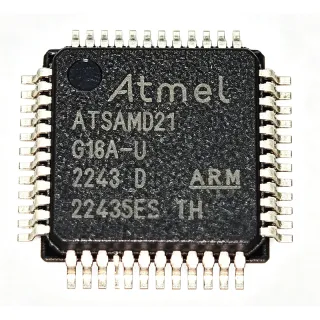
DSPIC33CK64MP503-E/M5 - 100MHz 64KB DSC | Microchip
MPN: DSPIC33CK64MP503-E/M5 ✓ Active| Qty | Unit Price | Extended |
|---|---|---|
| 1 | $0 | $0.00 |
| 10 | $0 | $0.00 |
| 100 | $0 | $0.00 |
| 500 | $0 | $0.00 |
| 1,000 | $0 | $0.00 |
DSPIC33CK64MP503-E/M5 Overview
A digital signal controller combines the computational throughput of a digital signal processor (DSP) with the integrated peripherals and deterministic control flow of a microcontroller (MCU). In the power-management hierarchy, DSCs sit between general-purpose MCUs and dedicated DSPs, making them the preferred choice for closed-loop control systems that need fast math (MAC, barrel shifter, DSP engine) alongside precise analog and timing peripherals on a single silicon die.
Key features of this device include a 100 MHz dsPIC33CK CPU core with DSP instruction extensions, 64 KB (64K x 8) of ECC Flash memory, on-chip 3 operational amplifiers and 3 analog comparators for embedded sensing loops, a PTG (Peripheral Trigger Generator) for hardware-sequenced operation, and CAN-FD connectivity for automotive and industrial networks. The MP family suffix denotes the full analog-peripheral set including the three op-amps, which offload external signal conditioning in current-sense applications.
Architecturally, the dsPIC33CK core delivers single-cycle MAC and dual-issue instruction execution, allowing deterministic control-loop latencies critical for peak-current-mode and sensorless field-oriented control. The Peripheral Trigger Generator enables ADC sampling and PWM events to be chained in hardware, reducing CPU interrupt load. The device is qualified to AEC-Q100 for automotive use, and the -E suffix indicates the extended operating temperature range for harsh environments.
Typical applications include digital power supplies (LLC, totem-pole PFC), brushless DC and PMSM motor control, advanced sensing front-ends that exploit the three integrated op-amps, and CAN-FD-connected industrial control nodes.
Design consideration: the 36-UQFN exposed pad must be soldered to a ground pour for thermal dissipation and signal integrity; plan ADC/PWM pin mapping early because peripheral pin-select flexibility trades against layout complexity.
This page synthesizes verified distributor data, drop-in alternatives within the dsPIC33CK/CH families, pricing tiers, and practical design notes not consolidated in the manufacturer datasheet.
Drop-in alternatives for DSPIC33CK64MP503-E/M5 — same package, pin-to-pin compatible. Different-package parts requiring PCB rework are excluded.
Variants in this series
Same-series models that are drop-in compatible with DSPIC33CK64MP503-E/M5 (same form factor and footprint) — differing in Package, Supply Voltage, Core Architecture, RAM, Operating Temperature.
Quick Comparison Tool — Select alternative parts for side-by-side comparison:
DSPIC33CK64MP503-I/M5
✅ Drop-In✓ In Stock
$2.12 / Unit
View Datasheet →DSPIC33CK64MC103T-I/M5
✅ Drop-In✓ In Stock
$0.58 / Unit
View Datasheet →DSPIC33CK128MC503T-I/M5
✅ Drop-In✓ In Stock
$3 / Unit
View Datasheet →DSPIC33CH64MP503-I/M5
✅ Drop-In✓ In Stock
$3.55 / Unit
View Datasheet →DSPIC33CK64MP503-E/M5 Maximum Ratings & Electrical Characteristics
| Core Architecture | 16-bit dsPIC33CK DSC |
| Maximum CPU Frequency | 100 MHz |
| Flash Program Memory | 64 KB (64K x 8) |
| RAM | 8 KB |
| Supply Voltage | 3.3 V |
| Package | 36-UQFN (5x5 mm) Exposed Pad |
| Mounting Type | Surface Mount |
| On-chip Operational Amplifiers | 3 |
| On-chip Comparators | 3 |
| Communication Interfaces | CAN-FD, UART, SPI, I2C |
| Peripheral Trigger Generator | Yes (PTG) |
| Qualification | AEC-Q100, Automotive |
| Temperature Grade | Extended (-E suffix) |
| DSP Engine | Single-cycle MAC, barrel shifter |
| Series | dsPIC33CK MP |
DSPIC33CK64MP503-E/M5 36-uqfn (5x5 mm) exposed pad Pin Configuration Guide
Pin configuration for DSPIC33CK64MP503-E/M5 (36-uqfn (5x5 mm) exposed pad package). This digital IC includes GPIO, communication interfaces (UART, SPI, I2C), and power pins. Refer to the manufacturer datasheet for alternate pin functions and configuration options. Essential for embedded system design and PCB layout.

No detailed pinout data available for DSPIC33CK64MP503-E/M5.
Refer to the datasheet for full pin configuration.
Typical Applications
DSPIC33CK64MP503-E/M5 is suitable for 6 applications: Digital Power Conversion, Brushless DC / PMSM Motor Control, CAN-FD Industrial Network Nodes, Advanced Analog Sensing Front-Ends, Automotive Embedded Control, High-Performance Embedded Control & PTG-Sequenced Systems.
Digital Power Conversion
The DSPIC33CK64MP503-E/M5 fits digital power supplies such as LLC resonant converters, totem-pole PFC stages, and bidirectional DC-DC converters because its 100 MHz dsPIC33CK core executes single-cycle MAC instructions for fast control-loop math, while the 3 on-chip comparators provide cycle-by-cycle overcurrent protection with nanosecond-class response independent of the CPU. The PTG chains ADC sampling of voltage/current feedback directly to PWM updates in hardware, keeping loop latencies deterministic even at switching frequencies above 100 kHz. Used as the standalone supervisory controller between the rectifier front end and the PWM gate drivers, it eliminates a separate analog controller; the trade-off versus a pure analog controller is firmware development effort, offset by full flexibility in compensation and mode changes via CAN-FD or UART communication.
Recommended
Brushless DC / PMSM Motor Control
Sensorless field-oriented control (FOC) of BLDC and PMSM motors is a flagship application for this device: the 3 integrated operational amplifiers amplify phase-current shunt signals on-chip, removing external op-amps from the BOM, and the 3 comparators implement hardware overcurrent trip points that shut down PWM outputs without CPU intervention. The 100 MHz core with DSP engine handles Clarke/Park transforms and PI current loops well within a 20 kHz PWM period, and the extended -E temperature rating covers motor-adjacent mounting in harsh enclosures. In a typical topology the DSC drives a three-phase inverter through gate drivers while sampling DC-link and phase currents each PWM cycle; the AEC-Q100 qualification further enables automotive pump, fan, and traction-auxiliary motor drives where functional safety documentation is required.
Recommended
CAN-FD Industrial Network Nodes
With an integrated CAN-FD module supporting 64-byte payloads and higher data rates than classical CAN, the DSPIC33CK64MP503-E/M5 serves as an intelligent node in industrial automation and automotive networks. The AEC-Q100 qualification and extended temperature grade make it suitable for under-hood actuators, agricultural equipment, and factory sensor hubs that must communicate over CAN-FD backbones. In a typical node, the DSC reads local sensors through the three op-amps and comparators, executes local control logic at 100 MHz, and reports status or receives setpoints over CAN-FD, with the PTG offloading periodic sampling tasks. An external CAN-FD transceiver is required at the physical layer; the trade-off of integrated CAN-FD silicon is pin-budget allocation on the 36-pin package, which PPS remapping helps manage.
Recommended
Advanced Analog Sensing Front-Ends
The three on-chip operational amplifiers distinguish the MP503 within the dsPIC33CK family and make it a compact choice for embedded sensing: current-sense amplification, buffer stages for resistive sensor bridges, and signal conditioning feeding on-chip ADC inputs - all without external op-amp ICs. The 3 comparators add fast threshold detection for limit alarms or safety trips. Applications include battery management sensing, pressure/strain measurement in industrial equipment, and precision temperature-compenstation loops. In practice, the op-amps are configured via firmware registers (gain, bandwidth) and routed internally to ADC channels, shortening the analog path and improving noise immunity versus board-level signal chains. The trade-off is that integrated op-amps have fixed spec envelopes; designs demanding sub-microvolt offset precision may still need external precision amplifiers.
Recommended
Automotive Embedded Control
AEC-Q100 qualification plus the -E extended temperature grade position the DSPIC33CK64MP503-E/M5 for automotive subsystems: LED lighting controllers, HVAC damper and blower motor drives, pump control, and smart actuator modules communicating over CAN-FD. The deterministic 100 MHz core supports time-critical control duties while the DSP engine accelerates sensor signal processing such as encoder decoding and filter computations. DigiKey classifies the part within the dsPIC33CK Functional Safety (FuSa) family, which supports customers building safety-relevant applications with Microchip's safety documentation packages. In an automotive ECU architecture, this DSC typically operates as a local control processor under a central domain controller, handling PWM generation and analog diagnostics locally and escalating faults on the CAN-FD bus.
Recommended
High-Performance Embedded Control & PTG-Sequenced Systems
The Peripheral Trigger Generator (PTG) is a distinctive dsPIC33CK feature that lets this device run fully hardware-sequenced control and data-acquisition routines with minimal CPU involvement - useful in LED drivers, UPS systems, battery chargers, and lab instrumentation where periodic ADC sampling, PWM updates, and decision events must execute with strict timing. The 64 KB Flash supports either a single unpartitioned program image or dual-partition boot configurations, enabling field-safe bootloader designs as described in the dsPIC33CK programming documentation. With 8 KB RAM, the device handles moderate buffering for DSP filtering and communication stacks. As a design pattern, the CPU services higher-level logic and communications while PTG sequences the real-time inner loop, reducing jitter and interrupt latency compared with pure interrupt-driven schemes.
Recommended
Recommended Products Summary
Engineering reference data for DSPIC33CK64MP503-E/M5 — comparison, design guidance, and compliance information.
Selection Guide
Comparison with Alternatives
| Parameter | This Product | DSPIC33CK64MP503-I/M5 | DSPIC33CK64MC103T-I/M5 | DSPIC33CK128MC503T-I/M5 | DSPIC33CH64MP503-I/M5 |
|---|---|---|---|---|---|
| Package | 36-UQFN (5x5 mm) Exposed Pad | 36-UQFN (5x5 mm) - same | 36-UQFN (5x5 mm) - same | 36-UQFN (5x5 mm) - same | 36-UQFN (5x5 mm) - same |
| Brand | Microchip Technology | Microchip Technology | Microchip Technology | Microchip Technology | Microchip Technology |
| Core / Architecture | 16-bit dsPIC33CK, single core | 16-bit dsPIC33CK, single core | 16-bit dsPIC33CK, single core | 16-bit dsPIC33CK, single core | 16-bit dsPIC33CH, dual core |
| CPU Frequency | 100 MHz | 100 MHz | 100 MHz | 100 MHz | 100 MHz |
| Flash Memory | 64 KB | 64 KB | 64 KB | 128 KB (+100%) | 64 KB |
| Temperature Grade | Extended (-E), AEC-Q100 | Industrial (-I) | Industrial (-I) | Industrial (-I) | Industrial (-I) |
Key Differentiators
- Full analog integration: 3 op-amps + 3 comparators on-chip (vs DSPIC33CK64MC103T-I/M5)
- Extended -E temperature grade with AEC-Q100 (vs DSPIC33CK64MP503-I/M5)
- Single-core deterministic control vs dual-core complexity (vs DSPIC33CH64MP503-I/M5)
Design Notes
The M5 UQFN (5x5 mm) exposed-pad package requires the thermal pad to be soldered to a grounded copper pour with an array of thermal vias for reliable heat dissipation and low-inductance grounding. Follow Microchip's UQFN land-pattern recommendations for stencil design - typically a segmented paste pattern on the exposed pad to avoid excessive solder voiding. Since the 36-pin budget is tight for digital power designs, plan peripheral pin select (PPS) assignments early so PWM, ADC, and CAN-FD pins do not conflict during layout routing.
Keep the analog front-end traces (op-amp inputs, current-shunt connections to ADC channels) short and routed away from PWM switching nodes and gate-drive traces. Use Kelvin sensing directly at the current shunt resistor for phase-current feedback into the integrated op-amps; ground referenced noise on these inputs directly degrades FOC current-loop accuracy. Decouple each VDD pin with 100 nF ceramics placed within 2 mm, and provide a bulk capacitor near the supply entry point.
Temperature grade substitution is the most common sourcing mistake on this part: the -E (extended) and -I (industrial) variants share identical silicon and footprint, so purchasing agents may substitute -I for -E without flagging the change - unacceptable for automotive or high-temperature enclosures. Also verify family suffix carefully: MC-family parts in the same M5 package lack the MP family's 3 op-amps and CAN-FD, and firmware written for MP peripherals will not function on MC silicon.
Compliance Information
Distributor data (DigiKey, Hotenda) confirms AEC-Q100 qualification and automotive positioning for the dsPIC33CK64MP503 series. RoHS/REACH/lead-free certificate status not stated in verified data - request CoC from Microchip.