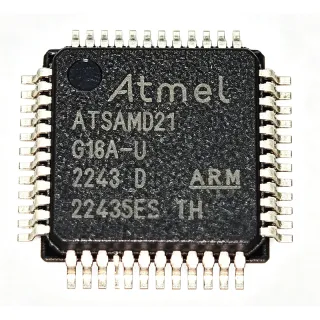
dsPIC33EP128MU504-I/ML - 16-bit DSC 70 MIPS 128KB Flash | Microchip
MPN: DSPIC33EP128MU504-I/ML ✓ Active| Qty | Unit Price | Extended |
|---|---|---|
| 1 | $5.42 | $5.42 |
| 10 | $4.88 | $48.80 |
| 100 | $4.34 | $434.00 |
| 500 | $3.95 | $1,975.00 |
| 1,000 | $3.58 | $3,580.00 |
DSPIC33EP128MU504-I/ML Overview
A digital signal controller combines the computational strengths of a microcontroller with the math-acceleration of a digital signal processor. In the embedded hierarchy, the DSC sits above general-purpose MCUs and below full DSPs, offering single-cycle MAC, DSP multiply/divide, and divide instructions while retaining microcontroller-style peripherals, interrupt architecture, and flash self-programming. This makes DSCs the default choice for real-time closed-loop control systems.
Key features of the dsPIC33EP128MU504 include the enhanced dsPIC33E core running at up to 70 MIPS from a 3.0 V to 3.6 V supply, a 12-bit ADC, UART, SPI, and I2C communication peripherals, and DSP engine support for FIR/IIR filtering and transform math. The 128 KB self-programmable Flash supports field firmware updates, and the 16 KB RAM provides headroom for control loops and communication buffers.
Architecturally, the dsPIC33E family pairs a pipelined 16-bit CPU with an integrated DSP engine (a 17-bit x 17-bit multiplier, 40-bit accumulator, and barrel shifter), enabling precision motor control, digital power conversion, and sensor signal processing in a single chip. Two on-chip PLLs allow flexible clocking and low-power operation.
Typical applications include brushless DC and PMSM motor control, digital power supplies (PFC, LLC), solar inverters, sensor fusion and industrial sensing nodes, and audio or biomedical signal processing.
Design consideration: keep the 3.3 V supply within the 3.0 V to 3.6 V range, decouple VDD/VSS pairs with 0.1 uF ceramics placed directly at the QFN pins, and use the exposed pad for a solid ground connection.
This page synthesizes distributor availability, drop-in alternative analysis, and practical design notes beyond what the manufacturer datasheet provides.
Drop-in alternatives for DSPIC33EP128MU504-I/ML — same package, pin-to-pin compatible. Different-package parts requiring PCB rework are excluded.
Variants in this series
Same-series models that are drop-in compatible with DSPIC33EP128MU504-I/ML (same form factor and footprint) — differing in Package, Operating Temperature, ADC Resolution, Communication Interfaces, Connectivity.
Quick Comparison Tool — Select alternative parts for side-by-side comparison:
No drop-in alternatives available for this product.
Request AlternativesDSPIC33EP128MU504-I/ML Maximum Ratings & Electrical Characteristics
| Core Architecture | 16-bit dsPIC33E DSC core |
| Maximum CPU Speed | 70 MIPS |
| Flash Memory | 128 KB |
| SRAM | 16 KB |
| Supply Voltage Range | 3.0 V to 3.6 V |
| ADC Resolution | 12-bit |
| Operating Temperature | -40C to +85C (Industrial, I suffix) |
| Package | 44-pin QFN (ML), 8x8 mm |
| Mounting Type | Surface Mount |
| Communication Interfaces | UART, SPI, I2C |
| Product Type | Digital Signal Controller (DSC) |
| RoHS Status | Compliant |
DSPIC33EP128MU504-I/ML 44-pin qfn (ml), 8x8 mm Pin Configuration Guide
Pin configuration for DSPIC33EP128MU504-I/ML (44-pin qfn (ml), 8x8 mm package). This digital IC includes GPIO, communication interfaces (UART, SPI, I2C), and power pins. Refer to the manufacturer datasheet for alternate pin functions and configuration options. Essential for embedded system design and PCB layout.

No detailed pinout data available for DSPIC33EP128MU504-I/ML.
Refer to the datasheet for full pin configuration.
Typical Applications
DSPIC33EP128MU504-I/ML is suitable for 6 applications: Sensorless BLDC Motor Control, Digital Power Conversion (PFC / LLC), Industrial Sensor Nodes and Data Acquisition, Audio Signal Processing, Solar Inverter and Energy Systems, Embedded Control and Building Automation.
Sensorless BLDC Motor Control
The dsPIC33EP128MU504-I/ML fits sensorless BLDC and PMSM drives because its 70 MIPS core completes field-oriented control loops well within 50 us periods, while the 12-bit ADC samples phase currents and the DC bus with sufficient resolution for current-loop control. DSP instructions (single-cycle 17x17 MAC, 40-bit accumulator) accelerate Clarke/Park transforms and PI compensation with deterministic cycle counts. Firmware uses the PWM module for six-step or space-vector modulation. A quantified benefit: at 70 MIPS a full FOC iteration typically consumes only a few microseconds of CPU budget, leaving ample margin for BEMF observers and communication stacks on the same silicon.
Recommended
Digital Power Conversion (PFC / LLC)
In digital power supplies, the dsPIC33EP128MU504-I/ML closes voltage and current loops for PFC, half-bridge, and LLC converter topologies. The 12-bit ADC with fast conversion rate captures instantaneous inductor current each switching cycle, and deterministic interrupt latency preserves loop stability at 100 kHz-plus switching frequencies. The 128 KB Flash holds compensation tables, soft-start state machines, and protection logic (overcurrent, overvoltage) without external memory. Because the DSC core executes the compensator in fixed-point math with single-cycle MAC, loop delay is minimized - directly improving achievable bandwidth compared to slower MCU-based digital power designs, while remaining cheaper than standalone DSPs.
Recommended
Industrial Sensor Nodes and Data Acquisition
The MU504 serves industrial sensing nodes where raw signals need local filtering before transmission. Its DSP engine runs real-time FIR/IIR filters on ADC streams from pressure, vibration, or current sensors, removing noise that would otherwise saturate the communication link. The 16 KB RAM buffers sampled waveforms for burst analysis, and UART/SPI/I2C interfaces connect to transceivers, external memory, or Displays. Running at reduced clock via the on-chip PLL, quiescent power drops for battery-backed field installations. The industrial -40C to +85C rating covers unconditioned factory-floor and outdoor cabinets, making a single-chip sensor-plus-processor solution practical without a separate signal-chain MCU.
Recommended
Audio Signal Processing
For embedded audio - effect pedals, intercoms, PA controllers - the dsPIC33EP128MU504-I/ML applies DSP algorithms such as equalization, echo cancellation, and AGC with its 17x17 multiplier and 40-bit accumulator executing biquad filters in deterministic cycles. The 12-bit ADC digitizes microphone or line-level inputs (with appropriate anti-alias filtering and biasing), and PWM/DAC outputs or an external codec completes the chain. 128 KB Flash stores multiple effect presets and boot-time tuning tables. The value proposition is cost: at roughly $5 unit price (as of 2026-09-24), one DSC replaces a separate MCU plus codec-DSP pairing in low-channel-count designs, cutting BOM count and firmware complexity.
Recommended
Solar Inverter and Energy Systems
Micro-inverters, solar optimizers, and battery chargers use the MU504 to run MPPT algorithms, grid-current shaping, and protection supervision simultaneously. The 70 MIPS core splits time between a fast inner current loop (executed every PWM cycle) and slower outer MPPT/monitoring tasks, with the DSP engine accelerating the multiplication-heavy control math. The 12-bit ADC reads panel voltage, current, and bus voltage with the resolution needed for accurate maximum-power-point tracking. The 128 KB self-programmable Flash enables field firmware updates - critical for long-lifecycle energy products that must adopt revised grid codes after deployment, without recalling hardware from the field.
Recommended
Embedded Control and Building Automation
General embedded controllers - HVAC boards, pump controllers, lighting managers - benefit from the MU504's blend of DSP-class math and microcontroller-style peripherals. UART connects to RS-485/Modbus transceivers, I2C reads environmental sensors and EEPROM configuration, and timers drive PWM outputs for fans, valves, or dimming. The 128 KB Flash accommodates protocol stacks plus an OTA-capable bootloader, and 16 KB RAM sustains multiple communication buffers concurrently. Because the -I/ML grade is RoHS compliant and surface-mountable on standard 4-layer boards with a grounded QFN exposed pad, it integrates into mainstream industrial electronics manufacturing flows without special thermal design at typical load levels.
Recommended
Recommended Products Summary
Engineering reference data for DSPIC33EP128MU504-I/ML — comparison, design guidance, and compliance information.
Selection Guide
Comparison with Alternatives
| Parameter | This Product | DSPIC33EP128MU504-E/ML | DSPIC33EP64MU504-I/ML | DSPIC33EP32MU504-I/ML | DSPIC33EP128MC504-I/ML | DSPIC33EP128MU504-H/PT |
|---|---|---|---|---|---|---|
| Package | 44-pin QFN (ML) | 44-pin QFN (ML) - same | 44-pin QFN (ML) - same | 44-pin QFN (ML) - same | 44-pin QFN (ML) - same | 44-pin TQFP (PT) - same 44-lead pattern, different body |
| Brand | Microchip Technology | Microchip Technology | Microchip Technology | Microchip Technology | Microchip Technology | Microchip Technology |
| Flash Memory | 128 KB | 128 KB | 64 KB | 32 KB | 128 KB | 128 KB |
| CPU Speed | 70 MIPS | 70 MIPS | 70 MIPS | 70 MIPS | 70 MIPS | 70 MIPS |
| Temperature Range | -40C to +85C (I) | -40C to +125C (E) | -40C to +85C (I) | -40C to +85C (I) | -40C to +85C (I) | H temperature grade (per Microchip suffix) |
| SRAM | 16 KB | 16 KB | 16 KB | 16 KB | 16 KB | 16 KB |
| Peripheral Emphasis | General connectivity (MU) | General connectivity (MU) | General connectivity (MU) | General connectivity (MU) | Motor control MCPWM (MC) | General connectivity (MU) |
| Best Use Case | General DSC control at -40C..+85C | Same, plus high-temp environments | Cost-reduced builds fitting 64 KB | Cost-reduced builds fitting 32 KB | Motor drives needing MCPWM | Hand-solderable TQFP alternative |
Key Differentiators
- Extended temperature option on identical silicon (vs DSPIC33EP128MU504-E/ML)
- 128 KB Flash ceiling within the same footprint (vs DSPIC33EP64MU504-I/ML)
- General peripheral set vs motor-control specialization (vs DSPIC33EP128MC504-I/ML)
Design Notes
The 44-pin QFN exposed pad must be soldered to a grounded PCB pad - it is the primary ground return and thermal path. Define a 3x3 or 4x4 via array under the pad to the ground plane. Decouple every VDD pin with 0.1 uF ceramic capacitors placed within 2 mm of the pin, and filter AVDD through an RC (10 ohm + 1 uF) or ferrite bead to protect the 12-bit ADC from digital switching noise. Microchip's dsPIC33EP layout guidelines in the family reference manual recommend this arrangement.
Supply the device from a regulated 3.0 V to 3.6 V rail; a 3.3 V LDO such as the MCP1754 works well. Budget roughly 70-110 mA of core current at 70 MIPS (verify against the datasheet current-vs-MIPS table) plus peripheral and I/O load when sizing the regulator. Estimated: at 3.3 V and 100 mA, dissipation is only 0.33 W, which the exposed-pad ground connection on a normal 2-layer board handles without a heatsink.
Do not assume cross-family register compatibility: firmware written for dsPIC33F or dsPIC33CK families will not run unchanged on dsPIC33EP silicon - the ADC, PWM, and DMA register maps differ. When substituting the pin-compatible dsPIC33EP128MC504 for the MU504, remember the MC variant's peripheral set differs (motor-control PWM vs general peripherals), so re-verify initialization code. Also program configuration bits (oscillator source, PLL dividers, watchdog) explicitly - incorrect CONFIG settings are the most common cause of a non-booting first prototype.
Use short, matched traces to the crystal (or use the internal FRC oscillator for non-precision timing) and keep high-current inverter gate-drive traces away from ADC input routing. For motor-control sampling, trigger the ADC from the PWM module at the center of the low-side PWM on-time so current ripple is minimized - this single technique can improve current-sensing accuracy noticeably without better hardware.
Compliance Information
RoHS compliant and lead-free per standard Microchip /I-grade offering; REACH, halogen-free, and conflict-minerals status not stated in the provided data.