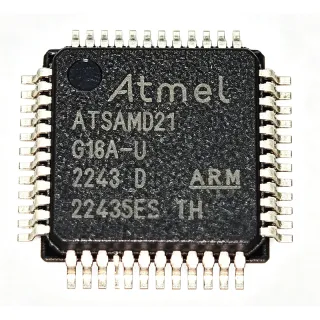
DSPIC33EP128MU504-I/MV - 70 MIPS 16-bit DSC 128KB | Microchip
MPN: DSPIC33EP128MU504-I/MV ✓ Active| Qty | Unit Price | Extended |
|---|---|---|
| 1 | $6.85 | $6.85 |
| 10 | $6.2 | $62.00 |
| 100 | $5.55 | $555.00 |
| 500 | $4.95 | $2,475.00 |
| 1,000 | $4.4 | $4,400.00 |
DSPIC33EP128MU504-I/MV Overview
A digital signal controller combines the computational strengths of a microcontroller with the math-acceleration of a digital signal processor on a single die. Within the power-management hierarchy of embedded systems, a DSC sits between general-purpose MCUs and dedicated DSPs, making it the preferred choice for control loops that need fast multiply-accumulate operations, deterministic interrupts, and rich on-chip peripherals in one silicon solution.
Key features of the DSPIC33EP128MU504 include the 16-bit dsPIC33E core with DSP instruction support and two 40-bit accumulators, single-cycle MAC operation, 128 KB self-programmable Flash with ECC-class endurance, and up to 85 general-purpose I/O. The MU variant is distinguished by its USB 2.0 full-speed device peripheral, high-speed 10/12-bit ADC capable of 1.1 Msps throughput, multiple UART, SPI, and I2C modules, output-compare and input-capture channels, and flexible motor-control PWM capability.
Architecturally, the dsPIC33E family uses a modified Harvard pipeline with 32-bit-wide instruction words, hardware looping, bit-reversal addressing for FFTs, and a DMA controller that moves ADC, UART, and SPI data without CPU intervention. This reduces ISR latency and keeps control loops deterministic at 70 MIPS, which is essential for field-oriented motor control and digital power conversion.
Typical applications include 3-phase BLDC and PMSM motor drives, digital power supplies and inverters, USB-connected industrial instruments, and embedded control nodes that mix sensing, DSP math, and communication. The 44-pin UQFN footprint suits compact, thermally constrained boards.
For design, budget the Flash carefully: the -I industrial temperature suffix covers -40C to +85C; the /MV (UQFN) footprint requires via-in-pad thermal design for best electrical and thermal performance.
This page synthesizes verified distributor data, drop-in alternatives, pricing context, and practical design notes not found on the manufacturer datasheet alone, adding selection and cross-reference value for engineers and buyers.
Drop-in alternatives for DSPIC33EP128MU504-I/MV — same package, pin-to-pin compatible. Different-package parts requiring PCB rework are excluded.
Variants in this series
Same-series models that are drop-in compatible with DSPIC33EP128MU504-I/MV (same form factor and footprint) — differing in Package, Motor Control PWM, Operating Temperature.
Quick Comparison Tool — Select alternative parts for side-by-side comparison:
DSPIC33EP128MU504-E/MV
✅ Drop-In✓ In Stock
Contact for price
View Datasheet →DSPIC33EP128MU504-H/PT
✅ Drop-In✓ In Stock
$4.48 / Unit
View Datasheet →DSPIC33EP128MC504-I/MV
✅ Drop-In ⚠️ Specs Unverified📋 Reference alternative (not in catalog)
DSPIC33EP128GP504-I/MV
✅ Drop-In✓ In Stock
$3.02 / Unit
View Datasheet →DSPIC33EP128MU504-I/ML
✅ Drop-In✓ In Stock
$3.58 / Unit
View Datasheet →DSPIC33EP128MU504-I/MV Maximum Ratings & Electrical Characteristics
| Core Architecture | 16-bit dsPIC33E DSC |
| Maximum CPU Speed | 70 MIPS |
| Flash Program Memory | 128 KB |
| RAM | 16 KB |
| ADC Resolution | 12-bit |
| Package | 44-pin UQFN (MV) |
| Operating Temperature Range | -40C to +85C (Industrial, -I suffix) |
| Supply Voltage Range | 3.0 V to 3.6 V |
| USB Interface | USB 2.0 full-speed device |
| Communication Interfaces | 2x UART, 2x SPI, 3x I2C |
| Motor Control PWM | Yes (complementary PWM outputs) |
| Timers | Multiple 16-bit timers with 32-bit combinations |
| Input Capture / Output Compare | Multiple channels |
| DMA Controller | Yes |
| Mounting Type | Surface Mount |
| Programming Interface | ICSP (In-Circuit Serial Programming), 2-wire EMUD1/EMUD2 debug |
| Device Description | IC DSC 16BIT 128KB FLASH |
DSPIC33EP128MU504-I/MV 44-pin uqfn (mv) Pin Configuration Guide
Pin configuration for DSPIC33EP128MU504-I/MV (44-pin uqfn (mv) package). This digital IC includes GPIO, communication interfaces (UART, SPI, I2C), and power pins. Refer to the manufacturer datasheet for alternate pin functions and configuration options. Essential for embedded system design and PCB layout.

No detailed pinout data available for DSPIC33EP128MU504-I/MV.
Refer to the datasheet for full pin configuration.
Typical Applications
DSPIC33EP128MU504-I/MV is suitable for 6 applications: 3-Phase BLDC/PMSM Motor Control, Digital Power Supplies and Inverters, USB-Connected Industrial Instruments, Sensor Acquisition and Edge Signal Processing, Audio Processing and Effects, Building Automation and Smart Nodes.
3-Phase BLDC/PMSM Motor Control
The DSPIC33EP128MU504-I/MV fits motor-drive applications because its 70 MIPS dsPIC33E core executes field-oriented control (FOC) loops with single-cycle 40-bit MAC operations, while the DMA controller streams 12-bit ADC current-sense samples without CPU overhead. In a typical BLDC drive, the ADC samples phase currents at 10-20 kHz PWM frequency, and hardware PWM outputs drive a 3-phase gate-driver stage such as the MCP8025 or IR21xx family. The input-capture channels handle hall-sensor or encoder feedback, and complementary PWM outputs support dead-time control. The USB device peripheral adds value by providing PC-based commissioning and live tuning of control gains during development. Thermal budget is comfortable since the DSC dissipates well under 1 W, but the UQFN exposed pad should be vias-connected to the ground plane for clean analog ground reference of the ADC.
Recommended
Digital Power Supplies and Inverters
Digital power conversion benefits directly from this DSC's 12-bit ADC and 70 MIPS core: the controller can close voltage and current loops at switching frequencies of 100-500 kHz when using averaged current-mode control, with deterministic interrupt latency maintained by hardware looping and zero-overhead DO/REPEAT instructions. The DSPIC33EP128MU504's output-compare modules generate PWM with sub-nanosecond-effective resolution when combined with the PLL-based clocking, and its DMA moves ADC results to RAM for logging or USB telemetry. In a typical AC-DC or DC-AC inverter, the DSC replaces analog control chips while adding USB-based firmware upgradability - a differentiator unique to MU variants. Design consideration: allocate the ADC's simultaneous sampling channels for voltage and current feedback and verify control-loop execution time stays well below the PWM period in the MPLAB X simulator before prototyping.
Recommended
USB-Connected Industrial Instruments
Industrial test and measurement instruments that report data over USB are a natural fit for the MU variant, which integrates a USB 2.0 full-speed device peripheral directly on chip - eliminating an external USB-interface IC and its firmware complexity. The 70 MIPS core runs signal-processing algorithms (filtering, FFT via bit-reversal addressing) on data acquired through the 12-bit ADC at up to 1.1 Msps, while UART and SPI modules talk to front-end components such as precision ADCs or sensor conditioning ICs. The 128 KB Flash holds both application firmware and USB descriptor/protocol stacks with room for a boot-loader enabling field updates. Design consideration: full-speed USB requires a stable 48 MHz clock from the internal PLL or external crystal; budget the PLL configuration carefully and route D+/D- as a 90-ohm differential pair with series protection per Microchip's USB layout guidance.
Recommended
Sensor Acquisition and Edge Signal Processing
For multi-sensor nodes performing local DSP, the DSPIC33EP128MU504-I/MV offers a strong parameter match: a 12-bit ADC with multiple channels and 1.1 Msps-class throughput, a 16 KB RAM buffer for block processing, and DSP instructions that accelerate FIR/IIR filters and FFTs by an order of magnitude versus software-only 8-bit MCUs. DMA transfers move conversion results to RAM continuously, letting the CPU process one buffer while the DMA fills another (double buffering). Communication to a gateway occurs over the two UARTs, SPI, or I2C modules, and the USB peripheral enables direct PC connections for benchtop-style sensors. The industrial -40C to +85C rating suits factory-floor deployments. Design consideration: keep analog routing away from USB and PWM traces on the UQFN breakout, and decouple VDD pins with 100 nF ceramics placed within 2 mm of each supply pair.
Recommended
Audio Processing and Effects
The dsPIC33E's fixed-point DSP engine - single-cycle MAC, dual 40-bit accumulators, modulo and bit-reversed addressing - makes the DSPIC33EP128MU504-I/MV viable for audio effects, mixing, and low-latency processing at 48 kHz sample rates. Two audio channels can stream in through the ADC or an external codec over SPI, with the 70 MIPS core applying reverb, EQ, or compression in real time; typical filter banks of 10-20 biquads consume only a fraction of the MIPS budget. The USB device peripheral enables USB-audio-class connectivity to a host PC without extra hardware, a capability the GP and MC variants in the same package lack. Design consideration: use the DMA to feed a codec continuously and process in ping-pong buffers to keep end-to-end latency under 10 ms; the 16 KB RAM bounds the maximum reverb/delay length, so budget delay-line memory first in the memory map.
Recommended
Building Automation and Smart Nodes
Connected building nodes - HVAC controllers, lighting managers, access panels - benefit from this DSC's blend of deterministic control and connectivity. The 70 MIPS core runs PID loops for damper and valve control using the 12-bit ADC for temperature, pressure, and current feedback, while UART and I2C interfaces link to sensors and displays and the USB port provides field-service diagnostics from a laptop. The 128 KB Flash supports firmware-over-USB updates during commissioning, reducing maintenance cost, and the industrial temperature rating covers rooftop and mechanical-room environments from -40C to +85C. DMA offloads periodic sensor polling so the main loop stays responsive. Design consideration: the 44-pin UQFN requires careful break-out routing on two-layer boards; consider via-in-pad grounding and, for simpler assembly, verify whether the TQFP (/PT or /ML) sibling suits your contract-manufacturing capabilities.
Recommended
Recommended Products Summary
Engineering reference data for DSPIC33EP128MU504-I/MV — comparison, design guidance, and compliance information.
Selection Guide
Comparison with Alternatives
| Parameter | This Product | DSPIC33EP128MU504-E/MV | DSPIC33EP128MC504-I/MV | DSPIC33EP128GP504-I/MV |
|---|---|---|---|---|
| Brand | Microchip Technology | Microchip Technology | Microchip Technology | Microchip Technology |
| Package | 44-pin UQFN (MV) | 44-pin UQFN (MV) - same | 44-pin UQFN (MV) - same | 44-pin UQFN (MV) - same |
| Core Speed | 70 MIPS | 70 MIPS | 70 MIPS | 70 MIPS |
| Flash Memory | 128 KB | 128 KB | 128 KB | 128 KB |
| RAM | 16 KB | 16 KB | 16 KB | 16 KB |
| USB Peripheral | USB 2.0 full-speed device | USB 2.0 full-speed device | No (motor-control peripherals instead) | No (general purpose) |
| Target Application Focus | USB + general DSP control | USB + extended temperature | Precision motor control | General purpose control |
| 12-bit ADC | Yes | Yes | Yes | Yes |
Key Differentiators
- Integrated USB 2.0 full-speed device peripheral (vs DSPIC33EP128GP504-I/MV)
- Extended-temperature drop-in availability (vs DSPIC33EP128MU504-E/MV)
- USB plus DSP control in one chip vs motor-control specialization (vs DSPIC33EP128MC504-I/MV)
Design Notes
The /MV 44-pin UQFN uses a 0.5 mm pitch land pattern with an exposed die pad. Per Microchip UQFN layout guidelines, connect the exposed pad to ground through a 4x4 or denser via array (0.3 mm drill, filled or tented) to provide both the primary ground return and thermal path. Keep USB D+/D- as a tightly coupled 90-ohm differential pair routed away from PWM and ADC traces. Verify the footprint against the latest Microchip PCB land-pattern data before releasing fabrication files, since UQFN pad geometry differs from TQFP /ML and /PT siblings.
Power the DSPIC33EP128MU504-I/MV from a 3.3 V rail within the 3.0-3.6 V range. Place a 100 nF ceramic capacitor at every VDD/VSS pair within 2 mm of the pins, plus a 10 uF bulk capacitor near the device. At 70 MIPS with all peripherals active the DSC dissipates well under 1 W, so no heatsink is required, but the exposed-pad via array is still the main thermal relief. For motor-control designs sharing the ADC with switching noise, consider an RC filter on analog supply inputs and sampling the ADC synchronized to the PWM cycle boundary via the ADC trigger source.
Two frequent mistakes with this MPN: (1) confusing suffixes - /MV (UQFN), /ML and /PT (TQFP) share the die but NOT the footprint, so ordering the wrong suffix strands production; (2) assuming the -E part is a different device - the DSPIC33EP128MU504-E/MV is the identical die with extended temperature rating and is a safe drop-in. Also configure the oscillator PLL correctly for the USB module's 48 MHz requirement when using USB; a PLL misconfiguration is the most common bring-up failure on MU variants. Always consult the Microchip errata sheet for the dsPIC33EP family alongside the datasheet.
Compliance Information
Compliance data was not present in the provided verified web data. Modern Microchip dsPIC33EP products are generally RoHS-compliant, but this must be confirmed against Microchip's official environmental documentation before publication.