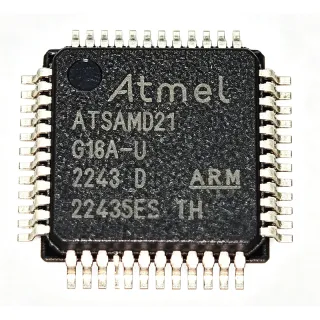
DSPIC33FJ128GP206T-I/PT - 16-bit 40 MIPS DSC 128KB | Microchip
MPN: DSPIC33FJ128GP206T-I/PT ✓ Active| Qty | Unit Price | Extended |
|---|---|---|
| 1 | $7.42 | $7.42 |
| 10 | $6.71 | $67.10 |
| 25 | $6.35 | $158.75 |
| 100 | $5.66 | $566.00 |
| 1,000 | $4.89 | $4,890.00 |
DSPIC33FJ128GP206T-I/PT Overview
A digital signal controller (DSC) is a hybrid device that merges the deterministic control structure of a microcontroller (MCU) with the mathematical throughput of a digital signal processor (DSP). Within the semiconductor hierarchy, it sits between general-purpose MCUs and dedicated DSPs in the broader category of embedded processing ICs, making it a natural choice for control loops that also need fast multiply-accumulate operations such as digital filters.
Key features of this part include 16-bit modified Harvard architecture execution at up to 40 MIPS (3.0-3.6V operating range), 128KB self-programmable Flash, 51 I/O ports per the digchip specification summary, and the dsPIC33F DSP engine with single-cycle MAC and dual operand fetch for filter algorithms. The GP (General Purpose) peripheral variant focuses on analog and digital control peripherals rather than motor-control PWM.
Architecturally, the dsPIC33F core provides a 16-bit data path with DSP instruction extensions, hardware looping, and a fast interrupt system, enabling high-speed precision digital control loops. Flash self-programming supports field firmware updates, while the device supports In-Circuit Serial Programming (ICSP) and in-circuit debugging through PGECx/PGEDx pin pairs using tools such as MPLAB SNAP, per the Microchip product page.
Typical applications include digital power supplies and power-factor-correction stages, sensor signal conditioning with digital filtering, industrial automation control nodes, and general-purpose systems that require DSP-class math. The Explorer 16/32 Development Board from Microchip supports this device family via Plug-In Modules for rapid prototyping.
Designers should note that the maximum 40 MIPS rating requires the full 3.0-3.6V supply range; at lower supply voltages the operating frequency must be deranged per the datasheet operating range table. Multiple PGECx/PGEDx pin pairs exist, and programming requires ICSPCLK and ICSPDAT from the same selected pair.
This page synthesizes distributor pricing context, verified drop-in family alternatives, and practical design notes not consolidated in the manufacturer datasheet, providing a single reference for selection and substitution decisions.
Drop-in alternatives for DSPIC33FJ128GP206T-I/PT — same package, pin-to-pin compatible. Different-package parts requiring PCB rework are excluded.
Variants in this series
Same-series models that are drop-in compatible with DSPIC33FJ128GP206T-I/PT (same form factor and footprint) — differing in Operating Temperature.
Quick Comparison Tool — Select alternative parts for side-by-side comparison:
DSPIC33FJ128GP206AT-I/PT
✅ Drop-In✓ In Stock
$4.6 / Unit
View Datasheet →DSPIC33FJ128GP206-I/PT
✅ Drop-In📋 Reference alternative (not in catalog)
DSPIC33FJ64GP206T-I/PT
✅ Drop-In ⚠️ Specs Unverified📋 Reference alternative (not in catalog)
DSPIC33FJ256GP206T-I/PT
✅ Drop-In ⚠️ Specs Unverified📋 Reference alternative (not in catalog)
DSPIC33FJ128GP806T-I/PT
✅ Drop-In ⚠️ Specs Unverified📋 Reference alternative (not in catalog)
DSPIC33FJ128GP206T-I/PT Maximum Ratings & Electrical Characteristics
| Core Architecture | 16-bit dsPIC33F DSC (RISC with DSP engine) |
| Maximum CPU Speed | 40 MIPS |
| Clock Speed | 60 MHz (per digchip listing) |
| Program Memory Size | 128KB (128K x 8) Flash |
| Program Memory Type | Flash |
| Supply Voltage Range | 3 V to 3.6 V |
| I/O Ports | 51 |
| Package Type | 64-TQFP (10x10 mm, 0.90 mm height) |
| Mounting Type | Surface Mount |
| Operating Temperature | -40C to +85C (I grade) |
| Programming Interface | ICSP via PGECx/PGEDx pairs |
| Debug Support | In-circuit debugging (MPLAB SNAP) |
| Lifecycle Stage | ACTIVE |
| RoHS Status | ROHS3 Compliant |
| Timers | General purpose timers per dsPIC33FJ GP family (count per datasheet) |
DSPIC33FJ128GP206T-I/PT 64-tqfp (10x10 mm, 0.90 mm height) Pin Configuration Guide
Pin configuration for DSPIC33FJ128GP206T-I/PT (64-tqfp (10x10 mm, 0.90 mm height) package). This digital IC includes GPIO, communication interfaces (UART, SPI, I2C), and power pins. Refer to the manufacturer datasheet for alternate pin functions and configuration options. Essential for embedded system design and PCB layout.

No detailed pinout data available for DSPIC33FJ128GP206T-I/PT.
Refer to the datasheet for full pin configuration.
Typical Applications
DSPIC33FJ128GP206T-I/PT is suitable for 6 applications: Digital Power Supplies, Industrial Automation Control Nodes, Sensor Signal Conditioning, Audio Signal Processing, Embedded Control with Field Updates, Motor and Actuator Control (Motion Assistance).
Digital Power Supplies
The DSPIC33FJ128GP206T-I/PT fits digital power conversion because the dsPIC33F family is explicitly designed, per Microchip, to execute high-speed precision digital control loops. Its 40 MIPS throughput with a single-cycle MAC DSP engine closes voltage-mode or current-mode compensator loops at switching frequencies typical of AC-DC and DC-DC stages, while 128KB Flash stores compensator coefficients, state machines, and protection logic with room for field updates. The 3.0-3.6V core supply integrates cleanly with a 3.3V bias rail derived from an auxiliary winding. Placement as the loop controller between the sensing dividers and the PWM gate drivers adds digital flexibility - programmable soft-start, non-linear gain scheduling, and adaptive protection - that analog controllers cannot match, at the cost of firmware validation effort and ADC latency budgeting in the loop design.
Recommended
Industrial Automation Control Nodes
In factory automation, the DSPIC33FJ128GP206T-I/PT serves as an intelligent sensor or actuator node. The 51 I/O ports interface switches, encoders, and relays directly, while the 40 MIPS DSP engine executes digital filtering on noisy industrial sensor signals, improving measurement fidelity where analog filtering alone would add phase lag. The -40C to +85C industrial temperature grade matches cabinet-mounted electronics, and the 128KB self-programmable Flash supports field firmware updates over a service interface without replacing hardware. Microchip's ICSP through paired PGECx/PGEDx pins allows programming the node in-circuit during production line calibration. The main trade-off versus a Cortex-M class MCU is the proprietary core toolchain; in exchange, designers gain deterministic DSP-class filtering and a family migration path (64KB to 256KB Flash in the same footprint) if requirements grow.
Recommended
Sensor Signal Conditioning
Precision sensor front ends benefit from the DSPIC33FJ128GP206T-I/PT because the on-chip DSP engine applies FIR and IIR filters to sampled sensor data at up to 40 MIPS, rejecting noise that would otherwise require costly external analog filter stages. The integrated ADC samples bridge, thermocouple-conditioned, or pressure-sensor signals directly, and the 51 I/O ports drive calibration muxes and status lines. With 128KB Flash, coefficient tables for multiple sensor profiles can be stored on-chip and selected at runtime. The 3.0-3.6V supply suits 3.3V analog domains shared with the sensor conditioning chain. Designers should budget ADC noise and sampling jitter into the resolution calculation - the digital filter improves SNR only if the front-end noise is within the ADC's usable range, making layout and reference quality the limiting factors rather than compute capacity.
Recommended
Audio Signal Processing
The dsPIC33F DSP engine makes the DSPIC33FJ128GP206T-I/PT capable of real-time audio effects, filtering, and level processing. Single-cycle multiply-accumulate at 40 MIPS executes biquad filter chains, mixing, and dynamic range compression on sampled audio at typical voice-band and music sample rates. The GP peripheral set includes general-purpose I/O for codec control interfaces, and the 128KB Flash retains multiple effect presets and boot code. The part integrates naturally into consumer and professional audio accessories where a full DSP chip is over-specified and cost matters. Limitations to observe: the on-chip ADC/DAC analog performance is general purpose rather than audio-graded, so designs demanding high dynamic range should pair the controller with an external codec, using the DSC purely as the processing engine over its serial interfaces.
Recommended
Embedded Control with Field Updates
Products requiring in-field firmware updates - metering devices, service equipment, and distributed instrumentation - use the DSPIC33FJ128GP206T-I/PT's self-programmable Flash to implement bootloaders. The 128KB array allows a dual-slot scheme: one slot holds the running application while the other receives the update, enabling rollback on failure. Programming happens through the standard ICSP interface on paired PGECx/PGEDx pins during manufacturing, then through a user-implemented bootloader (UART, SPI, or other transport) in the field. Microchip's MPLAB SNAP supports production programming per the product page. The 3.0-3.6V supply and -40C to +85C grade cover industrial environments. The key design consideration is flash endurance management - page-erase cycles must be counted and slot writes balanced to guarantee the update mechanism survives the product's service life.
Recommended
Motor and Actuator Control (Motion Assistance)
While the GP206 variant is the general-purpose member of the family, its 40 MIPS DSP engine and fast interrupt structure handle unidirectional motor drives, stepper sequencing, and actuator position loops where full complementary high-speed PWM peripherals are not required. Digital filters smooth encoder feedback, and the 51 I/O ports interface gate drivers, limit switches, and communication transceivers. The 128KB Flash accommodates trajectory planning tables and commutation code with margin for feature growth. For trapezoidal or field-oriented control of brushless motors with complementary outputs and hardware dead-time, Microchip's MC peripherals variants in the same 16-bit ecosystem are the better fit; the GP206 suits unidirectional PWM drives and step/direction motion controllers. Designers should verify interrupt latency budgets against loop bandwidth before committing the part.
Recommended
Recommended Products Summary
Engineering reference data for DSPIC33FJ128GP206T-I/PT — comparison, design guidance, and compliance information.
Selection Guide
Comparison with Alternatives
| Parameter | This Product | DSPIC33FJ128GP206AT-I/PT | DSPIC33FJ128GP206-I/PT | DSPIC33FJ64GP206T-I/PT | DSPIC33FJ256GP206T-I/PT | DSPIC33FJ128GP806T-I/PT |
|---|---|---|---|---|---|---|
| Package | 64-TQFP (10x10 mm) | 64-TQFP (10x10 mm) - same | 64-TQFP (10x10 mm) - same | 64-TQFP (10x10 mm) - same | 64-TQFP (10x10 mm) - same | TQFP-80 - different footprint |
| Brand | Microchip Technology | Microchip Technology | Microchip Technology | Microchip Technology | Microchip Technology | Microchip Technology |
| Flash Memory | 128KB | 128KB | 128KB | 64KB | 256KB | 128KB |
| Maximum Performance | 40 MIPS | 40 MIPS | 40 MIPS | 40 MIPS | 40 MIPS | 40 MIPS |
| Supply Voltage | 3.0 V to 3.6 V | 3.0 V to 3.6 V | 3.0 V to 3.6 V | 3.0 V to 3.6 V | 3.0 V to 3.6 V | 3.0 V to 3.6 V |
| Pin Count | 64 | 64 | 64 | 64 | 64 | 80 |
| Packing | Tape & Reel (T) | Tape & Reel (T) | Tray | Tape & Reel (T) | Tape & Reel (T) | Tape & Reel (T) |
Key Differentiators
- Latest A-step silicon available in same footprint (vs DSPIC33FJ128GP206AT-I/PT)
- Twice the Flash at same pin count (vs DSPIC33FJ64GP206T-I/PT)
- Tape-and-reel packing for automated assembly (vs DSPIC33FJ128GP206-I/PT)
Design Notes
Supply the DSPIC33FJ128GP206T-I/PT from a clean 3.0-3.6V rail; the full 40 MIPS rating applies only across the entire industrial operating range per the family datasheet. Decouple each VDD pin with 0.1uF ceramics placed within 2 mm of the pin, plus one bulk 4.7-10uF capacitor near the device. All VSS pins should connect to a solid ground plane. Estimated: at 40 MIPS the core current is in the tens of milliamps per family datasheet electrical characteristics - verify exact figures in the datasheet current-versus-frequency tables rather than assuming.
Route the PGECx/PGEDx programming pair to a header on the PCB even in production boards; the Northern Software developer notes confirm ICSPCLK and ICSPDAT must come from the SAME selected pair (e.g., PGEC2 with PGED2). Keep the pair short and away from switching nodes, since the debugger shares these lines. Reserve space for the standard 5-pin or 6-pin ICSP connector footprint. If analog accuracy matters, place the ADC-referenced traces away from the programming header to prevent contention during debug sessions.
Do not operate above 3.6V - the dsPIC33FJ absolute maximum supply is tightly bounded, and exceeding it permanently damages the part. Confirm which PGECx/PGEDx pair your programmer uses before routing. When migrating between Flash sizes (64KB/128KB/256KB family members), recompile and verify configuration bit settings, since the flash configuration word addresses differ. For the 'T' tape-and-reel part, observe MSL bake-out rules before reflow; check the product datasheet and MSL rating printed on the reel label.
Compliance Information
ROHS3 Compliant per ics-embedded product listing. Lifecycle stage ACTIVE per digchip. Reach/halogen status not stated in provided data.