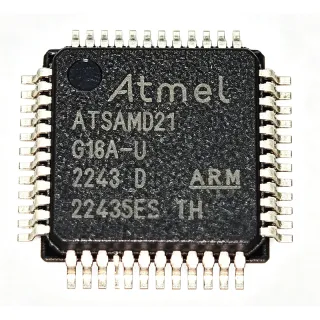
DSPIC33FJ256GP710A-E/PF - 16-bit DSC 40MIPS 256KB Flash | Microchip
MPN: DSPIC33FJ256GP710A-E/PF ✓ Active| Qty | Unit Price | Extended |
|---|---|---|
| 1 | $0 | $0.00 |
| 10 | $0 | $0.00 |
| 100 | $0 | $0.00 |
| 500 | $0 | $0.00 |
| 1,000 | $0 | $0.00 |
DSPIC33FJ256GP710A-E/PF Overview
A Digital Signal Controller combines the computational architecture of a digital signal processor with the peripheral set and ease of use of a microcontroller. In the power management hierarchy, the DSC sits between general-purpose MCUs and dedicated DSPs, making it the preferred choice for embedded control systems that require both fast math (multiply-accumulate, DSP engine instructions) and rich analog and communication peripherals on a single chip.
Key features of the dsPIC33FJ256GP710A include its 16-bit dsPIC33F core modified Harvard architecture operating up to 40 MIPS at 3.3V, 256 KB (256K x 8) of self-programmable Flash with ECC-style erase protection, 30 KB of SRAM, and the GP (General Purpose) peripheral family with advanced analog integration. Multiple communication interfaces, PWM outputs, and timer resources support demanding motor control and digital power loops.
Architecturally, the dsPIC33F core pairs a 16-bit ALU with a dedicated DSP engine supporting single-cycle MAC and dual data fetch, enabling real-time control algorithms such as field-oriented motor control, digital filters, and power conversion feedback loops without external co-processors. The A-suffix silicon is a die revision of the original dsPIC33FJ256GP710 with corrected errata, and Microchip fully supports it with the free MPLAB X IDE and MPLAB XC-DSC C/C++ compiler.
Typical applications include industrial motor drives, digital power supplies (PFC, LLC), solar inverters, and automotive body and convenience systems where the -E extended temperature grade and AEC-Q100-qualified H-variant siblings make platform reuse straightforward.
Design consideration: the device operates from a 3.0V to 3.6V supply, so plan level-shifting for 5V peripheral interfaces, and use the multiple PGECx/PGEDx pin pairs as matched pairs for ICSP programming.
This page synthesizes distributor pricing, drop-in same-package alternatives, extended-temperature substitution guidance, and practical design notes not consolidated in the 362-page manufacturer datasheet.
Drop-in alternatives for DSPIC33FJ256GP710A-E/PF — same package, pin-to-pin compatible. Different-package parts requiring PCB rework are excluded.
Variants in this series
Same-series models that are drop-in compatible with DSPIC33FJ256GP710A-E/PF (same form factor and footprint) — differing in Package, Operating Temperature, Supply Voltage, ADC Resolution, Core.
Quick Comparison Tool — Select alternative parts for side-by-side comparison:
DSPIC33FJ256GP710A-I/PF
✅ Drop-In✓ In Stock
$8.25 / Unit
View Datasheet →DSPIC33FJ256GP710A-H/PF
✅ Drop-In✓ In Stock
$6.15 / Unit
View Datasheet →DSPIC33FJ256GP510-I/PF
✅ Drop-In✓ In Stock
$4.98 / Unit
View Datasheet →DSPIC33FJ128GP710A-E/PF
✅ Drop-In ⚠️ Specs Unverified✓ In Stock
$6.25 / Unit
View Datasheet →DSPIC33FJ64GP710A-E/PF
✅ Drop-In ⚠️ Specs Unverified✓ In Stock
$6.1 / Unit
View Datasheet →DSPIC33FJ256GP710A-E/PF Maximum Ratings & Electrical Characteristics
| Core | dsPIC33F 16-bit |
| Program Memory Size | 256 KB (256K x 8) Flash |
| RAM Size | 30 KB SRAM |
| Maximum Speed | 40 MIPS |
| Supply Voltage | 3.0 V to 3.6 V (3.3 V nominal) |
| Operating Temperature | -40C to +125C (E grade) |
| Package | 100-TQFP (14x14 mm), PF |
| Pin Count | 100 |
| Mounting Type | Surface Mount |
| Core Supply Voltage | 3.3 V |
| Data Bus Width | 16 bit |
| Series | dsPIC33FJ256GP710A (GP family) |
| Packaging | Tray |
| Programming Interface | ICSP via PGECx/PGEDx pairs |
| Die Revision | A-suffix (errata-corrected) |
| Qualification (H variant) | AEC-Q100 qualified (DSPIC33FJ256GP710A-H/PF) |
| Development Tool Support | MPLAB X IDE, MPLAB XC-DSC compiler, Explorer 16/32 board |
DSPIC33FJ256GP710A-E/PF 100-tqfp (14x14 mm), pf Pin Configuration Guide
Pin configuration for DSPIC33FJ256GP710A-E/PF (100-tqfp (14x14 mm), pf package). This digital IC includes GPIO, communication interfaces (UART, SPI, I2C), and power pins. Refer to the manufacturer datasheet for alternate pin functions and configuration options. Essential for embedded system design and PCB layout.

No detailed pinout data available for DSPIC33FJ256GP710A-E/PF.
Refer to the datasheet for full pin configuration.
Typical Applications
DSPIC33FJ256GP710A-E/PF is suitable for 6 applications: Industrial Motor Drives, Digital Power Supplies (PFC / LLC), Solar Inverters and Renewable Energy Converters, Automotive Body and Convenience Electronics, Industrial Automation and Sensor Signal Processing, Embedded Development and Prototyping Platforms.
Industrial Motor Drives
The DSPIC33FJ256GP710A-E/PF fits industrial motor drives because its 40 MIPS 16-bit core with a single-cycle MAC DSP engine executes field-oriented control (FOC) loops at the multi-kilohertz rates demanded by PMSM and induction motors, while the GP peripheral set supplies PWM, timer, and analog resources on chip. The -40C to +125C -E grade tolerates drive-enclosure thermal rise without derating the control platform. In use, the DSC runs current-loop and speed-loop software while integrated PWM modules drive the inverter gate stage; the quantified benefit is deterministic loop timing from the DSP engine, avoiding external co-processors. Where automotive-adjacent drives are targeted, the pin-compatible DSPIC33FJ256GP710A-H/PF (AEC-Q100) allows PCB reuse.
Recommended
Digital Power Supplies (PFC / LLC)
Digital power conversion benefits directly from this DSC: the 40 MIPS dsPIC33F core closes voltage and current feedback loops fast enough for PFC and LLC stages, and 256 KB Flash holds control law compensators, state machines, and protection firmware with headroom for field upgrades. The 30 KB SRAM accommodates filter histories and lookup tables for nonlinear control. In circuit, the DSC samples feedback through its integrated analog peripherals and drives PWM outputs to the power stage with deterministic latency; compared with analog-only control, firmware-based compensation adapts across load ranges without hardware changes. The 3.0V to 3.6V single-supply operation simplifies bias generation from an auxiliary winding.
Recommended
Solar Inverters and Renewable Energy Converters
Grid-tied solar micro-inverters and MPPT converters use the DSPIC33FJ256GP710A-E/PF because its DSP engine sustains MPPT algorithms and grid-synchronization math at 40 MIPS, while the extended -40C to +125C operating range survives outdoor enclosure temperatures. The 256 KB Flash supports multiple certification firmware variants on one BOM. Operationally, the DSC executes maximum-power-point tracking and inverter modulation concurrently, with the integrated timers providing precise PWM phase relationships; the single-cycle MAC accelerates Clarke/Park transforms, delivering control bandwidth that fixed-point MCUs of the same clock rate cannot match. Firmware updates over the self-programmable Flash enable field re-tuning of MPPT parameters.
Recommended
Automotive Body and Convenience Electronics
For automotive body controllers, the decisive point is the pin-compatible DSPIC33FJ256GP710A-H/PF, which is AEC-Q100 qualified per Microchip USA data and shares the identical 100-pin TQFP footprint with the -E/PF. Designs prototyped on the -E grade migrate to the H grade for production with no PCB changes. The 40 MIPS core handles CAN-style communication stacks, lighting choreography, and sensor fusion simultaneously; 256 KB Flash holds autocalibration tables and diagnostic routines. In the vehicle, the DSC's deterministic interrupt latency supports time-critical loads such as LED matrix drivers and pump sequencing, while the extended temperature capability covers underhood-adjacent modules.
Recommended
Industrial Automation and Sensor Signal Processing
Factory automation nodes use the DSPIC33FJ256GP710A-E/PF to combine signal conditioning with protocol handling on one chip: the advanced analog integration of the GP family digitizes sensor inputs while the DSP engine applies digital filtering (IIR/FIR) at 40 MIPS, and 256 KB Flash stores communication stacks plus a local HMI state machine. The -E grade covers unconditioned panel environments from -40C to +125C. In deployment, the DSC samples sensor channels, executes compensation math in the DSP engine, and updates outputs deterministically; the benefit is eliminating a separate analog-front-end controller, cutting BOM count. Multiple PGECx/PGEDx pairs keep ICSP accessible in densely wired cabinets.
Recommended
Embedded Development and Prototyping Platforms
The Explorer 16/32 Development Board from Microchip supports this device through a 100-pin TQFP Plug-In Module (PIM, information sheet 70565A), making the DSPIC33FJ256GP710A-E/PF an excellent learning and prototyping platform for 16-bit DSC design. With MPLAB X IDE and the free MPLAB XC-DSC compiler, engineers go from ANSI C source to on-chip debug over ICSP quickly; the PGEC/PGED matched-pair scheme is fully exposed on the PIM. The 256 KB Flash permits large demo and benchmark applications, and programming benchmark tools (for example NSDSP measurements) confirm full-chip program/verify times. Prototype firmware developed here transfers unchanged to production boards using the I, E, or H variants.
Recommended
Recommended Products Summary
Engineering reference data for DSPIC33FJ256GP710A-E/PF — comparison, design guidance, and compliance information.
Selection Guide
Comparison with Alternatives
| Parameter | This Product | DSPIC33FJ256GP710A-I/PF | DSPIC33FJ256GP710A-H/PF | DSPIC33FJ256GP510-I/PF | DSPIC33FJ128GP710A-E/PF |
|---|---|---|---|---|---|
| Brand | Microchip Technology | Microchip Technology | Microchip Technology | Microchip Technology | Microchip Technology |
| Package | 100-TQFP (PF, 14x14 mm) | 100-TQFP (PF) - same | 100-TQFP (PF) - same | 100-TQFP (PF) - same | 100-TQFP (PF) - same |
| Flash Memory | 256 KB | 256 KB | 256 KB | 256 KB | 128 KB |
| Performance | 40 MIPS | 40 MIPS | 40 MIPS | 40 MIPS | 40 MIPS |
| Operating Temperature | -40C to +125C (E) | -40C to +85C (I) | AEC-Q100 grade (H) | -40C to +85C (I) | -40C to +125C (E) |
| Automotive Qualification | No | No | Yes (AEC-Q100) | No | No |
| Supply Voltage | 3.0 V to 3.6 V | 3.0 V to 3.6 V | 3.0 V to 3.6 V | 3.0 V to 3.6 V | 3.0 V to 3.6 V |
| Peripheral Set | GP family, advanced analog | GP family, identical | GP family, identical | GP family, reduced pin-mux options | GP family, identical |
Key Differentiators
- Extended -40C to +125C industrial temperature range (vs DSPIC33FJ256GP710A-I/PF)
- Automotive migration path in the same footprint (vs DSPIC33FJ256GP710A-H/PF)
- Full 256 KB Flash capacity (vs DSPIC33FJ128GP710A-E/PF)
Design Notes
Lay out the 100-pin TQFP with short, wide traces on the three VDD/VSS supply pairs and place 100 nF ceramic decoupling capacitors at each supply pin pair, plus 4.7-10 uF bulk capacitance near the device. Keep the VDDCORE/VDD circuit per Microchip's datasheet recommendation (core capacitor requirements differ from standard PIC devices). The 14x14 mm PF footprint needs thermal relief connections on ground pads to aid soldering during reflow. Match the PIM (70565A) pin mapping if Explorer 16/32 debugging is planned.
Programming requires using PGECx/PGEDx pins as matched pairs - PGEC2 must pair with PGED2, never mixed across pairs, per Microchip documentation. Do not design the original (non-A) dsPIC33FJ256GP710 into new products: the A-suffix die contains errata corrections. Watch the 3.0V-3.6V supply window; 5V logic requires level shifting. Finally, confirm the temperature suffix matches the derating analysis - the -I grade stops at +85C while -E reaches +125C.
Estimated: at 40 MIPS with all peripherals active, dsPIC33F-class devices draw tens of mA from a 3.3V rail; budget roughly 0.1-0.2 W for the DSC itself and verify against the datasheet current-consumption tables for your clock configuration. Regulatory: the dsPIC33F family is not designed to switch the power stage directly at high voltage - isolate gate drivers between the DSC PWM outputs and inverter bridges. Use Microchip's switching power supply application notes for digital power firmware structure.
Compliance Information
The -E/PF variant itself has no explicit qualification data in the retrieved sources. The sibling DSPIC33FJ256GP710A-H/PF is explicitly documented as AEC-Q100 qualified (Microchip USA). Verify current RoHS/REACH status on the Microchip product page before procurement.