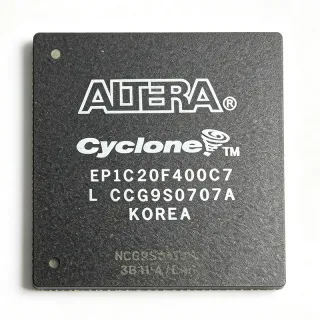
EP1C20F400I6 - Cyclone FPGA, 20060 LEs, 400-FBGA | Altera
MPN: EP1C20F400I6 ✗ End of Life| Qty | Unit Price | Extended |
|---|---|---|
| 1 | $95 | $95.00 |
| 10 | $88.5 | $885.00 |
| 100 | $82 | $8,200.00 |
| 500 | $76.5 | $38,250.00 |
| 1,000 | $71 | $71,000.00 |
EP1C20F400I6 Overview
A Field-Programmable Gate Array (FPGA) is a reconfigurable semiconductor device in which the logic fabric, interconnect, and I/O cells can be programmed after manufacture using a hardware description language (HDL) such as Verilog or VHDL. FPGAs sit at the top of the digital logic hierarchy alongside ASICs and CPLDs, sitting above microcontrollers in performance-per-watt for highly parallel workloads. Within the broader taxonomy, the Cyclone family belongs to the low-cost, high-volume FPGA segment optimized for glue logic, bus bridging, and DSP pre-processing rather than the high-end transceiver-rich Stratix tier.
Key features include support for LVDS, LVTTL, LVCMOS, SSTL-2, and SSTL-3 I/O standards; embedded multipliers for low-cost DSP; and a serial configuration interface compatible with EPCS serial configuration devices. The device operates from a 1.5 V core supply with separate VCCIO banks for flexible I/O voltage rails, and it supports passive or active serial configuration schemes plus JTAG boundary-scan testing per IEEE 1149.1.
The Cyclone architecture uses a 2-D row-and-column interconnect with embedded M4K RAM blocks, LAB (Logic Array Block) clusters of 10 logic elements each, and dedicated multiplier blocks for DSP operations. Industrial-grade silicon rated from -40C to +100C ambient ensures reliable operation in factory automation, automotive test, and outdoor wireless backhaul equipment.
Typical applications include industrial control and factory automation bridges, low-cost video processing pipelines, motor control and encoder interfaces, telecommunications line-card glue logic, and consumer electronics requiring parallel DSP pre-processing. The Cyclone family is widely used in education for HDL coursework and in prototype ASIC emulation because of its low non-recurring engineering cost.
Designers should plan for separate analog and digital ground returns under the BGA, keep PLL analog supply pins LC-filtered, and reference the Quartus II (or the latest Intel Quartus Prime) device handbook for pin assignments and timing closure. The 400-ball FBGA requires 1.0 mm ball pitch, which dictates PCB stack-up and via-in-pad process selection.
Drop-in alternatives for EP1C20F400I6 — same package, pin-to-pin compatible. Different-package parts requiring PCB rework are excluded.
Variants in this series
Same-series models that are drop-in compatible with EP1C20F400I6 (same form factor and footprint) — differing in Speed Grade, Process Technology, Family, PLLs, Package.
Quick Comparison Tool — Select alternative parts for side-by-side comparison:
EP1C20F400I-6
✅ Drop-In✓ In Stock
$27.85 / Unit
View Datasheet →EP1C20F400I7
✅ Drop-In✓ In Stock
$28.75 / Unit
View Datasheet →EP1C20F400C6
✅ Drop-In✓ In Stock
$18.95 / Unit
View Datasheet →EP1C20F400C6N
✅ Drop-In✓ In Stock
$53.1 / Unit
View Datasheet →EP1C20F400C8N
✅ Drop-In✓ In Stock
$62.5 / Unit
View Datasheet →EP1C20F400C7N
✅ Drop-In✓ In Stock
$65.8 / Unit
View Datasheet →EP1C20F400I6 Maximum Ratings & Electrical Characteristics
| Family | Cyclone FPGA |
| Logic Elements | 20,060 |
| Process Technology | 130 nm SRAM |
| Core Voltage | 1.5 V |
| Maximum User I/O | 301 |
| Embedded RAM | 288 Kbits (M4K blocks) |
| PLL Blocks | 2 |
| Operating Temperature Grade | Industrial (-40C to +100C) |
| Package | 400-ball FineLine BGA (FBGA-400) |
| Maximum Frequency | 405.2 MHz |
| Configuration Schemes | Passive Serial, Active Serial, JTAG |
| Supported I/O Standards | LVTTL, LVCMOS, LVDS, SSTL-2, SSTL-3 |
| Mounting Type | Surface Mount |
EP1C20F400I6 400-ball fineline bga (fbga-400) Pin Configuration Guide
Pin configuration for EP1C20F400I6 (400-ball fineline bga (fbga-400) package). This digital IC includes GPIO, communication interfaces (UART, SPI, I2C), and power pins. Refer to the manufacturer datasheet for alternate pin functions and configuration options. Essential for embedded system design and PCB layout.

No detailed pinout data available for EP1C20F400I6.
Refer to the datasheet for full pin configuration.
Typical Applications
EP1C20F400I6 is suitable for 6 applications: Industrial Control and Factory Automation, Telecommunications Line-Card Glue Logic, Low-Cost Video Processing Pipelines, Motor Control and Encoder Interfaces, Education and HDL Coursework Platforms, Prototype ASIC Emulation and Verification.
Industrial Control and Factory Automation
The EP1C20F400I6's industrial temperature grading (-40C to +100C) and 20,060 logic elements make it well suited for factory automation PLCs, sensor aggregation, and motor control interfaces. The 301 user I/O pins handle multi-axis encoder inputs, opto-isolated GPIO, and RS-485 transceivers without external bus expanders. The two PLL blocks synthesize deterministic clocks for EtherCAT or Profibus timing, and LVDS support enables high-speed encoder feedback. Designers typically route LVTTL or 24V-tolerant logic via external isolators and use the M4K RAM blocks as line buffers for protocol conversion. Its 130 nm 1.5 V core keeps active power low enough for DIN-rail-mounted industrial controllers in continuous operation.
Recommended
Telecommunications Line-Card Glue Logic
The EP1C20F400I6 functions as a versatile glue-logic bridge between line-card PHYs, TDM framers, and network processors in legacy telecom equipment. Its 288 Kbits of M4K RAM provide FIFO buffers for packet dequeueing, while LVDS I/O supports high-speed SPI4.2 interfaces to network processors. The 1.5 V core and 130 nm process yield acceptable power for always-on central-office chassis. Designers commonly instantiate POS-PHY Level 3 bridges, UTOPIA interfaces, or HDLC controllers in the 20,060-LE fabric. Industrial temperature grading allows deployment in outdoor remote cabinets and unconditioned roadside enclosures.
Recommended
Low-Cost Video Processing Pipelines
The EP1C20F400I6 implements cost-sensitive video processing pipelines such as NTSC/PAL decoders, deinterlacers, and on-screen-display overlays in surveillance and broadcast gear. Its embedded multipliers handle YCbCr color-space conversion and 2D FIR filtering, while 288 Kbits of M4K RAM store line and frame buffers. The 301 user I/O pins accept ITU-R BT.656 parallel video and drive LVDS panels. Cyclone devices were widely used in early flat-panel TV controllers and entry-level DVRs. Designers typically pair the device with an external video ADC/DAC and SDRAM controller for full pipeline support.
Recommended
Motor Control and Encoder Interfaces
The EP1C20F400I6's industrial temperature rating, fast logic fabric, and PLL-based clocking make it ideal for servo drives, stepper controllers, and CNC machine interfaces. The 301 user I/O pins accept quadrature encoder feedback from multiple axes, while the two PLLs synthesize deterministic PWM carrier frequencies for field-oriented control loops. The 20,060 LEs accommodate PI/DI state-space controllers in software-equivalent HDL, and the 288 Kbits of M4K RAM provide look-up tables for sine-wave PWM or space-vector modulation. Industrial grading ensures reliable operation near motor-drive power stages with high dV/dt and ambient temperature swings.
Recommended
Education and HDL Coursework Platforms
The EP1C20F400I6 is widely adopted in university digital-logic and computer-architecture courses because of its low cost, mature Quartus II toolchain support, and abundant reference designs. Students implement RISC-V cores, CPU pipelines, and memory controllers within the 20,060-LE fabric. The 400-ball FBGA on development boards exposes all 301 user I/O pins via headers for breadboard experimentation. Industrial temperature grading allows lab use in non-climate-controlled environments. Quartus II Web Edition (free) supports the entire Cyclone family, lowering the barrier for student adoption.
Recommended
Prototype ASIC Emulation and Verification
The EP1C20F400I6 serves as a flexible pre-silicon verification platform for ASIC prototypes, particularly for control-plane logic and bus-bridging IP. Engineers map RTL into the 20,060-LE fabric to validate functionality before committing to mask sets, saving NRE costs. The 288 Kbits of M4K RAM and 301 user I/O pins accommodate peripheral models, transaction recorders, and debug trace buffers. Industrial temperature grading supports verification in real-environment chassis. While modern ASIC prototyping uses larger FPGAs, Cyclone remains a cost-effective option for sub-50K-gate ASICs and legacy IP validation.
Recommended
Recommended Products Summary
Engineering reference data for EP1C20F400I6 — comparison, design guidance, and compliance information.
Selection Guide
Comparison with Alternatives
| Parameter | This Product | EP1C20F400I-6 | EP1C20F400I7 | EP1C20F400C6 | EP1C20F400C6N | EP1C20F400C8N | EP1C20F400C7N |
|---|---|---|---|---|---|---|---|
| Brand | Altera | Altera | Altera | Altera | Altera | Altera | Altera |
| Package | FBGA-400 | FBGA-400 - same | FBGA-400 - same | FBGA-400 - same | FBGA-400 - same | FBGA-400 - same | FBGA-400 - same |
| Logic Elements | 20,060 | 20,060 | 20,060 | 20,060 | 20,060 | 20,060 | 20,060 |
| Temperature Grade | Industrial (-40C to +100C) | Industrial (-40C to +100C) | Industrial (-40C to +100C) | Commercial (0C to +70C) | Commercial (0C to +70C) | Commercial (0C to +70C) | Commercial (0C to +70C) |
| Speed Grade | 6 | 6 | 7 (slower) | 6 | 6 | 8 (slowest) | 7 |
| Embedded RAM | 288 Kbits (M4K) | 288 Kbits (M4K) | 288 Kbits (M4K) | 288 Kbits (M4K) | 288 Kbits (M4K) | 288 Kbits (M4K) | 288 Kbits (M4K) |
| PLL Blocks | 2 | 2 | 2 | 2 | 2 | 2 | 2 |
| User I/O | 301 | 301 | 301 | 301 | 301 | 301 | 301 |
Key Differentiators
- Industrial temperature grade for harsh environments (vs EP1C20F400C6)
- Faster speed grade within the same family (vs EP1C20F400I7)
- Highest user I/O count in the 400-ball Cyclone package (vs EP1C20F324I7)
Design Notes
The EP1C20F400I6 requires a 1.5 V core supply (VCCINT) plus separate VCCIO bank voltages for I/O flexibility (typically 3.3 V, 2.5 V, or 1.8 V). According to the Cyclone datasheet, total quiescent current scales with logic utilization and toggle rate; estimate 1.5 V x 200-500 mA core current and 3.3 V x 50-200 mA for I/O banks in a typical design. Decouple each VCCINT and VCCIO ball with a 0.1 uF X7R ceramic placed within 3 mm of the package, and add bulk 47-100 uF tantalum or polymer capacitors near the regulator output.
The 400-ball FineLine BGA uses a 1.0 mm ball pitch, which requires via-in-pad or microvia PCB technology for reliable assembly. According to Cyclone hardware design guidelines, use a 6-8 layer stack-up with continuous ground and power planes; route signals on outer layers only. Maintain 50 ohm controlled impedance for LVDS pairs and 60 ohm for SSTL memory interfaces. Provide thermal vias under the package center for heat dissipation, especially when sustained toggle rates exceed 50 MHz across many I/O banks.
Do not confuse speed grade numbers across Altera families: in the Cyclone family, a higher number means SLOWER timing (I6 is faster than I7). The 'I' suffix denotes industrial temperature, while 'C' denotes commercial. Do not substitute Cyclone II EP2C20F400 for EP1C20F400I6 without verifying pinout - Cyclone II changed JTAG and configuration pin assignments. Always verify the exact ordering code against the Altera/Intel device handbook before committing to PCB layout.
Place the configuration device (EPCS1/EPCS4/EPCS16) within 50 mm of the FPGA DATA, DCLK, and nCS pins to meet AS configuration timing. According to the Cyclone datasheet, JTAG chain signals TCK, TMS, TDI, and TDO require 4.7 kohm pull-ups to VCCIO of the JTAG bank. Keep PLL analog supply pins (VCCA_PLL) filtered with ferrite beads and decoupled with 0.1 uF and 10 uF capacitors; noisy PLL supplies cause jitter degradation and clock-skew failures in high-speed interfaces.
Compliance Information
Compliance information not present in the Verified Web Data. Original Cyclone family was launched before RoHS became mandatory; many EP1C20F400 variants were later offered in lead-free packages (suffix N). Verify the specific suffix against the Altera/Intel ordering information for definitive compliance status.