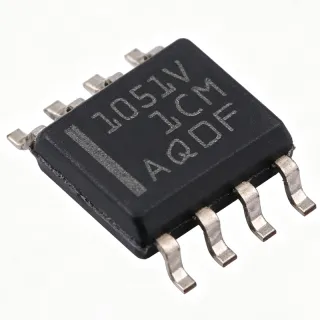
FUSB303TMX - USB Type-C Port Controller I2C 15W | onsemi
MPN: FUSB303TMX ✓ Active| Qty | Unit Price | Extended |
|---|---|---|
| 1 | $0.92 | $0.92 |
| 10 | $0.83 | $8.30 |
| 100 | $0.71 | $71.00 |
| 500 | $0.64 | $320.00 |
| 1,000 | $0.57 | $570.00 |
| 3,000 | $0.52 | $1,560.00 |
FUSB303TMX Overview
A USB Type-C port controller (also called a Type-C port controller, TCPC, or CC logic IC) manages the Configuration Channel (CC) lines of a USB-C connector. It detects cable attach and detach, determines source/sink role, handles DRP (Dual-Role Port) toggling, and supports accessory and audio/headphone adapter detection. Within the power-management and interface hierarchy of a USB-C system, the port controller sits between the CC pins of the connector and the system host controller (MCU, PMIC, or SoC), offloading connection-state management so the host need not constantly poll the CC lines.
Key features include fully autonomous CC logic detection for Source, Sink, DRP, and accessory roles, Dead Battery support as defined by USB-C specifications, and a configurable I2C slave address that allows multiple ports per system to share one I2C bus. GPIO control offers an additional mode for systems without an I2C host. The tiny 1.6 x 1.6 mm 12-X2QFN footprint minimizes PCB area in space-constrained designs.
Architecturally, the FUSB303 integrates the CC line comparators, Rp/Rd switches, and state machine needed for autonomous operation, requiring minimal host intervention once configured over I2C. This reduces firmware complexity and lowers overall system power compared with host-managed CC detection schemes.
Typical applications include smartphones, tablets, and other battery-powered consumer devices with 15 W or lower USB-C charging; power banks and dock accessories requiring role detection; and embedded systems adding USB-C connectivity where Dead Battery support is mandatory.
Design consideration: verify the I2C address configuration of each FUSB303 instance on a shared bus and ensure CC-line routing to the connector is short and matched to maintain detection robustness.
This page synthesizes distributor pricing, drop-in alternatives, and practical design notes not found in the manufacturer datasheet.
Drop-in alternatives for FUSB303TMX — same package, pin-to-pin compatible. Different-package parts requiring PCB rework are excluded.
Quick Comparison Tool — Select alternative parts for side-by-side comparison:
FUSB303BTMX
✅ Drop-In📋 Reference alternative (not in catalog)
FUSB301TMX
✅ Drop-In📋 Reference alternative (not in catalog)
FUSB303CSX
✅ Drop-In📋 Reference alternative (not in catalog)
FUSB307TMX
✅ Drop-In📋 Reference alternative (not in catalog)
FUSB307BUX
✅ Drop-In📋 Reference alternative (not in catalog)
FUSB303TMX Specifications
| Function | Autonomous USB Type-C Port Controller |
| Interface | I2C and GPIO control |
| Power Class Optimization | 15 W or less applications |
| Port Role Support | Source, Sink, DRP |
| Accessory Detection | Supported |
| Dead Battery Support | Yes (per USB-C specification) |
| I2C Address | Configurable (multiple ports per system) |
| Package | 12-X2QFN (1.6 x 1.6 mm) |
| Mounting Type | Surface Mount |
| RoHS Status | Compliant |
| Packaging | Tape and Reel (MX suffix) |
| Lifecycle Status | Active |
FUSB303TMX Pin Configuration
| Pin 1 | CC1 — Type-C Configuration Channel line 1 |
| Pin 2 | CC2 — Type-C Configuration Channel line 2 |
| Pin 3 | VBUS — VBUS voltage sense input |
| Pin 4 | VDD — Power supply |
| Pin 5 | GND — Ground |
| Pin 6 | SDA — I2C serial data |
| Pin 7 | SCL — I2C serial clock |
| Pin 8 | ADDR — I2C slave address configuration |
| Pin 9 | INTN — Interrupt output (active low, open drain) |
| Pin 10 | GPIO/CFG — GPIO control / mode configuration |
| Pin 11 | DEB — Reference / debounce setting (per datasheet) |
| Pin 12 | GND — Ground |
Typical Applications
FUSB303TMX is suitable for 6 applications: Smartphone and Tablet USB-C Charging Ports, Power Banks and Mobile Accessories, USB-C Docks and Multi-Port Hubs, Embedded and IoT Devices Adding USB-C, Portable Medical and Health Monitoring Devices, Consumer Audio Accessories and Cables.
Smartphone and Tablet USB-C Charging Ports
The FUSB303TMX fits smartphone and tablet USB-C charging ports because it is explicitly optimized for 15 W or less applications, matching the typical 5V/3A charging capability of these devices. Its autonomous CC logic handles attach detection, role determination, and accessory identification without burdening the application processor, saving host CPU cycles and firmware complexity. Dead Battery support as defined in the USB-C specification is essential here: a fully discharged phone must present as a Sink so an attached charger can begin powering the battery before the SoC boots. The 1.6 x 1.6 mm 12-X2QFN package conserves board area in tightly packed handheld layouts, and the configurable I2C address lets dual-port devices share one bus.
Recommended
Power Banks and Mobile Accessories
Power banks benefit directly from the FUSB303TMX DRP (Dual-Role Port) support, which lets the same connector charge the power bank itself (Sink role) and charge connected phones (Source role) with autonomous role switching. According to the onsemi data sheet, CC logic detection for Source, Sink, DRP, and accessory roles runs entirely in hardware, so an ultra-low-cost MCU or even no host in GPIO mode can manage the port. The 15 W or less optimization matches the standard output class of most portable batteries. Dead Battery support guarantees the power bank can always be recharged, and the tiny 12-X2QFN footprint suits compact puck or card-form designs.
Recommended
USB-C Docks and Multi-Port Hubs
In docking stations and multi-port hubs, the FUSB303TMX configurable-address I2C access allows multiple FUSB303 instances - one per USB-C connector - to share a single I2C bus, as stated in the onsemi data sheet. Each controller autonomously manages its own connector's attach, detach, role, and accessory detection, reporting events to the hub controller via the shared INTN lines. The 15 W optimization covers the standard downstream charging capability of bus-powered docks. The 1.6 x 1.6 mm 12-X2QFN package enables dense connector placement on crowded dock PCBs, and accessory/audio-adapter detection ensures legacy USB-C headphone adapters enumerate correctly.
Recommended
Embedded and IoT Devices Adding USB-C
Embedded controllers, IoT gateways, and single-board computers migrating legacy micro-USB ports to USB Type-C use the FUSB303TMX because it delivers standards-compliant CC detection with minimal engineering effort. In GPIO control mode the device can operate without an I2C-capable host, and in I2C mode a small MCU can configure role strategy (Sink-only, Source-only, or DRP) at boot and then rely on autonomous operation. Dead Battery support ensures externally powered startup works even on a depleted backup battery. The RoHS-compliant 12-X2QFN (1.6 x 1.6 mm) package fits the low-profile requirements of compact gateway and sensor-hub enclosures.
Recommended
Portable Medical and Health Monitoring Devices
Portable health monitors, glucose meters, and wearable medical accessories require dependable, standards-compliant charging connectivity, and the FUSB303TMX provides autonomous USB-C CC detection with Dead Battery support so a depleted device can always be charged immediately upon cable attach - a patient-safety relevant property. The 15 W or less optimization matches the low-power charging profiles typical of battery-operated medical wearables. Its 1.6 x 1.6 mm 12-X2QFN package and RoHS compliance support the compact, regulated-materials requirements of medical device hardware. Configurable I2C addressing permits a dock-plus-device dual-connector architecture on one host bus.
Recommended
Consumer Audio Accessories and Cables
USB-C audio adapters, headphones, and small consumer accessories use the FUSB303TMX accessory detection support, which per the onsemi data sheet covers the accessory and audio adapter cases defined by the USB-C specification. The autonomous state machine handles role detection so a sink-only headphone dongle correctly identifies itself to phones and laptops without host firmware. Operation optimized for 15 W or less matches the accessory power envelope, and GPIO control mode allows the simplest possible bill of materials in price-sensitive audio accessories. The 12-X2QFN (1.6 x 1.6 mm) footprint fits inside compact in-line adapter housings.
Recommended
Recommended Products Summary
Engineering reference data for FUSB303TMX — comparison, design guidance, and compliance information.
Selection Guide
Comparison with Alternatives
| Parameter | This Product | FUSB303BTMX | FUSB301TMX | FUSB303CSX | FUSB307TMX | FUSB307BUX |
|---|---|---|---|---|---|---|
| Package | 12-X2QFN (1.6 x 1.6 mm) | 12-X2QFN (1.6 x 1.6 mm) - same | 12-X2QFN (1.6 x 1.6 mm) - same | 12-bump CSP (1.6 x 1.6 mm) | 12-X2QFN class - verify land pattern | 12-X2QFN class - verify land pattern |
| Brand | onsemi | onsemi | onsemi | onsemi | onsemi | onsemi |
| Port Roles | Source, Sink, DRP | Source, Sink, DRP | Source, Sink, DRP | Source, Sink, DRP + PD | Source, Sink, DRP + PD | |
| Power Class Optimization | 15 W or less | 15 W or less | 15 W or less | USB PD (higher power capable) | USB PD (higher power capable) | |
| Dead Battery Support | Yes | Yes | Yes | Yes | Yes | |
| Host Interface | I2C (configurable address) + GPIO | I2C (configurable address) + GPIO | I2C (configurable address) + GPIO | I2C | I2C | |
| Accessibility Detection | Supported | Supported | Supported | Supported | Supported | |
| Lifecycle Status | Active | Active (recommended for new designs) | Active (periodically out of stock) | Active | Active |
Key Differentiators
- Lowest-complexity CC-only solution for sub-15W ports (vs FUSB307TMX)
- SuperSpeed switch control trade-off (vs FUSB301TMX)
- Configurable I2C addressing for multi-port systems (vs FUSB301TMX)
Design Notes
The 12-X2QFN (1.6 x 1.6 mm) package uses fine-pitch terminals that require accurate footprint definition per the onsemi datasheet land-pattern recommendation. Keep CC1/CC2 traces as short as possible and route them directly to the USB-C connector CC pins without stubs; long or unmatched CC traces degrade Rp/Rd detection timing. Place 0.1 uF decoupling on VDD within 2 mm of the pin. For CSP-variant land patterns (FUSB303CSX), confirm pad geometry differs before reusing an X2QFN footprint.
Connect the FUSB303TMX VDD to a clean always-on system rail (typically 1.8 V-3.3 V class; verify exact range in the datasheet) so CC monitoring and Dead Battery detection remain active when the main SoC sleeps or is unpowered. Do not power VDD from a switched rail controlled by the host, or Dead Battery charging support as defined in the USB-C specification will be lost. Add the VBUS sense connection directly at the connector through the recommended divider/resistance per the datasheet typical application circuit.
When substituting the FUSB303TMX for the FUSB301TMX (a frequent swap discussed on the NVIDIA Developer Forums), remember the FUSB301 provides SuperSpeed switch control that the FUSB303 omits - designs using SS lane switching will not work without an external SS switch. Also configure a unique I2C address per instance on shared buses via the address configuration pin, and rely on the INTN open-drain output (with pull-up) for event wake-up rather than polling, to minimize host overhead and power.
Compliance Information
RoHS compliant per onsemi active portfolio status; MX suffix indicates Pb-free tape-and-reel packaging. REACH, halogen-free, and conflict-minerals declarations should be confirmed from onsemi compliance certificates.