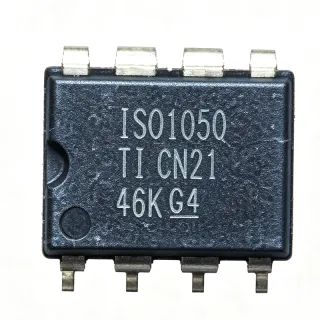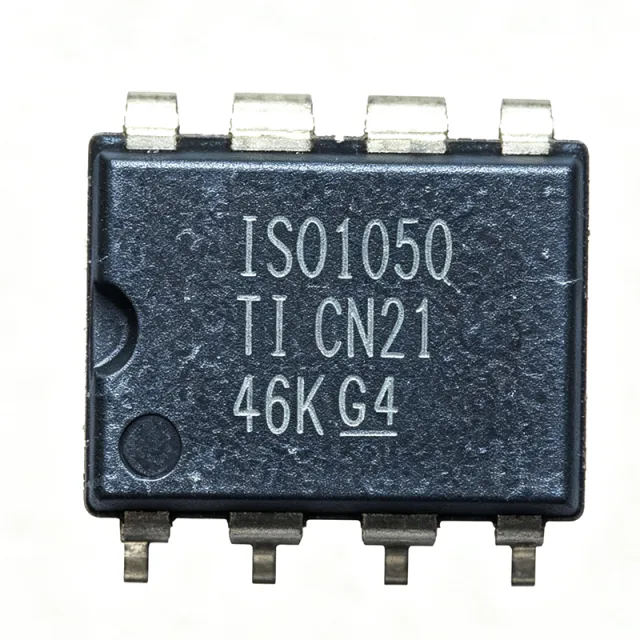
ISO1050DUBR - Isolated CAN Transceiver 2500Vrms | TI
MPN: ISO1050DUBR ✓ Active| Qty | Unit Price | Extended |
|---|---|---|
| 1 | $0.85 | $0.85 |
| 10 | $0.72 | $7.20 |
| 100 | $0.6 | $60.00 |
| 500 | $0.55 | $275.00 |
| 1,000 | $0.52 | $520.00 |
ISO1050DUBR Overview
An isolated CAN transceiver combines a CAN protocol controller interface with galvanic isolation, allowing data transmission between nodes without a direct electrical connection. Within the signal chain hierarchy, it sits between the CAN controller and the physical twisted-pair bus, isolating the logic domain from the bus domain. Isolation prevents ground loops, common-mode noise, and voltage spikes from damaging sensitive controller electronics in industrially noisy environments.
Key features include a SiO2 insulation barrier rated 2500 Vrms for the DUB package (the ISO1050DW variant reaches 5000 Vrms), failsafe outputs, low loop delay of 150 ns typical, and 50 kV/us typical transient immunity. Bus-fault protection extends to -40V on the bus pins, and the device operates from -55C to +105C. Both logic and bus sides operate from a 5V supply.
Architecturally, the ISO1050 uses an on-chip capacitive SiO2 isolation barrier providing high-speed signal transfer with low power consumption. The transceiver drives CANH and CANL differentially, supports dominant/recessive bus states per ISO 11898-2, and includes thermal shutdown protection on the bus driver.
Typical applications include industrial automation networks such as CANopen and DeviceNet, motor drives, building automation, battery management systems, and EV charging stations where ground potential differences exist between nodes.
Design tip: use a dedicated isolated DC-DC supply for the bus side and maintain adequate creepage and clearance on the PCB around the barrier. For higher isolation (5000 Vrms), select the ISO1050DW; TI recommends the ISO1042 or ISO1044 as successors for new designs.
This page synthesizes distributor pricing, drop-in alternative cross-references, and practical design notes not found in the manufacturer datasheet. Pricing as of 2026-09-01 from LCSC listing data.
Drop-in alternatives for ISO1050DUBR — same package, pin-to-pin compatible. Different-package parts requiring PCB rework are excluded.
Variants in this series
Same-series models that are drop-in compatible with ISO1050DUBR (same form factor and footprint) — differing in Package, Operating Temperature, Data Rate, Isolation Barrier, Loop Delay.
Quick Comparison Tool — Select alternative parts for side-by-side comparison:
ISO1050DUB
✅ Drop-In✓ In Stock
$0.52 / Unit
View Datasheet →ISO1042
✅ Drop-In✓ In Stock
$2.25 / Unit
View Datasheet →ISO1044
✅ Drop-In📋 Reference alternative (not in catalog)
ISO1050DUBR Specifications
| Function | Galvanically isolated CAN transceiver |
| Protocol Standard | ISO 11898-2 |
| Data Rate | Up to 1 Mbps |
| Duplex Mode | Half duplex |
| Isolation Voltage | 2500 Vrms (DUB package) |
| Isolation Barrier | Silicon dioxide (SiO2) capacitive |
| Transient Immunity | 50 kV/us (typical) |
| Loop Delay | 150 ns (typical) |
| Bus-Fault Protection | -40 V (bus pins) |
| Supply Voltage | 5 V (both sides) |
| Failsafe Outputs | Yes |
| Operating Temperature | -55C to +105C |
| Package | 8-SOP (DUB) |
| Mounting Type | Surface Mount |
| Number of Channels | 1/1 (Transceiver) |
| Thermal Shutdown | Yes |
ISO1050DUBR Pin Configuration
| Pin 1 | VCC1 — Logic-side 5V supply |
| Pin 2 | GND1 — Logic-side ground |
| Pin 3 | TXD — Transmit data input from CAN controller |
| Pin 4 | RXD — Receive data output to CAN controller (failsafe) |
| Pin 5 | VCC2 — Bus-side 5V supply (isolated domain) |
| Pin 6 | CANH — CAN bus high-level line |
| Pin 7 | CANL — CAN bus low-level line |
| Pin 8 | GND2 — Bus-side ground (isolated domain) |
Typical Applications
ISO1050DUBR is suitable for 6 applications: Industrial Automation Networks, Battery Management Systems, EV Charging Stations, Motor Drives and Inverters, Building Automation, Medical Equipment CAN Buses.
Industrial Automation Networks
In CANopen and DeviceNet industrial networks, nodes are spread across machinery where ground potentials can differ by tens of volts due to motor currents and grounding schemes. The ISO1050DUBR's 2500 Vrms SiO2 isolation breaks these ground loops, while its 50 kV/us typical transient immunity withstands switching noise from VFDs and contactors. The -40V bus-fault protection tolerates miswiring events common during machine installation. Its 1 Mbps capability supports high-speed motion coordination buses, and the 150 ns typical loop delay preserves the ISO 11898-2 timing budget for long cable runs of up to approximately 40 m at full rate. A dedicated isolated DC-DC supply for the bus side completes the isolated node design.
Recommended
Battery Management Systems
In automotive and stationary BMS architectures, stacked battery modules operate at different potentials, making direct logic connection impossible. The ISO1050DUBR's 2500 Vrms isolation links each module's CAN node to the pack communication bus without galvanic path, and its -55C to +105C operating range covers cold-crank and under-hood ambient conditions. The failsafe output ensures the RXD pin drives a defined recessive state when VCC1 is absent, preventing false bus wake-up. The 1 Mbps data rate supports typical BMS communication cycles for cell-voltage telemetry and balancing control. The 8-SOP package keeps per-module cost and PCB area minimal across dozens of modules per pack.
Recommended
EV Charging Stations
EVSE (electric vehicle supply equipment) communicates with vehicles over CAN or PLC while the power stage switches kilowatt-level energy, creating severe common-mode transients. The ISO1050DUBR isolates the control CAN bus from the rectifier and relay drive domain, with 2500 Vrms SiO2 barrier and 50 kV/us transient immunity handling fast dv/dt events from the power stage. Its -40V bus-fault protection guards against cable-damage shorts to the vehicle chassis. The device interfaces the charge-controller MCU domain to the metering and pilot-signal CAN segments, maintaining ISO 11898-2 compliance at 500 kbps to 1 Mbps typical charging-network rates.
Recommended
Motor Drives and Inverters
Variable-frequency drives and servo inverters switch hundreds of volts at nanosecond edges, imposing extreme dv/dt on any communication line crossing the control-power boundary. The ISO1050DUBR's 50 kV/us typical transient immunity prevents data corruption across this boundary, and the 2500 Vrms isolation rating provides reinforced separation between the controller ground and inverter power ground. Connecting the drive MCU's CAN port to a fieldbus gateway, the transceiver's 150 ns typical loop delay keeps bus timing within the 1 Mbps ISO 11898-2 budget. The -40V bus-fault protection additionally survives accidental contact between CAN wiring and inverter DC-link potentials during service.
Recommended
Building Automation
Building automation systems use CAN-based segments for HVAC controllers, elevators, and access control, where equipment is powered from different distribution panels and long cable runs pick up common-mode noise. The ISO1050DUBR's galvanic isolation eliminates inter-panel ground loops that would otherwise corrupt bus signaling, and the failsafe RXD output guarantees a recessive logic level when a node is unpowered, keeping the shared bus operational. Its -55C to +105C range suits rooftop and plant-room installations. Operating at 125 kbps to 500 kbps over structured cabling, the 2500 Vrms SiO2 barrier and 50 kV/us transient immunity deliver multi-decade fieldbus reliability with minimal component count.
Recommended
Medical Equipment CAN Buses
Medical devices such as patient monitors, infusion systems, and imaging subsystems require patient-applied-part isolation and robust internal communication across modules with different ground references. The ISO1050DUBR's 2500 Vrms SiO2 capacitive barrier provides the system-level galvanic separation demanded between mains-powered and patient-connected domains, while its low 150 ns typical loop delay supports responsive real-time control buses at 500 kbps to 1 Mbps. The -40V bus-fault tolerance adds robustness during module servicing. Combined with certified medical-grade isolated DC-DC supplies on the bus side, the transceiver contributes a proven, single-package isolation element to the overall safety architecture.
Recommended
Recommended Products Summary
Engineering reference data for ISO1050DUBR — comparison, design guidance, and compliance information.
Selection Guide
Comparison with Alternatives
| Parameter | This Product | ISO1050DUB | ISO1042 | ISO1044 |
|---|---|---|---|---|
| Package | 8-SOP (DUB) | 8-SOP (DUB) - same | 8-SOP (DUB) - same (verify footprint) | 8-SOP (DUB) - same (verify footprint) |
| Brand | Texas Instruments | Texas Instruments | Texas Instruments | Texas Instruments |
| Data Rate | 1 Mbps | 1 Mbps | 5 Mbps (CLASSIC + CAN FD) | 5 Mbps (CAN FD) |
| Lifecycle Status | Active | Obsolete (replaced by DUBR) | Active (recommended successor) | Active (recommended successor) |
| Protocol Support | Classic CAN (ISO 11898-2) | Classic CAN (ISO 11898-2) | Classic CAN + CAN FD | Classic CAN + CAN FD |
Key Differentiators
- Direct replacement for obsolete ISO1050DUB (vs ISO1050DUB)
- Lowest-risk choice for legacy ISO1050 layouts vs CAN FD successors (vs ISO1044)
- Cost-optimized 8-pin isolation for classic CAN (vs ISO1042)
Design Notes
Route the isolation barrier as a physical gap across the PCB directly under the ISO1050DUBR, keeping no copper from either ground domain in the gap. Maintain creepage and clearance per your system's isolation standard (the 2500 Vrms DUB rating requires adequate board spacing under pollution-degree conditions). Keep VCC1/GND1 components entirely on the logic side and VCC2/GND2 components on the bus side; never route a trace across the barrier except through the IC.
The ISO1050DUBR isolates signals only - the bus-side domain needs its own 5V supply, typically an isolated DC-DC module (e.g., a 1W unregulated module such as B0505S-class parts). Decouple VCC1 and VCC2 each with 0.1uF ceramic capacitors placed within 2 mm of pins 1 and 5, plus 10uF bulk per domain. Unregulated isolated supplies can rise well above 5V at light load; verify the bus-side rail stays within the datasheet VCC2 absolute maximum.
Add a common-mode choke and split termination (two 60-ohm resistors with a 4.7nF cap to bus-side GND2) on CANH/CANL for EMC compliance in industrial environments. Do not confuse the DUB (8-pin, 2500 Vrms) and DW (SOIC, 5000 Vrms) footprints - they are not interchangeable. Note that ISO1050DUB (non-R) is obsolete; new BOMs must specify ISO1050DUBR per TI E2E forum guidance from February 2025.
Compliance Information
Compliance status not explicitly stated in the retrieved distributor data; confirm on TI.com product page environmental sections before procurement.