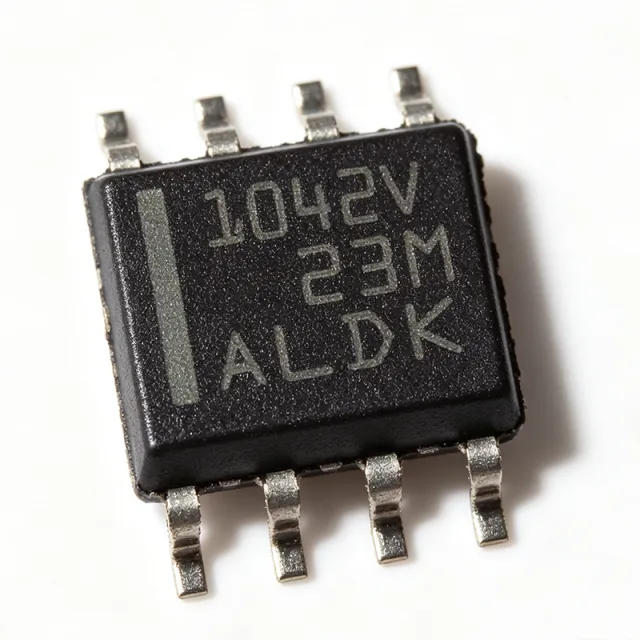
TCAN1042VDRQ1 - CAN FD Transceiver 5Mbps | TI | Automotive
MPN: TCAN1042VDRQ1 ✓ Active| Qty | Unit Price | Extended |
|---|---|---|
| 1 | $0.69758 | $0.70 |
| 10 | $0.5658 | $5.66 |
| 30 | $0.49902 | $14.97 |
| 100 | $0.42533 | $42.53 |
| 500 | $0.35818 | $179.09 |
| 1,000 | $0.33923 | $339.23 |
TCAN1042VDRQ1 Overview
A CAN transceiver is the physical-layer device that sits between a CAN protocol controller (often inside an automotive or industrial microcontroller) and the two-wire twisted-pair CAN bus. It converts controller TX logic into differential dominant/recessive bus states and recovers RX signals, providing the drive strength, receiver sensitivity, and fault robustness required by the ISO 11898-2 physical layer standard.
Key features include AEC-Q100 grade 1 qualification for automotive reliability, conformance to ISO 11898-2:2016 and ISO 11898-5:2007 physical layer standards, a supply range of 4.5V to 5.5V, and CAN FD data rates up to 5 Mbps. The VIO pin provides independent I/O voltage translation, allowing direct connection to 3.3V microcontroller logic without external level shifters. Bus pins CANH and CANL are protected against short circuits to battery or ground, with integrated thermal shutdown and a standby/silent mode for power saving and diagnostics.
Technically, the device uses a differential signaling architecture optimized for high immunity to EMI and low bus emissions, critical in dense automotive electronic control unit (ECU) environments. It is pin-compatible with other TI CAN transceiver family members, enabling drop-in upgrades across BOM tiers, and per TI E2E forum reports it serves as a pin-to-pin replacement for the Infineon TLE6251DS.
Typical applications include body control modules, gateway ECUs, battery management systems, powertrain controllers, and industrial automation networks that demand robust communication in harsh thermal and electrical environments.
When designing with the TCAN1042VDRQ1, terminate the CAN bus with 120 ohm at both ends, match VIO to the host controller logic level, and provide 100 nF of local decoupling on VCC and VIO. Pricing as of 2026-08-30 starts near $0.70 at single-unit quantity from distributor channels.
Drop-in alternatives for TCAN1042VDRQ1 — same package, pin-to-pin compatible. Different-package parts requiring PCB rework are excluded.
Variants in this series
Same-series models that are drop-in compatible with TCAN1042VDRQ1 (same form factor and footprint) — differing in Package, Function, Protocol, Duplex, Automotive Qualification.
Quick Comparison Tool — Select alternative parts for side-by-side comparison:
TCAN1042GVDRQ1
✅ Drop-In✓ In Stock
$0.349 / Unit
View Datasheet →TCAN1042DRQ1
✅ Drop-In📋 Reference alternative (not in catalog)
TCAN1051DRQ1
✅ Drop-In ⚠️ Specs Unverified📋 Reference alternative (not in catalog)
SN65HVD255QDRQ1
✅ Drop-In ⚠️ Specs Unverified✓ In Stock
$0.94 / Unit
View Datasheet →TJA1042T/1J
✅ Drop-In📋 Reference alternative (not in catalog)
TLE6251DS
✅ Drop-In📋 Reference alternative (not in catalog)
TCAN1042VDRQ1 Specifications
| Function | CAN FD Transceiver |
| Protocols Supported | CAN, CAN FD (flexible data-rate) |
| Maximum CAN FD Data Rate | 5 Mbps |
| Supply Voltage Range | 4.5 V to 5.5 V |
| I/O Level Shifting | Yes, VIO pin for 3.3V/5V logic |
| Number of Drivers/Receivers | 1/1 |
| Duplex | Half |
| Fault Protection | CANH/CANL short to battery and ground |
| Standards Compliance | ISO 11898-2:2016, ISO 11898-5:2007 |
| Qualification | AEC-Q100 Grade 1 |
| Operating Temperature | -55C to +125C |
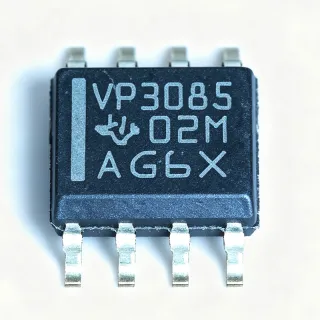
| Package | SOIC (D), 8 pins |
| Mounting Type | Surface Mount |
| Thermal Shutdown | Yes, integrated |
| Low Power Modes | Standby and Silent mode |
| RoHS Status | Compliant |
TCAN1042VDRQ1 Pin Configuration
| Pin 1 | TXD — Transmit data input from CAN controller (logic level set by VIO) |
| Pin 2 | GND — Ground reference |
| Pin 3 | VCC — Transceiver supply, 4.5 V to 5.5 V |
| Pin 4 | RXD — Receive data output to CAN controller (logic level set by VIO) |
| Pin 5 | VIO — I/O level-shifting supply for TXD/RXD logic levels |
| Pin 6 | CANL — CAN low bus line (fault protected) |
| Pin 7 | CANH — CAN high bus line (fault protected) |
| Pin 8 | STB — Standby/S mode control input (logic level set by VIO) |
Typical Applications
TCAN1042VDRQ1 is suitable for 6 applications: Body Control Modules (BCM), Gateway ECUs, Battery Management Systems (BMS), Powertrain Controllers, Industrial Automation Networks, Building Automation.
Body Control Modules (BCM)
Body control modules aggregate door, lighting, and lock functions over robust CAN networks in harsh 12V automotive electrical environments with load dump transients. The TCAN1042VDRQ1 fits because its CANH/CANL pins survive shorts to battery or ground and its AEC-Q100 Grade 1 rating covers -55C to +125C. It converts MCU TX/RX logic (level-shifted via VIO for 3.3V controllers) into ISO 11898-2 differential bus signals, with standby mode cutting current draw when the vehicle is parked.
Recommended
Gateway ECUs
Gateway ECUs bridge multiple CAN/CAN FD domains in a vehicle, so the transceiver must support both classic CAN arbitration traffic and 5 Mbps FD data phases. The TCAN1042VDRQ1's 5 Mbps flexible data-rate capability and ISO 11898-2:2016 receiver symmetry guarantee reliable FD frame timing, while its low EMI differential driver limits emissions near sensitive antennas. VIO level shifting allows direct connection to 3.3V gateway SoCs without external translators.
Recommended
Battery Management Systems (BMS)
In EV battery packs, BMS nodes communicate over CAN in high-voltage, electrically noisy surroundings where bus faults can occur during service or crash events. The TCAN1042VDRQ1's fault protection against CANH/CANL shorts to battery and ground plus integrated thermal shutdown prevents transceiver damage. Its -55C to +125C Grade 1 rating accommodates under-hood and pack-adjacent temperatures, and silent mode supports diagnostic bus monitoring without driving the bus.
Recommended
Powertrain Controllers
Powertrain ECUs near the engine require communication devices rated for extreme temperature and vibration. The TCAN1042VDRQ1 operates from -55C to +125C in a compact SOIC-8 and withstands battery-level faults common in engine bay wiring. Its 5 Mbps CAN FD support enables faster calibration and diagnostic traffic in modern powertrain networks, while the differential receiver with high common-mode range rejects ignition and injector noise.
Recommended
Industrial Automation Networks
Factory automation equipment uses CANopen and other CAN-based protocols where 24V field wiring faults and ground potential differences are routine. The TCAN1042VDRQ1's 4.5V to 5.5V supply tolerance and robust short-circuit protection keep the bus alive through wiring faults, while VIO simplifies interfacing with 3.3V industrial MCUs. The device's EMI-hardened differential signaling maintains communication integrity near variable-frequency drives and switching power supplies.
Recommended
Building Automation
Building automation controllers (HVAC, access, energy metering) rely on CAN for distributed sensor and actuator networks. The TCAN1042VDRQ1 provides a low-cost, automotive-proven physical layer whose fault protection tolerates miswired field cabling, and its standby mode reduces idle system power. As reported by distributor Censtry, the part is used in high-speed industrial and building automation CAN applications where reliability over long bus runs is essential.
Recommended
Recommended Products Summary
Engineering reference data for TCAN1042VDRQ1 — comparison, design guidance, and compliance information.
Selection Guide
Comparison with Alternatives
| Parameter | This Product | TCAN1042GVDRQ1 | TCAN1042DRQ1 | TJA1042T/1J | TLE6251DS |
|---|---|---|---|---|---|
| Package | SOIC-8 (D) | SOIC-8 (D) - same | SOIC-8 (D) - same | SOIC-8 - same footprint | SOIC-8 - same footprint |
| Brand | Texas Instruments | Texas Instruments | Texas Instruments | NXP Semiconductors | Infineon |
| CAN FD Data Rate | Up to 5 Mbps | Up to 5 Mbps | Up to 5 Mbps | Up to 5 Mbps | Classic CAN (up to 1 Mbps) |
| VIO I/O Level Shifting | Yes | Yes | No | No (5V logic) | No (pin 5 undefined) |
| AEC-Q100 Qualification | Grade 1 | Grade 1 | Grade 1 | Automotive qualified | Automotive qualified |
| SPLIT / Bus Bias Pin | No | No | No | Yes (SPLIT pin) | No |
Key Differentiators
- VIO I/O level shifting for 3.3V controllers (vs TCAN1042DRQ1)
- Confirmed pin-to-pin replacement for TLE6251DS (vs TLE6251DS)
- Wider temperature rating than NXP equivalent (vs TJA1042T/1J)
- Integrated fault protection plus thermal shutdown (vs TCAN1042GVDRQ1)
Design Notes
Place a 100 nF ceramic decoupling capacitor on both VCC and VIO within 2 mm of the respective pins, plus optional bulk 4.7-10 uF on VCC. Route TXD/RXD traces short and away from CANH/CANL to prevent coupling of bus transients into controller logic. The SOIC-8 thermal performance is adequate for the transceiver's low dissipation, but a solid ground plane improves EMI immunity in dense ECU layouts.
Do not leave VIO floating - tie it to the host controller I/O supply (typically 3.3V). When replacing an Infineon TLE6251DS (per TI E2E thread 694507), pin 5 was undefined on the old part; the schematic must now define it as VIO. Note the TCAN1042VDRQ1 has no SPLIT pin (TI E2E thread 749236); if bus bias stabilization via SPLIT is required, use NXP TJA1042T/1J instead.
Terminate the twisted-pair bus with 120 ohm at both physical ends; stubs longer than ~0.3 m degrade 5 Mbps CAN FD data-phase edges. Use 1:1 transformer-free direct connection with common-mode chokes if EMC testing shows radiated emissions issues. Observe receiver symmetry requirements of ISO 11898-2:2016 by keeping ground potential differences between nodes within the common-mode range.
VCC must stay within 4.5V to 5.5V; during crank transients consider a downstream LDO or protection device (e.g., an automotive load switch) to hold VCC in range. Standby mode significantly reduces supply current for parked-vehicle power budgets - drive STB low to enter standby and ensure the MCU can wake on bus activity per the datasheet wake-up timing.
Compliance Information
AEC-Q100 Grade 1 qualified per TI product page. RoHS compliant per TI/DigiKey listing. REACH and halogen-free status not stated in provided data.