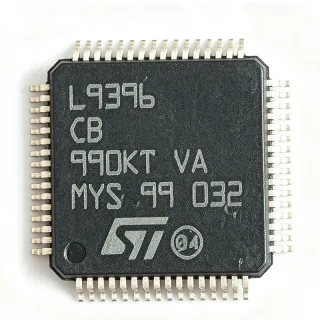
L9951-TR - SPI Controlled 8-Channel Low-Side Driver | STMicroelectronics
MPN: L9951-TR ✓ Active| Qty | Unit Price | Extended |
|---|---|---|
| 1 | $3.25 | $3.25 |
| 10 | $2.95 | $29.50 |
| 100 | $2.65 | $265.00 |
| 500 | $2.35 | $1,175.00 |
| 1,000 | $2.1 | $2,100.00 |
L9951-TR Overview
A low-side driver is a type of power switch that connects the load to ground when activated, allowing the load to be powered from a positive supply. In automotive systems, low-side drivers are commonly used to control actuators, lamps, and motors, where the load is referenced to the battery positive terminal. The L9951-TR belongs to the family of smart power switches, which integrate protection and diagnostic functions into a single package, reducing external component count and improving system reliability.
Key features of the L9951-TR include an 8-channel output stage with a maximum current capability of per channel, an SPI interface for serial control and readback of diagnostic information, and a wide operating voltage range of . The device also features a low quiescent current in standby mode, making it suitable for battery-powered applications. Its robust design includes protection against short circuits, overtemperature, and overvoltage, ensuring reliable operation in harsh environments.
The L9951-TR is built using STMicroelectronics' advanced BCD (Bipolar-CMOS-DMOS) technology, which combines the benefits of bipolar, CMOS, and DMOS transistors to achieve high power handling with low power dissipation. The SPI interface allows for flexible control of each channel independently, enabling complex load management strategies. The device also includes a dedicated diagnostic pin for fault reporting, simplifying system-level monitoring.
Typical applications for the L9951-TR include automotive body control modules, where it drives relays and lamps for lighting, wipers, and window lifts. It is also used in industrial automation for controlling solenoids and valves, and in smart home systems for driving LED lighting and small motors. The device's ability to handle inductive loads makes it suitable for driving relays and solenoids without additional freewheeling diodes, thanks to its integrated clamp circuitry.
When designing with the L9951-TR, it is important to consider the thermal performance of the package, as high current loads can generate significant heat. Proper PCB layout with adequate copper area for heat dissipation is recommended. Additionally, the SPI interface should be configured with appropriate pull-up resistors and decoupling capacitors to ensure reliable communication. The device's diagnostic features can be used to implement predictive maintenance strategies, reducing downtime in industrial applications.
Drop-in alternatives for L9951-TR — same package, pin-to-pin compatible. Different-package parts requiring PCB rework are excluded.
Variants in this series
Same-series models that are drop-in compatible with L9951-TR (same form factor and footprint) — differing in Operating Temperature Range, Package, Protection Features.
Quick Comparison Tool — Select alternative parts for side-by-side comparison:
L9951
✅ Drop-In ⚠️ Specs Unverified✓ In Stock
$5.61 / Unit
View Datasheet →L9950
⚡ Same Package ⚠️ Specs Unverified✓ In Stock
$5.6 / Unit
View Datasheet →L9952
⚡ Same Package ⚠️ Specs Unverified✓ In Stock
$3.1 / Unit
View Datasheet →MC33879
✅ Drop-In ⚠️ Specs Unverified📋 Reference alternative (not in catalog)
TLE6228
✅ Drop-In ⚠️ Specs Unverified📋 Reference alternative (not in catalog)
L9951-TR Maximum Ratings & Electrical Characteristics
| Number of Channels | 8 |
| Output Type | Low-Side Driver |
| Interface | SPI |
| Diagnostic Features | Open-load, overcurrent, overtemperature |
| Protection Features | Short-circuit, overtemperature, overvoltage |
| Operating Temperature Range | -40C to +150C |
| Package | PowerSO-20 |
| Mounting Type | Surface Mount |
| RoHS Status | Compliant |
| AEC-Q100 Qualified | Yes |
| Technology | BCD (Bipolar-CMOS-DMOS) |
L9951-TR Pin Configuration
| Pin 1 | OUT1 — Channel 1 output |
| Pin 2 | OUT2 — Channel 2 output |
| Pin 3 | OUT3 — Channel 3 output |
| Pin 4 | OUT4 — Channel 4 output |
| Pin 5 | OUT5 — Channel 5 output |
| Pin 6 | OUT6 — Channel 6 output |
| Pin 7 | OUT7 — Channel 7 output |
| Pin 8 | OUT8 — Channel 8 output |
| Pin 9 | GND — Ground |
| Pin 10 | VCC — Logic supply voltage |
| Pin 11 | VS — Power supply voltage |
| Pin 12 | SCK — SPI clock |
| Pin 13 | SDI — SPI data input |
| Pin 14 | SDO — SPI data output |
| Pin 15 | CSN — SPI chip select (active low) |
| Pin 16 | RST — Reset input |
| Pin 17 | DIAG — Diagnostic output |
| Pin 18 | NC — Not connected |
| Pin 19 | NC — Not connected |
| Pin 20 | NC — Not connected |
Typical Applications
L9951-TR is suitable for 6 applications: Automotive Body Control Module, Industrial Automation, Smart Home Systems, LED Lighting Control, Relay and Solenoid Driving, Motor Control.
Automotive Body Control Module
The L9951-TR is ideal for automotive body control modules where it drives relays, lamps, and small motors. Its 8 channels allow control of multiple loads such as headlights, wipers, and window lifts. The SPI interface enables efficient communication with the central ECU, and the diagnostic features provide real-time fault detection, improving system reliability. The device's AEC-Q100 qualification ensures operation in harsh automotive environments, with a wide temperature range and protection against load dump and reverse battery conditions. In a typical body control module, the L9951-TR is placed on the PCB near the loads, with the SPI lines connected to the microcontroller. Each channel can be independently controlled, allowing for flexible load management. The integrated clamp circuitry handles inductive loads like relays without external freewheeling diodes, reducing component count. The diagnostic feedback can be used to detect open loads, short circuits, and overtemperature, enabling predictive maintenance and reducing downtime.
Recommended
Industrial Automation
In industrial automation, the L9951-TR is used to drive solenoids, valves, and actuators in control systems. Its robust design and wide operating voltage range make it suitable for 24V industrial supplies. The SPI interface allows for precise control and monitoring of each channel, enabling complex automation sequences. The device's protection features, including overcurrent and overtemperature, ensure safe operation in demanding industrial environments. In a typical industrial application, the L9951-TR is used in a PLC output module to drive multiple actuators. The SPI interface connects to the PLC's microcontroller, allowing for fast and reliable control. The diagnostic features can be used to detect faults in the actuators or wiring, improving system uptime. The device's ability to handle inductive loads makes it ideal for driving solenoids and valves without additional protection components.
Recommended
Smart Home Systems
The L9951-TR is used in smart home systems to control lighting, small motors, and other loads. Its low quiescent current and standby mode make it suitable for battery-powered devices. The SPI interface allows for integration with home automation hubs, enabling remote control and monitoring. The device's diagnostic features can be used to detect faulty loads, improving system reliability. In a typical smart home application, the L9951-TR is used in a smart lighting controller to drive multiple LED channels. The SPI interface connects to a Wi-Fi or Zigbee module, allowing for remote control via a smartphone app. The device's ability to drive LEDs with PWM dimming makes it ideal for smart lighting. The diagnostic features can be used to detect open or shorted LEDs, enabling automatic fault reporting.
Recommended
LED Lighting Control
The L9951-TR is well-suited for LED lighting control in automotive and industrial applications. Its 8 channels can drive multiple LED strings, and the SPI interface allows for individual brightness control via PWM. The device's diagnostic features can detect open or shorted LEDs, enabling fault detection. The wide operating voltage range and robust protection make it ideal for automotive lighting systems. In a typical LED lighting application, the L9951-TR is used in a tail light module to drive multiple LED strings. The SPI interface connects to the vehicle's body control module, allowing for dynamic lighting effects. The device's ability to handle high currents and its thermal performance make it suitable for high-brightness LEDs. The diagnostic features can be used to detect LED failures, improving safety.
Recommended
Relay and Solenoid Driving
The L9951-TR is specifically designed to drive relays and solenoids, which are common in automotive and industrial systems. Its integrated clamp circuitry handles the inductive kickback, eliminating the need for external freewheeling diodes. The SPI interface allows for precise control of each relay or solenoid, and the diagnostic features can detect open or shorted coils. The device's robust protection ensures reliable operation in harsh environments. In a typical relay driving application, the L9951-TR is used in a central locking system to control door lock actuators. The SPI interface connects to the body control module, allowing for centralized control. The device's ability to handle the inductive load of the actuators without external components simplifies the PCB design. The diagnostic features can be used to detect faulty actuators, improving system reliability.
Recommended
Motor Control
The L9951-TR can be used in low-power motor control applications, such as driving small DC motors in automotive and industrial systems. Its 8 channels can be used to control multiple motors or to implement H-bridge configurations. The SPI interface allows for precise speed and direction control, and the diagnostic features can detect motor faults. The device's protection features ensure safe operation under overload conditions. In a typical motor control application, the L9951-TR is used in a seat adjustment module to control multiple motors. The SPI interface connects to the seat control unit, allowing for precise positioning. The device's ability to handle the inductive load of the motors and its thermal performance make it suitable for continuous operation. The diagnostic features can be used to detect motor stalls or short circuits, improving safety.
Recommended
Recommended Products Summary
Engineering reference data for L9951-TR — comparison, design guidance, and compliance information.
Selection Guide
Comparison with Alternatives
| Parameter | This Product | L9951 | L9950 | L9952 | MC33879 | TLE6228 |
|---|---|---|---|---|---|---|
| Package | PowerSO-20 | PowerSO-20 - same | PowerSO-20 - same | PowerSO-20 - same | PowerSO-20 - same | PowerSO-20 - same |
| Brand | STMicroelectronics | STMicroelectronics | STMicroelectronics | STMicroelectronics | NXP Semiconductors | Infineon |
| Interface | SPI | SPI | SPI | SPI | SPI | SPI |
| AEC-Q100 Qualified | Yes | Yes | Yes | Yes | Yes | Yes |
Key Differentiators
- 8-channel low-side driver with SPI (vs L9950)
- AEC-Q100 qualified (vs TLE6228)
- Integrated clamp for inductive loads (vs MC33879)
Design Notes
The L9951-TR in PowerSO-20 package can dissipate significant power when driving high currents. Ensure adequate PCB copper area and thermal vias under the exposed pad to keep the junction temperature within limits. For continuous operation at maximum current, consider a heatsink or forced air cooling. The thermal resistance from junction to ambient is [DATA_NEEDED: thermal resistance].
Place decoupling capacitors close to the VCC and VS pins to filter noise and prevent voltage spikes. Use a 100nF ceramic capacitor for high-frequency decoupling and a 10uF electrolytic capacitor for bulk storage. The SPI lines should be kept short and routed away from high-current traces to avoid interference. Add pull-up resistors on the SPI lines if needed.
Do not exceed the maximum supply voltage rating. Ensure the SPI interface is properly configured with correct polarity and phase. The diagnostic pin (DIAG) is an open-drain output and requires a pull-up resistor. When driving inductive loads, the integrated clamp circuitry handles the back-EMF, but ensure the clamp voltage is within the device's absolute maximum ratings.
Compliance Information
RoHS compliant per STMicroelectronics. AEC-Q100 qualified for automotive applications.