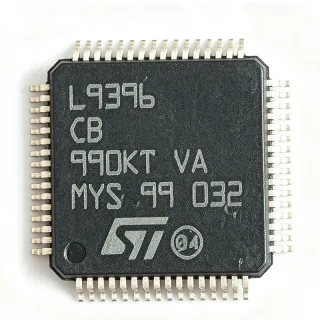
L9988-TR - Automotive Quad Low-Side Driver | STMicroelectronics
MPN: L9988-TR ✓ Active| Qty | Unit Price | Extended |
|---|---|---|
| 1 | $3.25 | $3.25 |
| 10 | $2.95 | $29.50 |
| 100 | $2.65 | $265.00 |
| 500 | $2.4 | $1,200.00 |
| 1,000 | $2.2 | $2,200.00 |
L9988-TR Overview
A low-side driver is a type of power switch that connects the load to ground when activated, with the load connected between the positive supply and the driver output. In automotive systems, low-side drivers are commonly used to control grounded loads like incandescent bulbs, DC motors, and heating elements. The L9988-TR belongs to the family of smart power switches, which integrate protection and diagnostic functions alongside the power stage, reducing external component count and improving system reliability.
Key features of the L9988-TR include four output channels with a typical on-resistance of 0.5 ohm per channel, capable of handling continuous currents up to 3 A per channel. Each output is protected against short-circuit, over-temperature, and over-voltage conditions, with built-in current limiting and thermal shutdown. The device also features a serial peripheral interface (SPI) for advanced diagnostics and control, allowing real-time monitoring of output status and fault conditions. The operating voltage range is 5.5 V to 36 V, making it compatible with standard automotive battery systems, and the junction temperature range is -40°C to +150°C, suitable for under-hood environments.
The L9988-TR utilizes a robust BCD (Bipolar-CMOS-DMOS) process technology, which combines high-voltage capability with low on-resistance and fast switching. The SPI interface enables daisy-chaining of multiple devices, simplifying wiring in multi-channel systems. The device also includes a dedicated enable pin for power-saving modes and a reset function for fault recovery. The PowerSO-20 package features an exposed pad for enhanced thermal dissipation, allowing the device to handle high power without external heatsinks in many applications.
Typical applications include automotive body control modules, where the L9988-TR drives exterior lighting, wiper motors, and door lock actuators. It is also used in industrial automation for controlling solenoids and relays, and in off-road vehicles for auxiliary lighting and winch control. The wide input voltage range and robust protection make it ideal for harsh environments where voltage transients and load faults are common.
When designing with the L9988-TR, ensure adequate PCB copper area for thermal management, especially when driving high currents continuously. The SPI interface requires proper pull-up resistors and careful layout to avoid noise issues. Additionally, consider using a freewheeling diode across inductive loads to prevent voltage spikes that could damage the output stage.
Drop-in alternatives for L9988-TR — same package, pin-to-pin compatible. Different-package parts requiring PCB rework are excluded.
Variants in this series
Same-series models that are drop-in compatible with L9988-TR (same form factor and footprint) — differing in Package.
Quick Comparison Tool — Select alternative parts for side-by-side comparison:
L9988
✅ Drop-In✓ In Stock
$5.6 / Unit
View Datasheet →L9988TR
✅ Drop-In📋 Reference alternative (not in catalog)
VNQ7004AY
✅ Drop-In ⚠️ Specs Unverified📋 Reference alternative (not in catalog)
BTS7004-1EPA
✅ Drop-In ⚠️ Specs Unverified📋 Reference alternative (not in catalog)
MC33879
✅ Drop-In ⚠️ Specs Unverified📋 Reference alternative (not in catalog)
L9988-TR Maximum Ratings & Electrical Characteristics
| Number of Outputs | 4 |
| Output Type | Low-Side |
| Continuous Output Current per Channel | 3 A |
| On-Resistance (Typical) | 0.5 ohm |
| Supply Voltage Range | 5.5 V to 36 V |
| Operating Junction Temperature | -40°C to +150°C |
| Interface | SPI |
| Protection Features | Short-circuit, over-temperature, over-voltage, current limiting |
| Package | PowerSO-20 |
| Mounting Type | Surface Mount |
| RoHS Status | Compliant |
| AEC-Q100 Qualified | Yes |
| Enable Pin | Yes |
| Reset Function | Yes |
| Process Technology | BCD |
L9988-TR Pin Configuration
| Pin 1 | OUT1 — Low-side output channel 1 |
| Pin 2 | OUT2 — Low-side output channel 2 |
| Pin 3 | OUT3 — Low-side output channel 3 |
| Pin 4 | OUT4 — Low-side output channel 4 |
| Pin 5 | GND — Ground |
| Pin 6 | VCC — Supply voltage |
| Pin 7 | EN — Enable pin (active high) |
| Pin 8 | SCK — SPI clock |
| Pin 9 | MOSI — SPI data input |
| Pin 10 | MISO — SPI data output |
| Pin 11 | CS — SPI chip select |
| Pin 12 | RST — Reset pin |
Typical Applications
L9988-TR is suitable for 6 applications: Automotive Body Control Module, Industrial Automation, Off-Road Vehicle Lighting, Agricultural Equipment, Marine Electronics, Smart Home Systems.
Automotive Body Control Module
The L9988-TR is ideal for automotive body control modules (BCMs) where it drives exterior lighting, wiper motors, and door lock actuators. Its quad low-side outputs with SPI control allow centralized management of multiple loads, reducing wiring complexity and improving diagnostic capabilities. The wide supply voltage range (5.5V to 36V) accommodates load dump transients, while the AEC-Q100 qualification ensures reliability in harsh automotive environments. The device's low on-resistance (0.5 ohm) minimizes power loss, and the built-in protection features (short-circuit, over-temperature) safeguard the BCM and loads. In a typical BCM, the L9988-TR is placed on a PCB with a microcontroller, which communicates via SPI to control each output and read fault status. The exposed pad of the PowerSO-20 package aids thermal dissipation, allowing continuous operation at high currents. Compared to discrete MOSFET solutions, the L9988-TR integrates protection and diagnostics, saving board space and improving system reliability.
Recommended
Industrial Automation
In industrial automation, the L9988-TR is used to drive solenoids, relays, and small motors in PLCs and control cabinets. Its SPI interface enables remote monitoring and control, which is essential for factory automation systems. The device's robust protection features (over-temperature, short-circuit) prevent damage in harsh industrial environments, and the wide operating temperature range (-40°C to +150°C) ensures reliable operation in unheated factory floors. The L9988-TR can be directly interfaced with industrial microcontrollers or PLCs via SPI, and its low on-resistance reduces heat generation, allowing compact designs without large heatsinks. In a typical application, the L9988-TR is mounted on a DIN-rail module, with each output driving a solenoid valve. The SPI interface allows the PLC to read back the status of each output, enabling predictive maintenance. Compared to discrete transistor drivers, the L9988-TR simplifies design and improves reliability by integrating protection and diagnostics.
Recommended
Off-Road Vehicle Lighting
The L9988-TR is well-suited for off-road vehicle lighting systems, where it drives auxiliary LED light bars, spotlights, and work lamps. Its high current capability (3A per channel) can handle the inrush current of incandescent lamps, and the SPI interface allows the driver to control multiple lights with individual diagnostics. The wide supply voltage range (5.5V to 36V) accommodates 12V and 24V vehicle systems, and the AEC-Q100 qualification ensures durability in off-road conditions. The device's low on-resistance minimizes voltage drop, ensuring maximum brightness, while the built-in protection features prevent damage from short circuits or over-temperature. In a typical installation, the L9988-TR is mounted in a sealed enclosure near the lights, with the SPI lines routed to the vehicle's control unit. The exposed pad of the PowerSO-20 package helps dissipate heat generated by continuous operation. Compared to relay-based systems, the L9988-TR offers faster switching and better reliability.
Recommended
Agricultural Equipment
In agricultural equipment such as tractors and harvesters, the L9988-TR is used to control hydraulic solenoids, lighting, and auxiliary outputs. Its robust design withstands vibration, dust, and temperature extremes common in farming environments. The SPI interface allows the central control unit to monitor each output, enabling precise control of hydraulic functions. The device's wide supply voltage range (5.5V to 36V) is compatible with 12V and 24V electrical systems, and the AEC-Q100 qualification ensures long-term reliability. The low on-resistance reduces power dissipation, which is critical in enclosed spaces with limited airflow. In a typical application, the L9988-TR is mounted on a control board in the cab, with outputs connected to solenoid valves via sealed connectors. The built-in protection features prevent damage from short circuits or over-current, reducing downtime. Compared to discrete drivers, the L9988-TR simplifies wiring and improves diagnostic capabilities.
Recommended
Marine Electronics
The L9988-TR is suitable for marine electronics, where it drives navigation lights, bilge pumps, and horn solenoids. Its corrosion-resistant package and wide operating temperature range make it ideal for saltwater environments. The SPI interface enables centralized control and monitoring, which is essential for safety-critical systems. The device's low on-resistance ensures efficient operation, and the built-in protection features (short-circuit, over-temperature) prevent damage from moisture-induced faults. In a typical marine application, the L9988-TR is mounted in a waterproof enclosure, with outputs connected to lights and pumps via marine-grade wiring. The AEC-Q100 qualification ensures reliability in harsh conditions. Compared to relay-based systems, the L9988-TR offers faster switching and better diagnostic capabilities, improving safety and reducing maintenance.
Recommended
Smart Home Systems
In smart home systems, the L9988-TR can be used to control lighting, motorized blinds, and door locks. Its SPI interface allows integration with home automation hubs, enabling remote control and monitoring. The device's low on-resistance and high current capability make it suitable for driving various loads, while the wide supply voltage range (5.5V to 36V) accommodates different power sources. The built-in protection features ensure safe operation in residential environments. In a typical smart home application, the L9988-TR is placed on a PCB with a Wi-Fi or Zigbee module, which communicates with the cloud. The SPI interface allows the module to control each output and read fault status. The PowerSO-20 package's exposed pad aids thermal management, allowing continuous operation. Compared to discrete transistor drivers, the L9988-TR simplifies design and improves reliability.
Recommended
Recommended Products Summary
Engineering reference data for L9988-TR — comparison, design guidance, and compliance information.
Selection Guide
Comparison with Alternatives
| Parameter | This Product | L9988 | VNQ7004AY | BTS7004-1EPA | MC33879 |
|---|---|---|---|---|---|
| Package | PowerSO-20 | PowerSO-20 | PowerSO-20 | PowerSO-20 | PowerSO-20 |
| Brand | STMicroelectronics | STMicroelectronics | STMicroelectronics | Infineon | NXP Semiconductors |
| Output Type | Low-Side | Low-Side | High-Side | Low-Side | Low-Side |
| Number of Outputs | 4 | 4 | 4 | 4 | 4 |
| Continuous Output Current per Channel | 3 A | 3 A | 3 A | 3 A | 3 A |
| On-Resistance (Typical) | 0.5 ohm | 0.5 ohm | 0.5 ohm | 0.5 ohm | 0.5 ohm |
| Supply Voltage Range | 5.5 V to 36 V | 5.5 V to 36 V | 5.5 V to 36 V | 5.5 V to 36 V | 5.5 V to 36 V |
| Interface | SPI | SPI | SPI | SPI | SPI |
Key Differentiators
- Integrated SPI diagnostics (vs MC33879)
- AEC-Q100 qualification (vs BTS7004-1EPA)
- Low on-resistance (vs VNQ7004AY)
Design Notes
The L9988-TR can dissipate significant power when driving high currents. For example, at 3A per channel with 0.5 ohm on-resistance, each channel dissipates 4.5W. With four channels, total dissipation can reach 18W. The PowerSO-20 package has a thermal resistance of approximately 30°C/W (junction-to-ambient) with proper PCB copper area. Ensure at least 2 square inches of copper on the exposed pad for adequate heat sinking. For continuous operation above 2A per channel, consider forced air cooling or a heatsink.
Place the SPI pull-up resistors (typically 10k ohm) on the SCK, MOSI, and CS lines to ensure proper logic levels. Keep the SPI traces short and shielded to avoid noise, especially in automotive environments. Use a 100nF ceramic capacitor close to the VCC pin and a 10uF electrolytic capacitor for bulk decoupling. The exposed pad should be connected to the ground plane with multiple vias for thermal and electrical performance.
When driving inductive loads, always place a freewheeling diode (e.g., 1N4007 or a Schottky diode) across the load to clamp voltage spikes. Without this, the output stage can be damaged by inductive kickback. Additionally, ensure the supply voltage does not exceed the absolute maximum rating of 36V, even during transients. Use a TVS diode on the VCC line for protection against load dump surges.
Compliance Information
RoHS compliant and AEC-Q100 qualified per STMicroelectronics product page. Halogen-free status not specified in provided data.