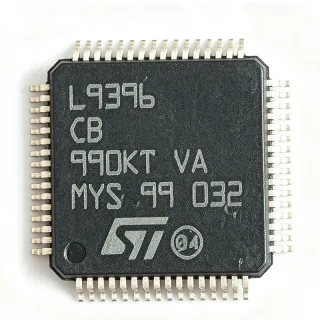
L9950-TR - SPI Controlled 8-Channel Low-Side Driver | STMicroelectronics
MPN: L9950-TR ✓ Active| Qty | Unit Price | Extended |
|---|---|---|
| 1 | $3.25 | $3.25 |
| 10 | $2.95 | $29.50 |
| 100 | $2.65 | $265.00 |
| 500 | $2.35 | $1,175.00 |
| 1,000 | $2.1 | $2,100.00 |
L9950-TR Overview
A low-side driver is a type of power switch that connects the load to ground when activated, allowing the microcontroller to control high-side loads indirectly. In the hierarchy of power management, a low-side driver is a type of power switch, which falls under the broader category of power management ICs. These devices are essential in automotive body control modules, industrial PLCs, and other systems where multiple loads must be switched reliably.
Key features of the L9950-TR include an SPI interface for serial control and diagnostics, eight low-side outputs with high current capability, and a wide operating voltage range. Each channel can handle continuous currents up to 1.2A, with peak currents up to 2A. The device supports 3.3V and 5V logic levels, making it compatible with modern microcontrollers. It also features a built-in 16-bit SPI protocol for reading fault status and controlling outputs.
The L9950-TR is built using STMicroelectronics' advanced BCD (Bipolar-CMOS-DMOS) technology, which combines high-voltage capability with low on-resistance and fast switching. This technology enables the device to handle automotive load dump transients and provides excellent thermal performance. The device is available in a PowerSO-20 package, which offers a compact footprint with an exposed pad for enhanced thermal dissipation.
Typical applications include automotive body control modules, industrial automation, and lighting control systems. In automotive applications, the L9950-TR can drive exterior lights, interior lighting, and small motors. In industrial settings, it can control solenoids, relays, and LED indicators. The SPI interface allows for real-time monitoring and control, reducing the need for additional discrete components.
When designing with the L9950-TR, it is important to consider the thermal dissipation, especially when driving multiple channels at high currents. The exposed pad should be soldered to a large copper area on the PCB to ensure adequate heat sinking. Additionally, proper decoupling capacitors should be placed near the supply pins to minimize voltage transients.
Drop-in alternatives for L9950-TR — same package, pin-to-pin compatible. Different-package parts requiring PCB rework are excluded.
Variants in this series
Same-series models that are drop-in compatible with L9950-TR (same form factor and footprint) — differing in Operating Temperature Range, Package.
Quick Comparison Tool — Select alternative parts for side-by-side comparison:
L9950
✅ Drop-In✓ In Stock
$5.6 / Unit
View Datasheet →L9950-TR Maximum Ratings & Electrical Characteristics
| Number of Channels | 8 |
| Output Type | Low-Side |
| Continuous Output Current per Channel | 1.2 A |
| Peak Output Current per Channel | 2 A |
| Supply Voltage Range | 4.5 V to 5.5 V |
| Logic Supply Voltage | 3.3 V to 5 V |
| On-Resistance (RDS(on)) | 0.5 ohm typical |
| SPI Interface | Yes, 16-bit |
| Operating Temperature Range | -40C to +150C |
| Package | PowerSO-20 |
| Mounting Type | Surface Mount |
| RoHS Status | Compliant |
| AEC-Q100 Qualified | Yes |
| Protection Features | Overcurrent, Overtemperature, Open-Load |
| Diagnostic Features | SPI fault reporting |
L9950-TR Pin Configuration
| Pin 1 | OUT1 — Low-side output channel 1 |
| Pin 2 | OUT2 — Low-side output channel 2 |
| Pin 3 | OUT3 — Low-side output channel 3 |
| Pin 4 | OUT4 — Low-side output channel 4 |
| Pin 5 | OUT5 — Low-side output channel 5 |
| Pin 6 | OUT6 — Low-side output channel 6 |
| Pin 7 | OUT7 — Low-side output channel 7 |
| Pin 8 | OUT8 — Low-side output channel 8 |
| Pin 9 | GND — Ground |
| Pin 10 | VCC — Logic supply voltage |
| Pin 11 | SCK — SPI clock input |
| Pin 12 | SDI — SPI data input |
| Pin 13 | SDO — SPI data output |
| Pin 14 | CS — SPI chip select (active low) |
| Pin 15 | RST — Reset input (active low) |
| Pin 16 | VS — Power supply for output stages |
| Pin 17 | NC — Not connected |
| Pin 18 | NC — Not connected |
| Pin 19 | NC — Not connected |
| Pin 20 | NC — Not connected |
Typical Applications
L9950-TR is suitable for 6 applications: Automotive Body Control Module, Industrial Automation, LED Lighting Control, Relay and Solenoid Driver, Test and Measurement Equipment, Smart Home and IoT.
Automotive Body Control Module
The L9950-TR is ideal for automotive body control modules (BCMs) where multiple loads such as exterior lights, interior lighting, and small motors must be controlled reliably. Its AEC-Q100 qualification ensures operation in harsh automotive environments, and the SPI interface allows for real-time diagnostics and control. In a typical BCM, the L9950-TR is placed between the microcontroller and the load, with each channel driving a relay or LED. The SPI interface reduces the number of GPIO pins required, simplifying the PCB layout. The device's overcurrent and overtemperature protection prevent damage to the module and the loads, while open-load detection helps identify faulty wiring. The wide operating temperature range (-40C to +150C) ensures reliable operation in extreme conditions.
Recommended
Industrial Automation
In industrial automation, the L9950-TR can be used to control solenoids, relays, and LED indicators in PLCs and control panels. Its SPI interface enables centralized control and monitoring, reducing wiring complexity. The device's robust protection features ensure reliable operation in industrial environments with high electrical noise. For example, in a PLC output module, the L9950-TR can drive 8 individual loads, with each channel controlled via SPI commands. The open-load detection feature can be used to detect disconnected loads, improving system diagnostics. The PowerSO-20 package with exposed pad allows for efficient heat dissipation, even when driving multiple channels at high currents.
Recommended
LED Lighting Control
The L9950-TR is suitable for LED lighting control in automotive and industrial applications. Each channel can drive up to 1.2A, which is sufficient for high-power LEDs. The SPI interface allows for individual channel control and diagnostics, enabling features like dimming and fault detection. In an automotive lighting system, the L9950-TR can control exterior lights such as headlights, taillights, and turn signals. The device's overcurrent protection prevents damage to the LEDs, and open-load detection can identify burnt-out bulbs. The wide supply voltage range and AEC-Q100 qualification make it ideal for automotive lighting.
Recommended
Relay and Solenoid Driver
The L9950-TR can drive relays and solenoids in various applications, including automotive and industrial systems. Its low-side configuration is ideal for switching inductive loads, and the built-in freewheeling diodes (if present) protect against voltage spikes. The SPI interface allows for precise control and monitoring of each channel. In a relay control application, the L9950-TR can replace multiple discrete transistors and drivers, reducing component count and PCB area. The device's thermal protection ensures safe operation even when driving multiple relays simultaneously.
Recommended
Test and Measurement Equipment
The L9950-TR can be used in test and measurement equipment to switch various loads, such as relays, solenoids, and LEDs, under program control. Its SPI interface enables automated testing and diagnostics, making it suitable for ATE (Automated Test Equipment) systems. The device's high current capability and protection features ensure reliable operation in demanding test environments. For example, in a functional test system, the L9950-TR can control multiple DUT (Device Under Test) power rails, with each channel switching a relay to connect or disconnect power. The open-load detection feature can be used to verify proper connections.
Recommended
Smart Home and IoT
The L9950-TR can be used in smart home and IoT devices to control lighting, locks, and other actuators. Its SPI interface allows for integration with microcontrollers and communication modules, enabling remote control and monitoring. The device's low on-resistance and high current capability make it suitable for driving various loads. In a smart lighting system, the L9950-TR can control multiple LED channels, with each channel dimmed via PWM signals. The SPI interface allows for individual channel control and fault reporting, enhancing system reliability. The compact PowerSO-20 package is suitable for space-constrained IoT devices.
Recommended
Recommended Products Summary
Engineering reference data for L9950-TR — comparison, design guidance, and compliance information.
Selection Guide
Comparison with Alternatives
| Parameter | This Product | L9950 | VN8080 |
|---|---|---|---|
| Package | PowerSO-20 | PowerSO-20 | PowerSO-36 |
| Brand | STMicroelectronics | STMicroelectronics | STMicroelectronics |
| Number of Channels | 8 | 8 | 8 |
| Output Current per Channel | 1.2 A continuous, 2 A peak | 1.2 A continuous, 2 A peak | 1.5 A continuous, 2.5 A peak |
| Supply Voltage Range | 4.5 V to 5.5 V | 4.5 V to 5.5 V | 5.5 V to 36 V |
| SPI Interface | Yes, 16-bit | Yes, 16-bit | Yes, 16-bit |
| On-Resistance | 0.5 ohm typical | 0.5 ohm typical | 0.3 ohm typical |
| AEC-Q100 Qualified | Yes | Yes | Yes |
Key Differentiators
- SPI diagnostics with 16-bit protocol (vs VN8080)
- Lower supply voltage range (4.5V to 5.5V) (vs VN8080)
- PowerSO-20 package with exposed pad (vs VN8080)
Design Notes
The L9950-TR can dissipate significant power when driving multiple channels at high currents. For example, at 1.2A per channel with 0.5 ohm on-resistance, each channel dissipates 0.72W, and 8 channels dissipate 5.76W. The PowerSO-20 package has an exposed pad that must be soldered to a large copper area on the PCB to ensure adequate heat sinking. Use thermal vias to connect the pad to inner and bottom layers for improved thermal performance.
Place decoupling capacitors (e.g., 100nF and 10uF) close to the VCC and VS pins to minimize voltage transients. For the SPI lines, keep traces short and avoid routing them near high-current switching paths to reduce noise coupling. Use a ground plane to provide a low-impedance return path for both logic and power currents.
Ensure the logic supply (VCC) is within the specified range (3.3V to 5V) and is stable during operation. The SPI chip select (CS) must be held high when not communicating to avoid accidental data corruption. Also, ensure that the load supply (VS) is properly decoupled and can handle the total current draw of all channels simultaneously.
Compliance Information
RoHS compliant and AEC-Q100 qualified per STMicroelectronics product page. Halogen-free status not explicitly stated.