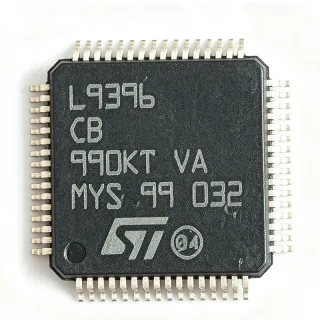
L9981 - Automotive Quad Low-Side Driver | STMicroelectronics
MPN: L9981 ✓ Active| Qty | Unit Price | Extended |
|---|---|---|
| 1 | $3.25 | $3.25 |
| 10 | $2.92 | $29.20 |
| 100 | $2.6 | $260.00 |
| 500 | $2.34 | $1,170.00 |
| 1,000 | $2.08 | $2,080.00 |
L9981 Overview
A low-side driver is a type of power switch that connects the load to ground when activated, allowing the microcontroller to control high-power loads with minimal logic-level signals. In automotive systems, low-side drivers are essential for controlling actuators, motors, and lighting, where they provide a safe and efficient interface between the electronic control unit (ECU) and the physical load. The L9981 fits into the broader category of power management ICs, specifically within the smart power switch family, which combines power switching with diagnostic and protection functions.
Key features of the L9981 include four independent output channels, each capable of delivering up to 1.5 A continuous current, with a maximum supply voltage of 40 V. The device incorporates overcurrent, overtemperature, and short-circuit protection, ensuring reliable operation in harsh environments. It also features a serial peripheral interface (SPI) for advanced diagnostics and control, allowing the microcontroller to monitor output status and fault conditions in real time. The PowerSO-20 package provides a low thermal resistance of 35 °C/W, enabling efficient heat dissipation without external heatsinks in moderate power applications.
The L9981 utilizes a robust BCD (Bipolar-CMOS-DMOS) process technology, which combines the benefits of bipolar, CMOS, and DMOS transistors to achieve high current capability, low on-resistance, and precise analog control. This architecture ensures stable performance across temperature and supply variations, making it suitable for automotive-grade applications that require high reliability. The SPI interface simplifies system integration, reducing the number of GPIO pins needed and enabling advanced features such as PWM control and fault reporting.
Typical applications include automotive body control modules, where the L9981 drives exterior lighting, wiper motors, and door locks; industrial automation for controlling solenoids and valves; and general-purpose power switching in embedded systems. The device's wide operating temperature range of -40°C to +150°C ensures reliable operation in extreme conditions.
When designing with the L9981, it is critical to ensure proper PCB layout with adequate copper area for thermal dissipation, especially when driving high currents. Additionally, the SPI interface requires careful timing and pull-up resistors on the data lines to ensure reliable communication. The device's protection features should be configured appropriately to match the load characteristics and prevent false triggering.
Drop-in alternatives for L9981 — same package, pin-to-pin compatible. Different-package parts requiring PCB rework are excluded.
Variants in this series
Same-series models that are drop-in compatible with L9981 (same form factor and footprint) — differing in Operating Temperature Range, Protection Features.
Quick Comparison Tool — Select alternative parts for side-by-side comparison:
L9980
✅ Drop-In ⚠️ Specs Unverified✓ In Stock
$2.1 / Unit
View Datasheet →TLE6228
✅ Drop-In ⚠️ Specs Unverified📋 Reference alternative (not in catalog)
MC33882
✅ Drop-In ⚠️ Specs Unverified📋 Reference alternative (not in catalog)
L9981 Maximum Ratings & Electrical Characteristics
| Number of Channels | 4 |
| Output Current per Channel | 1.5 A |
| Supply Voltage Range | 5.5 V to 40 V |
| On-Resistance (per channel) | 0.5 ohm |
| Interface | SPI |
| Protection Features | Overcurrent, Overtemperature, Short-circuit |
| Operating Temperature Range | -40°C to +150°C |
| Package | PowerSO-20 |
| Mounting Type | Surface Mount |
| Thermal Resistance, Junction-to-Ambient | 35 °C/W |
| Supply Current (standby) | 10 µA |
| Output Leakage Current | 1 µA |
| Switching Frequency (max) | 1 kHz |
| RoHS Status | Compliant |
| AEC-Q100 Qualified | Yes |
L9981 Pin Configuration
| Pin 1 | OUT1 — Output channel 1 |
| Pin 2 | OUT2 — Output channel 2 |
| Pin 3 | OUT3 — Output channel 3 |
| Pin 4 | OUT4 — Output channel 4 |
| Pin 5 | GND — Ground |
| Pin 6 | VCC — Supply voltage |
| Pin 7 | SCK — SPI clock |
| Pin 8 | SDI — SPI data input |
| Pin 9 | SDO — SPI data output |
| Pin 10 | CS — Chip select |
| Pin 11 | RST — Reset |
| Pin 12 | GND — Ground |
Typical Applications
L9981 is suitable for 6 applications: Automotive Body Control Module, Industrial Automation, General-Purpose Power Switching, Lighting Control, Relay and Solenoid Driving, Test and Measurement Equipment.
Automotive Body Control Module
The L9981 is ideal for automotive body control modules (BCMs) where it drives exterior lighting, wiper motors, and door locks. Its 1.5 A per channel output current and 40 V supply range handle typical automotive loads, while the SPI interface enables precise control and diagnostics. The AEC-Q100 qualification ensures reliability in harsh automotive environments, and the wide temperature range (-40°C to +150°C) supports under-hood applications. The integrated protection features (overcurrent, overtemperature, short-circuit) safeguard the BCM and loads, reducing system complexity and improving safety.
Recommended
Industrial Automation
In industrial automation, the L9981 drives solenoids, valves, and actuators in control systems. Its robust protection features and wide supply voltage range (5.5 V to 40 V) make it suitable for 24 V industrial buses. The SPI interface allows for remote monitoring and control, enabling predictive maintenance and fault detection. The PowerSO-20 package with exposed pad ensures efficient heat dissipation, even when driving multiple loads simultaneously. The device's low on-resistance (0.5 ohm) minimizes power loss, improving energy efficiency in continuous operation.
Recommended
General-Purpose Power Switching
The L9981 serves as a general-purpose quad low-side driver for embedded systems requiring multiple switched loads. Its SPI interface reduces GPIO usage, making it ideal for space-constrained designs. The device can drive resistive loads like LEDs and heaters, as well as inductive loads like relays and solenoids, with built-in freewheeling protection. The wide operating temperature range and AEC-Q100 qualification make it a reliable choice for both commercial and industrial products. The compact PowerSO-20 package simplifies PCB layout, and the exposed pad aids thermal management.
Recommended
Lighting Control
The L9981 is well-suited for automotive and industrial lighting control, driving LED modules and incandescent lamps. Its 1.5 A per channel output can handle high inrush currents of lamps, while the overcurrent protection prevents damage. The SPI interface enables PWM dimming and fault reporting, allowing for advanced lighting features. The device's thermal performance ensures stable operation even when all four channels are driving high-power loads. The AEC-Q100 qualification makes it a trusted choice for automotive lighting systems.
Recommended
Relay and Solenoid Driving
The L9981 is optimized for driving relays and solenoids in automotive and industrial systems. Its low-side configuration and built-in freewheeling protection handle inductive loads safely, preventing voltage spikes. The SPI interface allows for precise control of activation timing and provides diagnostic feedback on coil status. The device's wide supply voltage range accommodates various coil voltages, and the high output current ensures reliable actuation. The robust protection features protect the IC and the load from faults, enhancing system reliability.
Recommended
Test and Measurement Equipment
In test and measurement equipment, the L9981 provides reliable switching for various loads, such as relays in signal routing and solenoids in automated test fixtures. Its SPI interface enables precise control and monitoring, essential for automated test systems. The wide operating temperature range and high reliability make it suitable for benchtop and field instruments. The device's low on-resistance minimizes signal distortion, and the protection features ensure safe operation during fault conditions. The compact package allows for dense PCB layouts in multi-channel instruments.
Recommended
Recommended Products Summary
Engineering reference data for L9981 — comparison, design guidance, and compliance information.
Selection Guide
Comparison with Alternatives
| Parameter | This Product | L9980 | TLE6228 | MC33882 |
|---|---|---|---|---|
| Package | PowerSO-20 | PowerSO-20 | PowerSO-20 | PowerSO-20 |
| Brand | STMicroelectronics | STMicroelectronics | Infineon | NXP Semiconductors |
| Output Current per Channel | 1.5 A | 1 A | 1.5 A | 1.5 A |
| Supply Voltage Range | 5.5 V to 40 V | 5.5 V to 40 V | 5.5 V to 40 V | 5.5 V to 40 V |
| On-Resistance | 0.5 ohm | 0.6 ohm | 0.5 ohm | 0.5 ohm |
| Interface | SPI | SPI | SPI | SPI |
| Protection Features | Overcurrent, Overtemperature, Short-circuit | Overcurrent, Overtemperature, Short-circuit | Overcurrent, Overtemperature, Short-circuit | Overcurrent, Overtemperature, Short-circuit |
| AEC-Q100 Qualified | Yes | Yes | Yes | Yes |
Key Differentiators
- Higher output current than L9980 (vs L9980)
- AEC-Q100 qualification (vs TLE6228)
- Lower on-resistance than L9980 (vs L9980)
Design Notes
The PowerSO-20 package has a thermal resistance of 35 °C/W. When driving all four channels at 1.5 A each, the total power dissipation can reach 4.5 W (assuming 0.5 ohm on-resistance). This would cause a temperature rise of 157.5°C above ambient, exceeding the maximum junction temperature. Ensure adequate PCB copper area and consider a heatsink or forced airflow for high-current applications.
Place decoupling capacitors (100 nF and 10 µF) close to the VCC pin to suppress noise and handle transient currents. The exposed pad should be soldered to a large copper area connected to ground for optimal thermal performance. Keep SPI traces short and shielded to avoid interference with the power outputs.
Ensure the SPI communication is properly initialized before enabling any output. Incorrect SPI timing can cause false triggering of protection features. Also, verify that the load's inrush current does not exceed the overcurrent threshold, which could cause nuisance trips. Use appropriate freewheeling diodes for inductive loads to prevent voltage spikes.
Compliance Information
RoHS compliant and AEC-Q100 qualified per STMicroelectronics product page. Halogen-free status not specified in the provided data.