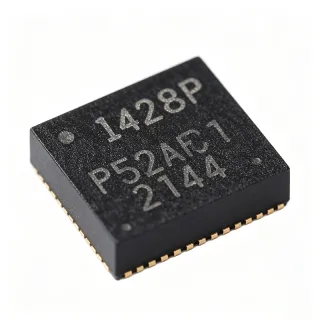
LIS2DH12TR - 3-Axis Accelerometer, ±2/±4/±8/±16g | STMicroelectronics
MPN: LIS2DH12TR ✓ Active| Qty | Unit Price | Extended |
|---|---|---|
| 1 | $1.65 | $1.65 |
| 10 | $1.11 | $11.10 |
| 100 | $0.96 | $96.00 |
| 500 | $0.85 | $425.00 |
| 1,000 | $0.77 | $770.00 |
| 2,000 | $0.73 | $1,460.00 |
| 4,000 | $0.7 | $2,800.00 |
| 8,000 | $0.67 | $5,360.00 |
LIS2DH12TR Overview
An accelerometer is a sensor that measures proper acceleration (g-force) along one or more axes. The LIS2DH12 is a MEMS (Micro-Electro-Mechanical Systems) capacitive accelerometer, which detects changes in capacitance caused by the displacement of a proof mass under acceleration. In the system hierarchy, it is a motion sensor -> inertial sensor -> MEMS sensor -> sensor, and it is commonly used in motion-activated functions, orientation detection, and vibration monitoring.
Key features include a wide full-scale range selection, a 16-bit data output, an embedded 32-level FIFO buffer, and a built-in high-pass filter. The device supports multiple operating modes (normal, low-power, and high-resolution) with output data rates from 1 Hz to 5.3 kHz. It also includes a self-test capability and an interrupt generator for motion detection, enabling low-power always-on applications.
The LIS2DH12 uses a capacitive sensing element and a dedicated IC interface, achieving low noise (220 µg/√Hz in high-resolution mode) and low power consumption (as low as 2 µA in low-power mode at 1 Hz ODR). The digital output simplifies system integration, eliminating the need for external ADCs. The device is AEC-Q100 qualified for automotive applications, ensuring reliability in harsh environments.
Typical applications include mobile devices for screen rotation and step counting, industrial vibration monitoring, and automotive anti-theft systems. Its low power and small footprint make it suitable for wearable devices and IoT sensors. In a smartphone, the LIS2DH12 detects orientation to switch between portrait and landscape modes, and it can count steps by analyzing acceleration patterns.
When designing with this device, ensure proper decoupling of the power supply with a 100 nF capacitor close to the VDD pin. The I2C address is selectable via the SA0 pin, allowing multiple devices on the same bus. For battery-powered designs, use the low-power mode to extend battery life, and configure the FIFO to reduce host processor wake-ups.
This page synthesizes distributor pricing, drop-in alternatives, and practical design notes not found in the ST datasheet, providing a comprehensive resource for engineers evaluating the LIS2DH12TR.
Drop-in alternatives for LIS2DH12TR — same package, pin-to-pin compatible. Different-package parts requiring PCB rework are excluded.
Variants in this series
Same-series models that are drop-in compatible with LIS2DH12TR (same form factor and footprint) — differing in Interface, Package, Noise Density, Operating Temperature, Supply Voltage.
Quick Comparison Tool — Select alternative parts for side-by-side comparison:
LIS2DH12
📋 Reference alternative (not in catalog)
LIS2DS12TR
📋 Reference alternative (not in catalog)
LIS2DW12TR
📋 Reference alternative (not in catalog)
LIS2DH12TR Maximum Ratings & Electrical Characteristics
| Axis | 3-axis (X, Y, Z) |
| Full-scale Range | ±2g, ±4g, ±8g, ±16g (user-selectable) |
| Interface | I2C (up to 400 kHz), SPI (up to 10 MHz) |
| Supply Voltage | 1.71 V to 3.6 V |
| Output Data Rate | 1 Hz to 5.3 kHz |
| Resolution | 16-bit (high-resolution mode) |
| Sensitivity | 1 mg/digit at ±2g (typ) |
| Noise Density | 220 µg/√Hz (high-resolution mode) |
| Current Consumption | 2 µA (low-power mode, 1 Hz ODR) |
| FIFO Buffer | 32-level embedded |
| Operating Temperature | -40°C to +85°C |
| Package | LGA-12 (2x2x1 mm) |
| Mounting Type | Surface Mount |
| AEC-Q100 | Qualified |
| RoHS | Compliant |
| Self-test | Built-in |
LIS2DH12TR Pin Configuration
| Pin 1 | VDD — Power supply (1.71V to 3.6V) |
| Pin 2 | GND — Ground |
| Pin 3 | SCL/SPC — I2C clock / SPI clock |
| Pin 4 | SDA/SDI/SDO — I2C data / SPI data in / SPI data out (3-wire) |
| Pin 5 | SA0 — I2C address select (0x18 or 0x19) |
| Pin 6 | CS — Chip select (active low for SPI) |
| Pin 7 | INT1 — Interrupt 1 output |
| Pin 8 | INT2 — Interrupt 2 output |
| Pin 9 | NC — Not connected |
| Pin 10 | NC — Not connected |
| Pin 11 | NC — Not connected |
| Pin 12 | NC — Not connected |
Typical Applications
LIS2DH12TR is suitable for 6 applications: Mobile Devices, Wearable Devices, Industrial Vibration Monitoring, Automotive Anti-Theft Systems, IoT Smart Home Sensors, Robotics and Drones.
Mobile Devices
The LIS2DH12TR is widely used in smartphones and tablets for screen rotation, gesture recognition, and step counting. Its low power consumption (2 µA at 1 Hz ODR) extends battery life, while the 16-bit resolution and low noise (220 µg/√Hz) enable accurate motion detection. In a typical smartphone, the accelerometer is connected via I2C to the application processor, with the INT1 pin triggering interrupts on motion events. The FIFO buffer allows the processor to stay in sleep mode, waking only when a threshold is exceeded, reducing overall system power. The device's small LGA-12 package (2x2x1 mm) fits easily into the slim profile of modern phones. Compared to higher-power accelerometers, the LIS2DH12's low current draw is critical for always-on motion sensing, enabling features like raise-to-wake without significant battery drain. Designers should configure the ODR to 100 Hz for responsive UI rotation while balancing power, and use the high-pass filter to remove gravity for gesture detection.
Recommended
Wearable Devices
The LIS2DH12TR is ideal for fitness trackers, smartwatches, and medical wearables due to its ultra-low power consumption and compact size. In a fitness tracker, the accelerometer detects steps, sleep patterns, and activity intensity. The device's low-power mode at 1 Hz ODR consumes only 2 µA, allowing continuous operation for months on a small coin cell battery. The built-in FIFO (32 levels) stores acceleration data, enabling the host MCU to remain in deep sleep and wake periodically to process batches of data, further reducing power. The 16-bit resolution provides fine granularity for detecting subtle movements like breathing rate. For medical wearables, the AEC-Q100 qualification ensures reliability, and the wide temperature range (-40°C to +85°C) supports body-worn applications. Designers should use the interrupt pins to wake the system on significant motion, and configure the high-pass filter to isolate dynamic acceleration from gravity for accurate step counting. The small LGA-12 package allows integration into slim wristbands.
Recommended
Industrial Vibration Monitoring
The LIS2DH12TR is used in industrial condition monitoring to detect abnormal vibrations in motors, pumps, and rotating machinery. Its high output data rate (up to 5.3 kHz) and low noise (220 µg/√Hz) enable detection of high-frequency vibration signatures. In a typical setup, the accelerometer is mounted on the equipment housing, and the digital output is read via SPI at high speed to capture transient events. The device's wide full-scale range (±16g) allows measurement of both normal operation and shock events without saturation. The built-in high-pass filter can remove DC offset from gravity, focusing on AC vibration. For predictive maintenance, the FIFO buffer can store pre-trigger data, and the interrupt generator can alert the system when vibration exceeds a threshold. The AEC-Q100 qualification ensures robustness in harsh industrial environments. Designers should use a sampling rate of at least 2 kHz to capture vibration frequencies up to 1 kHz, and ensure proper shielding to minimize electromagnetic interference.
Recommended
Automotive Anti-Theft Systems
The LIS2DH12TR is AEC-Q100 qualified, making it suitable for automotive anti-theft systems that detect vehicle tilt or movement. In a car alarm, the accelerometer monitors for unauthorized towing or jacking by detecting changes in orientation. The device's low power consumption (2 µA at 1 Hz ODR) allows it to be always-on, powered directly from the car battery. The interrupt generator can trigger an alarm when the tilt angle exceeds a preset threshold, waking the main controller. The wide operating temperature range (-40°C to +85°C) ensures reliable operation in extreme climates. The device's small size allows integration into the ECU or a dedicated sensor module. Designers should configure the high-pass filter to ignore slow temperature-induced drift, and use the FIFO to log events for post-incident analysis. The AEC-Q100 qualification guarantees reliability under vibration and thermal cycling.
Recommended
IoT Smart Home Sensors
The LIS2DH12TR is used in smart home devices for presence detection, security monitoring, and energy harvesting. In a smart thermostat, the accelerometer detects when the device is moved or tampered with, triggering an alert. In a smart door sensor, it detects opening and closing by measuring tilt. The device's ultra-low power consumption enables battery-powered operation for years. The I2C interface simplifies connection to low-power MCUs like the ESP32 or STM32L0. The FIFO buffer reduces host wake-ups, and the interrupt pins can wake the system only on motion events. The small LGA-12 package fits into compact sensor nodes. Designers should use the low-power mode at 1 Hz ODR for always-on sensing, and configure the interrupt threshold to avoid false triggers from vibrations. The device's wide supply voltage (1.71V to 3.6V) allows direct battery connection without a regulator.
Recommended
Robotics and Drones
The LIS2DH12TR is used in robotics and drones for orientation sensing, stabilization, and collision detection. In a quadcopter, the accelerometer provides tilt data for flight stabilization, complementing the gyroscope. The device's high output data rate (up to 5.3 kHz) and low latency enable real-time control loops. The 16-bit resolution provides precise angle estimation, and the wide full-scale range (±16g) can measure hard landings. The SPI interface allows high-speed data transfer to the flight controller. The device's small size and low weight are critical for aerial vehicles. Designers should use a complementary filter or Kalman filter to fuse accelerometer and gyroscope data for accurate orientation. The device's low power consumption is beneficial for battery-powered drones. The AEC-Q100 qualification ensures reliability under vibration and temperature extremes.
Recommended
Recommended Products Summary
Engineering reference data for LIS2DH12TR — comparison, design guidance, and compliance information.
Selection Guide
Comparison with Alternatives
| Parameter | This Product | LIS2DH12 | LIS2DS12TR | LIS2DW12TR |
|---|---|---|---|---|
| Package | LGA-12 (2x2x1 mm) | LGA-12 (2x2x1 mm) - same | LGA-12 (2x2x1 mm) - same | LGA-12 (2x2x1 mm) - same |
| Full-scale Range | ±2g, ±4g, ±8g, ±16g | ±2g, ±4g, ±8g, ±16g | ±2g, ±4g, ±8g, ±16g | ±2g, ±4g, ±8g, ±16g |
| Output Data Rate | 1 Hz to 5.3 kHz | 1 Hz to 5.3 kHz | 1 Hz to 5.3 kHz | 1 Hz to 1.6 kHz |
| Current Consumption (1 Hz ODR) | 2 µA | 2 µA | 2 µA | 0.9 µA |
| Noise Density | 220 µg/√Hz | 220 µg/√Hz | 220 µg/√Hz | 130 µg/√Hz |
| FIFO Size | 32 levels | 32 levels | 32 levels | 32 levels |
| Temperature Sensor | No | No | Yes | No |
| Machine Learning Core | No | No | Yes | No |
Key Differentiators
- Ultra-low power consumption (vs LIS3DH)
- Smaller package size (vs LIS3DH)
- AEC-Q100 qualification (vs LIS2DW12TR)
Design Notes
Decouple the VDD pin with a 100 nF ceramic capacitor placed as close as possible to the pin, and optionally a 10 µF bulk capacitor for transient loads. The LIS2DH12TR operates from 1.71V to 3.6V, so ensure the supply is stable and within this range. In battery-powered designs, use the low-power mode (2 µA at 1 Hz ODR) to extend battery life, and consider using the built-in voltage regulator to maintain consistent performance as the battery voltage drops.
Place the LIS2DH12TR on a PCB with a solid ground plane underneath to reduce noise. Keep the I2C/SPI traces short and shielded if possible. For I2C, add pull-up resistors (typically 4.7 kΩ) to VDD. The SA0 pin should be tied to GND or VDD to set the I2C address. Ensure the CS pin is tied high for I2C mode or driven low for SPI mode. Avoid routing high-speed digital traces near the sensor to prevent interference.
Do not leave the INT1 and INT2 pins floating; configure them as outputs and connect to the host MCU with appropriate pull-ups if needed. When using SPI, ensure the correct clock polarity and phase (CPOL=0, CPHA=0) as per the datasheet. The self-test feature should be enabled during production testing to verify the sensor is functioning. Be aware that the LIS2DH12TR's register map differs from the LIS3DH, so software written for LIS3DH will not work without modification.
Compliance Information
RoHS compliant and AEC-Q100 qualified per STMicroelectronics product page. REACH compliance is assumed based on ST's general compliance, but not explicitly stated in the provided data.