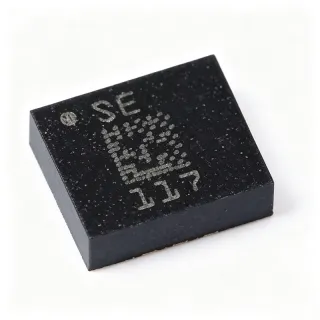
LPS22HII - MEMS Nano Pressure Sensor, 260-1260 hPa | STMicroelectronics
MPN: LPS22HII ✓ Active| Qty | Unit Price | Extended |
|---|---|---|
| 1 | $2.5 | $2.50 |
| 10 | $2.25 | $22.50 |
| 100 | $2 | $200.00 |
| 500 | $1.8 | $900.00 |
| 1,000 | $1.6 | $1,600.00 |
LPS22HII Overview
A pressure sensor is a device that converts applied pressure into an electrical signal. The LPS22HII is a MEMS (Micro-Electro-Mechanical Systems) pressure sensor, which uses a thin silicon membrane that deflects under pressure, changing the piezoresistive elements' resistance. This change is converted into a digital output via an integrated ADC. Pressure sensors are a subset of environmental sensors, which also include temperature, humidity, and gas sensors. In the sensor hierarchy, the LPS22HII is a barometric pressure sensor, a type of absolute pressure sensor, and a MEMS sensor.
Key features include a 24-bit pressure data output, an embedded temperature sensor, and a 16-bit temperature output. The sensor supports data rates from 1 Hz to 75 Hz, with a typical current consumption of 12 uA at 1 Hz output data rate. It operates from a 1.7V to 3.6V supply voltage, making it suitable for battery-powered devices. The LPS22HII also includes a FIFO buffer, interrupt pins, and a pressure threshold detection feature.
The LPS22HII uses a MEMS capacitive sensing element with a signal conditioning ASIC, providing high accuracy and low power consumption. The sensor has a pressure noise of 0.0075 hPa RMS, enabling precise measurements. It is designed for portable devices, with a small footprint and low height, and is compatible with lead-free soldering processes.
Typical applications include altimeters in drones and smartphones, weather station barometers, and GPS dead-reckoning for navigation. The sensor's low power and small size make it ideal for wearable devices and IoT nodes. In a drone, the LPS22HII provides altitude data for flight stabilization and landing.
When designing with the LPS22HII, ensure proper PCB layout with a pressure port opening for accurate readings. The sensor should be placed away from heat sources to minimize temperature-induced errors. Use the FIFO to reduce host processor wake-ups and save power.
Drop-in alternatives for LPS22HII — same package, pin-to-pin compatible. Different-package parts requiring PCB rework are excluded.
Variants in this series
Same-series models that are drop-in compatible with LPS22HII (same form factor and footprint) — differing in Current Consumption, Output Data Rate, Package, Supply Voltage.
Quick Comparison Tool — Select alternative parts for side-by-side comparison:
LPS22HH
✅ Drop-In✓ In Stock
$0.9705 / Unit
View Datasheet →LPS22HHTR
✅ Drop-In📋 Reference alternative (not in catalog)
BMP388
⚡ Same Package ⚠️ Specs Unverified📋 Reference alternative (not in catalog)
MS5837-30BA
⚡ Same Package ⚠️ Specs Unverified📋 Reference alternative (not in catalog)
LPS22HII Maximum Ratings & Electrical Characteristics
| Pressure Range | 260 to 1260 hPa |
| Absolute Accuracy | 0.5 hPa |
| Pressure Noise | 0.0075 hPa RMS |
| Interface | I2C and SPI |
| Supply Voltage | 1.7 V to 3.6 V |
| Current Consumption | 12 uA at 1 Hz ODR |
| Output Data Rate | 1 Hz to 75 Hz |
| Pressure Resolution | 24-bit |
| Temperature Sensor | Yes, 16-bit output |
| Temperature Range | -40C to +85C |
| Package | LGA-10 (2.0 x 2.0 x 0.7 mm) |
| Mounting Type | Surface Mount |
| FIFO | Yes, 32-level |
| Interrupt Pins | 2 (INT_DRDY, INT_SOURCE) |
| RoHS Status | Compliant |
LPS22HII Pin Configuration
| Pin 1 | VDD — Power supply (1.7V to 3.6V) |
| Pin 2 | GND — Ground |
| Pin 3 | SCL/SPC — I2C clock / SPI clock |
| Pin 4 | SDA/SDI — I2C data / SPI data in |
| Pin 5 | SA0/SDO — I2C address select / SPI data out |
| Pin 6 | CS — Chip select (active low) |
| Pin 7 | INT_DRDY — Interrupt / data ready |
| Pin 8 | INT_SOURCE — Interrupt source |
| Pin 9 | NC — Not connected |
| Pin 10 | NC — Not connected |
Typical Applications
LPS22HII is suitable for 6 applications: Altimeter for Drones, Weather Station Barometer, Smartphone Altimeter, Wearable Fitness Tracker, IoT Environmental Node, GPS Dead Reckoning.
Altimeter for Drones
The LPS22HII provides precise altitude data for drone flight stabilization and landing. Its low noise (0.0075 hPa RMS) enables altitude resolution of approximately 6 cm, which is critical for smooth altitude hold and safe landing. The sensor's small LGA-10 package (2x2x0.7mm) fits easily into drone flight controllers. In a typical drone application, the LPS22HII is connected to the flight controller via I2C, with the INT_DRDY pin triggering altitude updates. The sensor's low power consumption (12 uA at 1 Hz) extends flight time. Compared to GPS-only altitude, the barometer provides faster response and better accuracy in indoor or GPS-denied environments. Designers should ensure the pressure port is exposed to ambient air but protected from prop wash to avoid dynamic pressure errors.
Recommended
Weather Station Barometer
The LPS22HII measures atmospheric pressure with 0.5 hPa accuracy, making it suitable for weather stations. It can detect pressure trends for weather forecasting. The sensor's 24-bit resolution and low noise allow detection of pressure changes as small as 0.0075 hPa, which is essential for accurate trend analysis. In a weather station, the LPS22HII is typically placed in a ventilated enclosure to avoid direct sunlight and wind. The I2C interface connects to a microcontroller that logs data over time. The sensor's wide pressure range (260-1260 hPa) covers all terrestrial atmospheric pressures. The embedded temperature sensor provides additional environmental data. For best accuracy, the sensor should be calibrated against a reference barometer. The low power consumption enables battery-powered weather stations that run for months.
Recommended
Smartphone Altimeter
The LPS22HII is used in smartphones for altimeter and indoor navigation. It provides altitude data for fitness tracking (floors climbed) and emergency location (E911). The sensor's small size and low power are ideal for mobile devices. In a smartphone, the LPS22HII is mounted on the main PCB with a pressure port on the device's edge. The sensor's I2C interface connects to the application processor. The 24-bit pressure data is processed to calculate altitude using the hypsometric formula. The sensor's low noise (0.0075 hPa) enables altitude resolution of about 6 cm, which is sufficient for floor detection. The sensor's power consumption (12 uA at 1 Hz) is negligible compared to the phone's overall power budget. Designers must ensure the pressure port is not blocked by the phone case.
Recommended
Wearable Fitness Tracker
The LPS22HII enables altitude tracking in fitness wearables, such as counting floors climbed and measuring elevation gain during hikes. Its ultra-compact package and low power consumption are critical for wearable devices. In a fitness tracker, the LPS22HII is integrated into the main PCB, with a small pressure port on the device's side. The sensor's I2C interface connects to a low-power MCU. The sensor's 24-bit pressure data is used to calculate altitude changes, and the FIFO buffer allows the MCU to stay in sleep mode longer, reducing power consumption. The sensor's operating temperature range (-40C to +85C) ensures reliable operation in outdoor conditions. The low noise (0.0075 hPa) allows detection of small altitude changes, such as climbing a single step. Designers should ensure the pressure port is water-resistant to protect against sweat and rain.
Recommended
IoT Environmental Node
The LPS22HII is used in IoT nodes for environmental monitoring, providing barometric pressure data for weather and climate studies. Its low power and digital interface make it easy to integrate with wireless MCUs. In an IoT node, the LPS22HII is connected to a wireless MCU (e.g., STM32WB) via I2C. The sensor's low power consumption (12 uA at 1 Hz) allows battery-powered operation for years. The sensor's pressure data is transmitted via LoRa, BLE, or Wi-Fi to a cloud server. The embedded temperature sensor provides additional data. The sensor's small size allows integration into compact IoT devices. The FIFO buffer reduces host wake-ups, further saving power. Designers should place the sensor in a weatherproof enclosure with a pressure port that is protected from water ingress.
Recommended
GPS Dead Reckoning
The LPS22HII provides altitude data for GPS dead reckoning, improving navigation accuracy in urban canyons and tunnels where GPS signals are weak. The sensor's high accuracy and low noise are essential for reliable altitude estimation. In a GPS dead reckoning system, the LPS22HII is used alongside a GPS receiver and an IMU. The sensor's pressure data is fused with GPS and IMU data using a Kalman filter to estimate position. The sensor's 24-bit resolution and low noise (0.0075 hPa) enable precise altitude tracking. The sensor's I2C interface connects to the navigation processor. The sensor's low power consumption is important for battery-powered navigation devices. Designers should ensure the pressure port is exposed to ambient air but protected from wind and water.
Recommended
Recommended Products Summary
Engineering reference data for LPS22HII — comparison, design guidance, and compliance information.
Selection Guide
Comparison with Alternatives
| Parameter | This Product | LPS22HH | LPS22HHTR | BMP388 | MS5837-30BA |
|---|---|---|---|---|---|
| Package | LGA-10 (2.0 x 2.0 x 0.7 mm) | LGA-10 (2.0 x 2.0 x 0.7 mm) - same | LGA-10 (2.0 x 2.0 x 0.7 mm) - same | LGA-10 (2.0 x 2.0 x 0.8 mm) - different height | LGA-10 (2.0 x 2.0 x 0.7 mm) - same |
| Brand | STMicroelectronics | STMicroelectronics | STMicroelectronics | Bosch Sensortec | TE Connectivity |
| Pressure Range | 260 to 1260 hPa | 260 to 1260 hPa | 260 to 1260 hPa | 300 to 1250 hPa | 0 to 30 bar |
| Absolute Accuracy | 0.5 hPa | 0.5 hPa | 0.5 hPa | 0.5 hPa | 0.2 hPa |
| Pressure Noise | 0.0075 hPa RMS | 0.0075 hPa RMS | 0.0075 hPa RMS | 0.03 hPa RMS | 0.02 hPa RMS |
| Output Data Rate | 1 Hz to 75 Hz | 1 Hz to 200 Hz | 1 Hz to 75 Hz | 1 Hz to 200 Hz | 1 Hz to 40 Hz |
| Supply Voltage | 1.7V to 3.6V | 1.7V to 3.6V | 1.7V to 3.6V | 1.7V to 3.6V | 1.5V to 3.6V |
| Current Consumption | 12 uA at 1 Hz | 12 uA at 1 Hz | 12 uA at 1 Hz | 3.4 uA at 1 Hz | 0.6 uA at 1 Hz |
Key Differentiators
- Ultra-compact LGA-10 package (2x2x0.7mm) (vs BMP388)
- Lower pressure noise (0.0075 hPa RMS) (vs BMP388)
- Higher pressure resolution (24-bit) (vs BMP388)
Design Notes
Ensure the pressure port is open to ambient air. Place the sensor away from heat sources and air vents to avoid pressure and temperature errors. Use a small hole in the enclosure with a mesh to protect against dust and water.
Decouple the VDD pin with a 100nF capacitor placed as close as possible to the sensor. For noisy supplies, add a 1uF capacitor in parallel. The sensor operates from 1.7V to 3.6V, so ensure the supply is within this range.
Do not cover the pressure port with solder mask or conformal coating. Avoid placing the sensor near vibrating components, as mechanical stress can affect readings. Use the FIFO to reduce host wake-ups and save power.
Compliance Information
RoHS and REACH compliant per STMicroelectronics product page. Not AEC-Q100 qualified.