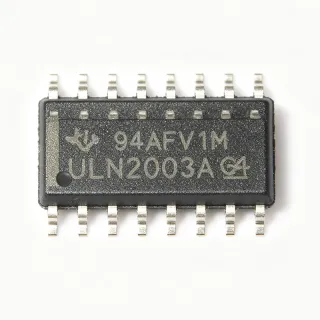
LSF0102DDFR - 2-Ch 100Mbps Level Translator | TI
MPN: LSF0102DDFR ✓ Active| Qty | Unit Price | Extended |
|---|---|---|
| 1 | $0.85 | $0.85 |
| 10 | $0.76 | $7.60 |
| 100 | $0.54 | $54.00 |
| 500 | $0.42 | $210.00 |
| 1,000 | $0.33 | $330.00 |
LSF0102DDFR Overview
A level translator, or voltage level shifter, is a logic IC that enables digital signals to safely cross between circuits operating at different supply voltages, such as 1.8V, 3.3V, and 5V domains. Within the hierarchy of logic ICs, translators sit alongside buffers and bus switches in the signal-interface layer of a system, ensuring reliable communication in mixed-voltage designs.
Key features include fully automatic bidirectional translation with no direction pin, support for open-drain buses (I2C, SMBus) and push-pull interfaces (SPI, UART), a wide 0.95V to 5V translation range, and ultra-low quiescent current of 6 uA typical. The fast propagation delay preserves signal timing in high-speed links up to 100 Mbps.
Technically, the LSF0102 uses a pass-gate (transmission-gate) architecture. The reference pins VREF_A and VREF_B set the logic levels on each side, and external pull-up resistors define the high levels of each domain. The device senses data direction automatically, making it transparent to the host system and reducing pin count and firmware complexity compared to directional translators.
Typical applications include I2C and SMBus level shifting between 1.8V, 3.3V, and 5V domains, SPI and UART interfaces in mixed-voltage embedded systems, general-purpose GPIO translation, and battery-powered portable devices where the 6 uA quiescent current minimizes standby drain.
Design consideration: pull-up resistor values directly trade off maximum data rate against power consumption; use lower resistance (1-2 kilohm) for high-speed push-pull operation and higher resistance (4.7-10 kilohm) for low-power open-drain buses.
Drop-in alternatives for LSF0102DDFR — same package, pin-to-pin compatible. Different-package parts requiring PCB rework are excluded.
Variants in this series
Same-series models that are drop-in compatible with LSF0102DDFR (same form factor and footprint) — differing in Package.
Quick Comparison Tool — Select alternative parts for side-by-side comparison:
LSF0102-Q1
✅ Drop-In✓ In Stock
Contact for price
View Datasheet →LSF0102DDFR Maximum Ratings & Electrical Characteristics
| Channels | 2 |
| Translation Type | Auto-Bidirectional Multi-Voltage |
| Signal Type Support | Open-Drain and Push-Pull |
| Data Rate | 100 Mbps |
| VCCA / VCCB Range | 1.8 V to 5.5 V |
| Reference Voltage Range (VREF) | 0.9 V to 5.5 V |
| Direction Control Pin | Not required (automatic) |
| Quiescent Current | 6 uA (typical) |
| Operating Temperature | -40C to +125C |
| Package | TSOT-23-8 (DDF), 8 pins |
| Mounting Type | Surface Mount |
| Output Type | Push-Pull, Open Drain |
| Input Logic Level | TTL |
| RoHS Status | Compliant |
| Feature | Partial power-down (Ioff) supported per LSF family |
LSF0102DDFR Pin Configuration
| Pin 1 | A1 — Channel 1, side A (low-voltage reference domain) |
| Pin 2 | VREF_A — Reference voltage for side A, sets A-side logic low level |
| Pin 3 | A2 — Channel 2, side A |
| Pin 4 | GND — Ground |
| Pin 5 | EN — Enable (high = translation active) |
| Pin 6 | B2 — Channel 2, side B |
| Pin 7 | VREF_B — Reference voltage for side B, sets B-side logic high level |
| Pin 8 | B1 — Channel 1, side B |
Typical Applications
LSF0102DDFR is suitable for 6 applications: I2C / SMBus Level Shifting, Mixed-Voltage SPI and UART Interfaces, Battery-Powered Portable Devices, Automotive Mixed-Voltage Buses, Sensor Interface Translation in IoT Nodes, Industrial Control GPIO Translation.
I2C / SMBus Level Shifting
The LSF0102DDFR is purpose-built for open-drain I2C and SMBus translation between 1.8V, 3.3V, and 5V controllers and peripherals. Its auto-bidirectional transmission gate requires no direction pin, and the open-drain topology means only two channels are needed for SDA and SCL. With 4.7 kilohm pull-ups the bus supports 100 kHz Standard-mode, and 2 kilohm pull-ups enable 400 kHz Fast-mode operation while keeping the 6 uA quiescent current advantage.
Recommended
Mixed-Voltage SPI and UART Interfaces
For SPI (MOSI, MISO, SCLK) and UART links crossing between a 1.8V microcontroller and 3.3V or 5V peripherals, the LSF0102DDFR provides automatic push-pull translation up to 100 Mbps. Two channels cover UART TX/RX; multiple devices can be cascaded for 4-wire SPI. Low 1.2 ns-class propagation delay preserves timing margins, and 1-2 kilohm pull-ups ensure fast rising edges at high clock rates.
Recommended
Battery-Powered Portable Devices
The 6 uA typical quiescent current of the LSF0102DDFR minimizes standby drain in wearables, meters, and handheld instruments where the coin cell or Li-ion budget is tight. Its 0.9V reference floor allows translation from low-voltage sub-1.2V domain cores up to 5V accessory rails, and the small TSOT-23-8 package saves board area in space-constrained portable designs.
Recommended
Automotive Mixed-Voltage Buses
Using the AEC-Q100 qualified LSF0102-Q1 variant (same die, same TSOT-23-8 footprint), designers can bridge 1.8V MCU domains to 3.3V or 5V automotive sensors and actuators across the -40C to +125C range. The open-drain support makes it ideal for translating LIN/K-line service interfaces and sensor I2C buses without direction-control firmware.
Recommended
Sensor Interface Translation in IoT Nodes
IoT nodes frequently mix 1.8V low-power MCUs with 3.3V sensors. The LSF0102DDFR transparently shifts I2C sensor buses (temperature, humidity, accelerometers) in both directions with no software overhead. The wide 0.9V reference floor supports future migration to lower-voltage process nodes, and the small footprint suits dense multi-sensor PCBs.
Recommended
Industrial Control GPIO Translation
In PLC and factory automation I/O modules, 5V field-side logic often meets 3.3V or 1.8V controller logic. The LSF0102DDFR handles push-pull GPIO, enable, and status lines across this boundary at speeds to 100 Mbps, with -40C to +125C operation for cabinet environments. Its pass-gate design adds negligible load to the bus, preserving signal integrity on long backplane traces.
Recommended
Recommended Products Summary
Engineering reference data for LSF0102DDFR — comparison, design guidance, and compliance information.
Selection Guide
Comparison with Alternatives
| Parameter | This Product | LSF0102-Q1 | LSF0101 |
|---|---|---|---|
| Package | TSOT-23-8 (DDF) | TSOT-23-8 (DDF) - same, drop-in | Different package (1-channel family member) |
| Brand | Texas Instruments | Texas Instruments | Texas Instruments |
| Channels | 2 | 2 | 1 |
| Voltage Translation Range | 0.9 V to 5.5 V | 0.9 V to 5.5 V | 0.9 V to 5.5 V |
| Max Data Rate | 100 Mbps | 100 Mbps | 100 Mbps |
| Direction Control | Automatic (no DIR pin) | Automatic (no DIR pin) | Automatic (no DIR pin) |
| Quiescent Current | 6 uA (typ) | 6 uA (typ) | 6 uA (typ) |
| Automotive Grade | No | Yes (AEC-Q100) | No |
Key Differentiators
- Supports both open-drain and push-pull buses (vs TXS0102-Q1)
- 0.9V reference floor (vs SN74LVC2T45)
- Ultra-low 6 uA quiescent current (vs LSF0101)
Design Notes
Pull-up resistor selection dominates LSF0102 performance. Oversized resistors (10 kilohm+) create slow RC rising edges that cap usable data rate; undersized resistors increase static power on open-drain buses. Start with 4.7 kilohm for I2C at 100-400 kHz and 1-2 kilohm for push-pull links near 100 Mbps. Never omit pull-ups on the VREF_B side - the transmission-gate architecture relies on them to define high levels.
The VREF_B pin is also the B-side supply path; current through pull-up resistors flows via the device. Keep total pull-up current within datasheet limits, and hold VREF_B >= VREF_A per datasheet requirements (an LSF family constraint). With 6 uA typical quiescent current, the device itself is negligible for battery budget - the pull-up network is the real consumption term.
Place the TSOT-23-8 device close to the domain crossing point to minimize stub lengths, and add 100 nF decoupling on the VREF_B/VCC rail. For push-pull links above 50 Mbps, keep traces under 10 cm and reference to a solid ground plane; the pass-gate adds minimal series resistance but bus capacitance directly slows edges via the pull-up network.
Compliance Information
RoHS compliant per LCSC/JLCPCB product listings. AEC-Q100 qualified variant available as LSF0102-Q1 (separate MPN). REACH and halogen-free status not stated in provided data.