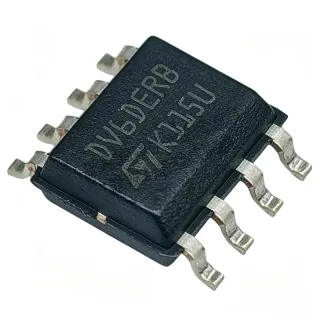
NHS3152UK/A1 - NFC Therapy Adherence Monitor IC | NXP
MPN: NHS3152UK/A1 ✓ Active| Qty | Unit Price | Extended |
|---|---|---|
| 1 | $4.35 | $4.35 |
| 10 | $4.1 | $41.00 |
| 100 | $3.85 | $385.00 |
| 500 | $3.6 | $1,800.00 |
| 1,000 | $3.4 | $3,400.00 |
NHS3152UK/A1 Overview
A therapy adherence monitor IC is a highly integrated sensor-and-logging system-on-chip designed to record whether and when a medication container is opened or dosed. In the system hierarchy it sits between a passive NFC tag and a full microcontroller subsystem: it contains an Arm Cortex-M0+ processor, nonvolatile logging memory, sensing front ends, and a contactless NFC power/data link, making it a complete smart-sensor IC within the broader power management and RFID/NFC semiconductor family.
Key features include the embedded NFC interface compliant with ISO 14443 at 13.56 MHz, an on-chip resistive-network sensing interface that can detect switch or foil openings, an internal temperature sensor for environmental logging, and an Arm Cortex-M0+ core that lets designers implement custom logging firmware. Because sensing, logging, processing, and the contactless interface are all on one die, the NHS3152 supports a single-layer foil implementation for pill blister packaging with a minimal number of external components.
Technically, the device pairs its Cortex-M0+ CPU with an ADC for analog sensing channels, a DAC for excitation or test stimulus generation, and a current sensor front end. The NFC interface transfers logged data to smartphones or dedicated readers and, during the exchange, the IC is powered directly from a small battery through its direct battery connection, operating across the 1.7 V to 3.6 V range.
Typical applications are pill blister and bottle adherence monitoring for clinical trials, connected drug packaging for pharmacy compliance programs, and disposable smart labels where temperature exposure and tamper events must be logged and later read via NFC from a phone.
A key design consideration is that the RESETN pin handling and firmware update path must be planned early: the device is programmed through its NFC interface, and unused pins should be terminated per the NXP datasheet guidance to guarantee reliable field reads.
This page synthesizes distributor pricing, family drop-in alternatives, and practical design notes not found in the manufacturer datasheet alone.
Drop-in alternatives for NHS3152UK/A1 — same package, pin-to-pin compatible. Different-package parts requiring PCB rework are excluded.
Quick Comparison Tool — Select alternative parts for side-by-side comparison:
NHS3152UK/A1Z
✅ Drop-In📋 Reference alternative (not in catalog)
NHS3152UK
✅ Drop-In📋 Reference alternative (not in catalog)
NHS3100UK
✅ Drop-In ⚠️ 参数待验证📋 Reference alternative (not in catalog)
NHS3152UK/A1 Specifications
| Product Type | NFC therapy adherence monitoring and logging IC |
| Embedded Core | Arm Cortex-M0+ |
| NFC Interface | 13.56 MHz, ISO 14443 |
| Supply Voltage Range | 1.7 V to 3.6 V |
| Battery Connection | Direct battery connection |
| Temperature Sensor | Internal, on-chip |
| ADC | Yes, on-chip |
| DAC | Yes, on-chip |
| Current Sensor | Yes, on-chip sensing interface |
| Resistive Sensing Interface | Resistive network sensing interface |
| Package | 25-UFBGA, WLCSP |
| Number of Terminals | 25 (ball grid) |
| Temperature Grade | Industrial |
| Mounting Type | Surface Mount |
| Primary Application | Therapy adherence monitoring and logging |
| External Components | Minimal; supports single-layer foil implementation |
NHS3152UK/A1 25-ufbga, wlcsp Pin Configuration Guide
Pin configuration for NHS3152UK/A1 (25-ufbga, wlcsp package). Pin numbering, functions, and connection diagrams are defined in the manufacturer datasheet. Refer to it for the exact footprint and soldering guidelines.

No detailed pinout data available for NHS3152UK/A1.
Refer to the datasheet for full pin configuration.
Typical Applications
NHS3152UK/A1 is suitable for 6 applications: Pill Blister Adherence Monitoring, Connected Clinical Trial Drug Packaging, Disposable Smart Labels and Tags, Cold Chain Temperature Logging, Smart Medication Bottles and Dose Counters, Wireless Sensor Nodes (NFC-Powered Field Sensing).
Pill Blister Adherence Monitoring
The NHS3152UK/A1 is NXP's purpose-built solution for therapy adherence in pill blister packaging. Its resistive-network sensing interface detects opens in a single-layer conductive foil each time a pocket is pressed, timestamping the event with the Cortex-M0+ core and storing it in on-chip logging memory. The direct battery connection sustains logging between reads across 1.7 V to 3.6 V, while the 13.56 MHz ISO 14443 NFC interface lets a pharmacist or clinician read the complete dose history from a smartphone without opening the package. The internal temperature sensor adds a secondary data channel, correlating each adherence event with storage conditions - a quantified benefit for cold-chain-sensitive medications and regulatory-grade trial evidence.
Recommended
Connected Clinical Trial Drug Packaging
Clinical trials require objective evidence that investigational medication was accessed at prescribed times. The NHS3152UK/A1 provides this by combining tamper sensing (resistive foil interface), timestamped event logging on the Cortex-M0+, and contactless NFC data extraction conforming to ISO 14443 at 13.56 MHz. The on-chip temperature sensor continuously records environmental exposure, enabling correlation of storage excursions with dosing events. Because sensing, logging, processing, and the contactless interface are integrated in one 25-ball WLCSP device operating from 1.7 V to 3.6 V, sponsors can instrument thousands of packages with a single-layer foil design and minimal external components, reducing per-unit cost and improving data integrity versus manual diaries.
Recommended
Disposable Smart Labels and Tags
The NHS3152UK/A1 suits disposable smart labels where temperature exposure and tamper events must be logged at low cost. The 25-ball WLCSP chip-scale package is thin enough for lamination into foil labels, and the direct battery connection accepts thin-film or coin cells in the 1.7 V to 3.6 V range. The ADC and DAC enable custom sensing channels beyond the built-in resistive interface, letting label makers differentiate products with firmware on the embedded Arm Cortex-M0+. Reads occur via any ISO 14443 NFC phone at 13.56 MHz, so no dedicated reader hardware is needed at the point of inspection - a practical advantage for retail, logistics, and tamper-evident cold-chain label deployments.
Recommended
Cold Chain Temperature Logging
Vaccines, biologics, and perishable pharmaceuticals need compact temperature history logging. The NHS3152UK/A1's internal temperature sensor, coupled with Cortex-M0+ logging firmware, records exposure over time; the ISO 14443 NFC interface (13.56 MHz) then delivers the log to any NFC smartphone for instant excursion analysis. Operating from 1.7 V to 3.6 V via the direct battery connection, the device runs for the shipment duration without external power. The ADC provides headroom for an external probe channel if wider-range measurement is needed, and the DAC can drive periodic self-test stimulus. Compared with dedicated data loggers, integration into one WLCSP die cuts board area and enables single-layer flexible foil implementations.
Recommended
Smart Medication Bottles and Dose Counters
For medication bottles, the NHS3152UK/A1 attaches to a cap-mounted switch or conductive trace monitored by its resistive sensing interface. Every cap opening is timestamped by the Cortex-M0+ and appended to the log, while the current sensing front end can supervise low-power accessory loads. Data retrieval is contactless through the 13.56 MHz ISO 14443 NFC interface, so patients can sync adherence history to a phone app without batteries in the phone-side workflow. The direct battery connection (1.7 V to 3.6 V) accepts a standard coin cell sized for months to years of logging, and the internal temperature sensor flags storage abuse - concrete parameters that support pharmacy compliance and refill-adherence programs.
Recommended
Wireless Sensor Nodes (NFC-Powered Field Sensing)
The NHS3152UK/A1 doubles as a compact NFC field sensor node for applications needing periodic contactless reads: equipment seals, hygiene monitors, and tamper-evident industrial labels. The ADC digitizes external analog sensors, the DAC provides excitation, the current sensor monitors loops, and the internal temperature sensor anchors compensation - all managed by Cortex-M0+ firmware over a 1.7 V to 3.6 V direct battery supply. The 13.56 MHz ISO 14443 NFC link both communicates and synchronizes, so the node can remain in ultra-low-power logging between reads. Compared with BLE sensor nodes, the NFC approach eliminates RF pairing complexity and benefits from the ubiquitous NFC reader base in smartphones, simplifying field deployment and data collection.
Recommended
Recommended Products Summary
Engineering reference data for NHS3152UK/A1 — comparison, design guidance, and compliance information.
Selection Guide
Comparison with Alternatives
| Parameter | This Product | NHS3152UK/A1Z | NHS3152UK | NHS3100UK |
|---|---|---|---|---|
| Package | 25-UFBGA, WLCSP | 25-UFBGA, WLCSP - same | 25-UFBGA, WLCSP - same | 25-UFBGA, WLCSP - same family |
| Brand | NXP Semiconductors | NXP Semiconductors | NXP Semiconductors | NXP Semiconductors |
| NFC Frequency | 13.56 MHz (ISO 14443) | 13.56 MHz (ISO 14443) | 13.56 MHz (ISO 14443) | 13.56 MHz (ISO 14443) |
| Embedded Core | Arm Cortex-M0+ | Arm Cortex-M0+ | Arm Cortex-M0+ | Arm Cortex-M0+ |
| Supply Voltage | 1.7 V to 3.6 V | 1.7 V to 3.6 V | 1.7 V to 3.6 V | 1.7 V to 3.6 V |
| Resistive Sensing Interface | Yes | Yes | Yes | Family dependent - verify |
| Internal Temperature Sensor | Yes | Yes | Yes | Yes |
Key Differentiators
- Purpose-built resistive sensing interface (vs NTAG216)
- Complete sensing system on one die (vs NHS3100UK)
- Phone-readable contactless data (vs BLE data logger ICs)
Design Notes
Size the primary battery for total logging energy, not just read energy. The NHS3152UK/A1 runs logging and sensing from the direct battery connection across 1.7 V to 3.6 V, so duty-cycle the Cortex-M0+ firmware: log events on sensing-interface interrupts and deep-sleep between them. Estimated: a 20 mAh thin-film cell with an average 5 uA load yields roughly 4500 hours (~6 months); for multi-year blister life, target sub-2 uA average with event-driven wakeups. Verify quiescent figures against the NXP NHS3152 datasheet power-mode tables before committing to a cell.
The 25-ball UFBGA/WLCSP requires a land pattern that exactly matches the NXP datasheet ball map; this is a chip-scale package with no lead compliance, so pad size errors directly cause open balls. Use NSMD pads and control reflow with the profile recommended for WLCSP (typical peak near 245 C for lead-free). For single-layer foil implementations, design the sensing traces as part of the resistive network with defined pull-up resistance, and keep NFC antenna traces short, wide, and matched to the tuning network in the NXP reference design.
Plan RESETN termination and the NFC provisioning flow at project start. Per NXP community discussion of the NHS3152UK/A1Z (Dec 2025), designers who do not need hardware reset must still terminate RESETN per datasheet guidance; incorrect floating can compromise startup. Firmware loads and log reads both occur through the NFC interface, so define the provisioning step in manufacturing and validate field-read range on the final antenna-in-foil assembly, not on the bare PCB.
Compliance Information
The /A1Z ordering code distributed via DigiKey/Mouser/LCSC is the RoHS-compliant, lead-free version per distributor listings. Formal REACH/halogen-free declarations should be obtained from the NXP product page for NHS3152UK.