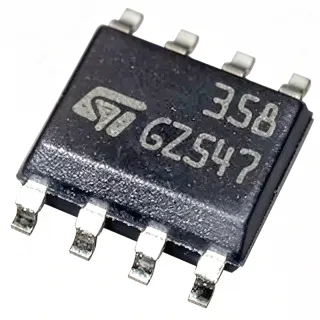
OPA1688 - 36V 10MHz Low Noise Audio Op Amp | TI
MPN: OPA1688ID ✓ Active| Qty | Unit Price | Extended |
|---|---|---|
| 1 | $1.45 | $1.45 |
| 10 | $1.3 | $13.00 |
| 100 | $1.1 | $110.00 |
| 500 | $0.95 | $475.00 |
| 1,000 | $0.82 | $820.00 |
OPA1688ID Overview
An operational amplifier (op amp) is a high-gain voltage amplifier with differential inputs and a single-ended output, fundamental to analog signal conditioning, filtering, and amplification. The OPA1688 belongs to the SoundPlus family of audio op amps, optimized for low noise, low distortion, and high output drive within the broader linear amplifier category used across audio, instrumentation, and communication systems.
Key features include 4.5 nV/√Hz input voltage noise, an 8 V/µs slew rate, and low quiescent current of 1.5 mA per channel. Excellent capacitive load stability allows direct drive of up to 1000 pF without oscillation, and ±75 mA output current enables direct headphone drive. The rail-to-rail output (RRO) stage maximizes dynamic range in single-supply designs.
Technically, the OPA1688 uses a complementary bipolar input stage with laser-trimmed input offset voltage of 0.5 mV (typical). The wide supply range supports both battery-powered and industrial systems, and the -40C to +85C operating range ensures reliability in demanding environments. THD+N of 0.00005% at 1 kHz and high PSRR preserve signal fidelity in high-fidelity audio paths.
Typical applications include headphone amplifiers, audio DAC output buffers, active filters, and professional audio mixing consoles. High output current and capacitive load stability make it especially suited to direct headphone drive, while low noise and distortion preserve audio integrity in portable devices where 1.5 mA quiescent current extends battery life.
Design tip: decouple supply pins with 0.1 µF ceramic capacitors placed close to the device, keep feedback paths short to minimize parasitic capacitance, and use an isolation resistor for capacitive loads beyond 1000 pF. Pricing references are as of 2026-08-30.
Drop-in alternatives for OPA1688ID — same package, pin-to-pin compatible. Different-package parts requiring PCB rework are excluded.
Variants in this series
Same-series models that are drop-in compatible with OPA1688ID (same form factor and footprint) — differing in Input Offset Voltage, Package, Supply Voltage Range, Gain Bandwidth Product, Amplifier Channels.
Quick Comparison Tool — Select alternative parts for side-by-side comparison:
OPA1656IDR
✅ Drop-In ⚠️ Specs Unverified📋 Reference alternative (not in catalog)
OPA1611AID
✅ Drop-In ⚠️ Specs Unverified📋 Reference alternative (not in catalog)
OPA828IDR
✅ Drop-In ⚠️ Specs Unverified✓ In Stock
$1.75 / Unit
View Datasheet →OPA1689IDR
✅ Drop-In📋 Reference alternative (not in catalog)
AD8599
✅ Drop-In ⚠️ Specs Unverified📋 Reference alternative (not in catalog)
OPA1688ID Maximum Ratings & Electrical Characteristics
| Amplifier Channels | 1 |
| Supply Voltage Range | 4.5 V to 36 V (±2.25 V to ±18 V) |
| Gain Bandwidth Product | 10 MHz |
| Slew Rate | 8 V/µs |
| Input Voltage Noise | 4.5 nV/√Hz |
| Quiescent Current | 1.5 mA per channel |
| Output Current | ±75 mA |
| THD+N | 0.00005% at 1 kHz |
| Input Offset Voltage | 0.5 mV typical |
| Output Type | Rail-to-Rail Output (RRO) |
| Capacitive Load Stability | Up to 1000 pF |
| Operating Temperature | -40C to +85C |
| Package | SOIC-8 (D) / WSON-8 |
| Mounting Type | Surface Mount |
| RoHS Status | Compliant |
OPA1688ID Pin Configuration
| Pin 1 | TRIM (NC/Offset) — No connect / offset trim per package variant |
| Pin 2 | IN- — Inverting input |
| Pin 3 | IN+ — Non-inverting input |
| Pin 4 | V- — Negative supply |
| Pin 5 | NC/TRIM — No connect / offset trim per package variant |
| Pin 6 | OUT — Rail-to-rail output |
| Pin 7 | V+ — Positive supply |
| Pin 8 | NC/TRIM — No connect / offset trim per package variant |
Typical Applications
OPA1688ID is suitable for 6 applications: Headphone Amplifiers, Audio DAC Output Buffering, Active Filters and Equalization, Professional Audio Mixing Consoles, Portable and Battery-Powered Audio, Precision Sensor Signal Conditioning.
Headphone Amplifiers
The OPA1688 fits headphone amplification directly: its ±75 mA output current drives 16 to 32 ohm headphone loads without a discrete buffer stage, while 4.5 nV/√Hz noise and 0.00005% THD+N at 1 kHz keep the signal path transparent. Stability with capacitive loads up to 1000 pF tolerates long headphone cables. In battery-powered portable players, 1.5 mA quiescent current per channel significantly extends playtime compared to higher-current audio op amps like the OPA1622.
Recommended
Audio DAC Output Buffering
As a DAC output buffer or I/V converter, the OPA1688 combines 10 MHz bandwidth with 0.00005% THD+N, preserving converter linearity at audio frequencies. The rail-to-rail output maximizes swing on 4.5 V single supplies common in portable DAC designs, and the wide 36 V range supports professional +18 V rails. Low input offset (0.5 mV typical) minimizes DC across headphone loads, eliminating the need for output coupling capacitors in many designs.
Recommended
Active Filters and Equalization
For active crossover, tone control, and RIAA equalization stages, the OPA1688's 10 MHz gain-bandwidth product ensures stable closed-loop gains with minimal phase error at 20 kHz. Low offset voltage (0.5 mV typical) reduces DC offset accumulation through cascaded filter stages, and the 36 V supply range allows high headroom in professional console architectures where interconnect noise immunity depends on maximum signal swing.
Recommended
Professional Audio Mixing Consoles
Console channel strips and bus summing amplifiers benefit from the OPA1688's balance of low noise, low distortion, and 36 V (±18 V) operation for maximum headroom on balanced lines. Its high output current handles low-impedance bus networks, while 1.5 mA quiescent current matters in large-format consoles where hundreds of op amps determine total power consumption and thermal load.
Recommended
Portable and Battery-Powered Audio
In smartphones, portable recorders, and wireless audio devices, the OPA1688's 1.5 mA quiescent current and 4.5 V minimum supply suit single-cell lithium (3.7 V nominal, boosted) systems. Micro package options reduce board area, and the rail-to-rail output extracts maximum swing as the battery discharges, keeping distortion low even near supply limits - a key advantage over conventional op amps whose output stages collapse near the rails.
Recommended
Precision Sensor Signal Conditioning
Beyond audio, the OPA1688 serves as a general-purpose 36 V amplifier for transducer front ends: 4.5 nV/√Hz noise resolves microvolt-level sensor signals, the wide supply range fits industrial 24 V rails, and -40C to +85C operation covers harsh environments. Capacitive load stability allows driving shielded cable directly, simplifying filtering at the sensor boundary in measurement instrumentation.
Recommended
Recommended Products Summary
Engineering reference data for OPA1688ID — comparison, design guidance, and compliance information.
Selection Guide
Comparison with Alternatives
| Parameter | This Product | OPA1656IDR | OPA1611AID | OPA828IDR | OPA1689IDR |
|---|---|---|---|---|---|
| Package | SOIC-8 (D) / WSON-8 | SOIC-8 | SOIC-8 | SOIC-8 | SOIC-8 |
| Brand | Texas Instruments | Texas Instruments | Texas Instruments | Texas Instruments | Texas Instruments |
| Channels | 1 | 1 | 1 | 1 | 2 |
| Supply Voltage | 4.5 V to 36 V | 4.5 V to 36 V | 4.5 V to 36 V | 10 V to 40 V | 4.5 V to 36 V |
| Gain Bandwidth | 10 MHz | 22 MHz | 80 MHz | 33 MHz | 10 MHz |
| Voltage Noise | 4.5 nV/√Hz | 2.9 nV/√Hz | 1.2 nV/√Hz | 3.3 nV/√Hz | 4.5 nV/√Hz |
| Quiescent Current | 1.5 mA/ch | 1 mA/ch | 3.6 mA/ch | 2.5 mA/ch | 1.5 mA/ch |
| Headphone Drive | Yes (±75 mA) | Limited | Limited | No | Yes (±75 mA) |
Key Differentiators
- Direct headphone drive without buffer stage (vs OPA1611AID)
- Lower cost and lower power than precision audio flagships (vs OPA1656IDR)
- Single-supply operation down to 4.5 V (vs OPA828IDR)
Design Notes
Decouple both supply pins with 0.1 µF ceramic capacitors placed within 2 mm of the V+ and V- pins, plus a 2.2-10 µF bulk capacitor per supply rail. Per TI datasheet SBOS724A layout guidance, keep the feedback path short to minimize parasitic capacitance at the inverting input, which can degrade phase margin at gains above 10.
Although the OPA1688 is stable with up to 1000 pF capacitive load, higher capacitive loads such as long shielded cables require an isolation resistor (typically 10-50 ohm) in series with the output to guarantee stability. Do not exceed the 36 V absolute maximum supply, and observe the -40C to +85C operating range; derate output current at elevated ambient temperatures.
When driving headphone loads directly, remember the ±75 mA output current rating is temperature dependent. At 32 ohm loads and high output swing, verify peak current stays within rating to avoid clipping-induced distortion. The RRO stage minimizes crossover artifacts, but source impedance before the amp should stay below 10 kohm to limit noise contribution and offset drift from bias currents.
Compliance Information
RoHS compliant per TI product page. AEC-Q100 qualification not indicated for this device.