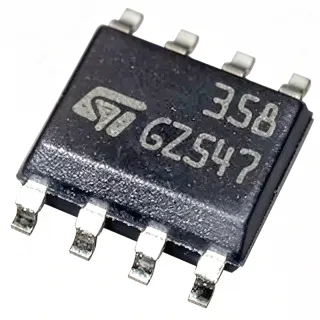
OPA2375IDDFR - Dual 10MHz 4.6nV Op Amp, TSOT-23-8 | TI
MPN: OPA2375IDDFR ✓ Active| Qty | Unit Price | Extended |
|---|---|---|
| 1 | $1.44 | $1.44 |
| 10 | $1.3 | $13.00 |
| 100 | $1.08 | $108.00 |
| 500 | $0.94 | $470.00 |
| 1,000 | $0.82 | $820.00 |
OPA2375IDDFR Overview
An operational amplifier (op amp) is a high-gain voltage amplifier with differential inputs, and it sits at the core of the analog signal chain hierarchy: op amp -> amplifier IC -> analog integrated circuit -> signal-conditioning subsystem. Within this hierarchy, low-noise precision CMOS amplifiers such as the OPA2375 bridge the gap between general-purpose and precision instrumentation amplifiers, conditioning sensor and transducer signals before analog-to-digital conversion.
Key features of the OPA2375IDDFR include a 10 MHz gain-bandwidth, an input-referred broadband noise of only 4.6 nV per root-hertz, a maximum input offset voltage of 500 uV, and rail-to-rail output swing that maximizes dynamic range on low-voltage rails. The CMOS input provides high input impedance and low bias current, important for high-impedance sensor interfaces.
Architecturally, the OPAx375 family (OPA375 single, OPA2375 dual, OPA4375 quad) uses a CMOS input stage with a rail-to-rail output stage (RRO). This combination delivers wide bandwidth and low noise simultaneously, a pairing usually traded off against each other, and the low offset of 500 uV maximum keeps DC accuracy acceptable in precision signal chains without system-level trimming.
Typical applications include sensor signal conditioning for pressure and temperature transducers, active filter stages ahead of precision ADCs, and transimpedance or buffer amplification in portable and battery-powered instrumentation where the 5.5 V maximum supply and small TSOT-23-8 footprint save board area.
Design consideration: the OPA2375 provides rail-to-rail output only (RRO), not rail-to-rail input. Keep the common-mode input range within the specified limits, typically about 1.5 V from either rail, or verify linearity in your operating region before committing the layout.
This page synthesizes distributor pricing from DigiKey, Mouser, LCSC and Octopart, drop-in alternative analysis, and practical design notes not found in the manufacturer datasheet, giving engineers a single citable reference for the OPA2375IDDFR.
Drop-in alternatives for OPA2375IDDFR — same package, pin-to-pin compatible. Different-package parts requiring PCB rework are excluded.
Variants in this series
Same-series models that are drop-in compatible with OPA2375IDDFR (same form factor and footprint) — differing in Package.
Quick Comparison Tool — Select alternative parts for side-by-side comparison:
OPA2375IDDT
✅ Drop-In📋 Reference alternative (not in catalog)
OPA2375IDDFR Maximum Ratings & Electrical Characteristics
| Amplifier Type | CMOS Operational Amplifier (RRO) |
| Number of Channels | 2 |
| Gain Bandwidth Product | 10 MHz |
| Input Voltage Noise | 4.6 nV per root-hertz (broadband) |
| Input Offset Voltage | 500 uV (maximum) |
| Supply Voltage Range | 2.2 V to 5.5 V |
| Supply Voltage Maximum | 5.5 V |
| Output Type | Rail-to-Rail Output (RRO) |
| Package | TSOT-23-8 (DDF) |
| Mounting Type | Surface Mount |
| Operating Temperature Range | -40C to +125C (I grade) |
| Family Members | OPA375 (single), OPA2375 (dual), OPA4375 (quad) |
| RoHS Status | Compliant |
| Unit Price | USD 1.4427 (LCSC, as of 2026-09-02) |
OPA2375IDDFR Pin Configuration
| Pin 1 | OUT A — Channel A output |
| Pin 2 | -IN A — Channel A inverting input |
| Pin 3 | +IN A — Channel A non-inverting input |
| Pin 4 | V- — Negative supply or ground |
| Pin 5 | +IN B — Channel B non-inverting input |
| Pin 6 | -IN B — Channel B inverting input |
| Pin 7 | OUT B — Channel B output |
| Pin 8 | V+ — Positive supply (2.2 V to 5.5 V) |
Typical Applications
OPA2375IDDFR is suitable for 6 applications: Precision ADC Anti-Aliasing Filter, Battery-Powered Sensor Conditioning, Industrial Current-Sense Post-Amplification, Portable Medical and Health Monitoring, Transimpedance Photodiode Amplifier, Audio Signal Conditioning and Active Filters.
Precision ADC Anti-Aliasing Filter
The OPA2375IDDFR fits precision ADC front ends because its 10 MHz gain-bandwidth provides ample open-loop gain at audio and low-frequency signal bands, keeping distortion low in Sallen-Key or multiple-feedback active filter stages, while 4.6 nV per root-hertz noise preserves the SNR budget of high-resolution converters such as the ADS131M08 delta-sigma ADC. In a typical 3.3 V design, the amplifier drives the ADC input directly with a series resistor and input capacitor for charge-kickback isolation; the rail-to-rail output swings close to the rails, maximizing usable input range on unipolar signals. Because the input is not rail-to-rail, bias the common-mode at mid-supply for best linearity. Its dual channels let one package implement two filter poles, halving board area versus single amplifiers in precision data-acquisition modules.
Recommended
Battery-Powered Sensor Conditioning
In battery-powered instruments, the OPA2375IDDFR conditions low-level sensor outputs on a single 3.3 V lithium or alkaline rail, since its 2.2 V minimum supply supports operation down to two NiMH cells or a nearly depleted lithium cell, and the 5.5 V maximum tolerates a fresh lithium primary. The 4.6 nV per root-hertz noise floor allows amplification of microvolt-level bridge, thermocouple or microphone signals without dominating system noise, and the 500 uV maximum offset keeps DC error acceptable in gain-of-100 stages where 50 mV of referred-to-output offset remains within typical ADC headroom. The rail-to-rail output recovers headroom as the battery sags, extending usable runtime, while the small TSOT-23-8 package conserves PCB area in handheld and wearable form factors.
Recommended
Industrial Current-Sense Post-Amplification
The OPA2375IDDFR serves as a post-amplification and filtering stage behind current-sense amplifiers in industrial 3.3 V and 5 V systems. A device such as the INA223AIDSKT converts shunt voltage to a ground-referenced output, and the OPA2375 then provides gain scaling, low-pass filtering of switching ripple, and low-impedance drive to an ADC. Its 10 MHz bandwidth supports fast settling after load transients, which matters in motor-drive and power-supply telemetry loops where the controller samples current within microseconds of a switching event. The 4.6 nV per root-hertz noise keeps measurement resolution high even at modest shunt values, and the -40C to +125C industrial grade matches factory-floor ambient requirements. Decouple both channels independently to prevent crosstalk between simultaneous current channels.
Recommended
Portable Medical and Health Monitoring
Portable medical devices benefit from the OPA2375IDDFR's combination of low noise and low-voltage single-supply operation. In biopotential and physiological sensor front ends, the 4.6 nV per root-hertz input noise permits high-gain first stages without masking millivolt-level signals, while the CMOS input stage presents high impedance that minimizes loading of high-impedance electrodes. The 2.2 V to 5.5 V supply range allows direct operation from a single lithium coin cell through regulation, and the rail-to-rail output maximizes dynamic range into the ADC on 3 V rails. The dual channel in one TSOT-23-8 package supports differential pair implementations with well-matched channels, improving common-mode rejection. Verify patient-isolation and IEC 60601 system-level requirements separately, since they apply to the complete design rather than the amplifier alone.
Recommended
Transimpedance Photodiode Amplifier
The OPA2375IDDFR works as a transimpedance amplifier (TIA) for photodiode signals in optical sensing, barcode scanning and pulse-oximetry modules. Its low input bias current, characteristic of the CMOS input stage, keeps photodiode current measurement from being corrupted by amplifier leakage, and the 10 MHz gain-bandwidth supports megohm-scale feedback resistors at moderate bandwidths. The key design trade-off is stability: total input capacitance from the photodiode plus cable adds a pole in the feedback loop, so calculate the required feedback capacitor Cf using Cf = sqrt(Cin/(2*pi*Rf*GBW)) as an estimate and validate with the TI photodiode amplification application notes. The second amplifier channel conveniently implements a following gain or filter stage, and the rail-to-rail output suits single-supply designs where the photodiode is referenced to ground.
Recommended
Audio Signal Conditioning and Active Filters
The OPA2375IDDFR conditions line-level audio in portable and compact consumer audio designs. Its 4.6 nV per root-hertz input noise is far below the thermal noise of typical source impedances, so it adds negligible hiss in gain stages, and the 10 MHz bandwidth keeps loop gain high at 20 kHz, yielding low distortion and flat response in tone, EQ and crossover filter stages. Rail-to-rail output on a 3.3 V or 5 V single supply maximizes headroom for line drivers, and the dual channel implements a complete stereo unity-gain buffer or one two-pole filter in a single TSOT-23-8 footprint. Because the input range is not rail-to-rail, bias inputs at mid-supply through the virtual ground of the filter topology. For headphone loads above tens of milliamps, add a dedicated driver stage after the OPA2375.
Recommended
Recommended Products Summary
Engineering reference data for OPA2375IDDFR — comparison, design guidance, and compliance information.
Selection Guide
Comparison with Alternatives
| Parameter | This Product | OPA2375IDDT |
|---|---|---|
| Package | TSOT-23-8 (DDF) | TSOT-23-8 (DDF) - same |
| Brand | Texas Instruments | Texas Instruments |
| Gain Bandwidth | 10 MHz | 10 MHz |
| Input Noise | 4.6 nV per root-hertz | 4.6 nV per root-hertz |
| Input Offset (max) | 500 uV | 500 uV |
| Supply Range | 2.2 V to 5.5 V | 2.2 V to 5.5 V |
| Output Stage | Rail-to-rail output (RRO) | Rail-to-rail output (RRO) |
| Packaging Quantity | 3000 (Tape & Reel) | 250 (Tape & Reel) |
Key Differentiators
- Dual channel density in TSOT-23-8 (vs OPA375IDDFR (single-channel family member))
- Low broadband noise with wide bandwidth combined (vs Micropower competitors (e.g. OPA2369 class))
- Rail-to-rail output on low-voltage supplies (vs Non-RRO precision bipolar amplifiers)
Design Notes
Decouple the V+ pin (pin 8) with a 100 nF ceramic capacitor placed within 2-3 mm of the pin, plus a 1 uF bulk capacitor per supply rail. In dual-channel operation, route channel A and channel B feedback networks symmetrically and keep the summing junctions (inverting inputs, pins 2 and 6) as small as possible to limit stray capacitance, which erodes phase margin at high gains. The TSOT-23-8 has no exposed pad, so thermal relief is limited; this is rarely an issue given the amplifier's low quiescent dissipation.
The OPA2375 is RRO, not rail-to-rail input: the input common-mode range does not extend to the positive rail. Configurations that drive an input near V+ (such as high-side sensing or unity-gain buffering of a signal near the positive rail) will exhibit input-stage nonlinearity. Keep input common-mode within the datasheet common-mode range, typically biasing signals at mid-supply on single-rail designs. Also verify phase margin in transimpedance circuits where photodiode capacitance adds a feedback-loop pole; estimate feedback capacitance before layout and confirm on the bench.
With 10 MHz of bandwidth, the OPA2375 will amplify RF and switching noise picked up on long input traces. Guard the high-impedance input nets with ground pour, keep feedback resistors below approximately 100 kilo-ohms where noise matters (resistor thermal noise of 100 kilo-ohms is about 40 nV per root-hertz, nearly 10x the amplifier's noise), and add a small series resistor with a Schottky clamp if inputs can be driven beyond the rails from off-board connections.
Compliance Information
Distributor listings (DigiKey, Mouser, LCSC) classify OPA2375IDDFR as RoHS-compliant and lead-free. REACH, halogen-free and conflict-minerals declarations not stated in provided data.