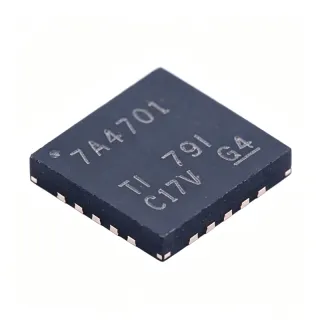
PCA9451A - PMIC for i.MX 93x, 6 Buck + 3 LDO | NXP
MPN: PCA9451A ✓ Active| Qty | Unit Price | Extended |
|---|---|---|
| 1 | $3.1 | $3.10 |
| 10 | $2.8 | $28.00 |
| 100 | $2.45 | $245.00 |
| 500 | $2.15 | $1,075.00 |
| 1,000 | $1.9 | $1,900.00 |
PCA9451A Overview
A power management IC (PMIC) is a highly integrated voltage regulator subsystem that consolidates multiple DC-DC converters, LDOs, load switches, sequencing logic, and supervisory functions into one device. In the power-management hierarchy it sits above discrete regulators and below system-level battery chargers, providing the complete multi-rail power tree an application processor requires while minimizing board area and BOM count.
Key features include the six buck regulators pre-configured with the voltage levels and power-up sequence required by the i.MX 93, three LDOs for analog and I/O rails, a 400 mA load switch for peripheral power gating, and an integrated 32.768 kHz crystal oscillator driver for the processor's RTC domain. The level translator channels bridge voltage domains between the PMIC and the processor's low-voltage I/O.
The PCA9451A is controlled via an I2C-bus interface supporting Standard-mode (100 kbit/s), Fast-mode (400 kbit/s) and Fast-mode plus (1 Mbit/s) transfers per NXP UM10204. Startup rail sequencing is factory-fixed for the i.MX 93, eliminating external sequencing logic. Regulator voltages can be adjusted dynamically over I2C for dynamic voltage and frequency scaling (DVFS).
Typical applications include i.MX 93 and i.MX 91 single-board computers, human-machine interface (HMI) panels, industrial edge gateways, portable battery-powered devices using 1-cell Li-Ion/Li-polymer cells, and 5 V adapter-powered non-portable designs.
When designing with this part, follow NXP application note AN13698 for external component selection - buck inductor values, output capacitor sizing, and layout of the power stage directly affect efficiency and output ripple.
This page synthesizes verified distributor data, NXP datasheet information, drop-in alternatives, and practical design guidance not found in a single manufacturer document.
Drop-in alternatives for PCA9451A — same package, pin-to-pin compatible. Different-package parts requiring PCB rework are excluded.
Quick Comparison Tool — Select alternative parts for side-by-side comparison:
PCA9451AHNY
✅ Drop-In📋 Reference alternative (not in catalog)
PCA9451AHNY-variant family
✅ Drop-In ⚠️ 参数待验证📋 Reference alternative (not in catalog)
PF9453
✅ Drop-In✓ In Stock
Contact for price
View Datasheet →PCA9451A Maximum Ratings & Electrical Characteristics
| Function | Power Management IC (PMIC) for i.MX 91x/93x processors |
| Buck Regulators | 6 |
| LDO Regulators | 3 |
| Total Buck Output Current | 6 A |
| Load Switch | 1 channel, 400 mA |
| Level Translator Channels | 2 |
| Crystal Oscillator Driver | 32.768 kHz |
| Input Supply | 5 V adapter or 1-cell Li-Ion / Li-polymer battery |
| Control Interface | I2C, 100 kbit/s / 400 kbit/s / 1 Mbit/s (Standard / Fast / Fast-mode Plus) |
| Power-Up Sequence | Factory-fixed for i.MX 93 |
| Target Processor | NXP i.MX 91x / 93x family |
| Ordering Code (DigiKey) | PCA9451AHNY |
| Mounting Type | Surface Mount |
PCA9451A standard Pin Configuration Guide
Pin configuration for PCA9451A (standard package). This power device features gate, drain, and source terminals. For non-polarized packages, refer to the manufacturer datasheet for exact pin 1 orientation and footprint details. Common applications include power supply design, motor driving, and load switching.

No detailed pinout data available for PCA9451A.
Refer to the datasheet for full pin configuration.
Typical Applications
PCA9451A is suitable for 6 applications: i.MX 93 Single-Board Computers, Battery-Powered Portable HMI Devices, Industrial Edge Gateways, HMI Touch Panels and Smart Displays, 5V Adapter-Powered Networked Devices, Medical and Diagnostic Portable Instruments.
i.MX 93 Single-Board Computers
The PCA9451A is purpose-built for i.MX 93 single-board computers and evaluation platforms. Its six buck converters are factory-programmed with the exact voltages and power-up sequence the i.MX 93 boot ROM expects, so the board powers up correctly without external sequencing CPLDs or supervisor ICs. With 6 A of total buck capability, it covers the Cortex-A55 core, DDR, and I/O rails in one chip, shrinking the power-tree area dramatically versus discrete solutions. In this role the PMIC sits between the 5 V barrel jack or battery and the processor rails, and its I2C interface (up to 1 Mbit/s Fast-mode Plus) allows the running software to modulate core voltage for DVFS power savings. Follow AN13698 for inductor and capacitor selection to meet i.MX 93 ripple requirements.
Recommended
Battery-Powered Portable HMI Devices
In 1-cell Li-Ion/Li-polymer portable products such as handheld HMIs, medical data terminals, and industrial tablets built on the i.MX 93, the PCA9451A accepts the battery voltage directly and generates all processor rails at high buck efficiency, maximizing runtime. The integrated 32.768 kHz crystal oscillator driver keeps the RTC domain alive in deep sleep, and the 400 mA load switch lets firmware power-gate peripherals such as displays, sensors, or wireless modules to cut standby drain. The three LDOs supply noise-sensitive analog rails without the switching ripple a buck would inject. Because the power-up sequence is fixed for i.MX 93, battery-insertion power-on behavior is deterministic. Designers should budget buck inductor RMS current for peak core loads and use the level translator channels to bridge the battery-domain and low-voltage I/O domains.
Recommended
Industrial Edge Gateways
Industrial edge gateways and IIoT nodes built around the i.MX 91 or i.MX 93 use the PCA9451A to derive all processor rails from a 5 V adapter or 24 V-derived 5 V bus. The PMIC's fixed i.MX 93 sequencing eliminates brown-out boot failures common with hand-rolled discrete sequencing, improving field reliability. Per NXP AN14012, the same PMIC supports both i.MX 91 and i.MX 93, letting one power design serve two processor SKUs and simplify qualification across product variants. The 6 A buck budget covers the processor plus LPDDR4 memory at full load, and the LDOs provide clean rails for Ethernet PHY and CAN/FD transceiver analog sections. Wide-temperature industrial qualification and RoHS-compliant packaging support conformal-coated factory-floor deployments.
Recommended
HMI Touch Panels and Smart Displays
Touch-panel HMIs for appliances, vending, and building control pair the i.MX 93 with display and touch controllers that need multiple clean, well-sequenced rails. The PCA9451A supplies the processor core, DDR, and I/O rails while its three LDOs power touch-sensor analog front ends and display interface logic with low noise. The 2-channel level translator is particularly useful here, bridging the processor's low-voltage GPIO domains to 3.3 V or 1.8 V peripheral interfaces without externalTranslator ICs. The 400 mA load switch can gate panel backlight boost converters or touch controllers during standby to meet energy-regulation limits. Because the PMIC is register-programmable over I2C at up to 1 Mbit/s, firmware can dim-power rails dynamically between screen-on and screen-off states.
Recommended
5V Adapter-Powered Networked Devices
Non-portable i.MX 93 products such as IP gateways, kiosks, and access-control terminals run from a 5 V wall adapter, which feeds the PCA9451A directly. The PMIC converts the 5 V input into the full multi-rail power tree with high efficiency, and its factory-fixed sequencing guarantees the i.MX 93 boots reliably on every adapter hot-plug event - a common failure mode with discrete designs lacking soft-start coordination. The three LDOs supply low-noise analog rails for audio codecs or sensor interfaces, while the 32.768 kHz oscillator driver provides the RTC timebase for networked time-stamping. Designers should select the adapter's output capacitance to hold up the 5 V input through inrush, and follow AN13698 guidance on buck output capacitors to keep load-transient droop within processor specification.
Recommended
Medical and Diagnostic Portable Instruments
Battery-operated medical instruments - handheld vital-sign monitors, portable diagnostic readers - built on the i.MX 93 benefit from the PCA9451A's combination of high-efficiency bucks for long battery life and low-noise LDOs for measurement analog front ends. Deterministic, factory-fixed power sequencing supports the reproducible start-up behavior medical software validation demands, and the I2C interface allows the application to report rail status to the device's safety supervisor. The 400 mA load switch isolates wireless or display subsystems during storage and transport power-down modes, extending shelf life on a single charge. Engineers should validate total quiescent draw in sleep states against the instrument's standby budget and consult NXP documentation for rail disable states when designing the power-fail safe-state behavior.
Recommended
Recommended Products Summary
Engineering reference data for PCA9451A — comparison, design guidance, and compliance information.
Selection Guide
Comparison with Alternatives
| Parameter | This Product | PCA9451AHNY | PF9453 |
|---|---|---|---|
| Brand | NXP Semiconductors | NXP Semiconductors | NXP Semiconductors |
| Supported Processor | i.MX 91x / 93x | i.MX 91x / 93x | i.MX 91 / 93 (per AN14012) |
Key Differentiators
- Factory-fixed i.MX 93 power sequencing (vs PF9453)
- Integrated ancillary functions reduce BOM (vs PF9453)
- Dual application coverage (vs Generic multi-rail PMICs)
Design Notes
Follow NXP application note AN13698 for the external power-stage design: select buck inductor saturation current above peak load, place input decoupling capacitors within a few millimeters of the PVIN pins, and keep high-di/dt buck loops as small as possible. The i.MX 93 core rail is the highest-current output - use multiple vias from the PMIC power pads to internal planes and size copper for the 6 A total buck budget with margin.
The PCA9451A's power-up sequence is factory-fixed for the i.MX 93 - do not attempt to reorder rails in hardware. Rail voltages changed over I2C during DVFS must stay within the i.MX 93 operating-point table or the processor will lock up; coordinate PMIC register writes with the clock-frequency change in software. Also reference NXP UM10204 for correct I2C timing at Fast-mode Plus (1 Mbit/s), since bus capacitance limits may pull actual speed below nominal.
When powering from a 1-cell Li-Ion battery, verify each buck's dropout behavior at the 3.0 V end-of-discharge voltage - buck efficiency and maximum duty cycle degrade near the input floor. For 5 V adapter designs, confirm the adapter can supply the combined peak buck load (up to 6 A aggregate) plus peripheral load-switch current without voltage droop below the PMIC's undervoltage-lockout threshold; add bulk input capacitance if the adapter cable is long.
Compliance Information
Compliance data not present in the provided web data; consult the NXP product page for current RoHS/REACH declarations.