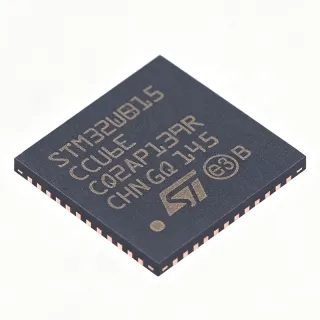
CYW43455XKUBGT - Wi-Fi 5 + Bluetooth 5.3 Combo SoC | Infineon
MPN: CYW43455XKUBGT ✓ Active| Qty | Unit Price | Extended |
|---|---|---|
| 1 | $3.85 | $3.85 |
| 10 | $3.66 | $36.60 |
| 100 | $3.47 | $347.00 |
| 500 | $3.3 | $1,650.00 |
| 1,000 | $3.14 | $3,140.00 |
Drop-in alternatives for CYW43455XKUBGT — same package, pin-to-pin compatible. Different-package parts requiring PCB rework are excluded.
Quick Comparison Tool — Select alternative parts for side-by-side comparison:
CYW43455XKUBG
✅ Drop-In ⚠️ 参数待验证📋 Reference alternative (not in catalog)
CYW43455XKUBGTXG
✅ Drop-In ⚠️ 参数待验证📋 Reference alternative (not in catalog)
BCM43455XKUBGT
✅ Drop-In📋 Reference alternative (not in catalog)
QCA9377
✅ Drop-In📋 Reference alternative (not in catalog)
MT7668
✅ Drop-In📋 Reference alternative (not in catalog)
CYW43455XKUBGT Maximum Ratings & Electrical Characteristics
| Device Type | Wi-Fi + Bluetooth Combo SoC (RF TxRx + MCU) |
| Wi-Fi Standard | 802.11a/b/g/n/ac (Wi-Fi 5) |
| Bluetooth Version | Bluetooth 5.3 (DigiKey listing cites Bluetooth v4.1 base rating) |
| Frequency Bands | 2.4 GHz and 5 GHz |
| Maximum PHY Data Rate | 433.3 Mbps |
| Receiver Sensitivity | -95.5 dBm |
| MIMO Configuration | 1x1 SISO |
| Coexistence Interface | Integrated Wi-Fi and Bluetooth coexistence, 2-/3-wire GCI |
| Package | 140-UFBGA, WLBGA (WLCSP), 4.47 x 5.27 mm |
| Automotive Grade | N (not automotive qualified) |
| Silicon | Device Type: Silicon |
| Mounting Type | Surface Mount |
CYW43455XKUBGT 140-ufbga, wlbga (wlcsp), 4.47 x 5.27 mm Pin Configuration Guide
Complete pinout information for CYW43455XKUBGT (140-ufbga, wlbga (wlcsp), 4.47 x 5.27 mm package). This digital IC includes GPIO, communication interfaces (UART, SPI, I2C), and power pins. Refer to the manufacturer datasheet for alternate pin functions and configuration options. Essential for embedded system design and PCB layout.

No detailed pinout data available for CYW43455XKUBGT.
Refer to the datasheet for full pin configuration.
Safe Operating Area (SOA) & Thermal Characteristics
No official SOA curve available for this digital IC. Always operate within absolute maximum ratings specified in the datasheet. Ensure adequate cooling and derate as needed.
Typical Applications
CYW43455XKUBGT is suitable for 6 applications: Smart Home Hubs and IoT Gateways, IP Cameras and Video Doorbells, Single-Board Computers and Compute Modules, Streaming Media Sticks and Set-Top Boxes, Wearables and Portable Audio Devices, Industrial Wireless Sensor Nodes and Edge Devices.
Smart Home Hubs and IoT Gateways
The CYW43455XKUBGT fits smart home hubs and IoT gateways because its dual-band 802.11ac radio with 433.3 Mbps peak PHY provides enough uplink bandwidth to aggregate dozens of low-bandwidth Zigbee, BLE, and Thread endpoints, while Bluetooth 5.3 enables direct commissioning of BLE devices without a second radio. The 1x1 SISO single-antenna architecture keeps the RF front end to one antenna, one switch path, and minimal matching components, which is critical in cost-sensitive hub hardware. The integrated 2-/3-wire GCI coexistence mechanism arbitrates the shared antenna between Wi-Fi and Bluetooth traffic in hardware, preventing the latency spikes that plague software-arbitrated dual-radio designs. Deployed between the host SoC via SDIO and the front-end module, the -95.5 dBm receiver sensitivity maintains connectivity at the far corners of a typical home coverage cell.
Recommended
IP Cameras and Video Doorbells
Network cameras and video doorbells need sustained multi-megabit uplink for 1080p or 4K streams, and the CYW43455XKUBGT delivers with 802.11ac 80 MHz channels reaching 433.3 Mbps PHY, roughly 200-300 Mbps of realistic throughput - ample for two simultaneous 1080p30 streams. The -95.5 dBm receiver sensitivity extends usable range at the edge of coverage, which matters for outdoor doorbell placements far from the router. Bluetooth 5.3 supports BLE-based setup flows and proximity detection for motion-arming features. Because the part integrates both radios with hardware coexistence, the camera can maintain a BLE maintenance link while streaming Wi-Fi video without antenna or scheduling conflicts. Its compact 4.47 x 5.27 mm WLCSP footprint fits inside slim doorbell and camera enclosures where module-height clearance is limited.
Recommended
Single-Board Computers and Compute Modules
The CYW43455 silicon is the connectivity engine of Raspberry Pi 3B+/4-class boards and the Compute Module 4, making the bare CYW43455XKUBGT the natural choice for carrier boards and industrial SBC derivatives that inherit the reference design. The benefit is software certainty: upstream Linux brcmfmac drivers, firmware blobs, and NVRAM calibration examples are public and battle-tested by millions of deployments, eliminating the biggest risk in embedded Wi-Fi integration. Designers replicate the proven SDIO 3.0 bus connection for WLAN and the UART/PCM links for Bluetooth, achieving 433.3 Mbps dual-band 802.11ac and Bluetooth 5.3 with identical behavior to the reference platforms. Hardware GCI coexistence and the shared single-antenna path match the reference module layout, so regulatory test data can often be partially leveraged.
Recommended
Streaming Media Sticks and Set-Top Boxes
TV sticks and budget set-top boxes require dual-band 802.11ac to pull 4K streams, and the CYW43455XKUBGT's 433.3 Mbps PHY on the clean 5 GHz band sustains the 25-50 Mbps needed for 4K HDR with headroom for retransmissions in congested environments. The 1x1 SISO architecture keeps BOM and antenna cost minimal - one dual-band PIFA or FPC antenna serves both Wi-Fi and Bluetooth. Bluetooth 5.3 connects voice remote controls and game controllers via BLE or BR/EDR concurrently with video streaming, with the 2-/3-wire GCI interface guaranteeing Wi-Fi throughput is not starved during active Bluetooth use. The bare-die WLCSP form factor allows the radio to sit directly on the main PCB beneath EMI shielding, meeting the tight z-height limits of HDMI-stick enclosures.
Recommended
Wearables and Portable Audio Devices
For head-mounted displays, portable speakers, and connected wearables, the CYW43455XKUBGT offers an attractive power/performance envelope: a single combo SoC replaces separate Wi-Fi and Bluetooth chips, cutting quiescent power, PCB area, and antenna count in half. Bluetooth 5.3 supports audio profiles and BLE companion links, while 802.11ac at 433.3 Mbps handles firmware updates, cloud sync, and content caching on demand. The small 4.47 x 5.27 mm WLCSP suits battery-constrained enclosures, and single-antenna SISO operation simplifies industrial-design constraints around metal housings. The -95.5 dBm sensitivity keeps connections alive at gym, street, or building-edge distances where margin is thin. Power-optimized firmware governors from the WICED SDK allow duty-cycled operation that extends battery life in intermittently connected wearable products.
Recommended
Industrial Wireless Sensor Nodes and Edge Devices
Industrial edge devices - machine monitors, environmental sensors, and asset trackers - increasingly demand Wi-Fi for high-rate backhaul and BLE for local commissioning, exactly the combination the CYW43455XKUBGT integrates on one die. The 5 GHz 802.11ac band avoids the crowded 2.4 GHz factory floor spectrum where legacy 802.11b sensor networks and Bluetooth coexist, and the 433.3 Mbps rate permits burst transfers of vibration or vision data between long low-power idle periods. Hardware GCI coexistence and a single antenna reduce certification complexity in metal-panel enclosures. Note that this part is not automotive grade (Automotive Grade: N per the datasheet summary), so it targets factory and building infrastructure rather than in-vehicle positions. The Linux brcmfmac stack and Infineon SDKs provide secure OTA and WPA3-ready firmware paths for industrial cybersecurity requirements.
Recommended
Recommended Products Summary
Engineering reference data for CYW43455XKUBGT — comparison, design guidance, and compliance information.
Selection Guide
Comparison with Alternatives
| Parameter | This Product | BCM43455XKUBGT | QCA9377 | MT7668 |
|---|---|---|---|---|
| Brand | Infineon | Broadcom | Qualcomm | MediaTek |
| Package | 140-ball WLCSP (WLBGA/UFBGA), 4.47 x 5.27 mm | 140-ball WLCSP - identical (same die) | [DATA_NEEDED: package] | [DATA_NEEDED: package] |
| Wi-Fi Standard | 802.11a/b/g/n/ac (Wi-Fi 5) | 802.11a/b/g/n/ac - same | 802.11a/b/g/n/ac (Wi-Fi 5) | 802.11a/b/g/n/ac (Wi-Fi 5) |
| Max PHY Data Rate | 433.3 Mbps | 433.3 Mbps - identical | 433.3 Mbps (1x1 802.11ac) | 433 Mbps (1x1 802.11ac) |
| Bluetooth Version | Bluetooth 5.3 (Infineon page) | Bluetooth 5.x - same die | Bluetooth 5.x | Bluetooth 5.x |
| Bands | 2.4 GHz + 5 GHz | 2.4 GHz + 5 GHz - same | 2.4 GHz + 5 GHz | 2.4 GHz + 5 GHz |
| Drop-in Compatible (same footprint) | - | Yes - pin-to-pin (same silicon) | No - PCB redesign required | No - PCB redesign required |
| Automotive Grade | N | N | [DATA_NEEDED] | [DATA_NEEDED] |
Key Differentiators
- Massively proven software ecosystem (vs QCA9377)
- True drop-in second source exists (vs MT7668)
- Single-chip dual-radio coexistence (vs QCA9377)
Design Notes
As a bare-die WLCSP-140 device, the CYW43455XKUBGT is sensitive to fanout density and PCB stackup. Follow the Infineon reference layout: use at least 4 layers with a solid unbroken ground plane on layer 2 directly beneath the die, keep the 50-ohm antenna trace short with a grounded coplanar waveguide geometry, and place RF matching components per the reference design values. Avoid routing high-speed SDIO signals under the RF section. Ball-map re-mapping should replicate the Raspberry Pi CM4 module reference, since its layout is field-proven at volume.
The WLAN host interface runs SDIO at up to 50 MHz (SDIO 3.0 class); keep the CLK, CMD, and D0-D3 traces length-matched within a few millimeters and route over a continuous reference plane. Add series damping resistors on SDIO CLK if the bus exceeds roughly 15 mm of trace. Bluetooth UART should be kept below 4 Mbps with clean ground returns. Because both radios share one antenna through the internal GCI arbitration, do not add external switch logic between the chip and antenna unless adding a front-end module - external switching can corrupt the timing assumptions of the coexistence scheme.
The most common integration failure is firmware/NVRAM mismatch: the CYW43455 requires a board-specific NVRAM text file (calibration data) loaded by the host driver, and reusing another board's NVRAM causes poor sensitivity, TX power violations, or regulatory non-compliance. Second, confirm the exact Bluetooth capability of your firmware build - the chip supports BT 5.3 per Infineon, but feature enablement (LE coded PHY, LE Audio) is firmware-dependent. Third, this part is not automotive grade; do not deploy it in AEC-Q100-required sockets. Always obtain the datasheet PDF from infineon.com/part/CYW43455 for the verified ballout before layout freeze.
Compliance Information
Datasheet summary explicitly states Automotive Grade: N, so AEC-Q100 qualification is not applicable/achieved. RoHS, REACH, lead-free and halogen-free status are not stated in the provided source data and must be confirmed from Infineon's official product page and material declarations.