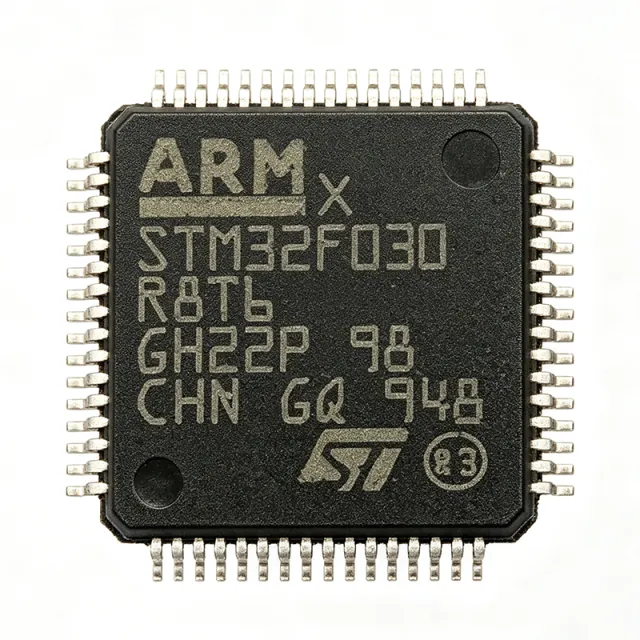
STM32F030R8T6 - 64KB Flash ARM Cortex-M0 MCU | STMicroelectronics
MPN: STM32F030R8T6 ✓ Active| Qty | Unit Price | Extended |
|---|---|---|
| 1 | $1.93 | $1.93 |
| 10 | $1.29 | $12.90 |
| 100 | $1.17 | $117.00 |
| 500 | $1.12 | $560.00 |
| 960 | $0.99 | $950.40 |
STM32F030R8T6 Overview
What is a microcontroller? A microcontroller (MCU) is a compact integrated circuit designed to govern a specific operation in an embedded system. It integrates a processor core, memory (Flash and SRAM), and programmable input/output peripherals on a single chip. The STM32F030R8T6 belongs to the STM32F0 series, which is part of the broader STM32 family of 32-bit ARM Cortex-M microcontrollers. This hierarchy places it within the ARM Cortex-M0 category, a low-power, entry-level core optimized for cost-sensitive applications.
Key features include 64KB of Flash memory, 8KB of SRAM, and a rich set of peripherals: five USARTs, two SPI interfaces, two I2C interfaces, one 12-bit ADC with up to 16 channels, and multiple 16-bit timers. The device also includes a 12-bit DAC, a DMA controller, and a real-time clock (RTC). The LQFP-64 package provides 51 GPIO pins, enabling flexible I/O expansion for various applications.
The STM32F030R8T6 is built on a 32-bit ARM Cortex-M0 core with a Harvard architecture, achieving 1.25 DMIPS/MHz. It supports a wide operating temperature range of -40°C to +85°C, making it suitable for industrial environments. The device is RoHS compliant and lead-free, aligning with modern environmental standards.
Typical applications include industrial control systems, consumer electronics, IoT devices, motor control, and home automation. Its low power consumption and rich peripheral set make it ideal for battery-powered applications and sensor interfacing.
When designing with this MCU, ensure proper decoupling of the power supply pins and consider the use of the internal RC oscillator for cost-sensitive designs, or an external crystal for higher accuracy. The device supports in-system programming via SWD, facilitating firmware updates in production.
This page synthesizes distributor pricing, drop-in alternatives, and practical design notes not found in the ST datasheet, providing a comprehensive resource for engineers evaluating the STM32F030R8T6.
Drop-in alternatives for STM32F030R8T6 — same package, pin-to-pin compatible. Different-package parts requiring PCB rework are excluded.
Variants in this series
Same-series models that are drop-in compatible with STM32F030R8T6 (same form factor and footprint) — differing in ADC, Flash Memory, SRAM, Timers.
Quick Comparison Tool — Select alternative parts for side-by-side comparison:
STM32F030R8T7
📋 Reference alternative (not in catalog)
STM32F031R8T6
📋 Reference alternative (not in catalog)
STM32F042R8T6
📋 Reference alternative (not in catalog)
STM32F030R8T6 Maximum Ratings & Electrical Characteristics
| Core | ARM Cortex-M0 |
| Core Frequency | 48 MHz |
| Flash Memory | 64 KB |
| SRAM | 8 KB |
| Supply Voltage | 2.4 V to 3.6 V |
| Package | LQFP-64 |
| GPIO Pins | 51 |
| ADC | 12-bit, 16 channels |
| DAC | 12-bit, 1 channel |
| Timers | Multiple 16-bit timers |
| USART | 5 |
| SPI | 2 |
| I2C | 2 |
| DMA | Yes |
| RTC | Yes |
| Operating Temperature | -40°C to +85°C |
| RoHS | Compliant |
| Lead-Free | Yes |
STM32F030R8T6 Pin Configuration
| Pin 1 | VBAT — Battery backup for RTC |
| Pin 2 | PC13 — GPIO / RTC output |
| Pin 3 | PC14 — GPIO / OSC32_IN |
| Pin 4 | PC15 — GPIO / OSC32_OUT |
| Pin 5 | PF0 — GPIO / OSC_IN |
| Pin 6 | PF1 — GPIO / OSC_OUT |
| Pin 7 | NRST — Reset (active low) |
| Pin 8 | VDD — Power supply |
| Pin 9 | VSS — Ground |
| Pin 10 | PA0 — GPIO / ADC_IN0 |
| Pin 11 | PA1 — GPIO / ADC_IN1 |
| Pin 12 | PA2 — GPIO / USART2_TX |
| Pin 13 | PA3 — GPIO / USART2_RX |
| Pin 14 | PA4 — GPIO / SPI1_NSS |
| Pin 15 | PA5 — GPIO / SPI1_SCK |
| Pin 16 | PA6 — GPIO / SPI1_MISO |
| Pin 17 | PA7 — GPIO / SPI1_MOSI |
| Pin 18 | PB0 — GPIO / ADC_IN8 |
| Pin 19 | PB1 — GPIO / ADC_IN9 |
| Pin 20 | PB2 — GPIO / BOOT1 |
Typical Applications
STM32F030R8T6 is suitable for 6 applications: Industrial Control, Consumer Electronics, IoT Devices, Motor Control, Home Automation, Medical Devices.
Industrial Control
The STM32F030R8T6 is ideal for industrial control systems due to its rich set of timers, ADC, and communication interfaces. Its 48 MHz Cortex-M0 core provides sufficient processing power for real-time control loops, while the 12-bit ADC enables precise sensor readings. The device's wide operating temperature range (-40°C to +85°C) ensures reliability in harsh factory environments. In a typical PLC or motor controller, the MCU manages digital I/O, reads analog sensors, and communicates via Modbus or CAN. The multiple USARTs allow simultaneous communication with HMI panels and supervisory systems. The DMA controller offloads data transfer, reducing CPU load and improving response times. The low power consumption and robust design make it a cost-effective choice for distributed control nodes.
Recommended
Consumer Electronics
In consumer electronics, the STM32F030R8T6 provides a balance of performance, cost, and power efficiency. Its 64KB Flash and 8KB SRAM are sufficient for user interface handling, sensor fusion, and connectivity protocols. The device supports multiple low-power modes, extending battery life in portable devices. For example, in a smart home thermostat, the MCU reads temperature and humidity sensors, drives an LCD, and communicates via I2C or SPI with a Wi-Fi module. The 12-bit ADC ensures accurate sensor readings, while the timers generate PWM for backlight control. The small LQFP-64 package allows compact PCB designs, and the wide supply voltage range (2.4V-3.6V) accommodates various battery chemistries. The rich peripheral set reduces the need for external components, lowering BOM cost.
Recommended
IoT Devices
The STM32F030R8T6 is well-suited for IoT edge nodes that require low power consumption and reliable communication. Its ARM Cortex-M0 core is energy-efficient, and the device offers multiple low-power modes, including sleep and standby, to conserve battery. The integrated USART, SPI, and I2C interfaces allow seamless connection to various wireless modules (e.g., LoRa, Zigbee, BLE). In a typical IoT sensor node, the MCU periodically wakes up, reads sensors, processes data, and transmits it via a radio module. The 12-bit ADC and DMA enable efficient sensor data acquisition without CPU intervention. The device's wide operating temperature range and robust design ensure reliable operation in outdoor environments. The 64KB Flash provides ample space for firmware updates over the air (OTA).
Recommended
Motor Control
The STM32F030R8T6 is an excellent choice for motor control applications, including brushless DC (BLDC) motors and stepper motors. Its multiple 16-bit timers can generate complementary PWM signals with dead-time insertion, essential for driving H-bridges. The 12-bit ADC with up to 16 channels allows simultaneous sampling of phase currents and DC bus voltage. The DMA controller can automatically transfer ADC results to memory, reducing CPU overhead. The device's 48 MHz core provides enough computational power for sensorless FOC (Field-Oriented Control) algorithms. In a typical BLDC motor driver, the MCU reads Hall sensors or back-EMF, computes the commutation sequence, and updates PWM duty cycles. The rich peripheral set and low cost make it a popular choice for power tools, drones, and automotive actuators.
Recommended
Home Automation
In home automation, the STM32F030R8T6 serves as a central controller for lighting, HVAC, and security systems. Its multiple communication interfaces (USART, SPI, I2C) enable integration with various sensors and actuators. The device's low power consumption is ideal for always-on applications, such as smart switches and thermostats. For example, in a smart lighting system, the MCU receives commands from a central hub via Zigbee or Wi-Fi, controls LED drivers via PWM, and monitors current via the ADC. The 64KB Flash allows storing multiple automation scenes and schedules. The device's robust design ensures long-term reliability in residential environments. The LQFP-64 package provides enough GPIOs to interface with multiple buttons, LEDs, and relays.
Recommended
Medical Devices
The STM32F030R8T6 is suitable for portable medical devices such as glucose meters, pulse oximeters, and blood pressure monitors. Its low power consumption extends battery life, and its rich analog peripherals enable precise sensor measurements. The 12-bit ADC can interface with various biosensors, while the DMA ensures efficient data acquisition. The device's small footprint and wide operating temperature range make it ideal for handheld devices. In a pulse oximeter, the MCU controls LED drivers, samples photodiode signals, and computes SpO2 levels. The 64KB Flash provides ample space for signal processing algorithms and user interface code. The device's reliability and long-term availability are critical for medical applications, and the STM32F0 series is known for its longevity.
Recommended
Recommended Products Summary
Engineering reference data for STM32F030R8T6 — comparison, design guidance, and compliance information.
Selection Guide
Comparison with Alternatives
| Parameter | This Product | STM32F030R8T7 | STM32F031R8T6 | STM32F042R8T6 |
|---|---|---|---|---|
| Package | LQFP-64 | LQFP-64 (same) | LQFP-64 (same) | LQFP-64 (same) |
| Core Frequency | 48 MHz | 48 MHz | 48 MHz | 48 MHz |
| Flash Memory | 64 KB | 64 KB | 64 KB | 64 KB |
| SRAM | 8 KB | 8 KB | 8 KB | 8 KB |
| USART | 5 | 5 | 7 | 6 |
| SPI | 2 | 2 | 3 | 3 |
| I2C | 2 | 2 | 2 | 2 |
| USB | No | No | No | Yes (USB 2.0 FS) |
| CAN | No | No | No | Yes |
| Operating Temperature | -40°C to +85°C | -40°C to +105°C | -40°C to +85°C | -40°C to +85°C |
Key Differentiators
- Higher number of USARTs (5) compared to some alternatives (vs STM32F030C8T6)
- Larger package with more GPIOs (vs STM32F030C8T6)
- Cost-effective entry-level Cortex-M0 (vs STM32F103R8T6)
Design Notes
Decouple the VDD pins with 100nF ceramic capacitors placed as close as possible to each VDD pin. Additionally, use a 4.7µF or larger bulk capacitor near the main power input. The STM32F030R8T6 operates from 2.4V to 3.6V, so ensure the supply is stable and within this range. For battery-powered designs, consider using the low-power modes (Sleep, Stop, Standby) to extend battery life.
For the LQFP-64 package, ensure proper soldering by following the recommended land pattern in the datasheet. Use a 4-layer PCB with a solid ground plane to minimize noise and improve EMC. Place the crystal oscillator (if used) close to the OSC_IN/OSC_OUT pins and keep the trace lengths short. Add series resistors (e.g., 22Ω) on high-speed signals like SPI to reduce ringing.
Do not leave unused GPIO pins floating; configure them as outputs or enable internal pull-ups/pull-downs to avoid excessive current consumption. Ensure the BOOT0 pin is properly tied to GND for normal boot from Flash. When using the internal RC oscillator, note that its accuracy is ±1% over temperature, which may not be sufficient for time-critical applications like USB; use an external crystal for such cases.
Compliance Information
RoHS compliant and lead-free per STMicroelectronics product page. AEC-Q100 not applicable for this standard-grade part.