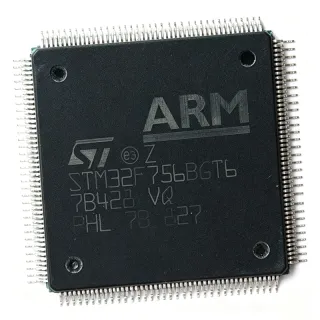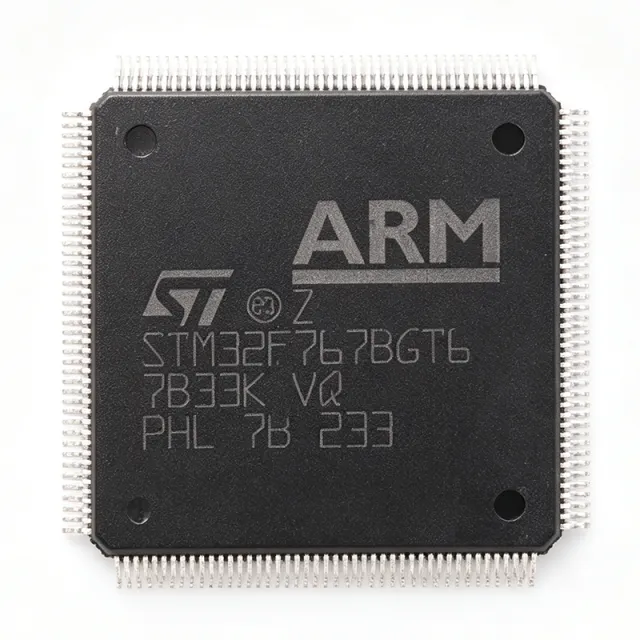
STM32F767BGT6 - 216MHz Cortex-M7 MCU, 1MB Flash | STMicroelectronics
MPN: STM32F767BGT6 ✓ Active| Qty | Unit Price | Extended |
|---|---|---|
| 1 | $17.94 | $17.94 |
| 10 | $14.33 | $143.30 |
| 25 | $13.43 | $335.75 |
| 100 | $12.44 | $1,244.00 |
| 360 | $11.81 | $4,251.60 |
| 720 | $11.55 | $8,316.00 |
STM32F767BGT6 Overview
A microcontroller (MCU) is a compact integrated circuit designed to govern a specific operation in an embedded system. It contains a processor core, memory, and programmable input/output peripherals on a single chip. The STM32F7 series sits at the high-performance end of the STM32 portfolio, positioned above the mainstream F4 series and below the application processors in the STM32MP1 line. This hierarchy places the STM32F767BGT6 as a top-tier MCU for applications requiring significant compute power and connectivity.
Key features include a 216 MHz Arm Cortex-M7 core with double-precision FPU, 1 MB of flash memory, 512 KB of SRAM, and a comprehensive set of peripherals. The device supports a wide range of communication interfaces, including USB OTG HS/FS, Ethernet, multiple USARTs, SPIs, I2Cs, and CAN. It also features an LCD-TFT controller and a DSI host, enabling direct connection to displays. The STM32F767BGT6 is available in a 208-pin LQFP package (28x28 mm), providing ample I/O for complex designs.
The STM32F767BGT6 leverages the Arm Cortex-M7 architecture, which includes a 6-stage pipeline, branch prediction, and a memory protection unit (MPU). The FPU supports both single and double precision, accelerating mathematical operations for signal processing and control algorithms. The device also includes a Chrom-ART Accelerator™ for 2D graphics, offloading the CPU for graphical user interfaces. With its high clock speed and advanced peripherals, the STM32F767BGT6 excels in applications such as industrial control, motor control, audio processing, and human-machine interfaces.
Typical applications include high-end industrial automation, robotics, audio processing, and advanced human-machine interfaces. The device's high performance and rich peripheral set make it ideal for applications requiring real-time control and complex user interfaces. For example, in industrial automation, the STM32F767BGT6 can handle multiple communication protocols simultaneously while executing complex control algorithms.
When designing with the STM32F767BGT6, ensure adequate power supply decoupling with 100 nF capacitors close to each power pin and a bulk capacitor. The device supports a wide supply voltage range of 1.7V to 3.6V, allowing flexible power design. For high-speed communication interfaces, pay attention to PCB layout to maintain signal integrity.
Drop-in alternatives for STM32F767BGT6 — same package, pin-to-pin compatible. Different-package parts requiring PCB rework are excluded.
Variants in this series
Same-series models that are drop-in compatible with STM32F767BGT6 (same form factor and footprint) — differing in Flash Memory, Package, SRAM, Core, Core Architecture.
Quick Comparison Tool — Select alternative parts for side-by-side comparison:
STM32F429BGT6
✓ In Stock
$7.24 / Unit
View Datasheet →STM32F767ZGT6
📋 Reference alternative (not in catalog)
STM32F746BGT6
✓ In Stock
$11.05 / Unit
View Datasheet →GD32F767BGT6
📋 Reference alternative (not in catalog)
STM32F767BGT6 Maximum Ratings & Electrical Characteristics
| Core | Arm Cortex-M7 |
| Core Architecture | 32-bit |
| Maximum Clock Frequency | 216 MHz |
| Flash Memory | 1 MB (1M x 8) |
| SRAM | 512 KB |
| Number of I/O Pins | 168 |
| Package | 208-LQFP (28x28 mm) |
| Operating Temperature Range | -40C to +85C |
| Supply Voltage Range | 1.7V to 3.6V |
| DSP Instructions | Yes |
| Floating Point Unit | Yes (double precision) |
| USB OTG | HS/FS |
| Ethernet | Yes |
| LCD Controller | Yes |
| DSI Host | Yes |
| DMIPS | 462 |
| Mounting Type | Surface Mount |
| RoHS Status | Compliant |
STM32F767BGT6 Pin Configuration
| Pin 1 | PE2 — GPIO / alternate function |
| Pin 10 | VSS — Ground |
| Pin 20 | VDD — Power supply |
| Pin 30 | PA0 — GPIO / ADC input |
| Pin 40 | PB0 — GPIO / timer channel |
| Pin 50 | PC0 — GPIO / ADC input |
| Pin 60 | PD0 — GPIO / FSMC |
| Pin 70 | PE0 — GPIO / timer |
| Pin 80 | PF0 — GPIO / oscillator |
| Pin 90 | PG0 — GPIO / FSMC |
| Pin 100 | PH0 — GPIO / oscillator |
| Pin 110 | PI0 — GPIO / alternate function |
| Pin 120 | VDD — Power supply |
| Pin 130 | PA8 — GPIO / USB |
| Pin 140 | PB8 — GPIO / I2C |
| Pin 150 | PC8 — GPIO / SDIO |
| Pin 160 | PD8 — GPIO / USART |
| Pin 170 | PE8 — GPIO / timer |
| Pin 180 | PF8 — GPIO / SPI |
| Pin 190 | PG8 — GPIO / Ethernet |
| Pin 200 | PH8 — GPIO / alternate function |
| Pin 208 | PI8 — GPIO / alternate function |
Typical Applications
STM32F767BGT6 is suitable for 6 applications: Industrial Automation, Motor Control, Audio Processing, Human-Machine Interface (HMI), IoT Gateway, Medical Devices.
Industrial Automation
The STM32F767BGT6 is ideal for industrial automation due to its high processing power (462 DMIPS) and extensive communication interfaces. It can handle multiple protocols like Ethernet, CAN, and USART simultaneously, enabling real-time control of machinery and processes. The device's 1 MB flash and 512 KB SRAM provide ample space for complex control algorithms and data logging. Its wide operating temperature range (-40C to +85C) ensures reliability in harsh industrial environments. The 168 I/O pins allow connection to sensors, actuators, and human-machine interfaces, making it a versatile choice for PLCs, robotics, and factory automation systems.
Recommended
Motor Control
The STM32F767BGT6 excels in motor control applications, leveraging its 216 MHz Cortex-M7 core with FPU and DSP instructions for complex algorithms like field-oriented control (FOC). The device's high-speed ADC and PWM timers enable precise current and voltage sensing, while its multiple communication interfaces allow integration with encoders and drives. The 1 MB flash memory supports storing multiple motor profiles and diagnostic routines. The device's real-time performance ensures smooth and efficient motor operation, making it suitable for industrial drives, robotics, and electric vehicles. The 208-LQFP package provides enough pins for three-phase inverter control and feedback circuits.
Recommended
Audio Processing
The STM32F767BGT6 is well-suited for audio processing applications, offering high computational power for real-time audio effects, filtering, and encoding. The Cortex-M7 core with FPU accelerates DSP algorithms, while the device's I2S and SAI interfaces connect to audio codecs and amplifiers. The 512 KB SRAM provides buffer space for audio streams, and the 1 MB flash can store audio samples or firmware. The device's low-latency interrupt handling ensures glitch-free audio output. Applications include professional audio equipment, musical instruments, and voice-controlled systems. The 208-LQFP package provides ample I/O for user interfaces and connectivity.
Recommended
Human-Machine Interface (HMI)
The STM32F767BGT6 is an excellent choice for human-machine interface applications, featuring an LCD-TFT controller and DSI host for direct display connection. The Chrom-ART Accelerator™ offloads 2D graphics rendering from the CPU, enabling smooth and responsive user interfaces. The device's high clock speed and memory allow for complex graphical elements and animations. The 168 I/O pins support touchscreens, buttons, and LEDs. Applications include industrial control panels, medical devices, and consumer electronics. The device's rich peripheral set enables connectivity to external memory, communication modules, and sensors, making it a comprehensive HMI solution.
Recommended
IoT Gateway
The STM32F767BGT6 is ideal for IoT gateway applications, providing Ethernet, USB OTG, and multiple communication interfaces for connecting to cloud services and local devices. The device's high processing power enables protocol conversion, data aggregation, and edge computing. The 1 MB flash and 512 KB SRAM support running embedded Linux or RTOS with multiple applications. The device's security features, including a true random number generator and cryptographic acceleration, ensure secure communication. Applications include smart home hubs, industrial IoT gateways, and remote monitoring systems. The 208-LQFP package provides ample I/O for connecting various sensors and actuators.
Recommended
Medical Devices
The STM32F767BGT6 is suitable for medical devices requiring high performance and reliability. Its 216 MHz Cortex-M7 core with FPU enables complex signal processing for diagnostic equipment, while the device's low power consumption and wide operating temperature range ensure dependable operation. The 1 MB flash and 512 KB SRAM support storing patient data and running sophisticated algorithms. The device's multiple communication interfaces allow integration with sensors, displays, and network systems. Applications include patient monitors, infusion pumps, and portable diagnostic tools. The 208-LQFP package provides enough I/O for connecting various medical sensors and user interfaces.
Recommended
Recommended Products Summary
Engineering reference data for STM32F767BGT6 — comparison, design guidance, and compliance information.
Selection Guide
Comparison with Alternatives
| Parameter | This Product | STM32F767ZGT6 | STM32F746BGT6 | STM32F429BGT6 | GD32F767BGT6 |
|---|---|---|---|---|---|
| Package | 208-LQFP (28x28 mm) | 208-LQFP (28x28 mm) - same | 208-LQFP (28x28 mm) - same | 208-LQFP (28x28 mm) - same | 208-LQFP (28x28 mm) - same |
| Brand | STMicroelectronics | STMicroelectronics | STMicroelectronics | STMicroelectronics | GigaDevice |
| Core | Arm Cortex-M7 | Arm Cortex-M7 | Arm Cortex-M7 | Arm Cortex-M4 | Arm Cortex-M7 |
| Maximum Clock Frequency | 216 MHz | 216 MHz | 216 MHz | 180 MHz | 216 MHz |
| Flash Memory | 1 MB | 1 MB | 1 MB | 1 MB | 1 MB |
| SRAM | 512 KB | 512 KB | 320 KB | 256 KB | 512 KB |
| DMIPS | 462 | 462 | 462 | 225 | 462 |
| DSI Host | Yes | Yes | No | No | Yes |
Key Differentiators
- Higher SRAM capacity (vs STM32F746BGT6)
- DSI host support (vs STM32F746BGT6)
- Higher performance core (vs STM32F429BGT6)
Design Notes
The STM32F767BGT6 operates from 1.7V to 3.6V. Use a 100 nF decoupling capacitor close to each VDD pin and a 4.7 uF bulk capacitor. For the VDDA pin, add a 1 uF capacitor and a ferrite bead to reduce noise. Ensure the VCAP pins have the recommended 2.2 uF capacitor for internal regulator stability.
For high-speed interfaces like USB OTG HS and Ethernet, maintain controlled impedance traces (90 ohms for USB, 100 ohms for Ethernet). Keep traces short and use ground planes to minimize EMI. For the 208-LQFP package, ensure adequate thermal relief for the exposed pad to improve heat dissipation.
When using the STM32F767BGT6, ensure the boot pins (BOOT0 and BOOT1) are configured correctly to avoid unexpected boot behavior. Also, verify the HSE oscillator crystal load capacitors match the crystal's specification. For firmware development, use the STM32CubeMX tool to configure the clock tree and peripherals correctly.
Compliance Information
RoHS compliant per STMicroelectronics product page. Not AEC-Q100 qualified.