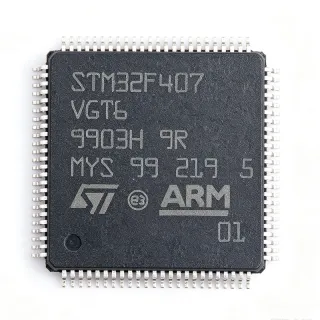
STM32F429BGT6 - 180MHz Cortex-M4 MCU 1MB Flash | STMicroelectronics
MPN: STM32F429BGT6 ✓ Active| Qty | Unit Price | Extended |
|---|---|---|
| 1 | $12.85 | $12.85 |
| 10 | $11.42 | $114.20 |
| 100 | $9.86 | $986.00 |
| 500 | $8.74 | $4,370.00 |
| 1,000 | $7.24 | $7,240.00 |
STM32F429BGT6 Overview
A microcontroller (MCU) is a compact integrated circuit that combines a processor core, non-volatile program memory (Flash), volatile data memory (SRAM), and programmable peripherals on a single die, allowing it to govern a dedicated embedded function without external support chips. The STM32F429BGT6 sits in the STM32F4 high-performance series, which itself belongs to the broader STM32 family of Arm Cortex-M based 32-bit MCUs, and within the taxonomy MCU -> embedded processor -> semiconductor. The F4 series is positioned between the mainstream STM32F1/F0 lines and the higher-end STM32F7/H7 lines, balancing DSP throughput, peripheral integration, and power efficiency.
Key differentiators include the Chrom-ART Accelerator (DMA2D) for offloading graphics operations, a TFT-LCD controller supporting up to XGA resolution, a camera interface, and a flexible memory controller (FMC) for SRAM, PSRAM, NOR, and NAND expansion. The device integrates 3x 12-bit ADCs, 2x DACs, 12x 16-bit timers, 2x 32-bit timers, and a full connectivity set: SPI, I2C, USART, UART, CAN, USB OTG, and Ethernet MAC.
Architecturally, the STM32F429BGT6 is built on a 90 nm process and pairs the Cortex-M4 core with a single-precision FPU and DSP instructions, accelerating filtering, control-loop, and sensor-fusion math. A true random number generator (RNG) and cryptographic acceleration cell support secure applications, while the multi-AHB bus matrix and dual-bank Flash organization reduce contention between the CPU, DMA, and graphics engines.
Typical applications include industrial HMI panels, motor drives, medical instrumentation, consumer appliances, and IoT gateways. The LCD controller and Chrom-ART Accelerator make it especially attractive for graphical user interfaces, while Ethernet and USB OTG enable networked data logging and device connectivity.
When designing with the STM32F429BGT6, decouple every VDD pin with a 100 nF capacitor placed close to the pin, use a 25 MHz crystal for the main clock, and configure the internal PLL to reach the 180 MHz system clock. The device operates from 1.7 V to 3.6 V and supports Sleep, Stop, and Standby low-power modes for energy-sensitive designs.
This page synthesizes distributor pricing, drop-in alternatives, and practical design notes not found in the manufacturer datasheet, giving engineers a single reference for selection, second-sourcing, and layout decisions.
Drop-in alternatives for STM32F429BGT6 — same package, pin-to-pin compatible. Different-package parts requiring PCB rework are excluded.
Variants in this series
Same-series models that are drop-in compatible with STM32F429BGT6 (same form factor and footprint) — differing in Core, Package, SRAM, Flash Memory, ADC.
Quick Comparison Tool — Select alternative parts for side-by-side comparison:
STM32F439BGT6
✅ Drop-In📋 Reference alternative (not in catalog)
STM32F427BGT6
✅ Drop-In📋 Reference alternative (not in catalog)
STM32F429BIT6
✅ Drop-In✓ In Stock
$11.05 / Unit
View Datasheet →STM32F429IIT6
✅ Drop-In✓ In Stock
$8.3523 / Unit
View Datasheet →STM32F746BGT6
✅ Drop-In✓ In Stock
$11.05 / Unit
View Datasheet →STM32F767BGT6
✅ Drop-In✓ In Stock
$11.55 / Unit
View Datasheet →STM32F429BGT6 Maximum Ratings & Electrical Characteristics
| Core | Arm Cortex-M4 32-bit RISC with FPU and DSP instructions |
| Maximum CPU Frequency | 180 MHz |
| Performance | 225 DMIPS / 1.25 DMIPS/MHz (Dhrystone 2.1) |
| Flash Memory | 1 MB |
| SRAM | 256 KB |
| Supply Voltage Range | 1.7 V to 3.6 V |
| Operating Temperature Range | -40 C to +85 C |
| Package | 208-pin LQFP (LQFP208) |
| Mounting Type | Surface Mount |
| ADC | 3x 12-bit ADC |
| DAC | 2x 12-bit DAC |
| Timers | 12x 16-bit + 2x 32-bit |
| Communication Interfaces | SPI, I2C, USART, UART, CAN, USB OTG, Ethernet |
| Graphics Accelerator | Chrom-ART Accelerator (DMA2D) |
| Display Controller | TFT-LCD controller up to XGA |
| External Memory Interface | FMC supporting SRAM, PSRAM, NOR, NAND |
| Security Features | True random number generator (RNG), cryptographic acceleration cell |
| Process Technology | 90 nm |
| Low-Power Modes | Sleep, Stop, Standby |
| RoHS Status | Compliant |
STM32F429BGT6 208-pin lqfp (lqfp208) Pin Configuration Guide
Pin configuration for STM32F429BGT6 (208-pin lqfp (lqfp208) package). This digital IC includes GPIO, communication interfaces (UART, SPI, I2C), and power pins. Refer to the manufacturer datasheet for alternate pin functions and configuration options. Essential for embedded system design and PCB layout.

No detailed pinout data available for STM32F429BGT6.
Refer to the datasheet for full pin configuration.
Typical Applications
STM32F429BGT6 is suitable for 6 applications: Industrial HMI Panels, Motor Drives and Motion Control, Medical Instrumentation, IoT Gateways and Networked Devices, Consumer Appliances with Displays, Test and Measurement Equipment.
Industrial HMI Panels
The STM32F429BGT6 fits industrial human-machine interface panels because its integrated TFT-LCD controller drives displays up to XGA resolution while the Chrom-ART Accelerator (DMA2D) offloads pixel blending, alpha compositing, and color conversion from the 180 MHz Cortex-M4 core. This leaves CPU headroom for touch handling, protocol stacks, and control logic. A typical design connects the LCD via the LTDC peripheral with external SDRAM through the FMC for frame buffering, and uses the Ethernet MAC for remote panel updates. The trade-off versus a Cortex-M7 STM32F746BGT6 is lower graphics throughput, but the F429 costs less and draws less power at equivalent clock rates, making it the right choice for moderate-resolution panels where BOM cost matters.
Recommended
Motor Drives and Motion Control
The STM32F429BGT6 suits motor drives because its Cortex-M4 core includes DSP instructions and a single-precision FPU that accelerate field-oriented control (FOC) and Park/Clarke transforms at 180 MHz. The device provides 2x 32-bit timers and 12x 16-bit timers for complementary PWM generation with dead-time insertion, plus 3x 12-bit ADCs for simultaneous three-phase current sampling. A typical implementation runs a 20 kHz FOC loop while the CPU also handles CAN or Ethernet communication. The -40 C to +85 C operating range covers most industrial cabinets. Compared with a dedicated motor-control MCU, the F429 trades some analog integration for far greater compute headroom and graphics capability for drive status displays.
Recommended
Medical Instrumentation
The STM32F429BGT6 is used in medical instrumentation such as patient monitors and diagnostic equipment, where its 3x 12-bit ADCs digitize sensor signals, the 2x DACs generate calibration or stimulus waveforms, and the FPU accelerates filtering and signal-processing algorithms. The integrated TFT-LCD controller supports graphical waveform and trend displays without an external display driver, reducing board area and cost. A typical design uses the FMC to attach external SRAM for waveform buffering and the USB OTG interface for data export. The device operates from 1.7 V to 3.6 V, allowing direct interfacing with 3.3 V analog front-ends. Designers should note that the F429 is not AEC-Q100 qualified, so it is not intended for automotive medical platforms.
Recommended
IoT Gateways and Networked Devices
The STM32F429BGT6 serves as an IoT gateway controller because it integrates an IEEE 802.3 Ethernet MAC with MII/RMII and a USB OTG controller, enabling wired network connectivity and device-side USB without external bridge chips. The 1 MB Flash and 256 KB SRAM accommodate TCP/IP stacks, TLS, and application logic, while the cryptographic acceleration cell and true random number generator support secure key storage and encrypted communication. A typical gateway design runs an RTOS with an Ethernet stack, uses the FMC for external memory, and drives a status LCD through the LTDC peripheral. The trade-off versus a Cortex-M7 STM32F767BGT6 is lower throughput for encryption-heavy workloads, but the F429 remains cost-effective for moderate-traffic gateways.
Recommended
Consumer Appliances with Displays
The STM32F429BGT6 is well suited to smart appliances such as washing machines, ovens, and thermostats that require a graphical user interface. The Chrom-ART Accelerator and TFT-LCD controller render menus, icons, and animations efficiently, while the 180 MHz Cortex-M4 core simultaneously runs motor-control or heating-control loops. The device's 1 MB Flash stores GUI assets and application code, and the 256 KB SRAM holds frame buffers and runtime data. A typical design uses capacitive-touch sensing through the ADC or an external controller, with the LTDC driving the panel. Compared with a Cortex-M7 solution, the F429 offers adequate graphics performance at lower cost and power, making it ideal for mid-range appliances.
Recommended
Test and Measurement Equipment
The STM32F429BGT6 is used in test and measurement instruments such as oscilloscopes, data loggers, and signal analyzers, where its 3x 12-bit ADCs capture analog inputs, the FPU and DSP instructions perform FFT and filtering, and the TFT-LCD controller renders waveform displays. The FMC allows external SRAM or SDRAM for deep sample buffers, and the USB OTG interface supports data export to a host PC. A typical design samples at rates up to several MSPS using ADC interleaving and DMA, then processes and displays results in real time. The 180 MHz core provides sufficient throughput for moderate-bandwidth instruments, while the integrated graphics path eliminates a separate display controller, reducing cost and board complexity.
Recommended
Recommended Products Summary
Engineering reference data for STM32F429BGT6 — comparison, design guidance, and compliance information.
Selection Guide
Comparison with Alternatives
| Parameter | This Product | STM32F439BGT6 | STM32F427BGT6 | STM32F429BIT6 | STM32F746BGT6 |
|---|---|---|---|---|---|
| Package | LQFP-208 | LQFP-208 - same | LQFP-208 - same | LQFP-208 - same | LQFP-208 - same |
| Brand | STMicroelectronics | STMicroelectronics | STMicroelectronics | STMicroelectronics | STMicroelectronics |
| Core | Arm Cortex-M4 with FPU | Arm Cortex-M4 with FPU | Arm Cortex-M4 with FPU | Arm Cortex-M4 with FPU | Arm Cortex-M7 with FPU |
| Maximum Frequency | 180 MHz | 180 MHz | 180 MHz | 180 MHz | 216 MHz |
| Flash Memory | 1 MB | 1 MB | 1 MB | 2 MB | 1 MB |
| SRAM | 256 KB | 256 KB | 256 KB | 256 KB | 320 KB |
| TFT-LCD Controller | Yes | Yes | No | Yes | Yes |
| Hardware Crypto | No | Yes (AES/DES/SHA) | No | No | Yes (AES/DES/SHA) |
| Supply Voltage | 1.7 V to 3.6 V | 1.7 V to 3.6 V | 1.7 V to 3.6 V | 1.7 V to 3.6 V | 1.7 V to 3.6 V |
| Operating Temperature | -40 C to +85 C | -40 C to +85 C | -40 C to +85 C | -40 C to +85 C | -40 C to +85 C |
Key Differentiators
- Integrated TFT-LCD controller and Chrom-ART Accelerator (vs STM32F427BGT6)
- Hardware cryptographic acceleration available in pin-compatible sibling (vs STM32F439BGT6)
- Higher Flash density option in the same footprint (vs STM32F429BIT6)
- Cost-effective graphics versus Cortex-M7 alternatives (vs STM32F746BGT6)
Design Notes
Decouple every VDD pin with a 100 nF ceramic capacitor placed as close to the pin as possible, and add a bulk 4.7 uF to 10 uF capacitor per supply domain. The STM32F429BGT6 operates from 1.7 V to 3.6 V, so a regulated 3.3 V rail is typical. Keep the VDDA analog supply filtered with a ferrite bead and a dedicated 100 nF plus 1 uF capacitor to protect ADC accuracy. Estimated: at 180 MHz with all peripherals active, core current is on the order of 100-150 mA, so size the regulator for at least 300 mA with margin.
Use a 25 MHz crystal for the main clock and route it with short, symmetric traces and a solid ground reference; the internal PLL multiplies this to the 180 MHz system clock. Place the crystal and its load capacitors within a few millimeters of the OSC_IN/OSC_OUT pins and guard them with ground. For the 208-pin LQFP, use a minimum 4-layer stackup with a dedicated ground plane to control return paths, especially for the FMC, Ethernet, and USB interfaces.
Do not exceed the 3.6 V maximum supply voltage, and ensure the BOOT0 pin is pulled low through a resistor for normal Flash boot. When using the TFT-LCD controller with external SDRAM, verify FMC timing against the memory datasheet - incorrect timings are a common cause of display corruption. Also confirm that the STM32F429BGT6 is not AEC-Q100 qualified before selecting it for automotive designs; use an automotive-grade STM32 variant instead.
Compliance Information
RoHS and REACH compliance per STMicroelectronics product page. The STM32F429BGT6 is not AEC-Q100 qualified; automotive designs should use an automotive-grade STM32 variant.