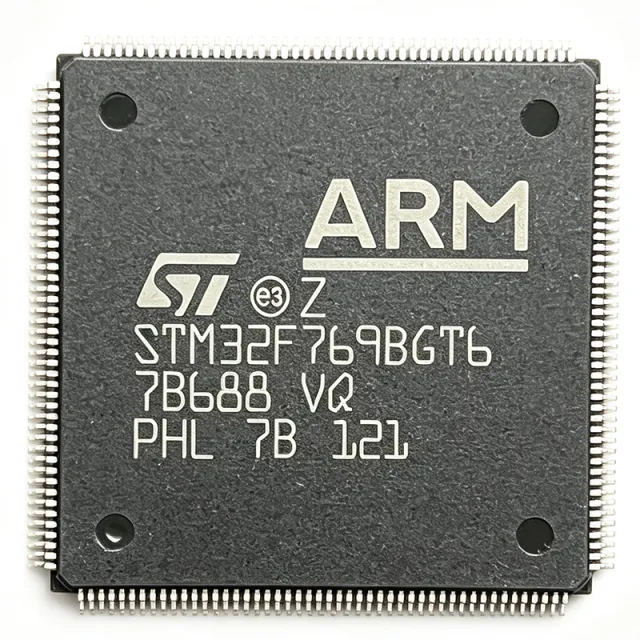
STM32F769BGT6 - 2MB Flash, 216MHz Cortex-M7 MCU | STMicroelectronics
MPN: STM32F769BGT6 ✓ Active| Qty | Unit Price | Extended |
|---|---|---|
| 1 | $26.83 | $26.83 |
| 10 | $24.15 | $241.50 |
| 100 | $21.47 | $2,147.00 |
| 500 | $19.36 | $9,680.00 |
| 1,000 | $17.92 | $17,920.00 |
STM32F769BGT6 Overview
What is a microcontroller? A microcontroller (MCU) is a compact integrated circuit that combines a processor core, volatile memory (SRAM), non-volatile memory (Flash), and programmable input/output peripherals on a single chip. Microcontrollers are the backbone of embedded systems, ranging from simple household appliances to complex industrial automation. The STM32F769BGT6 belongs to the STM32F7 series within the broader STM32 family of 32-bit ARM Cortex-M microcontrollers, placing it in the high-performance segment with advanced connectivity, hardware crypto, and TFT graphics.
Key specifications include a Chrom-ART Accelerator that offloads 2D DMA transfers from the CPU, an integrated TFT-LCD controller supporting resolutions up to WXGA, an 8 KB instruction cache and 8 KB data cache for low-latency code execution, and a hardware cryptographic accelerator plus True Random Number Generator (TRNG) for secure-boot and TLS applications. Operating voltage spans 1.7 V to 3.6 V across the industrial -40 °C to +85 °C range.
Technically, the device is fabricated on a low-power 40 nm CMOS process and includes the M7 instruction cache, DTCM and AXI/AHB bus matrix, DSP extensions, and the STM32 standard library ecosystem (HAL/LL drivers, STM32CubeMX). External memory interfaces include FMC for SDRAM, NOR/NAND Flash, and SRAM expansion. This architecture cleanly separates code, data, and peripheral DMA traffic.
Typical applications include human-machine interface (HMI) panels with TFT displays, industrial PLCs, secure IoT gateways, point-of-sale terminals, motor-control drives, and medical imaging controllers. The combination of high clock speed, hardware crypto, and Ethernet MAC makes it ideal for connected, secure, graphics-rich products.
When designing with this LQFP-208 device, follow ST's recommended land pattern and use a 4-layer PCB with a solid ground plane for the high-speed SDMMC, USB, and Ethernet signals. Provide dedicated 100 nF + 4.7 µF decoupling on each VDD pin, keep the NRST reset trace short, and ensure the BYPASS_REG pin uses a 1 nF + 1 µF network for internal LDO stability.
This page synthesizes distributor pricing, drop-in alternatives, application companions, and practical design notes beyond the manufacturer datasheet to accelerate your BOM and firmware decisions.
Drop-in alternatives for STM32F769BGT6 — same package, pin-to-pin compatible. Different-package parts requiring PCB rework are excluded.
Variants in this series
Same-series models that are drop-in compatible with STM32F769BGT6 (same form factor and footprint) — differing in Operating Temperature, Package, Flash Memory, SRAM, Core.
Quick Comparison Tool — Select alternative parts for side-by-side comparison:
STM32F767BGT6
✅ Drop-In✓ In Stock
$11.55 / Unit
View Datasheet →STM32F765BGT6
✅ Drop-In📋 Reference alternative (not in catalog)
STM32F746BGT6
✅ Drop-In✓ In Stock
$11.05 / Unit
View Datasheet →STM32F756BGT6
✅ Drop-In✓ In Stock
$15.86 / Unit
View Datasheet →STM32F769BGT6 Maximum Ratings & Electrical Characteristics
| Core Architecture | ARM Cortex-M7 with FPU and DSP instructions |
| Maximum Clock Frequency | 216 MHz |
| DMIPS | 462 |
| Flash Memory | 2 MB |
| SRAM | 512 KB |
| Instruction Cache | 8 KB |
| Data Cache | 8 KB |
| Operating Voltage | 1.7 V to 3.6 V |
| Operating Temperature | -40 °C to +85 °C |
| Package | LQFP-208 (BGT suffix, 28 x 28 mm, 0.5 mm pitch) |
| Mounting Type | Surface Mount |
| I2C Interfaces | 4 |
| SPI Interfaces | 6 |
| USART/UART | 4 x USART + 4 x UART |
| CAN Interfaces | 2 x CAN 2.0B |
| USB Interfaces | 1 x USB 2.0 OTG HS + 1 x USB 2.0 OTG FS |
| Ethernet MAC | 10/100 Mbps IEEE 802.3 |
| SAI Audio | 2 x SAI (Serial Audio Interface) |
| SDMMC | 1 x SDMMC |
| TFT-LCD Controller | Yes, supports up to WXGA resolution |
| Cryptographic Accelerator | AES, Hash, TRNG |
| Camera Interface | 8/10/12/14-bit DCMI |
| Process Technology | 40 nm CMOS |
| RoHS Compliance | Compliant |
STM32F769BGT6 lqfp-208 (bgt suffix, 28 x 28 mm, 0.5 mm pitch) Pin Configuration Guide
Pin configuration for STM32F769BGT6 (lqfp-208 (bgt suffix, 28 x 28 mm, 0.5 mm pitch) package). This digital IC includes GPIO, communication interfaces (UART, SPI, I2C), and power pins. Refer to the manufacturer datasheet for alternate pin functions and configuration options. Essential for embedded system design and PCB layout.

No detailed pinout data available for STM32F769BGT6.
Refer to the datasheet for full pin configuration.
Typical Applications
STM32F769BGT6 is suitable for 6 applications: Human-Machine Interface (HMI) with TFT Display, Industrial PLC and Motor-Control Drive, Secure IoT Gateway with Ethernet, Point-of-Sale (POS) Terminal, Medical Imaging Controller, Audio Streaming Interface (SAI-based).
Human-Machine Interface (HMI) with TFT Display
The STM32F769BGT6 is built for graphical HMIs. Its integrated TFT-LCD controller (up to WXGA) and Chrom-ART Accelerator offload 2D bitmap rendering to a dedicated DMA engine, freeing the Cortex-M7 for application logic. Hardware crypto (AES + TRNG) supports secure GUIs in medical and industrial panels. The 2 MB Flash accommodates full SLI-grade UI assets, and 512 KB SRAM holds frame buffers for WQVGA without external SDRAM. Versus STM32F746ZGT6 the F769 adds the crypto block and MIPI-DSI, enabling secure, large-display panels.
Recommended
Industrial PLC and Motor-Control Drive
Industrial PLCs and servo drives benefit from the STM32F769BGT6's 216 MHz Cortex-M7 with DSP extensions and double-precision FPU, which executes control loops (FOC, PID) well within 10 µs. Two CAN 2.0B interfaces fieldbus-connect to CANopen or DeviceNet networks, while 6× SPI drive high-resolution sigma-delta ADCs and digital isolators. The 512 KB SRAM buffers multi-axis trajectory tables without external memory. Compared with STM32F765BGT6, the F769 doubles SRAM, easing buffer budget on 4-axis drives.
Recommended
Secure IoT Gateway with Ethernet
Connected IoT gateways using the STM32F769BGT6 leverage the 10/100 Ethernet MAC, USB OTG HS, and hardware AES-256 with TRNG for TLS-style secure boot. Running FreeRTOS or Azure RTOS on the Cortex-M7, the 2 MB Flash stores TLS roots and a small web server, while 512 KB SRAM handles TCP buffers. ST's BSP+LWIP integration shortens development versus GD32 or NXP equivalents. Compared with STM32H743VIT6 the F769 is cheaper and the Ethernet stack is more mature on F7.
Recommended
Point-of-Sale (POS) Terminal
POS terminals capitalize on the STM32F769BGT6's TFT-LCD interface for the cashier screen, USB OTG FS/HS for peripherals (PIN pad, printer, contactless reader), and hardware crypto for PCI-compliant payment flows. The 512 KB SRAM holds full transaction buffers; the 2 MB Flash supports long-term firmware upgrades via SDMMC. Compared with STM32F746ZGT6 the F769 integrates cryptographic accelerators that simplify PCI-PTS certification.
Recommended
Medical Imaging Controller
Medical imaging peripherals use the STM32F769BGT6's Cortex-M7 DSP extensions and DCMI camera interface to run pre-processing pipelines on-board. The TFT controller drives preview LCDs, while the Ethernet MAC streams compressed images to a host workstation. Hardware AES supports HIPAA-grade data-at-rest protection. Compared with STM32F765BGT6 the F769's 512 KB SRAM doubles the image-buffer headroom. ST's medical-focused STM32Cube firmware accelerates IEC 62304 compliance.
Recommended
Audio Streaming Interface (SAI-based)
The STM32F769BGT6's dual SAI interfaces handle I2S / TDM audio streams for high-fidelity audio peripherals (USB-C DAC/headphone amps, AVB-style audio clocks). The Cortex-M7 runs Audio Weaver DSP and effects at 216 MHz with negligible overhead, and the 512 KB SRAM buffers multi-stream phase-aligned audio. The hardware crypto block also supports DRM key handling for content-protected audio. Compared with STM32F767BGT6 the F769 doubles SRAM and adds the cryptographic accelerator, vital for protected content paths.
Recommended
Recommended Products Summary
Engineering reference data for STM32F769BGT6 — comparison, design guidance, and compliance information.
Selection Guide
Comparison with Alternatives
| Parameter | This Product | STM32F767BGT6 | STM32F765BGT6 | STM32F746BGT6 | STM32F756BGT6 |
|---|---|---|---|---|---|
| Brand | STMicroelectronics | STMicroelectronics | STMicroelectronics | STMicroelectronics | STMicroelectronics |
| Package | LQFP-208 | LQFP-208 - same | LQFP-208 - same | LQFP-208 - same | LQFP-208 - same |
| Maximum Clock Frequency | 216 MHz | 216 MHz | 216 MHz | 216 MHz | 216 MHz |
| Flash Memory | 2 MB | 2 MB | 2 MB | 1 MB (-50%) | 1 MB (-50%) |
| SRAM | 512 KB | 512 KB | 256 KB (-50%) | 320 KB (-37%) | 320 KB (-37%) |
| Hardware AES / TRNG | Yes (AES-256, TRNG, Hash) | No crypto | Yes (AES, TRNG) | Yes (AES, TRNG) | Yes (AES, TRNG) |
| TFT-LCD Controller | Yes (up to WXGA, with MIPI-DSI) | Yes (no MIPI-DSI) | Yes (no MIPI-DSI) | Yes (no MIPI-DSI) | Yes (no MIPI-DSI) |
| Ethernet MAC | 10/100 Mbps | 10/100 Mbps | 10/100 Mbps | 10/100 Mbps | 10/100 Mbps |
Key Differentiators
- Hardware cryptographic accelerator plus TRNG (vs STM32F767BGT6)
- 512 KB SRAM for frame buffers and audio streams (vs STM32F765BGT6)
- MIPI-DSI controller (vs STM32F746BGT6 / STM32F756BGT6)
Design Notes
Provide a 100 nF X7R 0402 plus a 4.7 µF tantalum on every VDD pin and a single 1 µF bulk capacitor on VDDA. The BYPASS_REG pin must be decoupled with a 1 nF in parallel with a 1 µF ceramic; this network supplies the internal core LDO. Omitting it causes unpredictable reset behavior, brown-out, or full failure to enter main() on first prototypes.
Use a 4-layer PCB with a continuous ground plane below the LQFP-208 footprint to control the impedance of the high-speed SDMMC, USB, and Ethernet signals. Keep USB DP/DM tracks 90 Ω differential, length-matched within 150 mil, and keep the Ethernet TX/RX pairs routed as 100 Ω differential. Place the HSE crystal within 5 mm of OSC_IN/OSC_OUT, with a guard ring to reduce jitter on high-precision timers and USB.
At 216 MHz with all peripherals active, the STM32F769BGT6 dissipates approximately 0.5-0.7 W (estimate: VDD=3.3 V × IDD≈180 mA). The LQFP-208 with the PCB layout above holds junction temperature below 90 °C in ambient of 25 °C; at 85 °C ambient, derate CPU clock to 168 MHz or attach a small copper heat-spreader under the EP-adjacent pads.
Verify the BOOT0 pin state at every reset; tying it high forces System Memory (bootloader), not Flash, and many bricked prototypes trace to a missing BOOT0 pull-down. Disable the unused peripherals' clocks via __HAL_RCC_<MODULE>_CLK_DISABLE() before entering low-power modes - leaving them enabled adds hundreds of microamps to deep-sleep current.
Compliance Information
Per ST product page, BGT6 suffix indicates RoHS-compliant lead-free LQFP-208 package. Industrial temperature grade -40 °C to +85 °C. Not AEC-Q100; for automotive STM32F7 parts choose AEC-Q100 qualified variants.