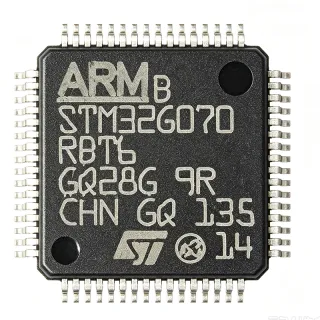
STM32H7B0RBT6 - 32-bit Arm Cortex-M7 MCU 280MHz | STMicroelectronics
MPN: STM32H7B0RBT6 ✓ Active| Qty | Unit Price | Extended |
|---|---|---|
| 1 | $12.5 | $12.50 |
| 10 | $11.25 | $112.50 |
| 100 | $10 | $1,000.00 |
| 500 | $9 | $4,500.00 |
| 1,000 | $8.1 | $8,100.00 |
STM32H7B0RBT6 Overview
What is a microcontroller? A microcontroller (MCU) is a compact integrated circuit designed to govern a specific operation in an embedded system. It contains a processor core, memory (Flash and RAM), and programmable input/output peripherals on a single chip. Microcontrollers are the brains of countless electronic devices, from automotive engine control units to IoT sensors and industrial automation systems. The STM32H7 series represents the high-performance tier of STMicroelectronics' STM32 portfolio, offering the Arm Cortex-M7 core with double-precision floating-point unit (FPU) and DSP instructions, making it suitable for real-time control, signal processing, and AI at the edge.
Key features of the STM32H7B0RBT6 include a 280 MHz Arm Cortex-M7 core with 128 Kbytes of Flash and 1 Mbyte of RAM, a 16-bit ADC with up to 3.6 MSPS, multiple 16-bit and 32-bit timers, and a rich set of communication interfaces including USART, SPI, I2C, CAN, USB OTG, and Ethernet. The device also features a Chrom-ART Accelerator for 2D graphics, a cryptographic acceleration unit, and a true random number generator (TRNG). These features enable high-performance computing and secure data handling in a compact footprint.
From a technical depth perspective, the STM32H7B0RBT6 leverages a 32-bit Arm Cortex-M7 core with a 6-stage pipeline, branch prediction, and a memory protection unit (MPU). The core supports single-cycle multiply-accumulate (MAC) instructions and hardware divide, enhancing real-time performance. The device integrates a flexible memory controller (FMC) for external memory expansion, and a power management unit with multiple low-power modes, including Sleep, Stop, and Standby, to optimize energy consumption. The advanced analog peripherals, including a 16-bit ADC with oversampling and a 12-bit DAC, provide high-resolution data acquisition for industrial and medical applications.
Typical applications for the STM32H7B0RBT6 include industrial motor control, power conversion, advanced human-machine interfaces (HMI), IoT gateways, audio processing, and medical devices. Its high clock speed and rich peripheral set make it ideal for applications requiring real-time control and complex algorithms, such as robotics and drone flight controllers. The device's connectivity options, including Ethernet and USB, enable seamless integration into networked systems.
When designing with the STM32H7B0RBT6, ensure adequate decoupling of the power supply pins with 100 nF capacitors placed close to each VDD pin, and a 4.7 uF bulk capacitor. The VDDA pin requires a dedicated 1 uF capacitor to ground for analog performance. For high-speed communication interfaces, pay attention to PCB layout to minimize signal integrity issues. The device supports a wide supply voltage range of 1.62V to 3.6V, allowing flexible power design.
Drop-in alternatives for STM32H7B0RBT6 — same package, pin-to-pin compatible. Different-package parts requiring PCB rework are excluded.
Quick Comparison Tool — Select alternative parts for side-by-side comparison:
STM32H7B0RBT6
✅ Drop-In✓ In Stock
$8.1 / Unit
View Datasheet →STM32H7B0RBT6
✅ Drop-In✓ In Stock
$8.1 / Unit
View Datasheet →STM32H7B0RBT6
✅ Drop-In✓ In Stock
$8.1 / Unit
View Datasheet →i.MX RT1052
✅ Drop-In ⚠️ Specs Unverified📋 Reference alternative (not in catalog)
STM32H7B0RBT6 Maximum Ratings & Electrical Characteristics
| Core | Arm Cortex-M7 |
| Maximum Clock Speed | 280 MHz |
| Flash Memory | 128 Kbytes |
| RAM | 1 Mbyte |
| Package | LQFP64 |
| Supply Voltage Range | 1.62V to 3.6V |
| ADC Resolution | 16-bit |
| ADC Sampling Rate | 3.6 MSPS |
| DAC Resolution | 12-bit |
| Communication Interfaces | USART, SPI, I2C, CAN, USB OTG, Ethernet |
| Timers | Multiple 16-bit and 32-bit timers |
| Graphics Acceleration | Chrom-ART Accelerator |
| Cryptographic Acceleration | Yes |
| True Random Number Generator | Yes |
| Low-Power Modes | Sleep, Stop, Standby |
STM32H7B0RBT6 Pin Configuration
| Pin 1 | VBAT — Battery backup supply |
| Pin 2 | PC13 — GPIO / RTC output |
| Pin 3 | PC14 — GPIO / OSC32_IN |
| Pin 4 | PC15 — GPIO / OSC32_OUT |
| Pin 5 | PF0 — GPIO |
| Pin 6 | PF1 — GPIO |
| Pin 7 | NRST — Reset |
| Pin 8 | VDD — Digital power supply |
| Pin 9 | VSS — Ground |
| Pin 10 | PA0 — GPIO / ADC |
| Pin 11 | PA1 — GPIO / ADC |
| Pin 12 | PA2 — GPIO / USART2_TX |
| Pin 13 | PA3 — GPIO / USART2_RX |
| Pin 14 | PA4 — GPIO / DAC_OUT1 |
| Pin 15 | PA5 — GPIO / DAC_OUT2 |
| Pin 16 | PA6 — GPIO / SPI1_MISO |
| Pin 17 | PA7 — GPIO / SPI1_MOSI |
| Pin 18 | PA8 — GPIO / USB_OTG_FS_SOF |
| Pin 19 | PA9 — GPIO / USB_OTG_FS_VBUS |
| Pin 20 | PA10 — GPIO / USB_OTG_FS_ID |
| Pin 21 | PA11 — GPIO / USB_OTG_FS_DM |
| Pin 22 | PA12 — GPIO / USB_OTG_FS_DP |
| Pin 23 | PA13 — GPIO / SWDIO |
| Pin 24 | PA14 — GPIO / SWCLK |
| Pin 25 | PA15 — GPIO / JTDI |
| Pin 26 | PB0 — GPIO / ADC |
| Pin 27 | PB1 — GPIO / ADC |
| Pin 28 | PB2 — GPIO / BOOT1 |
| Pin 29 | PB3 — GPIO / JTDO |
| Pin 30 | PB4 — GPIO / NJTRST |
| Pin 31 | PB5 — GPIO / I2C1_SMBA |
| Pin 32 | PB6 — GPIO / I2C1_SCL |
| Pin 33 | PB7 — GPIO / I2C1_SDA |
| Pin 34 | PB8 — GPIO / I2C1_SCL |
| Pin 35 | PB9 — GPIO / I2C1_SDA |
| Pin 36 | PB10 — GPIO / I2C2_SCL |
| Pin 37 | PB11 — GPIO / I2C2_SDA |
| Pin 38 | PB12 — GPIO / SPI2_NSS |
| Pin 39 | PB13 — GPIO / SPI2_SCK |
| Pin 40 | PB14 — GPIO / SPI2_MISO |
| Pin 41 | PB15 — GPIO / SPI2_MOSI |
| Pin 42 | PC0 — GPIO / ADC |
| Pin 43 | PC1 — GPIO / ADC |
| Pin 44 | PC2 — GPIO / ADC |
| Pin 45 | PC3 — GPIO / ADC |
| Pin 46 | PC4 — GPIO / ADC |
| Pin 47 | PC5 — GPIO / ADC |
| Pin 48 | PC6 — GPIO / SDIO_D6 |
| Pin 49 | PC7 — GPIO / SDIO_D7 |
| Pin 50 | PC8 — GPIO / SDIO_D0 |
| Pin 51 | PC9 — GPIO / SDIO_D1 |
| Pin 52 | PC10 — GPIO / SDIO_D2 |
| Pin 53 | PC11 — GPIO / SDIO_D3 |
| Pin 54 | PC12 — GPIO / SDIO_CK |
| Pin 55 | PD0 — GPIO / FMC_D2 |
| Pin 56 | PD1 — GPIO / FMC_D3 |
| Pin 57 | PD2 — GPIO / SDIO_CMD |
| Pin 58 | PD3 — GPIO / FMC_CLK |
| Pin 59 | PD4 — GPIO / FMC_NOE |
| Pin 60 | PD5 — GPIO / FMC_NWE |
| Pin 61 | PD6 — GPIO / FMC_NWAIT |
| Pin 62 | PD7 — GPIO / FMC_NE1 |
| Pin 63 | VDD — Digital power supply |
| Pin 64 | VSS — Ground |
Typical Applications
STM32H7B0RBT6 is suitable for 6 applications: Industrial Motor Control, IoT Gateway, Human-Machine Interface (HMI), Audio Processing, Medical Devices, Robotics and Drone Flight Controllers.
Industrial Motor Control
The STM32H7B0RBT6's high clock speed and advanced timers make it ideal for field-oriented control (FOC) of brushless DC motors. Its 16-bit ADC provides precise current sensing, while the Cortex-M7 core handles complex control algorithms in real time. The device's rich communication interfaces (CAN, Ethernet) enable integration into industrial networks. With a supply voltage range of 1.62V to 3.6V, it can operate in harsh industrial environments. The LQFP64 package allows compact PCB designs, and the low-power modes help reduce energy consumption in standby. Overall, the STM32H7B0RBT6 delivers the performance and reliability required for advanced motor control applications.
Recommended
IoT Gateway
The STM32H7B0RBT6 is well-suited for IoT gateways due to its Ethernet and USB OTG interfaces, enabling seamless connectivity to cloud services. Its high processing power allows it to handle protocol stacks (MQTT, HTTP) and edge computing tasks. The cryptographic acceleration unit ensures secure data transmission, and the TRNG provides robust security keys. With 1 Mbyte of RAM, it can buffer large amounts of sensor data. The device's low-power modes are beneficial for always-on gateways, reducing energy costs. The LQFP64 package is compact, making it easy to integrate into small form-factor gateways. Overall, the STM32H7B0RBT6 provides the performance and connectivity needed for modern IoT applications.
Recommended
Human-Machine Interface (HMI)
The STM32H7B0RBT6's Chrom-ART Accelerator enables smooth 2D graphics rendering for HMI displays. Its high clock speed ensures responsive touch input and animation. The device supports various display interfaces (LTDC, SPI) and can drive TFT LCDs directly. With 1 Mbyte of RAM, it can store frame buffers and graphical assets. The rich set of timers and PWM outputs allows control of backlight and audio feedback. The LQFP64 package is suitable for compact HMI panels. The device's low-power modes help reduce power consumption in battery-operated HMIs. Overall, the STM32H7B0RBT6 is an excellent choice for advanced HMI applications.
Recommended
Audio Processing
The STM32H7B0RBT6's Cortex-M7 core with DSP instructions is ideal for real-time audio processing, such as noise cancellation and audio effects. Its high clock speed allows complex algorithms to run in real time. The device supports I2S and SAI interfaces for audio codecs. With 1 Mbyte of RAM, it can buffer audio streams and process them efficiently. The 16-bit ADC can be used for audio input, while the 12-bit DAC provides analog output. The device's low-power modes are useful for portable audio devices. The LQFP64 package is compact, making it suitable for audio wearables. Overall, the STM32H7B0RBT6 delivers high-fidelity audio processing capabilities.
Recommended
Medical Devices
The STM32H7B0RBT6's high-resolution ADC and processing power make it suitable for medical devices like patient monitors and diagnostic equipment. Its 16-bit ADC provides accurate signal acquisition for vital signs monitoring. The device's cryptographic acceleration ensures secure patient data handling. With 1 Mbyte of RAM, it can store large datasets for analysis. The rich communication interfaces (USB, Ethernet) enable data transfer to hospital networks. The device's low-power modes are beneficial for portable medical devices. The LQFP64 package is compact, allowing miniaturization of medical devices. Overall, the STM32H7B0RBT6 meets the stringent requirements of medical applications.
Recommended
Robotics and Drone Flight Controllers
The STM32H7B0RBT6's high clock speed and real-time control capabilities make it ideal for robotics and drone flight controllers. Its advanced timers generate precise PWM signals for motor control. The device's rich communication interfaces (CAN, UART) allow connection to sensors and actuators. With 1 Mbyte of RAM, it can handle complex navigation algorithms. The 16-bit ADC provides accurate sensor readings for stabilization. The device's low-power modes are useful for battery-powered drones. The LQFP64 package is lightweight and compact, suitable for space-constrained designs. Overall, the STM32H7B0RBT6 provides the performance and reliability needed for autonomous systems.
Recommended
Recommended Products Summary
Engineering reference data for STM32H7B0RBT6 — comparison, design guidance, and compliance information.
Selection Guide
Comparison with Alternatives
| Parameter | This Product | STM32H7B0RBT6 | STM32H743VIT6 | i.MX RT1052 |
|---|---|---|---|---|
| Package | LQFP64 | LQFP64 | LQFP100 | LQFP64 |
| Brand | STMicroelectronics | STMicroelectronics | STMicroelectronics | NXP Semiconductors |
| Core | Arm Cortex-M7 | Arm Cortex-M7 | Arm Cortex-M7 | Arm Cortex-M7 |
| Maximum Clock Speed | 280 MHz | 280 MHz | 480 MHz | 600 MHz |
| Flash Memory | 128 Kbytes | 128 Kbytes | 2 Mbytes | 0 (external flash) |
| RAM | 1 Mbyte | 1 Mbyte | 1 Mbyte | 512 Kbytes |
| ADC Resolution | 16-bit | 16-bit | 16-bit | 12-bit |
| Ethernet | Yes | Yes | Yes | No |
Key Differentiators
- High clock speed of 280 MHz (vs STM32H743VIT6)
- Integrated Ethernet and USB OTG (vs i.MX RT1052)
- 16-bit ADC with 3.6 MSPS (vs i.MX RT1052)
Design Notes
Ensure adequate decoupling of the power supply pins with 100 nF capacitors placed close to each VDD pin, and a 4.7 uF bulk capacitor. The VDDA pin requires a dedicated 1 uF capacitor to ground for analog performance. This is critical for stable operation and ADC accuracy.
For high-speed communication interfaces like Ethernet and USB, pay attention to PCB layout to minimize signal integrity issues. Use controlled impedance traces and keep traces short. Place the crystal oscillator close to the MCU and ensure proper grounding.
Do not exceed the supply voltage range of 1.62V to 3.6V. Ensure the BOOT0 pin is correctly configured for the desired boot mode. For low-power modes, configure the RTC and wakeup sources properly to avoid unexpected resets.
Compliance Information
Compliance information not provided in the verified data. Please refer to the STMicroelectronics datasheet or product page for RoHS and REACH status.