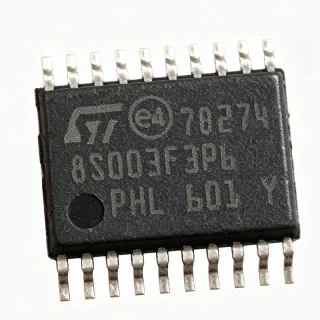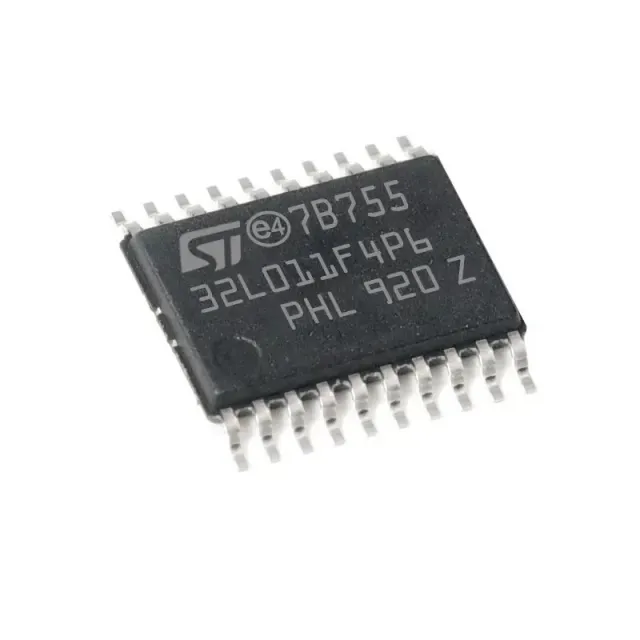
STM32L011F4P6 - 16KB Flash Cortex-M0+ MCU 32MHz | STMicroelectronics
MPN: STM32L011F4P6 ✓ Active| Qty | Unit Price | Extended |
|---|---|---|
| 1 | $0.67 | $0.67 |
| 10 | $0.61 | $6.10 |
| 100 | $0.55 | $55.00 |
| 500 | $0.5 | $250.00 |
| 1,000 | $0.46 | $460.00 |
STM32L011F4P6 Overview
What is a microcontroller? A microcontroller (MCU) is a compact integrated circuit that combines a processor core, memory, and programmable input/output peripherals on a single chip. Within the embedded-systems hierarchy, an MCU sits above simple logic ICs but below application processors, offering a balance of performance, power efficiency, and cost for dedicated control tasks. The STM32L011F4P6 belongs to ST's STM32L0 access line, the entry point of the STM32 ultra-low-power family.
Key features include a 12-bit ADC with up to 1 Msps sampling, multiple communication interfaces (I2C, SPI, USART), a rich set of timers, a real-time clock (RTC), a low-power UART (LPUART), and a 96-bit unique device ID for security and traceability.
The device runs from a wide 1.8V to 3.6V supply, operates from -40C to +85C, and is built on ST's ultra-low-power process technology. Multiple low-power modes - Sleep, Low-power Run, and Stop - deliver typical current as low as 0.23 uA in Stop mode with RTC running, making it suitable for coin-cell and energy-harvesting designs. The flexible clock tree supports internal MSI/HSI/LSI sources plus an external 32.768 kHz crystal for precise RTC timing.
Typical applications include portable medical devices, smart sensors, IoT battery nodes, and industrial monitoring systems, where the small TSSOP-20 footprint and microamp-level sleep currents extend battery life dramatically.
Design consideration: achieve the lowest sleep currents by using the internal LSI for the RTC and configuring unused GPIOs to analog mode; every external clock source adds standby current.
This page synthesizes distributor pricing (as of 2026-09-06), pin-compatible alternatives, and practical design notes not found in the manufacturer datasheet alone.
Drop-in alternatives for STM32L011F4P6 — same package, pin-to-pin compatible. Different-package parts requiring PCB rework are excluded.
Variants in this series
Same-series models that are drop-in compatible with STM32L011F4P6 (same form factor and footprint) — differing in Flash Memory, Package, SRAM, Supply Voltage Range, Communication Interfaces.
Quick Comparison Tool — Select alternative parts for side-by-side comparison:
STM32L011F3P6
✅ Drop-In ⚠️ 参数待验证📋 Reference alternative (not in catalog)
STM32L031F6P6
✅ Drop-In ⚠️ 参数待验证✓ In Stock
$1.38 / Unit
View Datasheet →STM32G030F6P6
✅ Drop-In✓ In Stock
$0.75 / Unit
View Datasheet →STM32G041F8P6
✅ Drop-In✓ In Stock
$1.2 / Unit
View Datasheet →STM32F031F6P7
✅ Drop-In📋 Reference alternative (not in catalog)
STM32L011F4P6 Maximum Ratings & Electrical Characteristics
| Core | ARM Cortex-M0+ 32-bit RISC |
| Maximum CPU Frequency | 32 MHz |
| Flash Memory | 16 KB |
| SRAM | 2 KB |
| Supply Voltage Range | 1.8 V to 3.6 V |
| Operating Temperature | -40C to +85C |
| ADC Resolution | 12-bit, up to 1 Msps |
| Communication Interfaces | I2C, SPI, USART, LPUART |
| RTC | Yes, with calendar and alarms |
| Stop Mode Current | 0.23 uA typical (with RTC) |
| Timers | Multiple 16-bit timers (TIM2, TIM21, TIM22, LPTIM, SysTick, IWDG, WWDG) |
| Unique Device ID | 96-bit |
| Package | 20-TSSOP |
| Mounting Type | Surface Mount |
| Supply Type | 1.8 V / 2.5 V / 3.3 V systems |
| Series | STM32L0 (access line) |
STM32L011F4P6 20-tssop Pin Configuration Guide
Pin configuration for STM32L011F4P6 (20-tssop package). This digital IC includes GPIO, communication interfaces (UART, SPI, I2C), and power pins. Refer to the manufacturer datasheet for alternate pin functions and configuration options. Essential for embedded system design and PCB layout.

No detailed pinout data available for STM32L011F4P6.
Refer to the datasheet for full pin configuration.
Typical Applications
STM32L011F4P6 is suitable for 6 applications: Battery-Powered IoT Sensor Nodes, Portable Medical and Health Devices, Smart Sensors and Industrial Monitoring, Energy Harvesting Systems, Consumer Appliances and Small Home Devices, Remote Controls and HMI Keyboards.
Battery-Powered IoT Sensor Nodes
The STM32L011F4P6 fits coin-cell and primary-battery IoT nodes because its 0.23 uA Stop-mode current with RTC dwarfs the sleep budgets of mainstream MCUs, while the 1.8V to 3.6V rail accepts a discharged CR2032 down to end-of-life. A typical topology wakes the MCU on LPTIM or LPUART, reads a sensor over I2C, then transmits via an external radio module on USART, spending over 99% of the duty cycle asleep. Quantified benefit: a node waking every 10 seconds can run for several years on one cell. The 20-pin TSSOP also keeps the PCB area under 25 mm2 for the MCU section.
Recommended
Portable Medical and Health Devices
In portable medical devices such as glucose meters, thermometers, and wearable monitors, the STM32L011F4P6 provides the 12-bit 1 Msps ADC needed for sensor front-ends and the ultra-low sleep current that long wearable runtimes demand. Running from 1.8V to 3.6V, it pairs directly with LiCoin or alkaline cells without a boost converter, and its 96-bit unique device ID supports traceability requirements. Placing the device in Stop mode between measurements keeps quiescent draw in the microamp range, while Low-power Run mode executes calibration algorithms at microwatt-level power. The -40C to +85C range covers autoclave-adjacent and transport conditions.
Recommended
Smart Sensors and Industrial Monitoring
The STM32L011F4P6 serves industrial monitoring endpoints - temperature, vibration, and flow sensors - where -40C to +85C operation and robust peripherals matter. Its I2C and SPI interfaces connect directly to digital sensors, while the 12-bit ADC digitizes 4-20 mA-derived or ratiometric analog channels at up to 1 Msps. The LPUART allows wake-on-character from an RS-485 transceiver, so the MCU sleeps at 0.23 uA until a master polls it. Multiple 16-bit timers generate PWM for actuator or alarm outputs. Unlike mains-powered controllers, its battery-backed operation tolerates power glitches in electrically noisy factory environments without data loss.
Recommended
Energy Harvesting Systems
Energy-harvesting designs (photovoltaic, thermoelectric, RF) require controllers that can operate on harvested microwatts, and the STM32L011F4P6 is built for exactly this: Low-power Run mode executes code around a 32.768 kHz clock at microwatt budgets, and Stop mode holds state at 0.23 uA with RTC. The wide 1.8V to 3.6V input range tolerates the slow, drooping supply characteristic of supercapacitor storage, and the brown-out reset keeps execution deterministic during cold start. Firmware typically wakes, samples, transmits one burst, and re-enters Stop - a duty cycle the L011 sustains indefinitely from a small harvest buffer.
Recommended
Consumer Appliances and Small Home Devices
In cost-sensitive consumer products - timers, remote controls, small appliance panels, and charger accessories - the STM32L011F4P6 offers ARM ecosystem tooling at an under-one-dollar price point (about $0.67 at single quantity as of 2026-09-06). The TSSOP-20 footprint fits single-sided, low-cost PCBs, and capacitive-touch sensing runs on its internal analog peripherals without a dedicated touch IC. Its 16 KB Flash is enough for button decoding, LED or PWM display driving, and USART-based debug or charging-IC communication. Compared with 8-bit alternatives, developers gain free STM32CubeIDE tooling, C/C++ libraries, and a growth path to pin-compatible 32 KB parts.
Recommended
Remote Controls and HMI Keyboards
The STM32L011F4P6 is an effective controller for IR/RF remote controls and small HMI keyboards, where battery life between coin-cell replacement is the primary metric. Stop mode at 0.23 uA with the RTC or LPTIM wake source means idle drain is negligible, while wake-on-GPIO reacts to keypresses within microseconds. Its PWM timers drive IR LED bursts at standard 38 kHz carrier frequencies with precise timing, and the 12-bit ADC can read battery voltage for low-battery indication. The 20-pin TSSOP leaves GPIO margin for a 4x4 key matrix plus status LEDs, all within 16 KB of firmware including a lightweight touch or scan library.
Recommended
Recommended Products Summary
Engineering reference data for STM32L011F4P6 — comparison, design guidance, and compliance information.
Selection Guide
Comparison with Alternatives
| Parameter | This Product | STM32L011F3P6 | STM32L031F6P6 | STM32G030F6P6 | STM32F031F6P7 |
|---|---|---|---|---|---|
| Package | 20-TSSOP | 20-TSSOP - same | 20-TSSOP - same | 20-TSSOP - same | 20-TSSOP - same |
| Brand | STMicroelectronics | STMicroelectronics | STMicroelectronics | STMicroelectronics | STMicroelectronics |
| Core | ARM Cortex-M0+ 32-bit | ARM Cortex-M0+ 32-bit | ARM Cortex-M0+ 32-bit | ARM Cortex-M0+ 32-bit | ARM Cortex-M0 32-bit |
| CPU Frequency | 32 MHz | 32 MHz | 32 MHz | 64 MHz | 48 MHz |
| Flash Memory | 16 KB | 8 KB | 32 KB | 32 KB | 32 KB |
| SRAM | 2 KB | 2 KB | 8 KB | 8 KB | 4 KB |
| Supply Voltage | 1.8 V to 3.6 V | 1.8 V to 3.6 V | 1.8 V to 3.6 V | 2.0 V to 3.6 V | 2.0 V to 3.6 V |
| Ultra-Low-Power Stop Mode | 0.23 uA typical with RTC | 0.23 uA typical with RTC | 0.23 uA typical with RTC | Higher than L0 series | Significantly higher than L0 series |
| Operating Temperature | -40C to +85C | -40C to +85C | -40C to +85C | -40C to +85C | -40C to +85C |
Key Differentiators
- Best-in-class sleep current in the TSSOP-20 footprint (vs STM32G030F6P6)
- Lowest entry price within the pin-compatible L0 family (vs STM32L031F6P6)
- Wider supply range enables direct coin-cell operation (vs STM32F031F6P7)
Design Notes
To achieve the datasheet 0.23 uA Stop-mode current, configure every unused GPIO as analog input, disable the debug interface before entering Stop (DBGMCU bits), and gate any external pull-ups. An LDO with 1 uA quiescent current will dominate the budget - a single漏 leak of 2 uA makes MCU sleep current irrelevant. Estimated: with 0.23 uA MCU sleep and 3 uA system leakage, a 220 mAh CR2032 lasts roughly (220000 uAh / 3.5 uA avg) ~ 7 years in a duty-cycled node. Verify measured current on your own board, not just evaluation boards.
Place a 100 nF ceramic decoupling capacitor within 2 mm of the VDD pin (pin 1) plus one bulk 1 uF to 4.7 uF capacitor per ST hardware getting-started guidance. Keep the NRST trace short and add an optional 100 nF on NRST for EMC robustness in industrial environments. For ADC accuracy, route analog signals (PA0-PA7, PB0-PB1) away from the oscillation circuit and use VREFINT calibration in firmware. The exposed TSSOP-20 needs no thermal pad, simplifying single-layer assembly.
The L011F4 has only 2 KB SRAM - avoid full HAL printf stacks; use the LL drivers or stripped HAL, and watch stack size in linker settings. Flash write-while-executing requires careful placement since 16 KB erases stall code fetch. Also, boot configuration is fixed: this part boots from Flash; do not design expecting a system-memory DFU over USB (no USB peripheral on this die). Use the UART bootloader via USART pins instead for production programming.
Compliance Information
Compliance status was not explicitly stated in the retrieved distributor data. STMicroelectronics STM32 parts are typically RoHS-compliant; confirm on the official ST product page or certificate of conformance before relying on this.