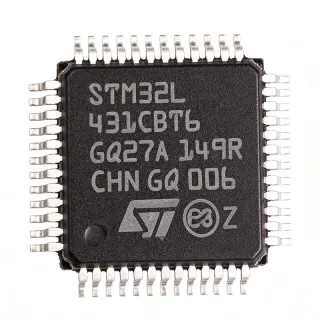
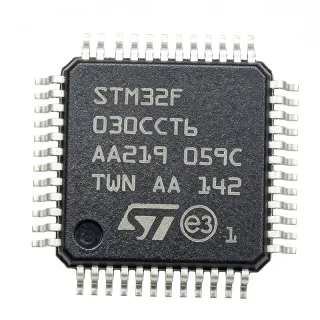
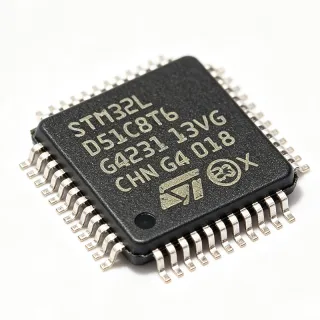
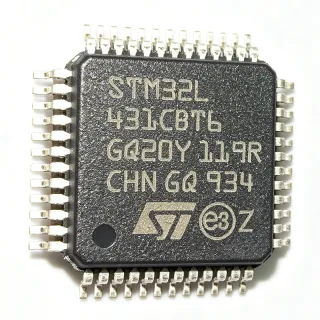
STM32G031C8T6 - 64KB Flash ARM Cortex-M0+ MCU | STMicroelectronics
MPN: STM32G031C8T6 ✓ Active| Qty | Unit Price | Extended |
|---|---|---|
| 1 | $2.85 | $2.85 |
| 10 | $2.56 | $25.60 |
| 100 | $2.28 | $228.00 |
| 500 | $2.05 | $1,025.00 |
| 1,000 | $1.82 | $1,820.00 |
STM32G031C8T6 Overview
What is a microcontroller? A microcontroller (MCU) is a compact integrated circuit designed to govern a specific operation in an embedded system. It integrates a processor core, memory (flash and SRAM), and programmable input/output peripherals on a single chip. Microcontrollers are the backbone of modern embedded systems, from simple household appliances to complex industrial automation. The STM32G031C8T6 belongs to the STM32G0 family, which is positioned as an entry-level, high-efficiency series within the broader STM32 portfolio, targeting applications that require low power consumption, robust analog capabilities, and a rich set of communication interfaces.
Key features of the STM32G031C8T6 include a 12-bit ADC with hardware oversampling (up to 16-bit resolution), a 12-bit DAC, two comparators, and an operational amplifier. It also integrates multiple communication interfaces: I2C, SPI, USART, and a low-power UART. The device supports a wide supply voltage range from 2.0V to 3.6V and offers several low-power modes, including Sleep, Stop, and Standby, with a typical standby current of only 0.27 µA. The MCU is designed with a high level of integration, reducing the need for external components and simplifying system design.
From a technical depth perspective, the STM32G031C8T6 is built on a 90 nm process technology, which contributes to its low power consumption and high performance. The Cortex-M0+ core includes a single-cycle multiplier and a nested vectored interrupt controller (NVIC), enabling efficient interrupt handling. The device also features a memory protection unit (MPU) for enhanced security and a cyclic redundancy check (CRC) unit for data integrity. The clock system is flexible, with an internal 16 MHz RC oscillator, an internal 32 kHz RC oscillator, and support for external crystals, allowing designers to optimize for cost or accuracy.
Typical applications for the STM32G031C8T6 include consumer electronics, industrial control, home automation, and portable devices. Its rich analog peripherals make it ideal for sensor interfacing, motor control, and power management. The low-power modes and wide voltage range enable battery-powered applications such as wearables and IoT nodes. The device is also well-suited for simple human-machine interfaces (HMI) with its capacitive touch sensing capability.
When designing with this MCU, it is essential to provide proper decoupling capacitors on the power supply pins and to follow the recommended layout guidelines in the datasheet to minimize noise and ensure reliable operation. The internal RC oscillators are sufficient for many applications, but for precise timing, an external crystal should be used. Additionally, the device's boot pins must be configured correctly to select the desired boot mode (flash, system memory, or SRAM).
Drop-in alternatives for STM32G031C8T6 — same package, pin-to-pin compatible. Different-package parts requiring PCB rework are excluded.
Variants in this series
Same-series models that are drop-in compatible with STM32G031C8T6 (same form factor and footprint) — differing in Core, Package, ADC, Communication Interfaces, DAC.
Quick Comparison Tool — Select alternative parts for side-by-side comparison:
STM32G031C8T6TR
✅ Drop-In📋 Reference alternative (not in catalog)
STM32G031C6T6
✅ Drop-In📋 Reference alternative (not in catalog)
STM32G041C8T6
✅ Drop-In📋 Reference alternative (not in catalog)
STM32G031C8T6
✅ Drop-In✓ In Stock
$1.82 / Unit
View Datasheet →STM32G031C8T6
✅ Drop-In✓ In Stock
$1.82 / Unit
View Datasheet →STM32G031C8T6
✅ Drop-In✓ In Stock
$1.82 / Unit
View Datasheet →STM32G031C8T6
✅ Drop-In✓ In Stock
$1.82 / Unit
View Datasheet →STM32G031C8T6
✅ Drop-In✓ In Stock
$1.82 / Unit
View Datasheet →STM32G031C8T6
✅ Drop-In✓ In Stock
$1.82 / Unit
View Datasheet →STM32G031C8T6
✅ Drop-In✓ In Stock
$1.82 / Unit
View Datasheet →STM32G031C8T6
✅ Drop-In✓ In Stock
$1.82 / Unit
View Datasheet →STM32G031C8T6
✅ Drop-In✓ In Stock
$1.82 / Unit
View Datasheet →STM32G031C8T6
✅ Drop-In✓ In Stock
$1.82 / Unit
View Datasheet →STM32G031C8T6
✅ Drop-In✓ In Stock
$1.82 / Unit
View Datasheet →STM32G031C8T6
✅ Drop-In✓ In Stock
$1.82 / Unit
View Datasheet →STM32G031C8T6
✅ Drop-In✓ In Stock
$1.82 / Unit
View Datasheet →STM32G031C8T6
✅ Drop-In✓ In Stock
$1.82 / Unit
View Datasheet →STM32G031C8T6
✅ Drop-In✓ In Stock
$1.82 / Unit
View Datasheet →STM32G031C8T6
✅ Drop-In✓ In Stock
$1.82 / Unit
View Datasheet →STM32G031C8T6
✅ Drop-In✓ In Stock
$1.82 / Unit
View Datasheet →STM32G031C8T6 Maximum Ratings & Electrical Characteristics
| Core | ARM Cortex-M0+ |
| Maximum Frequency | 64 MHz |
| Flash Memory | 64 KB |
| SRAM | 8 KB |
| Supply Voltage Range | 2.0 V to 3.6 V |
| Package | LQFP-48 (7x7 mm) |
| Operating Temperature Range | -40C to +85C |
| ADC | 12-bit, up to 16-bit with oversampling |
| DAC | 12-bit |
| Comparators | 2 |
| Operational Amplifier | 1 |
| Communication Interfaces | I2C, SPI, USART, LPUART |
| GPIO Pins | 38 |
| Standby Current | 0.27 µA |
| RoHS Status | Compliant |
STM32G031C8T6 Pin Configuration
| Pin 1 | VBAT — Battery backup supply |
| Pin 2 | PC13 — GPIO / RTC |
| Pin 3 | PC14 — GPIO / OSC32_IN |
| Pin 4 | PC15 — GPIO / OSC32_OUT |
| Pin 5 | PF0 — GPIO / OSC_IN |
| Pin 6 | PF1 — GPIO / OSC_OUT |
| Pin 7 | NRST — Reset (active low) |
| Pin 8 | VDD — Digital power supply |
| Pin 9 | VSS — Ground |
| Pin 10 | PA0 — GPIO / ADC |
| Pin 11 | PA1 — GPIO / ADC |
| Pin 12 | PA2 — GPIO / USART2_TX |
| Pin 13 | PA3 — GPIO / USART2_RX |
| Pin 14 | PA4 — GPIO / DAC |
| Pin 15 | PA5 — GPIO / SPI1_SCK |
| Pin 16 | PA6 — GPIO / SPI1_MISO |
| Pin 17 | PA7 — GPIO / SPI1_MOSI |
| Pin 18 | PB0 — GPIO / ADC |
| Pin 19 | PB1 — GPIO / ADC |
| Pin 20 | PB2 — GPIO / BOOT1 |
| Pin 21 | PB10 — GPIO / I2C2_SCL |
| Pin 22 | PB11 — GPIO / I2C2_SDA |
| Pin 23 | PB12 — GPIO / SPI2_NSS |
| Pin 24 | PB13 — GPIO / SPI2_SCK |
| Pin 25 | PB14 — GPIO / SPI2_MISO |
| Pin 26 | PB15 — GPIO / SPI2_MOSI |
| Pin 27 | PA8 — GPIO / MCO |
| Pin 28 | PA9 — GPIO / USART1_TX |
| Pin 29 | PA10 — GPIO / USART1_RX |
| Pin 30 | PA11 — GPIO / USB_DM |
| Pin 31 | PA12 — GPIO / USB_DP |
| Pin 32 | PA13 — GPIO / SWDIO |
| Pin 33 | PA14 — GPIO / SWCLK |
| Pin 34 | PA15 — GPIO / JTDI |
| Pin 35 | PB3 — GPIO / JTDO |
| Pin 36 | PB4 — GPIO / NJTRST |
| Pin 37 | PB5 — GPIO / I2C1_SMBA |
| Pin 38 | PB6 — GPIO / I2C1_SCL |
| Pin 39 | PB7 — GPIO / I2C1_SDA |
| Pin 40 | PB8 — GPIO / I2C1_SCL |
| Pin 41 | PB9 — GPIO / I2C1_SDA |
| Pin 42 | VDD — Digital power supply |
| Pin 43 | VSS — Ground |
| Pin 44 | VDDA — Analog power supply |
| Pin 45 | VREF+ — ADC reference voltage |
| Pin 46 | VSSA — Analog ground |
| Pin 47 | PC0 — GPIO / ADC |
| Pin 48 | PC1 — GPIO / ADC |
Typical Applications
STM32G031C8T6 is suitable for 6 applications: Industrial Control, Home Automation, Portable Medical Devices, IoT Nodes, Consumer Electronics, Automotive (Body Electronics).
Industrial Control
The STM32G031C8T6 is well-suited for industrial control applications such as PLCs, motor control, and process automation. Its 64 MHz Cortex-M0+ core provides sufficient processing power for real-time control loops, while the integrated 12-bit ADC and comparators enable precise sensor interfacing and current sensing. The device's wide operating temperature range (-40C to +85C) ensures reliable operation in harsh industrial environments. In a typical motor control application, the MCU reads current and position sensors via the ADC, executes a control algorithm, and generates PWM signals to drive the motor driver. The low-power modes allow energy-efficient operation in battery-backed systems. The rich set of communication interfaces (I2C, SPI, USART) facilitates connectivity with industrial networks and HMI panels. The STM32G031C8T6's robust design and comprehensive peripheral set make it a cost-effective choice for industrial control systems.
Recommended
Home Automation
The STM32G031C8T6 is ideal for home automation devices such as smart thermostats, lighting control, and security systems. Its low-power modes, including a standby current of 0.27 µA, enable battery-powered operation for wireless sensors and actuators. The MCU's capacitive touch sensing capability allows for sleek, button-less user interfaces. In a smart thermostat application, the STM32G031C8T6 reads temperature and humidity sensors via the ADC, processes the data, and controls heating or cooling relays. The device's communication interfaces (I2C, SPI, USART) support connectivity with Wi-Fi or Zigbee modules for remote monitoring and control. The wide supply voltage range (2.0V to 3.6V) accommodates various power sources, including batteries and energy harvesting circuits. The STM32G031C8T6's combination of low power, rich analog peripherals, and compact LQFP-48 package makes it a preferred choice for home automation products.
Recommended
Portable Medical Devices
The STM32G031C8T6 is suitable for portable medical devices such as glucose meters, pulse oximeters, and wearable health monitors. Its low power consumption and small form factor are critical for battery-operated devices. The integrated 12-bit ADC with oversampling enables accurate measurement of biosignals, while the operational amplifier can be used for signal conditioning. In a pulse oximeter, the MCU controls LED drivers, reads photodetector signals via the ADC, and calculates oxygen saturation levels. The device's low-power modes extend battery life, and the wide supply voltage range allows operation from a single lithium-ion cell. The STM32G031C8T6's rich analog peripherals and low-power features make it an excellent choice for portable medical devices that require high accuracy and long battery life.
Recommended
IoT Nodes
The STM32G031C8T6 is a perfect fit for IoT nodes that require low power consumption and wireless connectivity. Its standby current of 0.27 µA and support for low-power UART (LPUART) enable battery-powered operation for years. The MCU can interface with various wireless modules (LoRa, BLE, Zigbee) via SPI or UART. In a typical IoT sensor node, the STM32G031C8T6 wakes up periodically, reads sensors, processes data, and transmits it wirelessly before returning to sleep. The device's rich analog peripherals allow direct connection to sensors without external ADC. The wide supply voltage range and low-power modes make it ideal for energy harvesting applications. The STM32G031C8T6's combination of low power, processing capability, and communication interfaces makes it a leading choice for IoT edge devices.
Recommended
Consumer Electronics
The STM32G031C8T6 is widely used in consumer electronics such as smart appliances, gaming peripherals, and remote controls. Its cost-effectiveness and rich feature set make it attractive for high-volume products. The MCU's capacitive touch sensing enables intuitive user interfaces, while its communication interfaces support connectivity with other devices. In a smart appliance, the STM32G031C8T6 controls motors, reads sensors, and manages user inputs. The device's low-power modes help meet energy efficiency standards. The LQFP-48 package is suitable for compact PCB designs, and the wide operating temperature range ensures reliability in various environments. The STM32G031C8T6's balance of performance, power, and cost makes it a popular choice for consumer electronics.
Recommended
Automotive (Body Electronics)
The STM32G031C8T6 is suitable for automotive body electronics applications such as window lifters, seat control, and lighting control. Its wide operating temperature range (-40C to +85C) and robust design meet automotive requirements. The MCU's 12-bit ADC and comparators enable precise control of motors and solenoids. In a window lifter application, the STM32G031C8T6 reads switch inputs, controls the motor driver, and monitors current for anti-pinch detection. The device's communication interfaces (CAN is not available, but LIN can be implemented via USART) support automotive networking. The low-power modes help reduce battery drain when the vehicle is off. The STM32G031C8T6's combination of performance, reliability, and cost makes it a viable option for automotive body electronics.
Recommended
Recommended Products Summary
Engineering reference data for STM32G031C8T6 — comparison, design guidance, and compliance information.
Selection Guide
Comparison with Alternatives
| Parameter | This Product | STM32G031C8T6TR | STM32G031C6T6 | STM32G041C8T6 |
|---|---|---|---|---|
| Package | LQFP-48 | LQFP-48 | LQFP-48 | LQFP-48 |
| Brand | STMicroelectronics | STMicroelectronics | STMicroelectronics | STMicroelectronics |
| Flash Memory | 64 KB | 64 KB | 32 KB | 64 KB |
| SRAM | 8 KB | 8 KB | 8 KB | 8 KB |
| Maximum Frequency | 64 MHz | 64 MHz | 64 MHz | 64 MHz |
| ADC Resolution | 12-bit (16-bit with oversampling) | 12-bit (16-bit with oversampling) | 12-bit (16-bit with oversampling) | 12-bit (16-bit with oversampling) |
| DAC | 1x 12-bit | 1x 12-bit | 1x 12-bit | 2x 12-bit |
| Standby Current | 0.27 µA | 0.27 µA | 0.27 µA | 0.27 µA |
Key Differentiators
- Higher flash memory (64 KB) compared to STM32G031C6T6 (vs STM32G031C6T6)
- Additional DAC and timers compared to STM32G031C8T6 (vs STM32G041C8T6)
- Cost-effective entry-level MCU with rich analog peripherals (vs STM32F103C8T6)
Design Notes
Ensure proper decoupling of the VDD and VDDA pins with 100 nF ceramic capacitors placed as close to the pins as possible. Additionally, use a 4.7 µF capacitor on VDDA for analog noise filtering. The supply voltage range is 2.0V to 3.6V; do not exceed these limits to avoid damage.
For the LQFP-48 package, follow the recommended land pattern in the datasheet. Provide a solid ground plane under the MCU to minimize noise and improve thermal performance. Keep high-speed signals (SPI, USART) away from the crystal oscillator pins to reduce interference.
When using the internal RC oscillator, be aware of its accuracy (±1% typical). For applications requiring precise timing, use an external crystal. Also, configure the boot pins correctly to select the desired boot mode; incorrect settings can prevent the MCU from starting.
Compliance Information
RoHS compliant per STMicroelectronics product page. Not AEC-Q100 qualified; for automotive, consider STM32G031C8T6Q or similar.