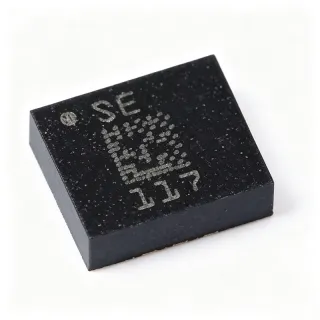
STM32WBA62CGU6 - BLE 5.4 Multiprotocol MCU 100MHz | ST
MPN: STM32WBA62CGU6 ✓ Active| Qty | Unit Price | Extended |
|---|---|---|
| 1 | $0 | $0.00 |
| 10 | $0 | $0.00 |
| 100 | $0 | $0.00 |
| 500 | $0 | $0.00 |
| 1,000 | $0 | $0.00 |
STM32WBA62CGU6 Overview
A wireless MCU is a microcontroller that combines a general-purpose processor core with an integrated radio transceiver, allowing a single chip to run both application firmware and a wireless protocol stack. Within the power-management hierarchy, the STM32WBA6 belongs to the STM32 wireless MCU family (STM32WBA series -> STM32 32-bit Arm Cortex MCUs -> microcontrollers -> embedded processors), positioned as the high-end member offering large flash memory for concurrent multi-protocol stacks.
Key differentiating features include Bluetooth Low Energy 5.4 and IEEE 802.15.4-2015 radio compliance supporting Zigbee, Thread, and Matter protocols with simultaneous multi-protocol operation, up to 2 Mbytes of flash and 512 Kbytes of RAM for large concurrent stacks, up to 86 GPIOs, and USB high-speed support for advanced connectivity. The device is built on a 40 nm process technology optimized for ultra-low-power operation and is compliant with RED and US security standards.
Architecturally, the Cortex-M33 with Arm TrustZone provides hardware-enforced security isolation, essential for Matter certification and secure over-the-air updates. The FPU accelerates signal processing for sensor fusion and audio applications. ST supports development through the STM32CubeWBA firmware package with HAL drivers, BLE, Zigbee, Thread, and Matter middleware.
Typical applications include smart-home Matter/Zigbee/Thread hubs, Bluetooth LE sensors and lighting, industrial wireless nodes, and connected building devices where large flash enables dual-image OTA and multi-stack coexistence.
Design consideration: multi-protocol concurrent operation increases RAM and flash footprint; budget at least 512 Kbytes RAM headroom and follow the STM32CubeWBA reference designs for RF matching and antenna layout.
This page synthesizes distributor inventory data, the manufacturer datasheet and migration application note AN6159, drop-in family alternatives, and practical design guidance not found on any single distributor page.
Drop-in alternatives for STM32WBA62CGU6 — same package, pin-to-pin compatible. Different-package parts requiring PCB rework are excluded.
Quick Comparison Tool — Select alternative parts for side-by-side comparison:
STM32WBA62CIU6
✅ Drop-In📋 Reference alternative (not in catalog)
STM32WBA62CGU6-variant family
✅ Drop-In ⚠️ 参数待验证📋 Reference alternative (not in catalog)
STM32WBA52CGU6
✅ Drop-In📋 Reference alternative (not in catalog)
STM32WBA55CGU6
✅ Drop-In ⚠️ 参数待验证📋 Reference alternative (not in catalog)
STM32WBA62CGU6 Maximum Ratings & Electrical Characteristics
| Core | Arm Cortex-M33 with TrustZone and FPU, 32-bit |
| Maximum CPU Frequency | 100 MHz |
| Flash Memory | 2 Mbytes |
| SRAM | 512 Kbytes |
| Radio Protocols | Bluetooth LE 5.4, IEEE 802.15.4-2015 (Zigbee, Thread, Matter) |
| Radio Frequency Band | 2.4 GHz |
| Multi-Protocol Operation | Concurrent (BLE + 802.15.4 simultaneously) |
| Security | Arm TrustZone; RED and US security standards compliant |
| USB | USB high-speed support |
| GPIO Count | Up to 86 GPIOs (family maximum; package dependent) |
| Process Technology | 40 nm |
| Package | 48-pin UFQFN with exposed pad |
| Mounting Type | Surface Mount |
| RoHS Status | Compliant |
STM32WBA62CGU6 48-pin ufqfn with exposed pad Pin Configuration Guide
Pin configuration for STM32WBA62CGU6 (48-pin ufqfn with exposed pad package). This digital IC includes GPIO, communication interfaces (UART, SPI, I2C), and power pins. Refer to the manufacturer datasheet for alternate pin functions and configuration options. Essential for embedded system design and PCB layout.

No detailed pinout data available for STM32WBA62CGU6.
Refer to the datasheet for full pin configuration.
Typical Applications
STM32WBA62CGU6 is suitable for 6 applications: Matter Smart-Home Hubs, Bluetooth LE Sensors and Beacons, Zigbee and Thread Lighting, Industrial Wireless Nodes, Connected Building and HVAC Devices, Wearables and Portable Health Devices.
Matter Smart-Home Hubs
The STM32WBA62CGU6 fits Matter hub designs because its 2.4 GHz radio is IEEE 802.15.4-2015 compliant while simultaneously supporting Bluetooth LE 5.4, letting one chip run the Matter-over-Thread stack and BLE commissioning channel concurrently. The 2 Mbytes of flash and 512 Kbytes of RAM hold both full stacks plus a TLS layer, which smaller wireless MCUs cannot fit internally. In a hub, the MCU terminates Thread sessions, bridges to BLE for device onboarding, and uses Arm TrustZone to isolate keys and attestation data required by Matter certification. ST states the device complies with RED and US security standards, easing regulatory approval. The concurrent-protocol arbitration is handled by STM32CubeWBA middleware, reducing integration risk compared to hand-tuned coexistence schemes.
Recommended
Bluetooth LE Sensors and Beacons
For battery-powered BLE sensors, the STM32WBA62CGU6 combines a 40 nm ultra-low-power process with a Cortex-M33 that runs at up to 100 MHz, giving fast burst processing between long sleep intervals. The BLE 5.4-compliant radio supports long-range and high-throughput PHY features of the 5.x specification, and 2 Mbytes of flash allow rich application code plus dual-image over-the-air updates without external memory. Peripheral blocks (ADC, timers, up to 86 GPIOs in the family) connect directly to sensors, while TrustZone secures sensor data and pairing keys. The ultra-low-power radio architecture keeps average current dominated by sleep-state consumption, extending coin-cell life in beacon and telemetry products.
Recommended
Zigbee and Thread Lighting
Connected lighting products benefit from the STM32WBA62CGU6's native IEEE 802.15.4-2015 radio, which runs Zigbee and Thread stacks from ST's STM32CubeWBA middleware with certification-ready MAC/PHY compliance. The 48-pin UFQFN package suits the compact form factor of lamp modules and drivers, while 512 Kbytes of RAM accommodate the full Zigbee stack plus application logic and OTA staging in the 2 Mbytes flash. Multi-protocol capability lets a single luminaire SKU serve ecosystems requiring BLE commissioning alongside Zigbee/Thread mesh networking. RED and US security compliance simplifies market access in Europe and North America, and hardware TrustZone protects network keys against physical extraction.
Recommended
Industrial Wireless Nodes
In factory and building automation, the STM32WBA62CGU6 provides 802.15.4 mesh connectivity (Thread/Zigbee) with the deterministic processing of a 100 MHz Cortex-M33 including hardware FPU for local control loops and sensor fusion. The 40 nm process delivers low active power for energy-harvesting or long-life battery nodes, and 2 Mbytes flash supports field-updatable firmware with redundant images for high availability. Up to 86 GPIOs (family max) and USB high-speed support allow configuration and diagnostics interfaces alongside the radio. TrustZone-based secure boot and key storage protect against tampering in industrial deployments, and ST's RED and US security compliance eases integration into certified installations.
Recommended
Connected Building and HVAC Devices
Thermostats, valve controllers, and room controllers use the STM32WBA62CGU6 to join Thread or Zigbee networks while offering BLE for smartphone setup - one chip replaces a two-radio BOM. The 512 Kbytes RAM handles concurrent stacks and a small UI framework, and the 2 Mbytes flash stores device-type clusters plus OTA images. The Cortex-M33 FPU executes PID control math for HVAC loops without fixed-point libraries, and low-power modes keep wall-battery designs within multi-year lifetime targets. Hardware TrustZone and secure OTA satisfy the security requirements of Matter-certified building products, per ST's RED and US security standards compliance statement.
Recommended
Wearables and Portable Health Devices
Battery-powered wearables leverage the STM32WBA62CGU6's ultra-low-power 40 nm design and BLE 5.4 radio for continuous sensor streaming to smartphones. The 100 MHz Cortex-M33 with FPU performs on-device signal processing (heart-rate, motion analysis) to reduce transmit payload sizes, directly extending battery life. The compact 48-UFQFN package fits small enclosures, and 2 Mbytes of flash holds signal-processing libraries plus logging buffers. TrustZone isolates personal health data at the hardware level, supporting privacy requirements for medical-adjacent products. USB high-speed support (family feature) provides a wired data path for clinical offload during charging.
Recommended
Recommended Products Summary
Engineering reference data for STM32WBA62CGU6 — comparison, design guidance, and compliance information.
Selection Guide
Comparison with Alternatives
| Parameter | This Product | STM32WBA62CIU6 | STM32WBA52CGU6 | STM32WBA55CGU6 |
|---|---|---|---|---|
| Package | 48-UFQFN (exposed pad) | 48-UFQFN (exposed pad) - same | 48-UFQFN (exposed pad) - same | 48-UFQFN (exposed pad) - same |
| Brand | STMicroelectronics | STMicroelectronics | STMicroelectronics | STMicroelectronics |
| Core / Frequency | Cortex-M33 (TrustZone, FPU), 100 MHz | Cortex-M33, 100 MHz | Cortex-M33, 100 MHz | Cortex-M33, 100 MHz |
| Radio Protocols | BLE 5.4, IEEE 802.15.4-2015 (Zigbee/Thread/Matter), concurrent | BLE 5.4, 802.15.4-2015, concurrent | BLE 5.x, 802.15.4-2015 | BLE 5.x, 802.15.4-2015 |
| Security Compliance | TrustZone; RED and US security standards | TrustZone; RED and US security | TrustZone | TrustZone |
Key Differentiators
- Largest memory in the STM32WBA series (vs STM32WBA52CGU6)
- Concurrent multi-protocol radio (vs STM32WBA55CGU6)
- USB high-speed connectivity (vs STM32WBA52CGU6)
Design Notes
The 2.4 GHz radio requires a matched antenna network; follow the reference design in the STM32CubeWBA package and the ST datasheet layout section for the 48-UFQFN exposed pad. Use a solid ground plane on layer 2 directly under the RF traces, keep the 32 MHz radio crystal traces short and guarded by ground, and place decoupling capacitors for each VDD/VSS pair within 1 mm of the pins. The exposed pad must be soldered to a via-stitched ground area for both thermal and RF performance.
Concurrent multi-protocol operation (BLE plus Thread/Zigbee/Matter) consumes significant RAM and flash; budget stack footprints against the 512 Kbytes RAM early using STM32CubeWBA stack configuration tools. If migrating from STM32WBA5, verify package pinout differences using ST application note AN6159 before reusing the PCB footprint - most packages are compatible but the application note lists exceptions. Never assume the family-maximum 86 GPIOs apply to the 48-pin UFQFN; count only the pins exposed in the datasheet pinout table.
Estimated: for battery designs, average current is dominated by sleep mode; enable the low-power run/sleep modes via STM32CubeWBA power APIs and shut down the radio between connection events. The 40 nm process supports very low leakage, but external pull-ups on unused GPIOs can erase that advantage - configure unused pins as analog inputs. Validate RF current consumption with your final antenna matching network, since mismatch can raise TX current noticeably.
Compliance Information
Device is stated by ST as compliant with RED and US security standards. RoHS status per standard STMicroelectronics product offering; REACH/lead-free/halogen details not present in captured data.