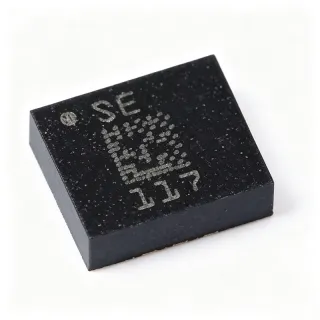
STM32WBA62PII6 - 100MHz Cortex-M33 BLE MCU | ST | IoT
MPN: STM32WBA62PII6 ✓ Active| Qty | Unit Price | Extended |
|---|---|---|
| 1 | $0 | $0.00 |
| 10 | $0 | $0.00 |
| 100 | $0 | $0.00 |
| 500 | $0 | $0.00 |
| 1,000 | $0 | $0.00 |
STM32WBA62PII6 Overview
A wireless MCU (microcontroller unit) combines a general-purpose processor with a 2.4 GHz radio transceiver on a single die. Within the system hierarchy, it sits below full application processors but above simple RF transceivers, since it embeds the CPU, memory, peripherals, and radio needed to run a complete wireless protocol stack such as Bluetooth LE, Zigbee, or Thread natively.
Key features include the 100 MHz Cortex-M33 with hardware TrustZone security and floating-point unit, 2 Mbytes of on-chip Flash for stacked protocol applications, and a patented ultra-low-power radio compliant with the Bluetooth SIG Low Energy specification 5.4 and IEEE 802.15.4-2015. Multi-protocol support covers Bluetooth LE, Zigbee, and Thread simultaneously, allowing one hardware design to serve multiple ecosystems.
Technically, the STM32WBA6xxx family embeds a radio sub-architecture optimized for concurrent multiprotocol operation with the radio stack firmware executing on the same Cortex-M33 core, reducing BOM cost versus two-chip host-plus-network-processor solutions. TrustZone-based isolation allows secure over-the-air updates and split secure/non-secure application partitions.
Typical applications include smart-home Zigbee and Thread devices, Bluetooth LE lighting and sensor nodes, and connected industrial equipment requiring secure 802.15.4 mesh networking. The 121-UFBGA package suits compact, board-constrained designs.
For design, plan RF layout carefully around the UFBGA ball field: a continuous ground plane under the antenna feed and 50-ohm controlled impedance matching are essential for radiated compliance.
This page synthesizes distributor listings, datasheet facts, family drop-in options, and practical design notes not consolidated in the manufacturer datasheet.
Drop-in alternatives for STM32WBA62PII6 — same package, pin-to-pin compatible. Different-package parts requiring PCB rework are excluded.
Quick Comparison Tool — Select alternative parts for side-by-side comparison:
STM32WBA62CGU6
✅ Drop-In✓ In Stock
Contact for price
View Datasheet →STM32WBA60PII6
✅ Drop-In ⚠️ 参数待验证📋 Reference alternative (not in catalog)
STM32WBA60CGU6
✅ Drop-In ⚠️ 参数待验证📋 Reference alternative (not in catalog)
STM32WBA62PII6 Maximum Ratings & Electrical Characteristics
| Core | Arm Cortex-M33 with TrustZone and FPU |
| CPU Frequency | 100 MHz |
| Flash Memory | 2 Mbytes |
| Wireless Protocol 1 | Bluetooth Low Energy 5.4 |
| Wireless Protocol 2 | IEEE 802.15.4-2015 |
| Protocol Stacks | Bluetooth LE, Zigbee, Thread |
| Power Class | Ultra-low-power |
| Radio Compliance | Bluetooth SIG Low Energy spec 5.4; IEEE 802.15.4-2015 |
| Package | 121-UFBGA |
| Mounting Type | Surface Mount |
| Product Type | Multiprotocol wireless 32-bit MCU with RF transceiver |
| Security | Arm TrustZone |
| Category | RF TxRx + MCU |
STM32WBA62PII6 121-ufbga Pin Configuration Guide
Pin configuration for STM32WBA62PII6 (121-ufbga package). This digital IC includes GPIO, communication interfaces (UART, SPI, I2C), and power pins. Refer to the manufacturer datasheet for alternate pin functions and configuration options. Essential for embedded system design and PCB layout.

No detailed pinout data available for STM32WBA62PII6.
Refer to the datasheet for full pin configuration.
Typical Applications
STM32WBA62PII6 is suitable for 6 applications: Smart Home Zigbee and Thread Devices, Bluetooth LE Lighting and Connected Fixtures, Battery-Powered Wireless Sensor Nodes, Industrial 802.15.4 Mesh Networking Equipment, Secure Connected Building Automation Controllers, Multiprotocol Prototype and Reference Designs.
Smart Home Zigbee and Thread Devices
The STM32WBA62PII6 fits Zigbee and Thread smart-home nodes because its radio is IEEE 802.15.4-2015 compliant and ST ships dedicated Zigbee and Thread stacks for the WBA6 family. The 2 Mbytes of Flash allows a full mesh protocol stack, an over-the-air update image in reserve, and application code without external memory, while the 100 MHz Cortex-M33 with FPU handles mesh routing, sensor fusion, and TrustZone-isolated secure key storage in one chip. In a typical battery-powered sensor or lighting node, the MCU runs the 802.15.4 radio in low-duty-cycle sleep modes, and its ultra-low-power architecture extends battery life versus general-purpose MCU plus separate radio designs. Designers should budget Flash for concurrent multiprotocol growth.
Recommended
Bluetooth LE Lighting and Connected Fixtures
For Bluetooth LE lighting products, the STM32WBA62PII6 provides a Bluetooth LE 5.4-compliant radio on the same die as the application CPU, eliminating a host-network-processor split and its UART/BLE latency. The 100 MHz Cortex-M33 drives PWM dimming engines and color-mixing algorithms with headroom, while 2 Mbytes Flash stores multiple firmware images for OTA upgrades in the field - a mandatory feature for large installed lighting fleets. TrustZone isolates the signing keys and update bootloader from the lighting application, improving supply-chain security. Because the part also speaks 802.15.4, one PCB design can ship as a BLE-only or Zigbee/Thread SKU, consolidating inventory. Layout should reserve antenna clearance and a matching network from the start.
Recommended
Battery-Powered Wireless Sensor Nodes
The STM32WBA62PII6 suits battery-powered sensors because ST positions the WBA6 family as ultra-low-power: the radio and MCU are architected for sleep-dominated duty cycles typical of BLE-connected sensing. A sensor node can use the 2 Mbytes Flash for local data logging and double-buffered OTA images, the Cortex-M33 FPU for on-node filtering or simple ML inference, and TrustZone to protect credentials for secure cloud onboarding over BLE. Sending readings via Bluetooth LE beacons or connections at multi-second intervals keeps average current dominated by sleep, preserving coin-cell life. Engineers should measure Sleep/Stop-mode currents from the datasheet tables during design, as the retrieved distributor data does not list current figures.
Recommended
Industrial 802.15.4 Mesh Networking Equipment
Industrial monitoring networks built on Thread or Zigbee mesh benefit from the STM32WBA62PII6's IEEE 802.15.4-2015 radio and generous 2 Mbytes Flash, which accommodates full mesh-router roles (router + border-router-adjacent logic) alongside application firmware. The 100 MHz Cortex-M33 with TrustZone enables signed-firmware over-the-air campaigns across a deployed fleet - critical when nodes are mounted in inaccessible locations. Multiprotocol capability lets one hardware platform serve facilities mixing BLE commissioning tools with 802.15.4 backhaul. The 121-UFBGA package suits gateways and panel controllers where board area is constrained but battery life is less critical than in sensors; verify the industrial temperature grade from the datasheet ordering table.
Recommended
Secure Connected Building Automation Controllers
Building automation controllers that bridge BLE commissioning apps with Thread/Zigbee device networks can implement both stacks on the single STM32WBA62PII6, cutting BOM count versus discrete MCU-plus-transceiver designs. The 2 Mbytes Flash hosts the multiprotocol stacks, a TLS-secured cloud agent, and field-updatable application images with rollback capability. Arm TrustZone partitions the secure world for key storage, attestation, and secure boot - increasingly required by commercial building-security certifications. The 100 MHz core with FPU executes HVAC or lighting control loops deterministically while servicing radio interrupts. Designers should validate end-to-end OTA timing on real hardware, since concurrent BLE and 802.15.4 operation shares the single 2.4 GHz radio time slot.
Recommended
Multiprotocol Prototype and Reference Designs
For R&D teams building a single hardware platform that must validate Bluetooth LE, Zigbee, and Thread, the STM32WBA62PII6 is a strong prototyping target: one PCB supports all three protocols, so only firmware changes are needed to retest a design across ecosystems. The 2 Mbytes Flash removes the constraint of swapping images during multi-stack development, and the 121-UFBGA footprint is shared across the WBA6x family, letting the same board accept lower-memory variants for cost studies. TrustZone support lets security teams prototype secure boot and OTA pipelines on production-representative silicon. Use the official ST Nucleo/Discovery WBA boards for stack bring-up before committing to the custom UFBGA-121 layout.
Recommended
Recommended Products Summary
Engineering reference data for STM32WBA62PII6 — comparison, design guidance, and compliance information.
Selection Guide
Comparison with Alternatives
| Parameter | This Product | STM32WBA62CGU6 | STM32WBA60PII6 | STM32WBA60CGU6 |
|---|---|---|---|---|
| Package | 121-UFBGA | 121-UFBGA - same family footprint | 121-UFBGA - same | 121-UFBGA - same |
| Brand | STMicroelectronics | STMicroelectronics | STMicroelectronics | STMicroelectronics |
| Core | Arm Cortex-M33 TrustZone + FPU | Arm Cortex-M33 TrustZone + FPU | Arm Cortex-M33 TrustZone + FPU | Arm Cortex-M33 TrustZone + FPU |
| CPU Frequency | 100 MHz | 100 MHz | 100 MHz | 100 MHz |
| Flash Memory | 2 Mbytes | 2 Mbytes | 1 Mbyte (family variant, verify) | 1 Mbyte (family variant, verify) |
| Bluetooth LE | LE 5.4 (datasheet) | LE 5.4 | LE 5.4 | LE 5.4 |
| IEEE 802.15.4 / Mesh | 802.15.4-2015, Zigbee, Thread | 802.15.4-2015, Zigbee, Thread | 802.15.4-2015, Zigbee, Thread | 802.15.4-2015, Zigbee, Thread |
| Lifecycle Status | active | active | active | active |
Key Differentiators
- 2 Mbytes on-chip Flash for concurrent multiprotocol stacks (vs STM32WBA60PII6)
- Bluetooth LE 5.4-qualified radio per ST datasheet (vs STM32WBA62CGU6)
- Single-die multiprotocol architecture (BLE + 802.15.4) (vs two-chip host + network coprocessor designs)
Design Notes
The 121-UFBGA ball grid array demands a disciplined RF layout: dedicate an unbroken ground plane on layer 2 directly under the RF balls, route the antenna feed as a 50-ohm controlled-impedance trace with a pi-matching network (series L, shunt C, shunt C) footprinted even if nominal 0-ohm/NC values are fitted initially. Follow the ST reference design layout for the WBA6 family, including keep-out zones around the 32.768 kHz crystal and DCDC inductor. Radiated spurious-emission compliance at 2.4 GHz is heavily layout dependent - allow at least one layout iteration for regulatory testing.
Size the power tree around the ultra-low-power operating modes: budget peak TX current from the datasheet radio tables (not listed in distributor data - confirm before battery sizing) and verify that your supply can handle connection-event current bursts without droop. Use the dedicated SMPS/DCDC ball with its recommended inductor per the datasheet application schematic to reduce active-mode consumption versus LDO-only operation. Estimated: sleep-dominated BLE sensor duty cycles typically reduce average current by two orders of magnitude versus continuous RX, so Sleep/Stop-mode currents dominate battery life calculations.
Do not confuse catalog protocol strings: DigiKey lists 'Bluetooth v5.3' while the ST datasheet qualifies the radio to Bluetooth LE 5.4 and ST's product page references LE 6.0 stack support - always design against the datasheet and the current ST firmware package version. Also, the 2 Mbyte Flash requirement for multiprotocol (BLE + Zigbee/Thread concurrent) stacks means a migration to 1 Mbyte WBA60 variants may break OTA image sizing; verify your linkerscript and OTA slot plan before any family variant substitution.
Compliance Information
Compliance statuses were not stated in the retrieved distributor snippets; consult the ST product page compliance documents for certified RoHS/REACH declarations.