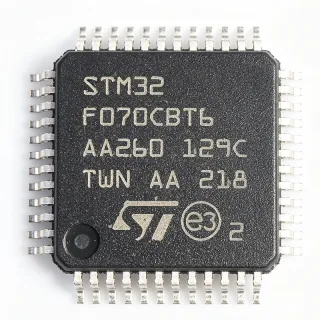
STM8AF6388 - 8-bit Automotive MCU, 64KB Flash | STMicroelectronics
MPN: STM8AF6388 ✓ Active| Qty | Unit Price | Extended |
|---|---|---|
| 1 | $3.85 | $3.85 |
| 10 | $3.47 | $34.70 |
| 100 | $3.08 | $308.00 |
| 500 | $2.77 | $1,385.00 |
| 1,000 | $2.46 | $2,460.00 |
STM8AF6388 Overview
An 8-bit microcontroller (MCU) is a single-chip computer with an 8-bit central processing unit (CPU), memory, and programmable input/output peripherals. It is a subset of the broader microcontroller family, which falls under embedded systems and integrated circuits. The STM8A core is an enhanced 8-bit architecture with a three-stage pipeline, delivering up to 16 MIPS at 24 MHz, making it suitable for real-time control applications.
Key features include 64KB of Flash memory with read-while-write capability, 6KB of SRAM, and 2KB of EEPROM with true data EEPROM. It integrates a 10-bit ADC with up to 16 channels, two 16-bit timers, one 8-bit timer, and a CAN 2.0B controller for automotive networking. The device also includes an SPI, I2C, and two UARTs for communication, along with a LIN interface for local interconnect networking.
The STM8AF6388 is built on a high-density Flash technology, providing robust data retention and endurance. The automotive qualification (AEC-Q100) ensures reliability under extreme temperature and vibration conditions. The CAN controller supports both standard and extended frame formats, enabling seamless integration into vehicle networks.
Typical applications include body control modules, automotive lighting control, sensor interfaces, and power window control. The device's low power consumption and wide voltage range make it ideal for battery-powered automotive systems. Its robust communication interfaces allow it to serve as a central node in distributed automotive networks.
When designing with this MCU, ensure proper decoupling of the power supply pins and use the internal RC oscillator for cost-sensitive designs, or an external crystal for higher accuracy. The CAN bus requires proper termination resistors and common-mode chokes for EMC compliance.
Drop-in alternatives for STM8AF6388 — same package, pin-to-pin compatible. Different-package parts requiring PCB rework are excluded.
Quick Comparison Tool — Select alternative parts for side-by-side comparison:
STM8AF6288
✅ Drop-In ⚠️ Specs Unverified📋 Reference alternative (not in catalog)
STM8AF5288
✅ Drop-In ⚠️ Specs Unverified📋 Reference alternative (not in catalog)
STM8AF6389
✅ Drop-In ⚠️ Specs Unverified📋 Reference alternative (not in catalog)
R5F10AGF
✅ Drop-In ⚠️ Specs Unverified📋 Reference alternative (not in catalog)
STM8AF6388 Maximum Ratings & Electrical Characteristics
| Core | STM8A 8-bit |
| Maximum Clock Frequency | 24 MHz |
| Flash Memory | 64 KB |
| SRAM | 6 KB |
| EEPROM | 2 KB |
| Supply Voltage | 3.0 V to 5.5 V |
| Operating Temperature | -40C to +150C |
| Package | LQFP-48 |
| ADC Resolution | 10-bit |
| ADC Channels | 16 |
| Timers | 2x 16-bit, 1x 8-bit |
| CAN Interface | 2.0B |
| SPI | 1 |
| I2C | 1 |
| UART | 2 |
| LIN | 1 |
| GPIO Pins | 38 |
| AEC-Q100 | Qualified |
| RoHS | Compliant |
STM8AF6388 Pin Configuration
| Pin 1 | VSS — Ground |
| Pin 2 | VDD — Power supply |
| Pin 3 | PA0 — GPIO/ADC |
| Pin 4 | PA1 — GPIO/ADC |
| Pin 5 | PA2 — GPIO/ADC |
| Pin 6 | PA3 — GPIO/ADC |
| Pin 7 | NRST — Reset |
| Pin 8 | PA4 — GPIO/ADC |
| Pin 9 | PA5 — GPIO/ADC |
| Pin 10 | PA6 — GPIO/ADC |
| Pin 11 | PA7 — GPIO/ADC |
| Pin 12 | PB0 — GPIO |
| Pin 13 | PB1 — GPIO |
| Pin 14 | PB2 — GPIO |
| Pin 15 | PB3 — GPIO |
| Pin 16 | PB4 — GPIO |
| Pin 17 | PB5 — GPIO |
| Pin 18 | PB6 — GPIO |
| Pin 19 | PB7 — GPIO |
| Pin 20 | PC0 — GPIO/ADC |
| Pin 21 | PC1 — GPIO/ADC |
| Pin 22 | PC2 — GPIO/ADC |
| Pin 23 | PC3 — GPIO/ADC |
| Pin 24 | PC4 — GPIO/ADC |
| Pin 25 | PC5 — GPIO/ADC |
| Pin 26 | PC6 — GPIO/ADC |
| Pin 27 | PC7 — GPIO/ADC |
| Pin 28 | PD0 — GPIO |
| Pin 29 | PD1 — GPIO |
| Pin 30 | PD2 — GPIO |
| Pin 31 | PD3 — GPIO |
| Pin 32 | PD4 — GPIO |
| Pin 33 | PD5 — GPIO |
| Pin 34 | PD6 — GPIO |
| Pin 35 | PD7 — GPIO |
| Pin 36 | PE0 — GPIO |
| Pin 37 | PE1 — GPIO |
| Pin 38 | PE2 — GPIO |
| Pin 39 | PE3 — GPIO |
| Pin 40 | PE4 — GPIO |
| Pin 41 | PE5 — GPIO |
| Pin 42 | PE6 — GPIO |
| Pin 43 | PE7 — GPIO |
| Pin 44 | VDD — Power supply |
| Pin 45 | VSS — Ground |
| Pin 46 | PF0 — GPIO/ADC |
| Pin 47 | PF1 — GPIO/ADC |
| Pin 48 | PF2 — GPIO/ADC |
Typical Applications
STM8AF6388 is suitable for 6 applications: Automotive Body Control Module, Automotive Lighting Control, Sensor Interface, Power Window Control, Electric Power Steering (EPS) Auxiliary, Industrial Automation.
Automotive Body Control Module
The STM8AF6388 is ideal for body control modules (BCM) due to its CAN interface, 64KB Flash for complex algorithms, and AEC-Q100 qualification. It manages lighting, wipers, and door locks, communicating over the CAN bus. The 10-bit ADC reads sensor inputs, while timers generate PWM for motor control. Its wide voltage range (3.0-5.5V) allows direct battery connection, and the low power modes extend battery life. The robust temperature range (-40 to +150°C) ensures operation in harsh automotive environments.
Recommended
Automotive Lighting Control
The STM8AF6388 controls LED headlights and taillights with PWM outputs from its timers. The 10-bit ADC monitors current sense resistors for fault detection. Its CAN interface allows synchronization with other vehicle modules. The 64KB Flash stores calibration tables and diagnostic routines. The device's high temperature rating is essential for under-hood lighting applications. The EEPROM stores non-volatile settings like brightness levels.
Recommended
Sensor Interface
The STM8AF6388 interfaces with various automotive sensors (temperature, pressure, position) via its 16-channel 10-bit ADC. The SPI and I2C interfaces connect to digital sensors. The UARTs support diagnostic communication. Its low power consumption is critical for always-on sensor monitoring. The 64KB Flash allows complex signal processing algorithms. The AEC-Q100 qualification ensures reliability in vibration-prone environments.
Recommended
Power Window Control
The STM8AF6388 controls power window motors using PWM from its timers. The 10-bit ADC monitors motor current for anti-pinch detection. The CAN interface allows central locking integration. Its 64KB Flash stores window position calibration and safety algorithms. The device's robust I/O handles direct motor drive via external H-bridge. The wide voltage range accommodates battery voltage fluctuations during cranking.
Recommended
Electric Power Steering (EPS) Auxiliary
The STM8AF6388 can serve as a secondary controller in EPS systems, handling torque sensor inputs and providing redundancy. Its 10-bit ADC reads torque and angle sensors. The CAN interface communicates with the main EPS ECU. The 64KB Flash stores diagnostic and calibration data. The high temperature rating is suitable for under-hood mounting. The device's deterministic timing ensures reliable real-time control.
Recommended
Industrial Automation
Beyond automotive, the STM8AF6388 is used in industrial automation for motor control and sensor monitoring. Its CAN interface supports industrial networks. The 10-bit ADC and timers enable precise control. The wide voltage range and temperature tolerance make it suitable for factory floor environments. The 64KB Flash allows complex control algorithms. The device's robustness reduces field failures.
Recommended
Recommended Products Summary
Engineering reference data for STM8AF6388 — comparison, design guidance, and compliance information.
Selection Guide
Comparison with Alternatives
| Parameter | This Product | STM8AF6288 | STM8AF5288 | STM8AF6389 | R5F10AGF |
|---|---|---|---|---|---|
| Package | LQFP-48 | LQFP-48 | LQFP-48 | LQFP-48 | LQFP-48 |
| Brand | STMicroelectronics | STMicroelectronics | STMicroelectronics | STMicroelectronics | Renesas Electronics |
| Flash Memory | 64 KB | 32 KB | 32 KB | 128 KB | 32 KB |
| SRAM | 6 KB | 6 KB | 6 KB | 6 KB | 4 KB |
| Max Clock Frequency | 24 MHz | 24 MHz | 24 MHz | 24 MHz | 20 MHz |
| ADC Resolution | 10-bit | 10-bit | 10-bit | 10-bit | 10-bit |
| CAN Interface | Yes (2.0B) | Yes (2.0B) | Yes (2.0B) | Yes (2.0B) | Yes (2.0B) |
| AEC-Q100 | Qualified | Qualified | Qualified | Qualified | Qualified |
Key Differentiators
- Larger Flash memory than STM8AF6288 (vs STM8AF6288)
- Higher clock speed than Renesas R5F10AGF (vs R5F10AGF)
- Same package and pinout as STM8AF6389 (vs STM8AF6389)
Design Notes
Decouple VDD pins with 100nF ceramic capacitors placed as close as possible to each VDD pin, and a 10uF bulk capacitor near the power entry. The wide 3.0-5.5V range allows direct battery connection, but ensure stable supply during load transients.
For CAN bus, place a 120-ohm termination resistor at each end of the bus and use a common-mode choke for EMC. Keep the CANH and CANL traces close together and routed as a differential pair to minimize radiation.
Do not leave unused GPIO pins floating; configure them as outputs or enable internal pull-ups. Ensure the NRST pin has a 100nF capacitor to ground for reliable reset. For ADC accuracy, provide a clean analog ground and separate AVDD if available.
Compliance Information
AEC-Q100 qualified per STMicroelectronics. RoHS compliant. Halogen-free status not specified in provided data.