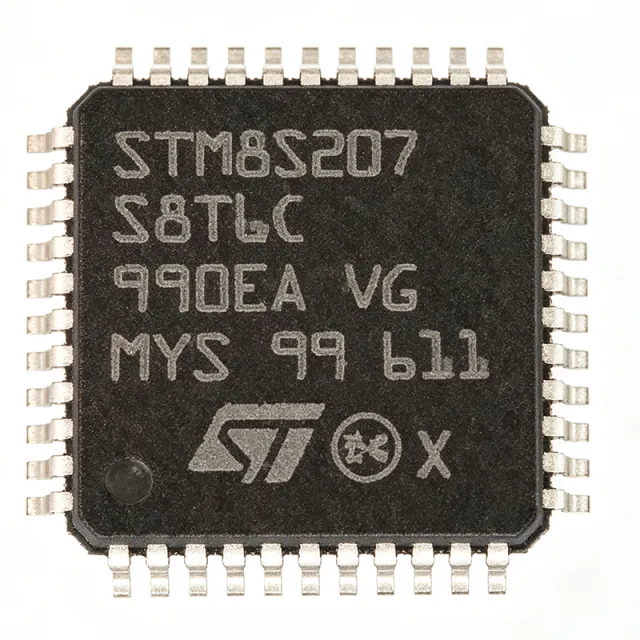
STM8S207S8T6 - 24MHz 8-bit MCU, 64KB Flash | STMicroelectronics
MPN: STM8S207S8T6 ✓ Active| Qty | Unit Price | Extended |
|---|---|---|
| 1 | $4.0909 | $4.09 |
| 10 | $2.9545 | $29.55 |
| 100 | $2.6136 | $261.36 |
| 500 | $2.5 | $1,250.00 |
| 1,000 | $2.3864 | $2,386.40 |
STM8S207S8T6 Overview
An 8-bit microcontroller (MCU) is a single-chip computer with an 8-bit data bus, executing instructions on 8-bit words. It typically integrates a CPU core, memory (Flash, RAM, EEPROM), and programmable peripherals on a single die. In the system hierarchy, an 8-bit MCU sits below 16-bit and 32-bit counterparts in processing power but offers lower cost, simpler architecture, and adequate performance for control-oriented tasks. The STM8S207S8T6 belongs to the STM8S performance line, which is designed for applications requiring higher clock speeds and richer connectivity than the value line, while maintaining the ease of use and robustness of the STM8 core.
Key features of the STM8S207S8T6 include a 24 MHz CPU clock, 64 KB of Flash memory, 2 KB of data EEPROM, and a 10-bit ADC with up to 16 multiplexed channels. It also provides two UARTs, one SPI, one I2C, and a CAN 2.0B interface, enabling flexible communication in industrial networks. The device operates from a 3.3V or 5V supply, with a wide operating temperature range of -40°C to +85°C, and is available in a 44-pin LQFP package with a 10x10 mm body and 0.8 mm pitch.
Technically, the STM8S207S8T6 is built on a high-performance 8-bit core with a three-stage pipeline, achieving up to 20 MIPS at 24 MHz. It includes a nested interrupt controller, a clock controller with multiple sources (internal RC, external crystal, or PLL), and a comprehensive set of timers including a 16-bit advanced control timer, two 16-bit general-purpose timers, and an 8-bit basic timer. The device also features a CAN controller with 3 mailboxes, supporting both standard and extended identifiers, which is critical for automotive and industrial networking.
Typical applications include industrial control systems, home appliances, power tools, and automotive body electronics. The CAN interface makes it particularly suitable for automotive networks, while the rich timer set and ADC support motor control and sensor interfacing. The 5V tolerance simplifies direct connection to legacy sensors and actuators without level shifting.
When designing with this MCU, ensure proper decoupling of the VDD and VDDA pins with 100 nF capacitors placed close to the device. The internal RC oscillator can be used for cost-sensitive designs, but for precise timing, an external crystal is recommended. The STM8S207S8T6 supports in-circuit programming and debugging via the SWIM interface, which requires a single-wire connection and simplifies firmware updates.
Drop-in alternatives for STM8S207S8T6 — same package, pin-to-pin compatible. Different-package parts requiring PCB rework are excluded.
Quick Comparison Tool — Select alternative parts for side-by-side comparison:
STM8S207C8T6
✓ In Stock
$1.95 / Unit
View Datasheet →STM8S105S6T6
✓ In Stock
$1.45 / Unit
View Datasheet →STM8S207S8T6B
📋 Reference alternative (not in catalog)
STM8S207S8T6C
📋 Reference alternative (not in catalog)
STM8S207S8T6TR
📋 Reference alternative (not in catalog)
STM8S207R8T6
📋 Reference alternative (not in catalog)
STM8S207S8T6 Maximum Ratings & Electrical Characteristics
| Core | STM8 8-bit CISC |
| Maximum Clock Frequency | 24 MHz |
| Flash Program Memory | 64 KB (64K x 8) |
| Data EEPROM | 2 KB |
| RAM | 6 KB |
| ADC Resolution | 10-bit |
| ADC Channels | 16 |
| UART Interfaces | 2 |
| SPI Interfaces | 1 |
| I2C Interfaces | 1 |
| CAN Interface | 1 (CAN 2.0B) |
| Timers | 1x 16-bit advanced, 2x 16-bit general purpose, 1x 8-bit basic |
| Operating Voltage | 3.3V to 5V |
| Operating Temperature | -40C to +85C |
| Package | LQFP-44 (10x10 mm, 0.8 mm pitch) |
| Mounting Type | Surface Mount |
| RoHS Status | Compliant |
STM8S207S8T6 Pin Configuration
| Pin 1 | PE5 — Port E bit 5 / SPI NSS |
| Pin 2 | PE4 — Port E bit 4 / SPI SCK |
| Pin 3 | PE3 — Port E bit 3 / SPI MOSI |
| Pin 4 | PE2 — Port E bit 2 / SPI MISO |
| Pin 5 | PE1 — Port E bit 1 / TIM1_CH1 |
| Pin 6 | PE0 — Port E bit 0 / TIM1_CH2 |
| Pin 7 | VSS — Ground |
| Pin 8 | VDD — Power supply 3.3V/5V |
| Pin 9 | PD7 — Port D bit 7 / TIM1_CH4 |
| Pin 10 | PD6 — Port D bit 6 / TIM1_CH3 |
| Pin 11 | PD5 — Port D bit 5 / UART2_TX |
| Pin 12 | PD4 — Port D bit 4 / UART2_RX |
| Pin 13 | PD3 — Port D bit 3 / I2C_SCL |
| Pin 14 | PD2 — Port D bit 2 / I2C_SDA |
| Pin 15 | PD1 — Port D bit 1 / CAN_TX |
| Pin 16 | PD0 — Port D bit 0 / CAN_RX |
| Pin 17 | PC7 — Port C bit 7 / ADC_IN7 |
| Pin 18 | PC6 — Port C bit 6 / ADC_IN6 |
| Pin 19 | PC5 — Port C bit 5 / ADC_IN5 |
| Pin 20 | PC4 — Port C bit 4 / ADC_IN4 |
| Pin 21 | PC3 — Port C bit 3 / ADC_IN3 |
| Pin 22 | PC2 — Port C bit 2 / ADC_IN2 |
| Pin 23 | PC1 — Port C bit 1 / ADC_IN1 |
| Pin 24 | PC0 — Port C bit 0 / ADC_IN0 |
| Pin 25 | PB7 — Port B bit 7 / TIM2_CH1 |
| Pin 26 | PB6 — Port B bit 6 / TIM2_CH2 |
| Pin 27 | PB5 — Port B bit 5 / TIM2_CH3 |
| Pin 28 | PB4 — Port B bit 4 / TIM2_CH4 |
| Pin 29 | PB3 — Port B bit 3 / TIM3_CH1 |
| Pin 30 | PB2 — Port B bit 2 / TIM3_CH2 |
| Pin 31 | PB1 — Port B bit 1 / TIM3_CH3 |
| Pin 32 | PB0 — Port B bit 0 / TIM3_CH4 |
| Pin 33 | PA7 — Port A bit 7 / UART1_TX |
| Pin 34 | PA6 — Port A bit 6 / UART1_RX |
| Pin 35 | PA5 — Port A bit 5 / SWIM |
| Pin 36 | PA4 — Port A bit 4 / CLK_CCO |
| Pin 37 | PA3 — Port A bit 3 / TIM1_ETR |
| Pin 38 | PA2 — Port A bit 2 / TIM1_CH3 |
| Pin 39 | PA1 — Port A bit 1 / TIM1_CH2 |
| Pin 40 | PA0 — Port A bit 0 / TIM1_CH1 |
| Pin 41 | NRST — Reset (active low) |
| Pin 42 | VDDA — Analog power supply |
| Pin 43 | VSSA — Analog ground |
| Pin 44 | VREF — ADC reference voltage |
Typical Applications
STM8S207S8T6 is suitable for 6 applications: Industrial Control, Automotive Body Electronics, Home Appliances, Power Tools, Smart Home Devices, Medical Monitoring Devices.
Industrial Control
The STM8S207S8T6 is ideal for industrial control systems due to its 24 MHz clock, rich timer set, and 10-bit ADC. It can handle motor control, sensor interfacing, and real-time monitoring. The CAN interface enables robust communication in factory automation networks. Its 5V tolerance simplifies direct connection to industrial sensors and actuators without level shifting, reducing BOM cost. The wide operating temperature range of -40°C to +85°C ensures reliable operation in harsh environments. The 64 KB Flash provides ample space for complex control algorithms, while the 2 KB EEPROM allows for parameter storage without external memory. The device's low power consumption and multiple low-power modes make it suitable for energy-efficient industrial designs. The STM8 core's robustness and the availability of comprehensive development tools, including STM8CubeMX and IAR, accelerate time-to-market. The 44-pin LQFP package is compact yet provides sufficient I/O for typical control applications. Overall, the STM8S207S8T6 offers a cost-effective solution for industrial control, balancing performance, connectivity, and reliability.
Recommended
Automotive Body Electronics
The STM8S207S8T6 is well-suited for automotive body electronics, such as window lifters, mirror controls, and lighting modules. Its CAN 2.0B interface allows seamless integration into vehicle networks, enabling communication with the body control module. The device operates from 3.3V to 5V, matching automotive supply rails, and its -40°C to +85°C temperature range covers most automotive environments. The 10-bit ADC can read analog sensors like temperature and position, while the timers generate PWM for motor control. The 64 KB Flash is sufficient for bootloader and application code, supporting over-the-air updates. The STM8 core's deterministic execution is ideal for real-time control tasks. The device's robustness, including ESD protection and a watchdog timer, ensures reliable operation in the electrically noisy automotive environment. While not AEC-Q100 qualified in the standard version, the STM8S207S8T6B variant offers automotive-grade qualification. The 44-pin LQFP package is compact, fitting into space-constrained modules. Overall, the STM8S207S8T6 provides a cost-effective, reliable solution for automotive body electronics, leveraging its CAN connectivity and robust design.
Recommended
Home Appliances
The STM8S207S8T6 is an excellent choice for home appliances like washing machines, refrigerators, and air conditioners. Its 24 MHz clock and rich peripherals enable precise motor control, temperature sensing, and user interface management. The 10-bit ADC reads thermistors and potentiometers, while the timers generate PWM for inverter motor drives. The two UARTs allow communication with external modules like Wi-Fi or Bluetooth for smart home integration. The I2C interface connects to EEPROMs and display drivers. The device's low cost and high integration reduce overall system cost, making it ideal for mass-produced appliances. The 64 KB Flash provides ample space for complex control algorithms and user settings. The 2 KB EEPROM stores calibration data and user preferences. The device operates from 3.3V or 5V, compatible with common appliance power supplies. Its robust design, including brown-out reset and watchdog timer, ensures reliable operation over years of use. The STM8S207S8T6's small 44-pin LQFP package fits into compact control boards. Overall, it offers a balanced combination of performance, connectivity, and cost for modern home appliances.
Recommended
Power Tools
The STM8S207S8T6 is suitable for power tools such as drills, saws, and grinders, where it manages motor control, battery monitoring, and safety features. Its 24 MHz clock and advanced timer generate high-frequency PWM for brushless DC motor control, improving efficiency and torque. The 10-bit ADC monitors battery voltage and current, enabling accurate fuel gauging and protection. The device's CAN interface can be used for communication in professional tool systems. The 64 KB Flash stores complex control algorithms and safety routines. The 2 KB EEPROM saves calibration and usage data. The device operates from 3.3V to 5V, compatible with battery management systems. Its wide temperature range ensures operation in demanding conditions. The STM8 core's fast interrupt response is critical for real-time motor control and fault handling. The device's low power modes extend battery life during idle periods. The 44-pin LQFP package is compact, fitting into tool handles. Overall, the STM8S207S8T6 provides the performance and reliability needed for advanced power tools, enabling features like variable speed, soft-start, and electronic braking.
Recommended
Smart Home Devices
The STM8S207S8T6 is a cost-effective choice for smart home devices like smart plugs, thermostats, and security sensors. Its 24 MHz clock and rich peripherals enable sensor reading, communication, and control. The 10-bit ADC reads temperature, humidity, and light sensors. The UART interfaces connect to Wi-Fi or Zigbee modules for cloud connectivity. The I2C interface links to displays and external memory. The device's low power consumption and multiple sleep modes are ideal for battery-powered devices, extending battery life. The 64 KB Flash provides ample space for firmware and over-the-air updates. The 2 KB EEPROM stores device configuration and user settings. The device operates from 3.3V, common in smart home systems. Its small 44-pin LQFP package fits into compact enclosures. The STM8 core's deterministic execution ensures reliable operation. The device's robust design, including a watchdog timer, ensures long-term reliability. Overall, the STM8S207S8T6 offers a balanced combination of performance, connectivity, and cost for smart home applications, enabling seamless integration into the Internet of Things.
Recommended
Medical Monitoring Devices
The STM8S207S8T6 can be used in medical monitoring devices like patient monitors, glucose meters, and pulse oximeters. Its 24 MHz clock and 10-bit ADC enable accurate sensor signal processing. The device's low power consumption is critical for battery-operated portable devices. The UART interfaces allow communication with external modules for data logging or wireless transmission. The I2C interface connects to sensors and displays. The 64 KB Flash stores complex algorithms for signal processing and data analysis. The 2 KB EEPROM saves patient data and calibration settings. The device operates from 3.3V, compatible with battery systems. Its wide temperature range ensures reliable operation in clinical environments. The STM8 core's deterministic execution is essential for real-time monitoring. The device's robust design, including a watchdog timer, ensures patient safety. The 44-pin LQFP package is compact, fitting into handheld devices. While not certified for medical use, the STM8S207S8T6 provides the performance and reliability needed for many monitoring applications. Overall, it offers a cost-effective solution for medical monitoring, balancing performance, power efficiency, and connectivity.
Recommended
Recommended Products Summary
Engineering reference data for STM8S207S8T6 — comparison, design guidance, and compliance information.
Selection Guide
Comparison with Alternatives
| Parameter | This Product | STM8S207S8T6B | STM8S207S8T6C | STM8S207S8T6TR | STM8S207R8T6 | STM8S207C8T6 |
|---|---|---|---|---|---|---|
| Package | LQFP-44 | LQFP-44 (same) | LQFP-44 (same) | LQFP-44 (same) | LQFP-64 (different) | LQFP-48 (different) |
| Brand | STMicroelectronics | STMicroelectronics | STMicroelectronics | STMicroelectronics | STMicroelectronics | STMicroelectronics |
| Core | STM8 8-bit CISC | STM8 8-bit CISC | STM8 8-bit CISC | STM8 8-bit CISC | STM8 8-bit CISC | STM8 8-bit CISC |
| Maximum Clock Frequency | 24 MHz | 24 MHz | 24 MHz | 24 MHz | 24 MHz | 24 MHz |
| Flash Memory | 64 KB | 64 KB | 64 KB | 64 KB | 64 KB | 64 KB |
| CAN Interface | Yes (1x CAN 2.0B) | Yes (1x CAN 2.0B) | Yes (1x CAN 2.0B) | Yes (1x CAN 2.0B) | Yes (1x CAN 2.0B) | Yes (1x CAN 2.0B) |
| Operating Voltage | 3.3V to 5V | 3.3V to 5V | 3.3V to 5V | 3.3V to 5V | 3.3V to 5V | 3.3V to 5V |
| Operating Temperature | -40C to +85C | -40C to +125C (automotive) | -40C to +105C | -40C to +85C | -40C to +85C | -40C to +85C |
Key Differentiators
- Integrated CAN 2.0B interface (vs STM8S105S6T6)
- Higher clock speed of 24 MHz (vs STM8S105S6T6)
- Larger Flash memory of 64 KB (vs STM8S105S6T6)
Design Notes
The STM8S207S8T6 operates from 3.3V to 5V. Place a 100 nF ceramic capacitor close to each VDD pin and a 1 uF capacitor on VDDA. For noisy environments, add a 10 uF bulk capacitor on the main supply. Ensure the VSS and VSSA pins are connected to a solid ground plane to minimize noise and improve ADC accuracy.
For the 44-pin LQFP package, use a 0.8 mm pitch footprint. Provide a thermal pad on the PCB for the exposed pad (if present) to improve heat dissipation. Keep traces for the SWIM interface short and direct to ensure reliable programming and debugging. Route the CAN bus lines with proper termination (120 ohm) and keep them away from high-speed digital signals to reduce EMI.
Do not leave unused pins floating; configure them as outputs or enable internal pull-ups to avoid excessive current consumption. Ensure the NRST pin has a 100 nF capacitor to ground for reliable reset. When using the internal RC oscillator, note that accuracy is +/-1% at 25C, which may not be sufficient for CAN communication; use an external crystal for CAN applications. Also, verify that the ADC reference voltage (VREF) is stable and clean for accurate conversions.
Compliance Information
RoHS compliant per STMicroelectronics datasheet. Standard version is not AEC-Q100 qualified; use STM8S207S8T6B for automotive.