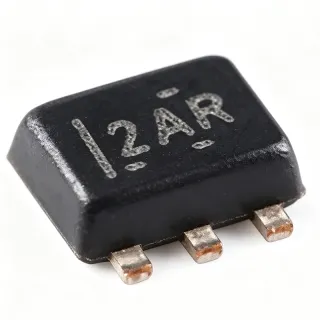
SZNUP2105LT3G - Dual CAN Bus TVS ESD Protector | onsemi
MPN: SZNUP2105LT3G ✓ Active| Qty | Unit Price | Extended |
|---|---|---|
| 1 | $0.15 | $0.15 |
| 10 | $0.12 | $1.20 |
| 100 | $0.08 | $8.00 |
| 500 | $0.05 | $25.00 |
| 1,000 | $0.04 | $40.00 |
SZNUP2105LT3G Overview
A TVS (Transient Voltage Suppressor) diode is a semiconductor protection device that clamps fast overvoltage events such as electrostatic discharge (ESD), load dump, and inductive switching transients before they reach sensitive circuitry. In the power-protection hierarchy, TVS diodes sit at the board level, upstream protection layer, complementing fuses, varistors, and common-mode chokes in a complete electromagnetic-compatibility (EMC) front end.
Key features include bidirectional protection on each of the two channels in a single package, a low 30pF line capacitance that preserves CAN FD and high-speed CAN signal integrity, and an automotive-grade SZ prefix indicating AEC-Q101 qualification for harsh environments. The 26.2V minimum breakdown voltage and 24V standoff rating give designers margin over the nominal 12V/24V vehicle rail transients seen on CAN_H and CAN_L.
The device is specifically engineered for high-speed and fault-tolerant CAN networks per the onsemi datasheet, protecting the transceiver pins from ESD strikes and harmful transient voltage events. Its symmetrical bidirectional characteristic suits differential signaling, where both positive and negative overvoltages must be clamped relative to ground.
Typical applications include automotive CAN_H/CAN_L line protection at the transceiver, industrial CANopen and DeviceNet nodes, 24V industrial bus protection, and general dual-line ESD protection for RS-485 style differential links.
For design, place the SZNUP2105LT3G as close as possible to the connector side of the CAN transceiver, with a short, low-inductance ground return; excessive trace inductance degrades clamping performance during fast ESD edges.
This page synthesizes distributor pricing, drop-in alternative comparisons, and practical design notes not found in the manufacturer datasheet alone.
Drop-in alternatives for SZNUP2105LT3G — same package, pin-to-pin compatible. Different-package parts requiring PCB rework are excluded.
Quick Comparison Tool — Select alternative parts for side-by-side comparison:
NUP2105LT3G
✅ Drop-In📋 Reference alternative (not in catalog)
SZNUP2105LT1G
✅ Drop-In📋 Reference alternative (not in catalog)
NUP2105LT1G
✅ Drop-In📋 Reference alternative (not in catalog)
SZNUX2105
✅ Drop-In📋 Reference alternative (not in catalog)
SZNUP2105LT3G Specifications
| Device Type | Dual Line CAN Bus Protector (TVS Diode) |
| Channels | 2 (bidirectional) |
| Reverse Standoff Voltage | 24 V |
| Breakdown Voltage | 26.2 V (min) |
| Clamping Voltage | 44 V (max) @ 8 A |
| Peak Pulse Current (Ipp) | 8 A (8/20 us) |
| Peak Pulse Power | 350 W |
| Junction Capacitance | 30 pF (typ) |
| ESD Rating | 30 kV (per datasheet family rating) |
| Polarity | Bidirectional |
| Application | CAN Bus / High-speed and fault-tolerant CAN networks |
| Package | SOT-23-3 (TO-236) |
| Mounting Type | Surface Mount |
| Qualification | AEC-Q101 qualified (SZ prefix) |
| RoHS Status | Compliant (Pb-free suffix G) |
SZNUP2105LT3G Pin Configuration
| Pin 1 | I/O 1 — Protected line 1 (anode of channel 1), connect to CAN_H or line 1 |
| Pin 2 | GND — Common ground reference (cathode), connect to system ground |
| Pin 3 | I/O 2 — Protected line 2 (anode of channel 2), connect to CAN_L or line 2 |
Typical Applications
SZNUP2105LT3G is suitable for 6 applications: Automotive CAN Bus Line Protection, Industrial CANopen / DeviceNet Nodes, 24V Rail Transient Protection, Body Control Module I/O, RS-485 / RS-422 Differential Link Protection, Two-Wheeler and Off-Highway Vehicle Networks.
Automotive CAN Bus Line Protection
The SZNUP2105LT3G was purpose-designed to protect the CAN transceiver in high-speed and fault-tolerant automotive networks. Its 24V reverse standoff clears normal 12V-system CAN common-mode range with margin, while the 44V clamp at 8A absorbs load-dump-coupled and inductive transients arriving on CAN_H and CAN_L. The SZ prefix confirms AEC-Q101 qualification, satisfying automotive reliability documentation requirements. With only 30pF of line capacitance, the device does not degrade 500 kbps classic CAN signaling and remains acceptable for most CAN FD nodes when placed near the connector with short ground returns. It clamps bidirectionally on both lines from one SOT-23, halving the protection footprint versus discrete solutions.
Recommended
Industrial CANopen / DeviceNet Nodes
Industrial 24V CAN networks such as CANopen and DeviceNet expose transceiver pins to switching transients from contactors, motors, and wiring inductance. The SZNUP2105LT3G's 24V standoff is precisely matched to 24V rails, so it never conducts during normal operation yet clamps at 44V maximum before transceiver damage thresholds. The 350W peak pulse power rating absorbs the energy of 8/20 us surge events typical of industrial EMC test levels. Its bidirectional characteristic handles the positive and negative excursions of differential signaling symmetrically. Factory automation and robot networks benefit from the compact SOT-23, which fits directly at the connector entry point on dense I/O boards.
Recommended
24V Rail Transient Protection
Beyond CAN, the SZNUP2105LT3G protects any two signal or low-power lines referenced to ground in 24V industrial systems, including 4-20 mA loop equipment accessories, solenoid driver sense lines, and limit-switch inputs. The 26.2V minimum breakdown guarantees no leakage conduction on nominal 24V supplies, while the 8A, 44V clamp rides through contact-bounce inductive kicks that would otherwise punch through comparator or MCU inputs. Designers should place the device within millimeters of the protected connector and use a solid ground plane, because clamp performance during sub-nanosecond ESD edges depends directly on return-path inductance rather than the diode alone.
Recommended
Body Control Module I/O
Body control modules aggregate dozens of automotive I/O lines exposed to harness-coupled ESD and transient events. The SZNUP2105LT3G provides AEC-Q101-qualified dual-line protection for pairs of switch inputs or low-speed network lines, with the 30pF capacitance keeping debouncing thresholds and timing unaffected. Its symmetrical bidirectional clamp is ideal for lines whose polarity reverses during faults, such as motor-commutation sense lines. At volume pricing near $0.04 per unit, dual-channel integration also reduces BOM line count versus two discrete TVS parts, easing procurement and placement in high-volume BCM production while meeting OEM transient-susceptibility requirements.
Recommended
RS-485 / RS-422 Differential Link Protection
The SZNUP2105LT3G doubles as an ESD and surge protector for RS-485 and RS-422 differential pairs in the factory and building-automation segments. Its 24V standoff accommodates the -7V to +12V common-mode range of RS-485 systems with margin for fault conditions up to the 26.2V breakdown, and the bidirectional clamp symmetrizes protection across the A/B pair. With 30pF per line, data rates up to several Mbps remain practical when stubs are short. For installations facing severe surge exposure, pair the TVS with a series PTC or gas discharge tube upstream so the semiconductor clamp is not asked to absorb the full fault energy alone.
Recommended
Two-Wheeler and Off-Highway Vehicle Networks
Motorcycles, agricultural, and construction vehicles run CAN or LIN sub-networks with even harsher transient environments than passenger cars, including 12V/24V mixed systems and unclamped load dump. The SZNUP2105LT3G's 350W pulse rating and 8A Ipp handle these repeated surge events, while AEC-Q101 qualification documents reliability for vehicle-mounted electronics. The 44V clamp protects transceiver inputs during jump-start and alternator-fault conditions. Compact SOT-23 packaging suits the miniaturized nodes typical of two-wheeler ECUs. For highest immunity, place the device at the harness connector, follow with the transceiver, and keep the ground connection via multiple vias to the chassis plane.
Recommended
Recommended Products Summary
Engineering reference data for SZNUP2105LT3G — comparison, design guidance, and compliance information.
Selection Guide
Comparison with Alternatives
| Parameter | This Product | NUP2105LT3G | SZNUP2105LT1G | NUP2105LT1G |
|---|---|---|---|---|
| Package | SOT-23-3 (TO-236) | SOT-23-3 (TO-236) - same | SOT-23-3 (TO-236) - same | SOT-23-3 (TO-236) - same |
| Brand | onsemi | onsemi | onsemi | onsemi |
| Reverse Standoff Voltage | 24 V | 24 V | 24 V | 24 V |
| Clamping Voltage @ Ipp | 44 V @ 8 A | 44 V @ 8 A | 44 V @ 8 A | 44 V @ 8 A |
| Peak Pulse Power | 350 W | 350 W | 350 W | 350 W |
| Junction Capacitance | 30 pF (typ) | 30 pF (typ) | 30 pF (typ) | 30 pF (typ) |
| AEC-Q101 Automotive Qualification | Yes (SZ prefix) | No (standard grade) | Yes (SZ prefix) | No (standard grade) |
| Typical Unit Price (qty 1) | $0.15 (as of 2026-10-20) | $0.11 | $0.14 | $0.10 |
Key Differentiators
- AEC-Q101 automotive qualification in the same SOT-23 footprint (vs NUP2105LT3G)
- 24V standoff matched to industrial 24V buses (vs lower-standoff general-purpose dual TVS arrays)
- Dual channels in a single 3-pin package (vs two discrete single-line TVS diodes)
Design Notes
Place the SZNUP2105LT3G within a few millimeters of the CAN connector, before the transceiver, with the GND pin (pin 2) tied to the ground plane through at least two vias. During a 1 ns ESD edge, even 10 nH of trace inductance adds ~10V of overshoot per ampere of surge current, partially defeating the 44V clamp. Keep the protected-line stubs as short and direct as possible; the protection loop area, not the diode alone, determines real-world clamping performance.
Do not substitute a general-purpose lower-standoff TVS (e.g., 15V or 5V parts) on a 24V CAN bus: the diode would conduct during normal common-mode operation, heating and eventually failing short. Also verify that surge sources upstream (unclamped automotive load dump can exceed 60V for hundreds of milliseconds) are handled by upstream suppression such as a varistor or load-dump clamp, since the 350W/8A rating of this device covers short 8/20 us pulses, not sustained overvoltage.
The 30pF per-channel capacitance adds to the total CAN bus capacitance budget. For classic 500 kbps networks this is negligible, but for CAN FD at 2-5 Mbps with long stubs, compute total node capacitance (TVS 30pF + transceiver + connector + trace) and verify rise-time compliance. If bit-rate errors appear at the network's fastest nodes, evaluate placing lower-capacitance ESD arrays on only the most exposed nodes, keeping the SZNUP2105LT3G on surge-exposed connector nodes.
Automotive programs must order the SZ-prefixed part; the standard NUP2105LT3G shares the same silicon but lacks the AEC-Q101 qualification documentation required by most OEM PPAP packages. Conversely, for cost-driven industrial builds, the non-SZ variants deliver identical electrical protection at lower price. Mixing the two on one BOM is a common procurement error - standardize per program, not per reel.
Compliance Information
G suffix indicates lead-free/RoHS-compliant construction. SZ prefix indicates AEC-Q101 qualification (discrete semiconductor reliability standard AEC-Q101). REACH and halogen-free status not stated in provided data.