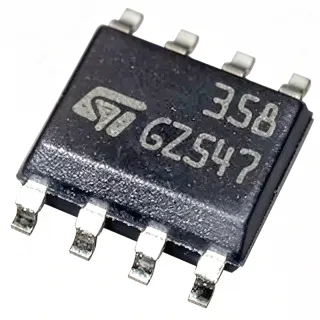
THS4031Q-Q1 - 100MHz 1.6nV Low-Noise Op Amp AEC-Q100 | TI
MPN: THS4031Q-Q1 ✓ Active| Qty | Unit Price | Extended |
|---|---|---|
| 1 | $2.6 | $2.60 |
| 10 | $2.34 | $23.40 |
| 100 | $2.05 | $205.00 |
| 500 | $1.82 | $910.00 |
| 1,000 | $1.63 | $1,630.00 |
THS4031Q-Q1 Overview
A high-speed operational amplifier is a voltage feedback amplifier optimized for wide bandwidth and fast settling, sitting within the amplifier IC hierarchy of linear signal chain components. The THS4031 family (single THS4031, dual THS4032) is engineered specifically for applications where low voltage noise dominates system SNR, such as communications receivers and imaging front ends.
Key features include ultra-low 1.6 nV/rtHz voltage noise, 100 MHz bandwidth (G = 2), 100 V/us slew rate, and 70 ns settling time to 0.1%. Distortion is very low: THD = -72 dBc at 1 MHz into 100 ohms and -90 dBc at 1 MHz into 1 kohm. Input offset voltage is a low 0.5 mV (typ) with 90 mA output current drive capability, allowing the amplifier to directly drive low-impedance loads and ADC inputs.
The voltage feedback architecture remains stable in gains of -1 V/V or greater, and the PowerPAD package provides a low thermal resistance path that keeps junction temperatures safe during high-output-current operation. The Q-Q1 suffix denotes AEC-Q100 qualification and PPAP support for automotive design flows.
Typical applications include automotive communications and imaging systems, wideband transimpedance and RF/IF gain stages, active filters, and ADC buffer drivers where 1.6 nV/rtHz noise preserves dynamic range.
Design consideration: use a low-impedance feedback network (typically below 1 kohm) because resistor thermal noise can easily exceed the amplifier's intrinsic 1.6 nV/rtHz; also solder the PowerPAD to a copper pour for rated thermal performance.
Drop-in alternatives for THS4031Q-Q1 — same package, pin-to-pin compatible. Different-package parts requiring PCB rework are excluded.
Variants in this series
Same-series models that are drop-in compatible with THS4031Q-Q1 (same form factor and footprint) — differing in Amplifier Type, Bandwidth, Operating Temperature, Package, Settling Time (0.1%).
Quick Comparison Tool — Select alternative parts for side-by-side comparison:
THS4031ID
✅ Drop-In ⚠️ Specs Unverified📋 Reference alternative (not in catalog)
THS4031CD
✅ Drop-In ⚠️ Specs Unverified📋 Reference alternative (not in catalog)
THS4031QDRQ1
✅ Drop-In ⚠️ Specs Unverified📋 Reference alternative (not in catalog)
THS4032Q-Q1
✅ Drop-In📋 Reference alternative (not in catalog)
LM7171AIM8
⚡ Same Package ⚠️ Specs Unverified📋 Reference alternative (not in catalog)
THS4031Q-Q1 Maximum Ratings & Electrical Characteristics
| Amplifier Type | Voltage Feedback, Single |
| Bandwidth | 100 MHz (G = 2) |
| Input Voltage Noise | 1.6 nV/rtHz |
| Slew Rate | 100 V/us |
| Settling Time (0.1%) | 70 ns |
| THD | -72 dBc at 1 MHz, RL = 100 ohm; -90 dBc at 1 MHz, RL = 1 kohm |
| Input Offset Voltage | 0.5 mV (typ) |
| Output Current | 90 mA |
| Minimum Stable Gain | -1 V/V or greater |
| Operating Temperature | -40C to +125C (AEC-Q100 Grade 1, automotive) |
| Qualification | AEC-Q100 Qualified, Q-Q1 automotive variant |
| Package | HTSSOP-8 PowerPAD (DDA) |
| Mounting Type | Surface Mount |
THS4031Q-Q1 Pin Configuration
| Pin 1 | NC — No internal connection |
| Pin 2 | IN- — Inverting input |
| Pin 3 | IN+ — Non-inverting input |
| Pin 4 | V- — Negative supply |
| Pin 5 | NC — No internal connection |
| Pin 6 | OUT — Amplifier output |
| Pin 7 | V+ — Positive supply |
| Pin 8 | NC — No internal connection |
| Pin PAD | PowerPAD — Die attach thermal pad - solder to PCB pour per datasheet |
Typical Applications
THS4031Q-Q1 is suitable for 6 applications: Automotive Communications Receivers, Imaging Front-End Amplifiers, ADC Input Buffer / Driver, Wideband Active Filters, Test and Measurement Signal Chains, Transimpedance and Sensor Gain Stages.
Automotive Communications Receivers
The THS4031Q-Q1's 1.6 nV/rtHz input voltage noise and 100 MHz bandwidth make it ideal for automotive RF/IF gain stages where noise figure directly impacts receiver sensitivity. Placed as a gain-of-2 to gain-of-10 IF amplifier between a mixer and ADC, it adds minimal noise compared with typical 50-ohm source impedance contributions. Its AEC-Q100 Grade 1 rating (-40C to +125C) meets underhood and telematics temperature requirements, while the 100 V/us slew rate preserves large-signal IF fidelity without slew-induced distortion.
Recommended
Imaging Front-End Amplifiers
In automotive and industrial imaging chains (CCD/CMOS sensor output buffers), the THS4031Q-Q1 combines low 1.6 nV/rtHz noise with 90 mA output drive so it can charge ADC sample capacitors directly without an external buffer, reducing settling errors. The 70 ns settling time to 0.1% supports pixel-rate multiplexed sampling, and -90 dBc THD at 1 MHz into 1 kohm keeps harmonic artifacts below typical 12-bit converter resolution. PowerPAD thermal design sustains continuous drive during high frame-rate operation.
Recommended
ADC Input Buffer / Driver
As an ADC driver, the THS4031Q-Q1's 100 MHz bandwidth and 90 mA output current deliver fast charging of switched-capacitor SAR inputs with low settling error. A gain-of-1 or -1 configuration with a low-impedance feedback network (under 1 kohm) keeps total noise near the amplifier floor, while 0.5 mV typical offset preserves DC accuracy in precision chains. The single-channel package eliminates crosstalk between channels in multi-ADC boards versus dual alternatives.
Recommended
Wideband Active Filters
The THS4031Q-Q1 remains stable in gains of -1 V/V or greater, which suits Sallen-Key and multiple-feedback active filters operating in the tens of MHz. Its 100 V/us slew rate prevents slew-induced distortion of large filter outputs, and the ultra-low 1.6 nV/rtHz noise keeps filter-contributed noise below source noise in communications anti-alias roles. Designers should keep resistor values low so Johnson noise does not dominate the amplifier's intrinsic noise figure.
Recommended
Test and Measurement Signal Chains
In oscilloscope front ends and arbitrary waveform output stages, the THS4031Q-Q1's flat 100 MHz bandwidth and 70 ns settling time preserve pulse fidelity, while 1.6 nV/rtHz noise keeps the measurement noise floor low. The 90 mA drive capability feeds 50-ohm back-terminated lines, and the PowerPAD package handles the dissipation of driving heavy loads continuously. The -72 dBc distortion at 1 MHz suits spectral analysis accuracy requirements.
Recommended
Transimpedance and Sensor Gain Stages
Although optimized as a voltage feedback amplifier, the THS4031Q-Q1's 1.6 nV/rtHz voltage noise benefits low-capacitance photodiode TIA designs in automotive LiDAR and optical sensors, where amplifier voltage noise multiplied by input capacitance dominates output noise. The 100 MHz bandwidth supports fast rise-time photodiode signals, and AEC-Q100 qualification permits use in exterior-mounted sensing modules rated to +125C ambient.
Recommended
Recommended Products Summary
Engineering reference data for THS4031Q-Q1 — comparison, design guidance, and compliance information.
Selection Guide
Comparison with Alternatives
| Parameter | This Product | THS4031ID | THS4031CD | THS4032Q-Q1 | LM7171AIM8 |
|---|---|---|---|---|---|
| Package | HTSSOP-8 PowerPAD (DDA) | HTSSOP-8 PowerPAD (DDA) - same | HTSSOP-8 PowerPAD (DDA) - same | HTSSOP-8 PowerPAD (DDA) - same | SOIC-8 - same footprint, verify PowerPAD |
| Brand | Texas Instruments | Texas Instruments | Texas Instruments | Texas Instruments | Texas Instruments |
| Channels | 1 | 1 | 1 | 2 | 1 |
Key Differentiators
- Ultra-low 1.6 nV/rtHz voltage noise (vs LM7171AIM8)
- AEC-Q100 automotive qualification (vs THS4031ID)
- Single-channel isolation vs dual (vs THS4032Q-Q1)
Design Notes
With only 1.6 nV/rtHz intrinsic noise, external resistors become the dominant noise source: a 1 kohm resistor contributes about 4 nV/rtHz. Keep feedback and gain-setting resistors below a few hundred ohms where possible, and balance the low resistor values against the amplifier's 90 mA output drive capability so the feedback network does not overload the output at large signal swings.
The HTSSOP-8 PowerPAD must be soldered to a copper pour tied to the appropriate supply plane per the TI THS403x datasheet thermal guidelines. When sourcing or sinking up to 90 mA into low-impedance loads, junction dissipation can reach several hundred milliwatts; without a proper PowerPAD connection, thermal shutdown risk and long-term reliability degradation increase significantly in automotive +125C ambient environments.
Decouple both V+ and V- with 0.1 uF ceramic capacitors placed within a few millimeters of pins 7 and 4, plus a bulk 2.2-10 uF capacitor per rail. Wideband amplifiers like the 100 MHz THS4031 can oscillate if supply impedance is high at RF; a small series resistor or ferrite bead per rail helps isolate the amplifier from shared supply noise in mixed-signal automotive boards.
Do not substitute the commercial THS4031CD for the Q-Q1 in production automotive programs - AEC-Q100 and PPAP traceability would be lost. Also verify that the dual THS4032 is acceptable if channel crosstalk matters: the single THS4031 eliminates channel-to-channel coupling entirely by physical separation.
Compliance Information
Q-Q1 suffix denotes AEC-Q100 qualification per TI automotive nomenclature. RoHS/REACH status not stated in provided data - verify on TI product page.