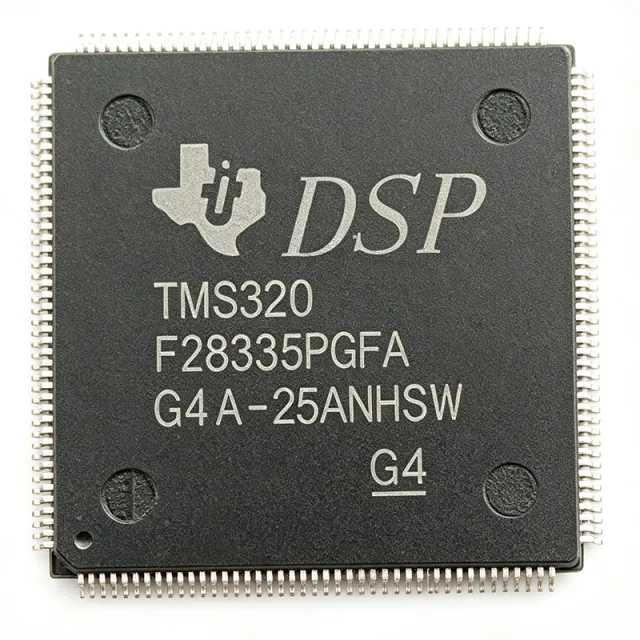
TMS320F28335PTPQ - 150MHz C2000 DSC MCU, 512KB Flash | TI
MPN: TMS320F28335PTPQ ✓ Active| Qty | Unit Price | Extended |
|---|---|---|
| 1 | $41.21 | $41.21 |
| 10 | $39.5 | $395.00 |
| 100 | $37.8 | $3,780.00 |
| 500 | $36.5 | $18,250.00 |
| 1,000 | $35.2 | $35,200.00 |
TMS320F28335PTPQ Overview
A digital signal controller combines the computational throughput of a digital signal processor with the peripheral integration of a microcontroller. In the embedded control hierarchy, the C2000 Delfino family sits at TI's high-performance real-time control tier, positioned above general-purpose MCUs and alongside dedicated DSPs. These devices are engineered specifically for closed-loop control systems where fast math and precise analog feedback are critical.
Key features include 150 MIPS C28x CPU performance with a hardware FPU for executing complex control laws, 512KB of flash with 68KB of SRAM, and an external memory interface (EMIF) for memory expansion. A 12-bit, 16-channel ADC provides high-resolution conversion for motor current and voltage sensing, while up to 18 PWM outputs deliver precise power-stage switching timing.
Architecturally, the C28x core uses a modified Harvard bus structure enabling simultaneous instruction and data fetches. Six-channel DMA offloads the CPU for data movement, and the ADC and PWM modules are synchronized for deterministic control-loop execution. A code security module, watchdog timer, and real-time interrupt support robust operation in safety-critical powertrain systems.
Typical applications include automotive traction inverters, electric power steering, industrial servo drives, solar inverters, and digital power supplies. AEC-Q100 Grade 1 qualification makes the device suitable for under-hood environments where reliability is paramount.
Designers should budget for dual-rail power (1.9V core, 3.3V I/O) with careful decoupling, provide a clean analog supply and reference for full 12-bit ADC accuracy, and configure flash wait states correctly at 150 MHz for optimal performance.
This page synthesizes manufacturer datasheet data, distributor pricing, drop-in replacement information, and practical design notes in a single resource not available in the raw datasheet.
Drop-in alternatives for TMS320F28335PTPQ — same package, pin-to-pin compatible. Different-package parts requiring PCB rework are excluded.
Variants in this series
Same-series models that are drop-in compatible with TMS320F28335PTPQ (same form factor and footprint) — differing in Package, Flash Memory, Core Processor, SRAM, ADC Resolution.
Quick Comparison Tool — Select alternative parts for side-by-side comparison:
SM320F28335PTPMEP
✅ Drop-In📋 Reference alternative (not in catalog)
SM320F28335PTPS
✅ Drop-In📋 Reference alternative (not in catalog)
TMS320F28335PGFA
✅ Drop-In✓ In Stock
$14.2 / Unit
View Datasheet →TMS320F28335PTPS
✅ Drop-In ⚠️ Specs Unverified📋 Reference alternative (not in catalog)
TMS320F28332PTPS
✅ Drop-In ⚠️ Specs Unverified✓ In Stock
$8.6 / Unit
View Datasheet →TMS320F28335PTPQ Maximum Ratings & Electrical Characteristics
| Core Processor | C28x C2000 Delfino |
| Core Size | 32-Bit |
| Maximum Clock Frequency | 150 MHz |
| Processing Performance | 150 MIPS |
| Floating Point Unit | Yes (hardware FPU) |
| Flash Memory | 512KB (256K x 16) |
| SRAM | 68KB |
| ADC Resolution | 12 bit |
| ADC Channels | 16 |
| PWM Outputs | Up to 18 |
| External Memory Interface | Yes (EMIF) |
| DMA Channels | 6 |
| Core Supply Voltage | 1.9 V |
| I/O Supply Voltage | 3.3 V |
| Operating Temperature | -40C to +125C |
| Qualification | AEC-Q100 Grade 1 (automotive) |
| Package | 176-HLQFP (PTP), 24x24 mm |
| Mounting Type | Surface Mount |
| Safety Features | Watchdog timer, code security module, real-time interrupt |
TMS320F28335PTPQ 176-hlqfp (ptp), 24x24 mm Pin Configuration Guide
Pin configuration for TMS320F28335PTPQ (176-hlqfp (ptp), 24x24 mm package). This digital IC includes GPIO, communication interfaces (UART, SPI, I2C), and power pins. Refer to the manufacturer datasheet for alternate pin functions and configuration options. Essential for embedded system design and PCB layout.

No detailed pinout data available for TMS320F28335PTPQ.
Refer to the datasheet for full pin configuration.
Typical Applications
TMS320F28335PTPQ is suitable for 6 applications: Automotive Traction Inverters, Electric Power Steering (EPS), Industrial Servo Drives, Solar String Inverters, Digital Power Supplies and Telecom Rectifiers, Motor Control Development and Legacy Platform Maintenance.
Automotive Traction Inverters
The TMS320F28335PTPQ fits traction inverter control because its 150 MHz hardware-FPU C28x core executes field-oriented control (FOC) at loop rates well above the 10 kHz electrical frequencies of EV motors, while the 12-bit 16-channel ADC samples phase currents with sufficient resolution for torque-accuracy targets. Up to 18 PWM outputs with hardware dead-band generation drive three-phase IGBT or SiC bridges directly. The AEC-Q100 Grade 1 -40C to +125C rating is mandatory for under-hood mounting. Placed as the single central controller, its 6-channel DMA keeps ADC-to-PWM latency deterministic; the trade-off is single-core throughput headroom versus newer dual-core C2000 devices for overload functions.
Recommended
Electric Power Steering (EPS)
EPS racks demand torque-assist loop rates of several kHz with functional-safety-grade determinism, which the TMS320F28335PTPQ delivers through its 150 MIPS C28x core, synchronized 12-bit ADC, and high-resolution PWM for brushless assist motors. The -40C to +125C AEC-Q100 Grade 1 rating covers the engine-bay-adjacent ECU environment, and the code security module protects steering IP. The ADC-to-PWM synchronization eliminates software jitter in the current loop, improving assist smoothness at low vehicle speed. Its 512KB flash accommodates assist maps, diagnostics, and fault-management code with room for growth, though designers must budget the 1.9V core rail in the ECU power tree.
Recommended
Industrial Servo Drives
In industrial servo amplifiers, the TMS320F28335PTPQ runs cascaded current, velocity, and position loops on its 150 MHz FPU-equipped core, with the 512KB flash storing multi-axis tuning tables and industrial network stacks. The 12-bit ADC provides current-feedback resolution consistent with sub-arc-second positioning when paired with 20-bit+ encoders handled via SPI/QEP peripherals, and 18 PWM channels support dual-axis drives in one chip. The EMIF can attach external memory for trajectory buffers. Because the industrial ambient is milder than automotive, the non-Q PTPS variant can be substituted to reduce cost where the same 176-HLQFP footprint is retained.
Recommended
Solar String Inverters
Solar string inverters use the TMS320F28335PTPQ to run maximum-power-point-tracking (MPPT) algorithms and grid-synchronized current control simultaneously: the FPU accelerates the iterative MPPT math while hardware PWM with dead-band drives the DC-DC boost and DC-AC inverter stages. The 12-bit ADC digitizes panel voltage/current and grid waveforms across 16 channels, and the 6-channel DMA moves samples without CPU intervention, preserving loop determinism. The -40C to +125C range suits outdoor NEMA enclosures. Designers typically dedicate one ePWM set per conversion stage; flash wait-state configuration at 150 MHz must be correct for full control-loop execution speed.
Recommended
Digital Power Supplies and Telecom Rectifiers
High-density digital power supplies leverage the TMS320F28335PTPQ's deterministic ADC-to-PWM path to close voltage loops at hundreds of kHz with digital compensation, replacing analog compensators entirely. The 150 MHz core executes PID or 3p3z compensators with the FPU, while 18 PWM outputs with high resolution support phase-shifted full-bridge, LLC, and interleaved buck topologies. The 512KB flash stores PMBus-style telemetry, fault logs, and firmware-update code. The watchdog and code security module support robust field operation. Thermal design must account for the HLQFP exposed pad; the -40C to +125C range covers both indoor rectifiers and harsher outdoor cabinets.
Recommended
Motor Control Development and Legacy Platform Maintenance
Beyond end equipment, the TMS320F28335PTPQ is a mainstay of motor-control development platforms and long-life industrial platforms designed around the Delfino footprint over the past decade. TI's C2000ware libraries, controlCARD reference designs, and Code Composer Studio provide a mature ecosystem, and the E2E forum documents eight-plus years of field deployments. For platforms facing supply uncertainty, the pin-compatible SM320F28335PTPMEP and SM320F28335PTPS variants offer 100% software-compatible second sources without PCB changes, letting engineering teams extend product life while planning a gradual migration to newer C2000 generations.
Recommended
Recommended Products Summary
Engineering reference data for TMS320F28335PTPQ — comparison, design guidance, and compliance information.
Selection Guide
Comparison with Alternatives
| Parameter | This Product | SM320F28335PTPMEP | SM320F28335PTPS | TMS320F28335PGFA | TMS320F28335PTPS | TMS320F28332PTPS |
|---|---|---|---|---|---|---|
| Package | 176-HLQFP (PTP), 24x24 mm | 176-HLQFP (PTP) - same footprint | 176-HLQFP (PTP) - same footprint | 176-LQFP - same 176-pin footprint family | 176-HLQFP (PTP) - same footprint | 176-HLQFP (PTP) - same footprint |
| Brand | Texas Instruments | Texas Instruments | Texas Instruments | Texas Instruments | Texas Instruments | Texas Instruments |
| CPU / Core | C28x 32-bit, FPU, 150 MHz | C28x 32-bit, FPU, 150 MHz | C28x 32-bit, FPU, 150 MHz | C28x 32-bit, FPU, 150 MHz | C28x 32-bit, FPU, 150 MHz | C28x 32-bit, FPU, 150 MHz |
| Flash Memory | 512KB (256K x 16) | 512KB | 512KB | 512KB | 512KB | 256KB (-50%) |
| Operating Temperature | -40C to +125C (AEC-Q100 Grade 1) | -55C to +125C (Hi-REL EP) | Hi-REL characterized | Commercial range | Commercial range | Commercial range |
| Automotive Qualification | AEC-Q100 Grade 1 | Enhanced product (Hi-REL) | Enhanced product (Hi-REL) | No | No | No |
| Software Compatibility | Baseline (100%) | 100% compatible (per TI E2E) | 100% compatible (per TI E2E) | 100% compatible | 100% compatible | Code compatible, flash budget reduced |
Key Differentiators
- Automotive AEC-Q100 Grade 1 qualification in the Delfino family (vs TMS320F28335PTPS)
- Extended low-temperature Hi-REL option available drop-in (vs SM320F28335PTPMEP)
- Largest flash in its 176-pin F2833x drop-in group (vs TMS320F28332PTPS)
- FPU-accelerated 150 MIPS real-time control (vs TMS320F28069PZT)
Design Notes
The TMS320F28335PTPQ requires a dual-rail power design: 1.9V for the C28x core and 3.3V for I/O, flash pump, and analog. Provide local decoupling per the datasheet power-supply recommendation - bulk capacitance at each regulator plus 0.1 uF ceramics at supply pins. Follow the datasheet power-up sequencing requirement between rails to avoid core/I/O latch-up during board bring-up. Estimated: budget core current per TI datasheet typical figures at 150 MHz before sizing the 1.9V regulator.
The 176-HLQFP (PTP) has an exposed thermal pad that must be soldered to a grounded copper pour for heat dissipation and ground integrity - do not omit it to ease rework. Place the 12-bit ADC's analog supply, reference decoupling, and a quiet analog ground region away from PWM switching paths; the ADC needs a clean reference to achieve full 12-bit accuracy. Keep crystal/oscillator traces short and guard them from the 18 PWM output nets to avoid clock jitter.
Configure flash wait states correctly for 150 MHz operation - running code from flash with incorrect wait-state registers is the most common cause of unexpected stalls on the F2833x family, per TI datasheet and E2E guidance. Also verify PLL configuration at boot and ensure the watchdog is serviced or deliberately disabled during initialization. When substituting the SM320 EP variants, note the -55C rating does not change electrical behavior, but update your qualification documentation for change control.
Compliance Information
AEC-Q100 Grade 1 qualification confirmed per TI product page ('Automotive C2000, -40 to 125'). RoHS/REACH/lead-free status not stated in the provided data - verify on the TI product quality page.