TPS92691-Q1 - 65V AEC-Q100 LED Driver Controller | TI
MPN: TPS92691QPWPTQ1 ✓ Active| Qty | Unit Price | Extended |
|---|---|---|
| 1 | $3.45 | $3.45 |
| 10 | $3.1 | $31.00 |
| 100 | $2.6 | $260.00 |
| 500 | $2.25 | $1,125.00 |
| 1,000 | $1.95 | $1,950.00 |
TPS92691QPWPTQ1 Overview
An LED driver controller is a power management IC that regulates current through LED strings using a switching regulator architecture. Within the power management IC hierarchy, it sits between generic DC-DC controllers and dedicated constant-current LED drivers, adding dimming control, fault protection, and LED-specific features. Peak current mode control is a control technique in which the switch current is sensed and compared against an error-amplifier-derived threshold on a cycle-by-cycle basis, giving inherent cycle limiting and simple loop compensation.
Key features include fixed-frequency peak current mode control with programmable switching frequency, programmable slope compensation for stable operation at duty cycles above 50%, programmable soft-start timing to limit inrush current, and a dedicated PWM dimming input that linearly varies LED brightness by modulating the duty cycle of the voltage applied to the PWM pin. Analog dimming is also supported, allowing flexible brightness control in automotive lighting systems.
Architecturally, the integrated high-voltage current sense amplifier is the differentiating block: by tolerating a 60 V common-mode input, it removes the need for a dedicated low-side sense resistor path in high-rail strings and simplifies short-circuit diagnostics. The controller generates gate drive for an external MOSFET, so output power is set by external components rather than IC limits.
Typical applications include automotive headlights, daytime running lights (DRL), fog lamps, LED backlighting, and industrial lighting driven from 12 V, 24 V, or 48 V automotive and industrial buses.
Design consideration: choose the switching frequency and slope compensation together - higher frequency shrinks the inductor but increases switching loss; slope compensation must be set based on the sensed inductor current downslope to avoid subharmonic oscillation at duty cycles above 50%.
Drop-in alternatives for TPS92691QPWPTQ1 — same package, pin-to-pin compatible. Different-package parts requiring PCB rework are excluded.
Variants in this series
Same-series models that are drop-in compatible with TPS92691QPWPTQ1 (same form factor and footprint) — differing in Switching Frequency.
Quick Comparison Tool — Select alternative parts for side-by-side comparison:
TPS92691QPWPT
✅ Drop-In📋 Reference alternative (not in catalog)
TPS92692QPWPTQ1
⚡ Same Package📋 Reference alternative (not in catalog)
TPS92690QPWPTQ1
⚡ Same Package ⚠️ Specs Unverified📋 Reference alternative (not in catalog)
TPS92691QPWPRQ1
✅ Drop-In📋 Reference alternative (not in catalog)
TPS92691QPWPTQ1 Maximum Ratings & Electrical Characteristics
| Topology Support | Boost, Buck, Buck-Boost, SEPIC, Cuk, Flyback |
| Input Voltage Range | 4.5 V to 65 V |
| Control Method | Fixed-frequency peak current mode |
| Current Sense Amplifier Common-Mode Range | 0 V to 60 V |
| LED Current Accuracy | ±3% (over +25°C to +140°C junction) |
| Dimming Methods | Analog, PWM |
| Switching Frequency | Programmable |
| Slope Compensation | Programmable |
| Soft-Start | Programmable timing |
| Automotive Qualification | AEC-Q100 qualified |
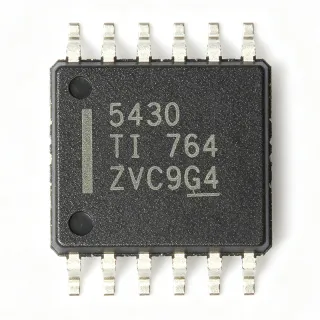
| Package | 16-HTSSOP (PWP) |
| Mounting Type | Surface Mount |
| Outputs | 1 output DC-DC controller |
| Gate Drive Output | External MOSFET gate drive |
TPS92691QPWPTQ1 Pin Configuration
| Pin 1 | COMP — Error amplifier output for loop compensation |
| Pin 2 | VSENSE — Current sense amplifier input (LED current feedback) |
| Pin 3 | CSENSE — Current sense amplifier input |
| Pin 4 | IADJ — LED current adjustment / analog dimming input |
| Pin 5 | PWM — PWM dimming input |
| Pin 6 | RT/SYNC — Switching frequency programming / synchronization |
| Pin 7 | SLOPE — Slope compensation programming |
| Pin 8 | SS/TRK — Soft-start programming |
| Pin 9 | GND — Ground |
| Pin 10 | DRV — Gate drive output for external MOSFET |
| Pin 11 | CS — Peak current sense input |
| Pin 12 | VCC — Internal regulator output |
| Pin 13 | IN — Input supply (4.5 V to 65 V) |
| Pin 14 | FAULT — Fault indication output |
| Pin 15-16 | PAD/Pins — [DATA_NEEDED: exact pin functions per datasheet pin configuration diagram] |
Typical Applications
TPS92691QPWPTQ1 is suitable for 6 applications: Automotive LED Headlights, Daytime Running Lights (DRL), Fog Lamp LED Drivers, Automotive LED Backlighting, Industrial LED Lighting from 24V/48V Bus, High-Side Current-Sensed LED Strings.
Automotive LED Headlights
The TPS92691-Q1 fits automotive headlight drivers because its 4.5 V to 65 V input survives cold-crank and transient conditions on 12 V automotive buses, while the boost topology efficiently drives series LED strings above battery voltage. Its ±3% current accuracy over +25°C to +140°C keeps luminous output consistent across underhood temperatures, and AEC-Q100 qualification satisfies automotive reliability requirements. Implemented as a boost LED driver with an external MOSFET and high-side current sensing via the 60 V common-mode amplifier, it delivers stable LED current with programmable soft-start limiting inrush at headlight turn-on.
Recommended
Daytime Running Lights (DRL)
For DRL modules, the TPS92691-Q1 provides analog and PWM dimming that lets the lighting ECU step brightness between DRL and indicator modes from a single LED string. The fixed-frequency peak current mode control with programmable switching frequency allows designers to place switching noise outside sensitive AM/radio bands, while slope compensation ensures stability at high duty cycles typical of boost DRL designs. The ±3% LED current accuracy maintains the mandated uniform appearance across production tolerance and temperature, and the 16-HTSSOP PWP package supports compact lamp-driver PCBs inside headlamp housings.
Recommended
Fog Lamp LED Drivers
Fog lamps demand high, tightly regulated LED current in a harsh thermal environment, which the TPS92691-Q1 addresses with its rail-to-rail current sense amplifier holding ±3% accuracy up to a +140°C junction. The SEPIC or buck-boost topology options handle LED string voltages both above and below the battery rail, useful as bus voltage sags. PWM dimming input supports flicker-free brightness control, and programmable soft-start suppresses the turn-on current surge that stresses wiring harnesses. The 65 V input rating provides headroom against automotive load-transient events at the fog lamp connector.
Recommended
Automotive LED Backlighting
Cluster and display backlight strings benefit from the TPS92691-Q1's PWM dimming input, which linearly varies LED brightness with the duty cycle applied to the PWM pin - supporting wide contrast ratios without color shift that analog-only dimming can introduce. The boost topology steps the 12 V rail up to multi-LED string voltages efficiently, while cycle-by-cycle peak current limiting protects the string during faults. Its ±3% current accuracy ensures uniform backlight brightness across multiple display zones, and AEC-Q100 qualification covers the automotive cabin temperature and reliability envelope required by instrument clusters.
Recommended
Industrial LED Lighting from 24V/48V Bus
In industrial fixtures fed from 24 V or 48 V rails, the TPS92691-Q1's 65 V maximum input and multi-topology support let one controller design cover buck, boost, or flyback configurations depending on the LED string voltage. The flyback option provides isolated lighting power for machinery and signage, while cycle-by-cycle current limiting and programmable soft-start improve robustness in electrically noisy environments. The ±3% LED current accuracy keeps light output consistent across lamp lifetime, and the standard (non-Q1) TPS92691 variant offers a lower-cost option where automotive qualification is unnecessary.
Recommended
High-Side Current-Sensed LED Strings
Designs that must sense LED current on the high side - for chassis-referenced negative LED terminals or short-circuit diagnostic schemes - exploit the TPS92691-Q1's defining feature: a 65-V rail-to-rail current sense amplifier with 0 V to 60 V common-mode range and low input offset for better than ±3% accuracy. This eliminates discrete high-side sense amplifier circuitry and its associated error terms. Per the TI datasheet, the amplifier maintains accuracy over the full automotive junction temperature range, enabling reliable overcurrent and open-LED detection in high-rail strings used in exterior lighting modules.
Recommended
Recommended Products Summary
Engineering reference data for TPS92691QPWPTQ1 — comparison, design guidance, and compliance information.
Selection Guide
Comparison with Alternatives
| Parameter | This Product | TPS92691QPWPT | TPS92692QPWPTQ1 | TPS92690QPWPTQ1 |
|---|---|---|---|---|
| Package | 16-HTSSOP (PWP) | 16-HTSSOP (PWP) - same | 16-HTSSOP (PWP) - same | 16-HTSSOP (PWP) - same |
| Brand | Texas Instruments | Texas Instruments | Texas Instruments | Texas Instruments |
| Automotive Qualification | AEC-Q100 qualified | No (commercial grade) | AEC-Q100 qualified | AEC-Q100 qualified |
| Dimming Methods | Analog, PWM | Analog, PWM | Analog, PWM | Analog, PWM |
Key Differentiators
- Rail-to-rail 65 V current sense amplifier (vs TPS92691QPWPT)
- Multi-topology flexibility from one controller (vs TPS92690QPWPTQ1)
- High-side current sensing without external amplifier (vs TPS92692QPWPTQ1)
Design Notes
Program slope compensation to match the sensed inductor current downslope for your chosen topology. At duty cycles above 50% (typical in boost LED drivers from a 12 V bus), insufficient slope compensation causes subharmonic oscillation and visible LED flicker. The SLOPE pin sets this with a single resistor - derive its value from the TI datasheet SLVSD68 equations for your inductance, sense resistor, and switching frequency combination.
Keep the CS sense trace to the external MOSFET source resistor short and Kelvin-connected directly at the resistor terminals; peak current mode control depends on clean current-sense signals. Place the RT/SYNC, COMP, and SLOPE compensation components close to the IC and away from the DRV gate-drive loop to prevent jitter. Use the HTSSOP power pad as a low-inductance ground connection - solder it to a solid ground plane with an array of vias.
The controller itself dissipates little power (gate drive plus quiescent), but verify total thermal design including the external MOSFET, sense resistor, and rectifier. Since the current sense amplifier accuracy is specified to +140°C junction, dimension heatsinking so the TPS92691-Q1 junction stays well below this in the lamp enclosure, where ambient can exceed 85°C in automotive headlamp housings.
Compliance Information
AEC-Q100 qualified for automotive applications per TI product page and Mouser listing. RoHS/REACH status not stated in verified data - confirm on TI.com.