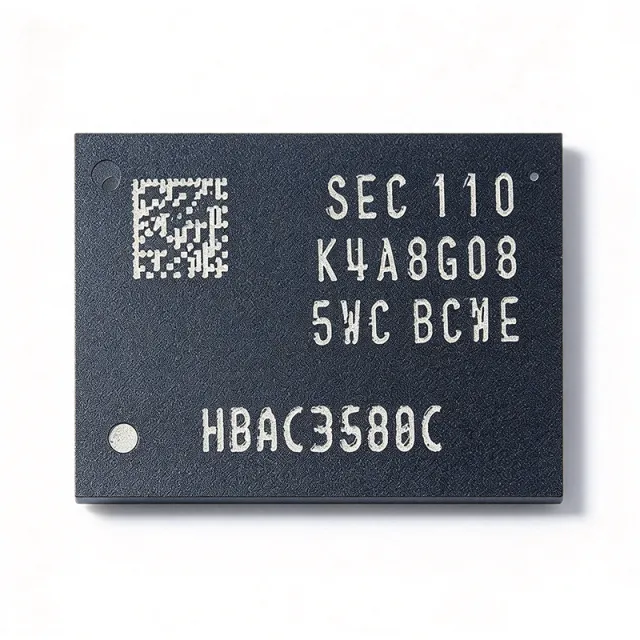
What Is the Samsung K4A8G085WC-BCWE and Why Does It Matter Right Now?
The Samsung K4A8G085WC-BCWE is an 8 Gb DDR4 SDRAM organized as 1G x 8, operating at DDR4-3200 data rates (3200 Mbps per pin) from a 1.2 V supply in a 78-ball FBGA (78FBGA) surface-mount package rated 0C to +85C. It uses DDR4 bank-group architecture with 8n prefetch and on-die termination (ODT), making it compatible with standard DDR4 memory controllers from AMD Ryzen, Intel, and embedded platforms. XAIPART currently lists 22,000 units in stock, MOQ 1, with volume pricing at $7.3828 per unit at 1,000 pcs as of 2026-10-13 (see the K4A8G085WC-BCWE product page for live data). Because DDR4 capacity is tightening as Samsung shifts lines toward DDR5 and HBM, this part sits at the center of BOM-continuity planning for desktop, embedded, and networking designs — one of the reasons the DDR5/DDR4 price divergence matters to buyers this cycle.
Three verified specs define its compatibility envelope: the 8 Gb / 1G x 8 organization (eight chips build an 8 GB rank on a 64-bit channel), the -BCWE speed bin (DDR4-3200), and the 78FBGA package shared across the K4A8G085WC family. The part is RoHS compliant per JLCPCB and LCSC listings. Designers value it because the C-die generation improves bit density per die, reducing chip count in high-capacity designs, and the 1.2 V rail cuts memory-subsystem power versus DDR3.
Takeaway: If your controller supports DDR4-3200 x8 devices and your layout uses the standard 78FBGA DDR4 land pattern, the K4A8G085WC-BCWE is a direct fit — and with 22,000 units available at XAIPART, you can source prototype and pilot quantities immediately.
How Do You Select and Design In the K4A8G085WC-BCWE?
Design-in success for this part hinges on three verified parameters: the 1.2 V VDD/VDDQ supply, the DDR4-3200 timing assumptions tied to the -BCWE suffix, and the 78FBGA footprint. Work through the following steps.
Step 1 — Match the speed bin to the controller. The -BCWE suffix denotes DDR4-3200 (3200 Mbps per pin, commercial temperature). Confirm your memory controller's supported-MPN table and timing tables include the DDR4-3200 bin. According to compatibility reporting, the part appears on AMD Ryzen platform validator lists and Intel DRAM compatibility lists for desktop and workstation designs, but discrete-DRAM embedded designs must still confirm the specific controller's supported-MPN list, since UEFI/BIOS memory training depends on die-specific timing parameters.
Step 2 — Design the power rail. The device requires a single 1.2 V rail for VDD and VDDQ with precision power-up sequencing per the Samsung datasheet initialization procedure. A stable, low-noise 1.2 V VDDQ supply is required to sustain 3200 Mbps signaling; a low-noise buck regulator is appropriate for this rail in embedded designs.
Step 3 — Route for DDR4 signaling. DDR4 mandates fly-by command/address routing with per-byte ODT and write-leveling training. Match data-group trace lengths within your stackup's window for 3200 Mbps and validate eye diagrams at speed. On-die termination reduces external termination components, cutting BOM cost on multi-chip boards.
Step 4 — Verify temperature class in the BOM. The -BCWE variant is rated 0C to +85C, which suits office and indoor industrial environments but not extended-temperature deployments. For -40C to +85C operation, use the pin-compatible K4A8G085WC-BIWE industrial variant, which per Samsung migration guidance requires zero PCB redesign.
Step 5 — Plan initialization and training. DDR4 requires correct power-up initialization sequencing and controller training (write leveling, read training). Follow the datasheet sequence exactly — deviations are a common cause of BIOS-level memory-training failures on COM Express and SODIMM carrier boards.
Takeaway: Validate controller supported-MPN lists and the 1.2 V power-up sequence before layout release; both steps cost hours now versus respins later. Download the datasheet from the K4A8G085WC datasheet PDF (961 KB, 23 pages, covering the full family including the -BCWE suffix).
Which Alternatives Are Drop-In Replacements for the K4A8G085WC-BCWE?
Same-family Samsung parts in the 78FBGA package are the safest substitutions. Cross-reference data identifies the K4A8G085WC-BIWE as requiring zero PCB redesign, while speed-bin variants (-BCTD) trade data rate for flexibility. All values in the table come from verified database entries for each part.
| Parameter | K4A8G085WC-BCWE | K4A8G085WC-BIWE | K4A8G085WC-BCTD | K4A8G085WB-BCWE |
|---|---|---|---|---|
| Density / Organization | 8 Gb, 1G x 8 | 8 Gb, 1G x 8 | 8 Gb, 1G x 8 | 8 Gb, 1G x 8 |
| Data Rate | 3200 Mbps (DDR4-3200) | DDR4-3200 class (industrial temp variant) | 2666 Mbps (DDR4-2666) | 3200 Mbps (DDR4-3200) |
| Supply Voltage | 1.2 V | 1.2 V | 1.2 V | 1.2 V |
| Temperature | 0C to +85C (commercial) | Industrial (-40C to +85C) | Commercial (0C to +85C) | Commercial (0C to +85C) |
| Package | 78FBGA | 78FBGA | 78FBGA | 78FBGA |
| Drop-in status | Reference part | Pin/layout-compatible, zero PCB redesign per cross-reference data | Physically drop-in; system designed for 3200 can typically run BCTD at reduced speed; reverse requires controller support | Identical footprint but differs in critical timing parameters and die generation; requires electrical validation before substitution |
On cross-brand options: a commonly cited SK Hynix equivalent is the H5AN8G8NCJR (8 Gb DDR4, x8, 78FBGA). However, this component does not appear in the verified cross-reference data as a confirmed pin-compatible drop-in for the Samsung part. Treat cross-brand DDR4 swaps as engineering-validation projects requiring pinout, timing-table, and supported-MPN validation — not drop-ins.
Takeaway: For shortage mitigation, rank the -BIWE first when temperature range allows commercial spec, or as the industrial-grade swap; use the -BCTD when your controller is limited to DDR4-2666. Validate the full ordering code — organization, package, temperature class, speed bin, and die generation — before any BOM change.
What Is the Market and Supply Situation for the K4A8G085WC-BCWE?
Lifecycle status: active, per the XAIPART product database. Supply picture as of the latest data: XAIPART holds 22,000 units with MOQ 1, priced from $12.6563 (qty 1) down to $7.3828 (qty >= 1000) as of 2026-10-13.
One conflict in the data requires explicit attention: distributor records from 2026-09-04 list the part at $5.755 at LCSC (product C2920122) but show LCSC as out of stock, while XAIPART's verified listing shows $7.3828 at 1k with 22,000 units in stock as of 2026-10-13. This roughly 28% spread within weeks reflects the DDR4 market volatility documented during the DDR4-to-DDR5 transition. Cite both figures when budgeting, and re-verify pricing at order time.
Secondary distributors including Ampheo, Win Source, Avaq, and ETEI advertise RFQ-based availability. Because DDR4 components are in EOL phase-out at some manufacturers, buyers should confirm lead times and date codes when ordering through secondary channels; incoming inspection is advisable given elevated counterfeit risk in this segment.
Takeaway: The part is active but supply-constrained in the broader market. With 22,000 units on the shelf at XAIPART as of 2026-10-13, buyers needing prototype through production pilot quantities should lock pricing now rather than wait for DDR4 allocation to worsen. For market context, see the XAIPART blog and the DDR5/DDR4 price-divergence analysis linked above.
Where Is This DRAM Used in Real Systems?
The verified application data covers six scenarios. Each maps directly to a spec from the table above.
Desktop and workstation main memory. At DDR4-3200, the part delivers 25.6 GB/s of peak bandwidth per 64-bit channel. Eight chips build an 8 GB UDIMM; sixteen build a 16 GB DIMM on DDR4's fly-by command/address topology. Platform acceptance is confirmed by AMD Ryzen validator lists and Intel DRAM compatibility lists.
Embedded industrial controllers. The 8 Gb density in a single 78FBGA die simplifies BOM and board space versus stacking smaller chips; the 3200 Mbps bin gives headroom for frame buffers and logging workloads. Designs targeting -40C should use the pin-identical -BIWE variant.
Networking and communication equipment. Routers and switches use the part for packet buffering and control-plane memory. The DDR4 bank-group architecture with 8n prefetch improves random-access efficiency for scattered packet buffers — an advantage over DDR3 in network workloads — and the 1.2 V operation lowers power in fanless enclosures.
Computing modules (COM Express / SODIMM carrier boards). The 78FBGA supports the standard DDR4 land pattern, enabling drop-in substitution among Samsung speed bins during shortages without PCB respins — critical for long-lifecycle embedded products.
Replacement sourcing and BOM continuity. Buyers maintaining legacy DDR4 products use the K4A8G085WC family for last-time-buy planning; the alternatives table above ranks substitutions by parametric proximity.
Gaming and graphics workloads. Multiple x8 devices gang into 128-bit or 256-bit buses for proportionally higher aggregate bandwidth, with ODT cutting external component count on multi-chip boards.
Takeaway: Whatever your end system, the substitution rule is identical: match organization, package, temperature class, speed bin, and die generation to your controller's assumptions.
What Should Buyers Watch Next for DDR4 Sourcing?
Three trends anchored to verified data deserve attention:
1. Price volatility is the norm, not the exception. The documented spread between the $5.755 LCSC listing (2026-09-04, out of stock) and the $7.3828 XAIPART 1k-tier price (2026-10-13, in stock) shows how quickly DDR4 pricing moves. Budget with a range, not a point estimate, and re-verify at PO time.
2. Speed-bin availability will diverge. The -BCWE (DDR4-3200) bin commands bandwidth leadership but, per the verified selection guidance, the slower -BCTD (DDR4-2666) and -BCRC (DDR4-2400) bins suit controllers limited to lower speed bins or tight signal-integrity headroom. Because all share the 78FBGA footprint, keeping a dual-bin BOM strategy gives procurement flexibility without respins.
3. Date-code and counterfeit risk rise with scarcity. As capacity shifts to DDR5 and HBM, secondary-market sourcing increases. Verify the full ordering-code suffix on the package to confirm the DDR4-3200 bin before purchase, and run incoming inspection on parts sourced outside franchised channels.
Takeaway: Anchor your continuity plan to the drop-in family — K4A8G085WC-BCWE for commercial 3200 Mbps designs, -BIWE for industrial temperature, -BCTD for 2666 Mbps controllers — and treat cross-brand swaps as validation projects. Browse additional memory components in the XAIPART component catalog.
Comentários
Seja o primeiro a comentar.
🔐 Por favor entrar para publicar um comentário.
Não tem uma conta? Cadastre-se