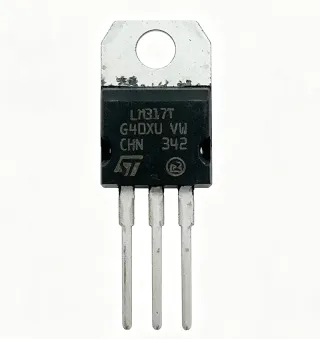
LM7805CT/NOPB - 5V 1.5A Linear Regulator TO-220 | Texas Instruments
N.º da peça: LM7805CT/NOPB ✓ Ativo| Qtd. | Preço unitário | Total |
|---|---|---|
| 1 | $1.55 | $1,55 |
| 10 | $1.32 | $13,20 |
| 100 | $1.05 | $105,00 |
| 500 | $0.88 | $440,00 |
| 1.000 | $0.74 | $740,00 |
LM7805CT/NOPB Visão geral
What is a linear voltage regulator? A linear voltage regulator (also called an LDO when dropout voltage is low, or simply a three-terminal regulator in the LM78xx case) is a power management IC that maintains a constant DC output voltage from a higher, possibly variable DC input. Unlike a switching DC-DC converter, a linear regulator dissipates the difference between VIN and VOUT as heat, so efficiency equals VOUT/VIN. The taxonomy: three-terminal regulator -> linear regulator -> voltage regulator -> power management IC -> semiconductor. The LM78xx family is the most widely used fixed-output linear regulator series in history, with billions of units shipped across industrial, consumer, and hobby markets.
Key features include 1.5 A peak output current, 5 V fixed output with typical +/-2% accuracy, 35 V maximum input voltage (per Mouser catalog listing), 2 V typical dropout, and internal thermal overload protection. The TO-220 package provides excellent thermal performance with a tab that can be soldered or screwed to a heatsink for continuous high-current operation.
The LM7805CT/NOPB uses a bipolar Darlington pass element with bandgap reference and on-chip resistor dividers. Its safe-area compensation allows momentary output shorts without damage, and the thermal shutdown circuit typically trips around 170 C junction temperature. Quiescent current is typically 5 mA and rises only slightly with load.
Typical applications include local 5 V regulation for digital logic (Arduino, microcontroller rails), USB charger / power-bank subsystems, hobby electronics, retrofit 5 V supplies in automotive 12 V systems, and as a quiet post-regulator after a switching converter to clean up ripple.
When designing, always check worst-case dissipation (P = (VIN(max) - 5 V) x IOUT(max)) and select a heatsink accordingly. A heatsink is required whenever P exceeds about 1.5 W in free air at 25 C ambient.
This page synthesizes distributor pricing, drop-in alternatives, and design notes not found in the manufacturer datasheet alone.
Alternativas drop-in para LM7805CT/NOPB — mesmo encapsulamento, compatível pino a pino. Peças de encapsulamento diferente que exigem retrabalho na PCB são excluídas.
Variantes desta série
Modelos da mesma série compatíveis como drop-in com LM7805CT/NOPB (mesmo formato e footprint) — diferindo em Maximum Output Current, Mounting Type, Output Voltage Tolerance, Package, Output Voltage.
Ferramenta de comparação rápida — selecione peças alternativas para comparação lado a lado:
LM7805CT
✅ Drop-In📋 Alternativa de referência (fora do catálogo)
LM78M05CT/NOPB
✅ Drop-In📋 Alternativa de referência (fora do catálogo)
L7805CV
✅ Drop-In✓ Em estoque
$0.1464 / unidade
Ver ficha técnica →MC7805CTG
✅ Drop-In📋 Alternativa de referência (fora do catálogo)
L7805CV
✅ Drop-In✓ Em estoque
$0.1464 / unidade
Ver ficha técnica →LM7805CT/NOPB Classificações máximas e características elétricas
| Regulator Type | Linear, Fixed Positive |
| Tensão de saída | 5 V |
| Output Voltage Tolerance | +/-2% (typical) |
| Corrente máxima de saída | 1.5 A (peak) |
| Input Voltage Range (max) | 30 V (TI) / 35 V (Mouser listing) |
| Dropout Voltage (typical) | 2 V at 1 A |
| Quiescent Current (typical) | 5 mA |
| Line Regulation | 10 mV (typ) |
| Load Regulation | 25 mV (typ) |
| Temperatura de junção de operação | 0 C to +125 C |
| Resistência térmica, junção-ambiente | 22.6 C/W (TO-220, typical) |
| Protection Features | Internal current limit, thermal shutdown, safe-area compensation |
| Encapsulamento | TO-220-3 (NDE) |
| Tipo de montagem | Through-hole (TAB also serves as heatsink tab) |
| Lead-Free / RoHS | Yes (NOPB suffix indicates lead-free, RoHS compliant) |
Configuração de pinos do LM7805CT/NOPB
| Pino 1 | INPUT — Unregulated DC input (typically 7-30 V) |
| Pino 2 | GND — Common ground / 0 V reference |
| Pino 3 | OUTPUT — Regulated +5 V DC output |
Aplicações típicas
LM7805CT/NOPB é adequado para 6 aplicaçãos: Microcontroller & Arduino 5 V Rail, Retrofit Automotive 12 V to 5 V Supply, Post-Regulator After Switching Converter, USB Charger / Power Bank Subsystem, Hobby Electronics & Breadboard Power, Industrial Sensor & Actuator Power.
Microcontroller & Arduino 5 V Rail
The LM7805CT/NOPB is the classic 5 V rail regulator for Arduino Uno, Nano, and bare microcontroller boards (ATmega328P, PIC, STM32 'bluepill'). It drops a 7-12 V wall-adapter or battery input to a clean 5 V with +/-2% accuracy, 10 mV line regulation and 25 mV load regulation, sufficient for digital logic rails. The 1.5 A peak capability comfortably drives an ATmega328P plus a few LEDs and discrete peripherals. Unlike a switching regulator, the LM7805 adds no high-frequency ripple, which is helpful when the same board also hosts analog sensors. At 12 V input and 200 mA load, dissipation is about 1.4 W - a small clip-on heatsink is recommended for enclosed cases. The internal current limit and thermal shutdown protect the board if the output is accidentally shorted. Use a 0.33 uF input cap and 0.1 uF output cap as recommended by the LM78xx datasheet to ensure stability.
Recomendado
Retrofit Automotive 12 V to 5 V Supply
The LM7805CT/NOPB has been used for decades in automotive 12 V systems to derive 5 V for sensors, displays, microcontrollers, and aftermarket accessories. Nominal 13.8 V VIN with 5 V VOUT at 500 mA load dissipates about 4.4 W - the TO-220 tab and a small clip-on heatsink handle this comfortably. Cold-crank transients can drop VIN to 6-8 V, leaving only 1-3 V of headroom over the 2 V typical dropout; for cold-crank robustness, pair with a pre-boost or use an automotive-grade LDO. Load-dump transients up to 40 V require an external TVS clamp (e.g., 33 V SMAJ) on the input. The 1.5 A peak current handles brief inrush loads such as a relay coil or fan. Internal thermal shutdown and safe-area compensation protect the device if the output is shorted during wiring faults. The /NOPB suffix ensures RoHS compliance for OEM automotive modules.
Recomendado
Post-Regulator After Switching Converter
Cascading the LM7805CT/NOPB after a switching buck converter is a classic technique to obtain a clean, low-ripple 5 V rail from a higher-voltage intermediate bus. The switching converter handles the bulk voltage step-down efficiently (e.g., 24 V to 7 V), and the LM7805 drops the last 2 V linearly, removing all switching ripple and high-frequency noise. This topology is common in industrial PLCs and instrumentation where sensitive analog or RF circuits share a power bus with digital switching noise. The combined dissipation is split between the switcher and the linear regulator, keeping each within its SOA. The LM7805CT/NOPB's 5 mA quiescent current adds negligible overhead, and its 1.5 A peak handles transients beyond the linear stage's steady-state rating. Stability is maintained with the standard 0.33 uF input and 0.1 uF output capacitors.
Recomendado
USB Charger / Power Bank Subsystem
In low-cost USB charger and power bank designs, the LM7805CT/NOPB is often used to derive a clean 5 V rail from a 1S lithium cell boosted to 6-7 V, or directly from a higher-voltage wall adapter. The fixed 5 V output is well-suited to feed a downstream charging IC or a USB voltage regulator. The 1.5 A peak current supports 5 V / 1 A charging of smartphones and tablets. While efficiency is lower than a switching regulator at full VIN-VOUT delta (5 V / 7 V = 71% efficient), the simplicity of the LM7805 BOM (one IC, two caps, optional heatsink) keeps cost and PCB area minimal. For higher efficiency designs, a dedicated synchronous buck converter such as the LM3671 or TPS62840 is preferred, but the LM7805CT/NOPB remains a reliable fallback for cost-sensitive, lower-volume products.
Recomendado
Hobby Electronics & Breadboard Power
The LM7805CT/NOPB is a staple of hobbyist breadboards and educational kits. With three pins (IN, GND, OUT) and only two recommended bypass capacitors, it fits on any 0.1" spaced perfboard or breadboard. A 9 V battery or 9-12 V wall adapter powers any 5 V Arduino, Raspberry Pi (via 5 V rail), LED strip, or sensor cluster. The metal tab is also a convenient tie-point for a 5 V distribution rail on a solderless breadboard. Thermal behavior is forgiving at hobby currents (< 200 mA), so most breadboard builds run without a heatsink. The /NOPB suffix ensures lead-free compliance for school and competition projects. Drop-in compatibility with other 7805 variants means parts from any vendor work interchangeably.
Recomendado
Industrial Sensor & Actuator Power
In industrial 24 V systems, the LM7805CT/NOPB can drop 24 V down to 5 V to power logic-level sensors, isolated digital inputs, and low-power microcontroller nodes. At 24 V input and 200 mA load, dissipation is 3.8 W - a small TO-220 clip-on heatsink keeps the junction below 100 C in a 60 C ambient. For installations with long input lines subject to voltage transients and inductive kickback, a TVS clamp and input fuse protect the regulator. The internal safe-area compensation handles momentary output shorts from wiring faults, and thermal shutdown protects against sustained overload. The fixed 5 V output eliminates trim resistors, reducing calibration and field-failure modes. For higher-efficiency 24 V applications, a dedicated wide-Vin LDO such as the TPS7A4501 is preferred, but the LM7805CT/NOPB remains a low-cost, time-proven solution for non-isolated sensor nodes.
Recomendado
Resumo dos produtos recomendados
Dados de referência de engenharia para LM7805CT/NOPB — comparação, orientação de projeto e informações de conformidade.
Guia de seleção
Comparação com alternativas
| Parâmetro | Este produto | LM7805CT | LM78M05CT/NOPB | L7805CV | MC7805CTG |
|---|---|---|---|---|---|
| Brand | Texas Instruments | Texas Instruments | Texas Instruments | STMicroelectronics | onsemi |
| Package | TO-220-3 (NDE) | TO-220-3 (NDE) - same | TO-220-3 - same | TO-220-3 - same | TO-220-3 - same |
| Output Voltage | 5 V | 5 V | 5 V | 5 V | 5 V |
| Output Current (peak) | 1.5 A | 1.5 A | 0.5 A | 1 A | 1 A |
| Maximum Input Voltage | 30 V | 30 V | 35 V | 35 V | 35 V |
| Dropout Voltage (typ) | 2 V | 2 V | 2 V | 2 V | 2 V |
| Quiescent Current (typ) | 5 mA | 5 mA | 4 mA | 5 mA | 5 mA |
| Lead-Free / RoHS | Yes (/NOPB) | No (legacy tin-lead) | Yes (/NOPB) | Yes | Yes |
Principais diferenciais
- Industry-standard drop-in availability across vendors (vs LM78M05CT/NOPB)
- 1.5 A peak current vs L7805CV's 1 A (vs L7805CV (STMicroelectronics))
- Lead-free /NOPB plating matches RoHS directives (vs Legacy LM7805CT (no NOPB))
- Three-pin simplicity vs switching regulator complexity (vs LM2591HVS-ADJ (switching))
Notas de projeto
Estimated: At VIN = 12 V, VOUT = 5 V, IOUT = 1 A, power dissipation is P = (12 - 5) x 1 = 7 W. With the TO-220 theta_JA of approximately 22.6 C/W in free air, the junction rises about 158 C above ambient - well beyond the 125 C rating. A clip-on heatsink (e.g., Fischer SK 104 with theta_SA around 8 C/W) or 100 sq cm of copper pours the junction temperature back into spec. Rule of thumb: any application with continuous P > 1.5 W in 25 C ambient requires a heatsink. The LM7805CT/NOPB thermal shutdown (typically 170 C) will protect the die but may cause output droop or system reset if it engages.
Always place a 0.33 uF (or larger) input capacitor close to the IN pin to GND, and a 0.1 uF output capacitor close to the OUT pin to GND. These capacitors ensure stability of the internal feedback loop and provide high-frequency bypassing for load transients. If the input source is more than a few inches away, use a larger input cap (e.g., 1-10 uF electrolytic) to handle the inrush. The TO-220 tab is electrically tied to the die substrate - usually grounded, but if left floating it picks up stray noise that can couple into the output. Solder the tab to a copper pour connected to GND for both thermal and electrical benefits.
Do not operate the LM7805CT/NOPB without input/output capacitors - the internal loop can oscillate and produce erratic output. Do not exceed 30 V VIN continuously (TI spec), even though legacy 78xx datasheets quote 35 V - this derating margin improves long-term reliability. Do not bypass the heatsink tab connection to GND on a high-current design - leaving it floating creates a leakage path and degrades thermal performance. Finally, do not use the LM7805CT/NOPB as a voltage dropper for high-current battery charging - the linear topology wastes too much power; use a switching charger IC instead.
Keep the input capacitor, regulator, and output capacitor in a tight linear layout with short, wide traces. The TO-220 tab is the primary thermal path - dedicate at least 1 sq inch of 2 oz copper pour (or 0.5 sq inch per watt of dissipation) and stitch vias to the bottom layer for through-hole designs. For surface-mount replacements, plan for the DPAK or TO-252 footprint instead. Avoid routing digital switching signals across the regulator's feedback traces (none here, but the IN/OUT traces can carry switching ripple from external loads).
Informações de conformidade
The /NOPB suffix indicates lead-free plating per Texas Instruments' NOPB designation; the part is RoHS-compliant. Not AEC-Q100 qualified - for automotive designs requiring AEC-Q100, choose an automotive-grade LDO such as the TPS7A4501-Q1. Conflict-minerals compliance per TI's published CMRT.