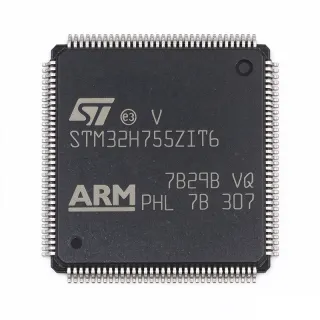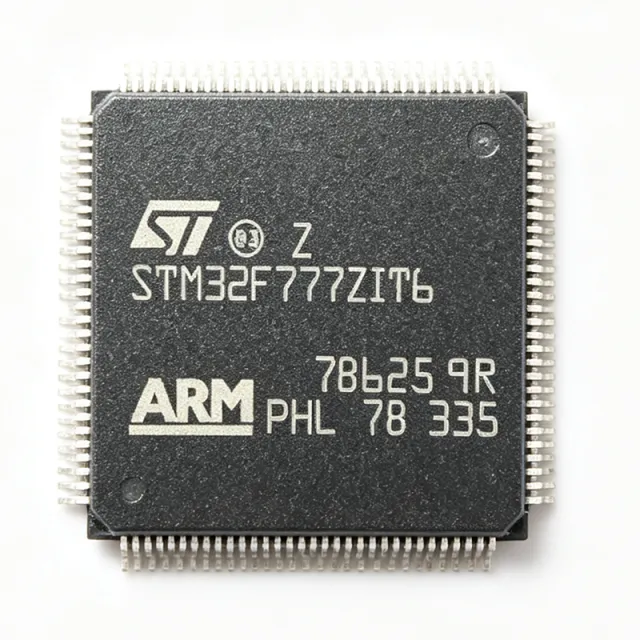
STM32F777ZIT6 - 2MB Flash, 216MHz ARM Cortex-M7 MCU | STMicroelectronics
N.º da peça: STM32F777ZIT6 ✓ Ativo| Qtd. | Preço unitário | Total |
|---|---|---|
| 1 | $14.1224 | $14,12 |
STM32F777ZIT6 Visão geral
What is a microcontroller? A microcontroller (MCU) is a compact integrated circuit designed to govern a specific operation in an embedded system. It integrates a processor core, memory (Flash and SRAM), and programmable input/output peripherals on a single chip. In the system hierarchy, an MCU sits above a bare microprocessor by including on-chip memory and peripherals, and below a full application processor (like those in smartphones) which typically runs a rich OS. The STM32F777ZIT6 belongs to the STM32F7 series, which is part of the broader STM32 family of 32-bit Flash microcontrollers based on ARM Cortex-M cores. This family is widely used in industrial, consumer, and IoT applications due to its balance of performance, power efficiency, and peripheral integration.
Key features include a Chrom-ART Accelerator for 2D graphics, a hardware cryptographic accelerator (AES, DES, 3DES, SHA-1, SHA-256, MD5), a true random number generator, and a JPEG codec. The device supports a comprehensive set of communication interfaces: 4x I2C, 4x USART, 4x UART, 6x SPI, 3x CAN, 2x USB OTG (FS/HS), 2x SDMMC, 1x FMC (external memory interface), and 2x SAI (serial audio interfaces). It also includes a 12-bit ADC with 3.6 MSPS, a 12-bit DAC, and multiple timers including high-resolution timers.
The STM32F777ZIT6 operates from a 1.7V to 3.6V supply and features a wide temperature range of -40°C to +85°C (industrial grade). It supports various low-power modes (Sleep, Stop, Standby) to optimize energy consumption. The device is RoHS compliant and available in tape and reel packaging.
Typical applications include industrial control systems, motor drives, medical devices, audio processing, and high-end consumer electronics. The dual-bank Flash allows over-the-air firmware updates with minimal downtime, and the cryptographic accelerator enables secure communication protocols.
When designing with this MCU, ensure adequate decoupling on all power pins and follow the recommended layout for the high-speed USB and external memory interfaces. The internal LDO can be bypassed for lower power consumption, but this requires careful power sequencing.
Alternativas drop-in para STM32F777ZIT6 — mesmo encapsulamento, compatível pino a pino. Peças de encapsulamento diferente que exigem retrabalho na PCB são excluídas.
Variantes desta série
Modelos da mesma série compatíveis como drop-in com STM32F777ZIT6 (mesmo formato e footprint) — diferindo em Core, Flash Memory, Operating Temperature, Package, Supply Voltage.
Ferramenta de comparação rápida — selecione peças alternativas para comparação lado a lado:
STM32F767ZIT6
✓ Em estoque
$17.6 / unidade
Ver ficha técnica →STM32F779ZIT6
✓ Em estoque
$11.75 / unidade
Ver ficha técnica →STM32H743ZIT6
✓ Em estoque
$10.65 / unidade
Ver ficha técnica →STM32F769ZIT6
📋 Alternativa de referência (fora do catálogo)
STM32F777ZIT6TR
📋 Alternativa de referência (fora do catálogo)
i.MX RT1052
📋 Alternativa de referência (fora do catálogo)
STM32F777ZIT6 Classificações máximas e características elétricas
| Core | ARM Cortex-M7 |
| Max Clock Frequency | 216 MHz |
| Flash Memory | 2 MB (dual-bank) |
| SRAM | 512 KB |
| Tensão de alimentação | 1.7 V to 3.6 V |
| Temperatura de operação | -40°C to +85°C |
| Encapsulamento | LQFP-144 (20x20 mm) |
| GPIO Pins | 114 |
| ADC | 3x 12-bit, 3.6 MSPS |
| DAC | 2x 12-bit |
| Communication Interfaces | 4x I2C, 4x USART, 4x UART, 6x SPI, 3x CAN, 2x USB OTG, 2x SDMMC, 1x FMC, 2x SAI |
| Timers | 12x 16-bit, 2x 32-bit, 2x high-resolution |
| Cryptographic Acceleration | AES, DES, 3DES, SHA-1, SHA-256, MD5 |
| DMA | 2x DMA controllers with 16 streams each |
| RoHS | Compliant |
Configuração de pinos do STM32F777ZIT6
| Pino 1 | PE2 — GPIO / FMC_A23 / TRACECLK |
| Pino 2 | PE3 — GPIO / FMC_A19 / TRACED0 |
| Pino 3 | PE4 — GPIO / FMC_A20 / TRACED1 |
| Pino 4 | PE5 — GPIO / FMC_A21 / TRACED2 |
| Pino 5 | PE6 — GPIO / FMC_A22 / TRACED3 |
| Pino 6 | VBAT — Backup battery supply |
| Pino 7 | PC13 — GPIO / RTC_AF1 / WKUP2 |
| Pino 8 | PC14 — GPIO / OSC32_IN |
| Pino 9 | PC15 — GPIO / OSC32_OUT |
| Pino 10 | PF0 — GPIO / FMC_A0 |
| Pino 11 | PF1 — GPIO / FMC_A1 |
| Pino 12 | PF2 — GPIO / FMC_A2 |
| Pino 13 | PF3 — GPIO / FMC_A3 |
| Pino 14 | PF4 — GPIO / FMC_A4 |
| Pino 15 | PF5 — GPIO / FMC_A5 |
| Pino 16 | PF6 — GPIO / FMC_NWAIT / TIM13_CH1 |
| Pino 17 | PF7 — GPIO / FMC_NCE4_1 / TIM13_CH2 |
| Pino 18 | PF8 — GPIO / FMC_NCE4_2 / TIM14_CH1 |
| Pino 19 | PF9 — GPIO / FMC_NCE4_3 / TIM14_CH2 |
| Pino 20 | PF10 — GPIO / FMC_NCE4_4 |
| Pino 21 | VSS — Ground |
| Pino 22 | VDD — Power supply |
| Pino 23 | PF11 — GPIO / FMC_SDNCAS |
| Pino 24 | PF12 — GPIO / FMC_SDNE0 |
| Pino 25 | PF13 — GPIO / FMC_A6 |
| Pino 26 | PF14 — GPIO / FMC_A7 |
| Pino 27 | PF15 — GPIO / FMC_A8 |
| Pino 28 | PG0 — GPIO / FMC_A9 |
| Pino 29 | PG1 — GPIO / FMC_A10 |
| Pino 30 | PG2 — GPIO / FMC_A11 |
| Pino 31 | PG3 — GPIO / FMC_A12 |
| Pino 32 | PG4 — GPIO / FMC_A13 |
| Pino 33 | PG5 — GPIO / FMC_A14 |
| Pino 34 | PG6 — GPIO / FMC_NE1 |
| Pino 35 | PG7 — GPIO / FMC_NE2 |
| Pino 36 | PG8 — GPIO / FMC_NE3 |
| Pino 37 | PG9 — GPIO / FMC_NE4 |
| Pino 38 | PG10 — GPIO / FMC_NE5 |
| Pino 39 | PG11 — GPIO / FMC_NE6 |
| Pino 40 | PG12 — GPIO / FMC_NE7 |
| Pino 41 | PG13 — GPIO / FMC_A15 |
| Pino 42 | PG14 — GPIO / FMC_A16 |
| Pino 43 | PG15 — GPIO / FMC_A17 |
| Pino 44 | VSS — Ground |
| Pino 45 | VDD — Power supply |
| Pino 46 | PD0 — GPIO / FMC_D2 |
| Pino 47 | PD1 — GPIO / FMC_D3 |
| Pino 48 | PD2 — GPIO / FMC_D4 |
| Pino 49 | PD3 — GPIO / FMC_D5 |
| Pino 50 | PD4 — GPIO / FMC_D6 |
| Pino 51 | PD5 — GPIO / FMC_D7 |
| Pino 52 | PD6 — GPIO / FMC_D8 |
| Pino 53 | PD7 — GPIO / FMC_D9 |
| Pino 54 | PD8 — GPIO / FMC_D10 |
| Pino 55 | PD9 — GPIO / FMC_D11 |
| Pino 56 | PD10 — GPIO / FMC_D12 |
| Pino 57 | PD11 — GPIO / FMC_D13 |
| Pino 58 | PD12 — GPIO / FMC_D14 |
| Pino 59 | PD13 — GPIO / FMC_D15 |
| Pino 60 | PD14 — GPIO / FMC_D0 |
| Pino 61 | PD15 — GPIO / FMC_D1 |
| Pino 62 | PC0 — GPIO / ADC123_IN10 |
| Pino 63 | PC1 — GPIO / ADC123_IN11 |
| Pino 64 | PC2 — GPIO / ADC123_IN12 |
| Pino 65 | PC3 — GPIO / ADC123_IN13 |
| Pino 66 | PC4 — GPIO / ADC12_IN14 |
| Pino 67 | PC5 — GPIO / ADC12_IN15 |
| Pino 68 | VSS — Ground |
| Pino 69 | VDD — Power supply |
| Pino 70 | PB2 — GPIO / RTC_AF1 |
| Pino 71 | PE7 — GPIO / TIM1_ETR |
| Pino 72 | PE8 — GPIO / TIM1_CH1 |
| Pino 73 | PE9 — GPIO / TIM1_CH2 |
| Pino 74 | PE10 — GPIO / TIM1_CH3 |
| Pino 75 | PE11 — GPIO / TIM1_CH4 |
| Pino 76 | PE12 — GPIO / TIM1_CH1N |
| Pino 77 | PE13 — GPIO / TIM1_CH2N |
| Pino 78 | PE14 — GPIO / TIM1_CH3N |
| Pino 79 | PE15 — GPIO / TIM1_CH4N |
| Pino 80 | PB10 — GPIO / I2C2_SCL / USART3_TX |
| Pino 81 | PB11 — GPIO / I2C2_SDA / USART3_RX |
| Pino 82 | VSS — Ground |
| Pino 83 | VDD — Power supply |
| Pino 84 | PB12 — GPIO / SPI2_NSS / I2C2_SMBA |
| Pino 85 | PB13 — GPIO / SPI2_SCK / I2C2_SCL |
| Pino 86 | PB14 — GPIO / SPI2_MISO / TIM12_CH1 |
| Pino 87 | PB15 — GPIO / SPI2_MOSI / TIM12_CH2 |
| Pino 88 | PD8 — GPIO / USART3_TX / FMC_D13 |
| Pino 89 | PD9 — GPIO / USART3_RX / FMC_D14 |
| Pino 90 | PD10 — GPIO / USART3_CK / FMC_D15 |
| Pino 91 | PD11 — GPIO / USART3_CTS / FMC_D0 |
| Pino 92 | PD12 — GPIO / USART3_RTS / FMC_D1 |
| Pino 93 | PD13 — GPIO / USART3_DE / FMC_D2 |
| Pino 94 | PD14 — GPIO / USART3_DE / FMC_D3 |
| Pino 95 | PD15 — GPIO / USART3_DE / FMC_D4 |
| Pino 96 | PC6 — GPIO / I2S2_MCK / USART6_TX |
| Pino 97 | PC7 — GPIO / I2S3_MCK / USART6_RX |
| Pino 98 | PC8 — GPIO / I2S3_SCK / USART6_CK |
| Pino 99 | PC9 — GPIO / I2S3_WS / USART6_CTS |
| Pino 100 | PA0 — GPIO / WKUP1 / TIM2_CH1 / ADC123_IN0 |
| Pino 101 | PA1 — GPIO / TIM2_CH2 / ADC123_IN1 |
| Pino 102 | PA2 — GPIO / TIM2_CH3 / ADC123_IN2 |
| Pino 103 | PA3 — GPIO / TIM2_CH4 / ADC123_IN3 |
| Pino 104 | VSS — Ground |
| Pino 105 | VDD — Power supply |
| Pino 106 | PA4 — GPIO / SPI1_NSS / DAC_OUT1 |
| Pino 107 | PA5 — GPIO / SPI1_SCK / DAC_OUT2 |
| Pino 108 | PA6 — GPIO / SPI1_MISO / TIM13_CH1 |
| Pino 109 | PA7 — GPIO / SPI1_MOSI / TIM14_CH1 |
| Pino 110 | PA8 — GPIO / MCO1 / TIM1_CH1 |
| Pino 111 | PA9 — GPIO / USB_OTG_FS_VBUS / TIM1_CH2 |
| Pino 112 | PA10 — GPIO / USB_OTG_FS_ID / TIM1_CH3 |
| Pino 113 | PA11 — GPIO / USB_OTG_FS_DM / TIM1_CH4 |
| Pino 114 | PA12 — GPIO / USB_OTG_FS_DP / TIM1_ETR |
| Pino 115 | PA13 — GPIO / SWDIO / JTMS |
| Pino 116 | PA14 — GPIO / SWCLK / JTCK |
| Pino 117 | PA15 — GPIO / JTDI / TIM2_CH1 |
| Pino 118 | PC10 — GPIO / I2S3_SCK / USART4_TX |
| Pino 119 | PC11 — GPIO / I2S3_WS / USART4_RX |
| Pino 120 | PC12 — GPIO / I2S3_SD / USART4_CK |
| Pino 121 | PD0 — GPIO / FMC_D2 / USART2_CTS |
| Pino 122 | PD1 — GPIO / FMC_D3 / USART2_RTS |
| Pino 123 | PD2 — GPIO / FMC_D4 / USART2_DE |
| Pino 124 | PD3 — GPIO / FMC_D5 / USART2_TX |
| Pino 125 | PD4 — GPIO / FMC_D6 / USART2_RX |
| Pino 126 | PD5 — GPIO / FMC_D7 / USART2_CK |
| Pino 127 | PD6 — GPIO / FMC_D8 / USART2_CTS |
| Pino 128 | PD7 — GPIO / FMC_D9 / USART2_RTS |
| Pino 129 | VSS — Ground |
| Pino 130 | VDD — Power supply |
| Pino 131 | PB0 — GPIO / ADC12_IN8 / TIM3_CH3 |
| Pino 132 | PB1 — GPIO / ADC12_IN9 / TIM3_CH4 |
| Pino 133 | PB3 — GPIO / JTDO / SPI1_SCK |
| Pino 134 | PB4 — GPIO / NJTRST / SPI1_MISO |
| Pino 135 | PB5 — GPIO / SPI1_MOSI / I2C1_SMBA |
| Pino 136 | PB6 — GPIO / I2C1_SCL / USART1_TX |
| Pino 137 | PB7 — GPIO / I2C1_SDA / USART1_RX |
| Pino 138 | PB8 — GPIO / I2C1_SCL / CAN1_RX |
| Pino 139 | PB9 — GPIO / I2C1_SDA / CAN1_TX |
| Pino 140 | PE0 — GPIO / TIM4_ETR / FMC_NBL0 |
| Pino 141 | PE1 — GPIO / TIM4_CH1 / FMC_NBL1 |
| Pino 142 | VSS — Ground |
| Pino 143 | VDD — Power supply |
| Pino 144 | NRST — Reset (active low) |
Aplicações típicas
STM32F777ZIT6 é adequado para 6 aplicaçãos: Industrial Control Systems, Medical Devices, Audio Processing, IoT Gateways, Motor Drives, Human-Machine Interface (HMI).
Industrial Control Systems
The STM32F777ZIT6 is ideal for industrial control systems due to its high-performance 216 MHz Cortex-M7 core, extensive communication interfaces (CAN, Ethernet, UART), and robust timer peripherals. It can handle complex PLC logic, motor control, and real-time monitoring. The dual-bank Flash enables safe firmware updates in the field, while the cryptographic accelerator secures communication protocols. Its wide operating temperature range (-40°C to +85°C) ensures reliability in harsh industrial environments. The 12-bit ADC with 3.6 MSPS provides fast and accurate analog signal acquisition for sensors and feedback loops. The FMC interface allows connection to external memory for data logging. With 114 GPIOs, it can interface with numerous sensors and actuators. The device's low-power modes help reduce energy consumption in always-on industrial nodes. The STM32CubeF7 firmware package includes middleware for industrial protocols like Modbus and CANopen, accelerating development.
Recomendado
Medical Devices
The STM32F777ZIT6 is well-suited for medical devices such as patient monitors, infusion pumps, and diagnostic equipment. Its high processing power enables real-time signal processing for ECG, EEG, and imaging. The cryptographic accelerator ensures secure data transmission and patient privacy compliance. The device's multiple ADCs and DACs interface with biosensors and actuators. The SAI interfaces support audio for alarms and voice guidance. The low-power modes extend battery life in portable devices. The wide supply voltage range (1.7V-3.6V) allows operation from single-cell batteries. The device's reliability and long-term availability make it suitable for medical-grade products. The STM32CubeF7 includes safety documentation and middleware for medical applications. The 2 MB Flash provides ample space for complex algorithms and patient data logging. The FMC interface can connect to external memory for larger data storage. The device's temperature range covers clinical environments.
Recomendado
Audio Processing
The STM32F777ZIT6 excels in audio processing applications such as audio interfaces, effects processors, and smart speakers. Its 216 MHz Cortex-M7 core with DSP instructions handles real-time audio codecs (MP3, AAC, Opus) and effects. The two SAI interfaces connect to multiple audio codecs and digital microphones. The USB OTG HS supports audio streaming to/from hosts. The Chrom-ART Accelerator can drive graphical user interfaces for audio equipment. The device's high-speed ADC can sample analog audio for processing. The cryptographic accelerator enables secure audio streaming and DRM. The 512 KB SRAM provides ample buffering for audio data. The device's low latency and deterministic timing make it suitable for professional audio. The STM32CubeF7 includes audio middleware like PDM2PCM for MEMS microphones. The device's power efficiency is beneficial for portable audio devices.
Recomendado
IoT Gateways
The STM32F777ZIT6 is an excellent choice for IoT gateways that aggregate data from multiple sensors and communicate with the cloud. Its Ethernet MAC, USB OTG, and SDMMC interfaces enable wired and wireless connectivity. The cryptographic accelerator secures TLS/DTLS connections and data encryption. The device's multiple UARTs and SPIs interface with various wireless modules (Wi-Fi, LoRa, Zigbee). The 2 MB Flash stores firmware and configuration data. The low-power modes allow energy-efficient operation. The device's processing power handles protocol conversion and edge computing. The FMC interface can connect to external memory for data buffering. The device's wide temperature range suits outdoor installations. The STM32CubeF7 includes LwIP and FreeRTOS middleware for network applications. The device's security features protect against cyber threats.
Recomendado
Motor Drives
The STM32F777ZIT6 is designed for advanced motor control applications, including brushless DC (BLDC), permanent magnet synchronous (PMSM), and stepper motors. Its high-speed 216 MHz core executes complex FOC algorithms with ease. The high-resolution timers generate precise PWM signals for inverter control. The 12-bit ADC with 3.6 MSPS samples phase currents and voltages for feedback. The device's multiple timers can handle encoder and Hall sensor inputs. The CAN interface enables communication with motor drives in industrial networks. The cryptographic accelerator secures firmware updates and prevents IP theft. The device's temperature range and robustness suit industrial motor drives. The STM32CubeF7 includes motor control libraries (MC SDK) for rapid development. The device's low latency ensures stable control loops. The FMC interface can connect to external memory for data logging.
Recomendado
Human-Machine Interface (HMI)
The STM32F777ZIT6 is ideal for HMI applications such as industrial panels, smart home controllers, and point-of-sale terminals. Its Chrom-ART Accelerator offloads 2D graphics rendering from the CPU, enabling smooth animations and rich user interfaces. The device's TFT-LCD controller (in F769 variant) or external display via FMC supports high-resolution screens. The SAI interfaces drive audio for user feedback. The multiple touch controllers can be interfaced via I2C or SPI. The cryptographic accelerator secures user data and communication. The device's processing power handles complex UI logic and multitasking. The 2 MB Flash stores UI assets and fonts. The device's low-power modes extend battery life in portable HMIs. The STM32CubeF7 includes TouchGFX and STemWin middleware for GUI development. The device's wide temperature range suits various environments.
Recomendado
Resumo dos produtos recomendados
Dados de referência de engenharia para STM32F777ZIT6 — comparação, orientação de projeto e informações de conformidade.
Guia de seleção
Comparação com alternativas
| Parâmetro | Este produto | STM32F767ZIT6 | STM32F769ZIT6 | STM32F777ZIT6TR | STM32H743ZIT6 |
|---|---|---|---|---|---|
| Package | LQFP-144 | LQFP-144 | LQFP-144 | LQFP-144 | LQFP-144 |
| Brand | STMicroelectronics | STMicroelectronics | STMicroelectronics | STMicroelectronics | STMicroelectronics |
| Core | ARM Cortex-M7 | ARM Cortex-M7 | ARM Cortex-M7 | ARM Cortex-M7 | ARM Cortex-M7 |
| Max Clock Frequency | 216 MHz | 216 MHz | 216 MHz | 216 MHz | 480 MHz |
| Flash Memory | 2 MB | 2 MB | 2 MB | 2 MB | 2 MB |
| SRAM | 512 KB | 512 KB | 512 KB | 512 KB | 1 MB |
| Cryptographic Accelerator | Yes | No | Yes | Yes | Yes |
| TFT-LCD Controller | No | No | Yes | No | Yes |
| Pin Compatibility | Reference | Pin-compatible | Pin-compatible | Pin-compatible | Not pin-compatible |
Principais diferenciais
- Hardware cryptographic accelerator (vs STM32F767ZIT6)
- True random number generator (TRNG) (vs STM32F767ZIT6)
- Higher performance than STM32F4 series (vs STM32F407ZIT6)
Notas de projeto
The STM32F777ZIT6 requires a stable 3.3V supply with adequate decoupling. Place a 100nF ceramic capacitor close to each VDD pin and a 4.7uF bulk capacitor at the power entry. The VDDA pin should be filtered with a ferrite bead and 1uF capacitor to reduce noise for the ADC. If using the internal regulator, ensure the VCAP pins have the recommended 2.2uF capacitor to ground. For low-power operation, consider using the bypass mode to reduce quiescent current.
For high-speed interfaces like USB OTG HS and Ethernet, follow the layout guidelines in the STM32F7 hardware development application note (AN4666). Keep traces short and matched for differential pairs. Use a solid ground plane and avoid splitting it under the MCU. For the crystal oscillator, place it close to the OSC_IN/OSC_OUT pins with proper load capacitors and a ground guard ring to minimize noise coupling.
Ensure the boot pins (BOOT0, BOOT1) are configured correctly to boot from Flash. Do not leave the NRST pin floating; connect a 100nF capacitor to ground. When using the FMC interface, verify the timing parameters for the external memory. The dual-bank Flash requires proper configuration to enable read-while-write; refer to the reference manual (RM0385) for the option bytes. Also, note that the STM32F777ZIT6 is not 5V tolerant on most pins, so level shifting is needed for 5V logic.
Informações de conformidade
RoHS compliant per STMicroelectronics product page. Not AEC-Q100 qualified (industrial grade only).