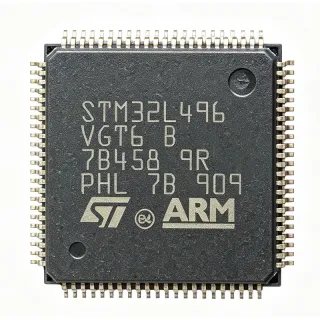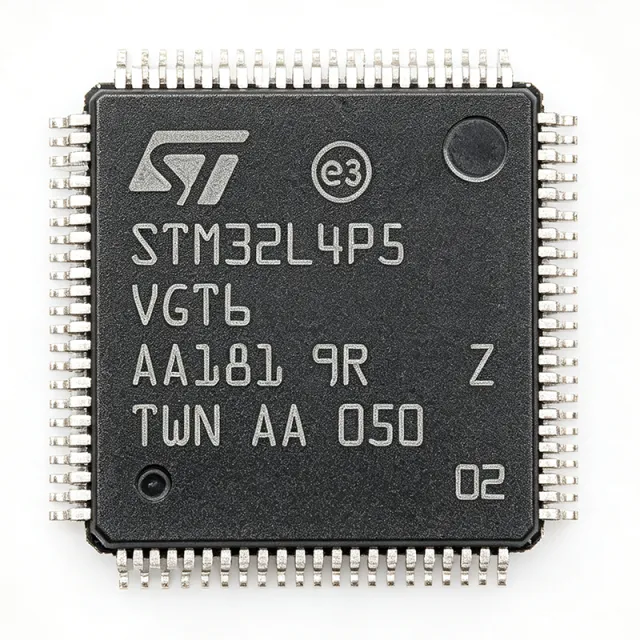
STM32L4P5VGT6 - Ultra-Low-Power Cortex-M4 MCU | STMicroelectronics
N.º da peça: STM32L4P5VGT6 ✓ Ativo| Qtd. | Preço unitário | Total |
|---|---|---|
| 1 | $19.0909 | $19,09 |
| 10 | $13.7879 | $137,88 |
| 100 | $12.197 | $1.219,70 |
| 500 | $11.6667 | $5.833,35 |
| 1.000 | $11.1364 | $11.136,40 |
STM32L4P5VGT6 Visão geral
What is an ARM Cortex-M4 microcontroller? It is a 32-bit processor core designed for embedded systems, featuring a single-cycle multiply-accumulate (MAC) unit, hardware divide, and optional single-precision floating-point unit (FPU). The Cortex-M4 is part of the ARM Cortex-M family, which includes the M0, M0+, M3, M4, and M7 cores, each optimized for different performance and power trade-offs. In the system hierarchy, a microcontroller (MCU) integrates the processor core, memory, and peripherals on a single chip, serving as the central processing unit in embedded systems such as IoT devices, industrial controllers, and consumer electronics.
Key features include a rich set of analog peripherals: two 12-bit DACs, three 12-bit ADCs with hardware oversampling, two operational amplifiers, two comparators, and an internal voltage reference buffer. The device also integrates advanced digital peripherals: two CAN FD controllers, one USB 2.0 OTG FS/HS, one SDMMC interface, and a flexible memory controller (FMC) for external memory expansion. The STM32L4P5VGT6 supports multiple low-power modes, including Sleep, Low-power Run, Low-power Sleep, Stop 0/1/2, and Standby, with a typical current consumption of 100 nA in Standby mode with backup domain.
The STM32L4P5VGT6 is built on ST's ultra-low-power technology, featuring a dynamic voltage scaling (DVS) capability that adjusts the core voltage to optimize power consumption at different operating frequencies. The device includes a hardware cryptographic accelerator (AES, DES, 3DES) and a true random number generator (TRNG), enhancing security for connected applications. The rich set of timers includes two advanced-control timers, six general-purpose timers, two basic timers, and two low-power timers, providing precise timing and PWM generation.
Typical applications include IoT nodes, smart meters, portable medical devices, industrial sensors, and wearable devices. The ultra-low-power modes and high integration make it ideal for battery-powered systems requiring long operational life. The device also supports a wide operating temperature range of -40°C to +85°C, suitable for industrial environments.
When designing with this MCU, pay attention to the power supply decoupling: place a 100 nF capacitor close to each VDD pin and a 4.7 uF capacitor at the main power input. For low-power operation, configure the GPIOs to analog mode when unused to reduce leakage current. The STM32L4P5VGT6 is supported by STM32CubeMX and STM32CubeL4 firmware package, simplifying development.
Alternativas drop-in para STM32L4P5VGT6 — mesmo encapsulamento, compatível pino a pino. Peças de encapsulamento diferente que exigem retrabalho na PCB são excluídas.
Ferramenta de comparação rápida — selecione peças alternativas para comparação lado a lado:
STM32L4A6RGT6
✓ Em estoque
$9.56 / unidade
Ver ficha técnica →STM32L4P5VGT6P
📋 Alternativa de referência (fora do catálogo)
STM32L4R5VGT6
📋 Alternativa de referência (fora do catálogo)
GD32F450VGT6
📋 Alternativa de referência (fora do catálogo)
LPC4357FET256
✓ Em estoque
$9.5 / unidade
Ver ficha técnica →STM32L4P5VGT6 Classificações máximas e características elétricas
| Core | ARM Cortex-M4 with FPU |
| Frequência máxima de clock | 120 MHz |
| Flash Memory | 1 MB |
| SRAM | 320 KB |
| Encapsulamento | 100-LQFP (14x14 mm) |
| Faixa de temperatura de operação | -40°C to +85°C |
| Supply Voltage Range | 1.71 V to 3.6 V |
| DMIPS | 213 |
| CoreMark | 550 |
| DAC | 2x 12-bit |
| ADC | 3x 12-bit with hardware oversampling |
| Operational Amplifiers | 2 |
| Comparators | 2 |
| CAN FD | 2 |
| USB | USB 2.0 OTG FS/HS |
| SDMMC | 1 |
| FMC | Yes |
| Low-Power Modes | Sleep, Low-power Run, Low-power Sleep, Stop 0/1/2, Standby |
| Standby Current | 100 nA (typical, with backup domain) |
| Cryptographic Accelerator | AES, DES, 3DES |
| TRNG | Yes |
| Timers | 2 advanced-control, 6 general-purpose, 2 basic, 2 low-power |
| RoHS | Compliant |
Configuração de pinos do STM32L4P5VGT6
| Pino 1 | VBAT — Backup battery supply |
| Pino 2 | PC13 — GPIO / RTC output |
| Pino 3 | PC14 — GPIO / OSC32_IN |
| Pino 4 | PC15 — GPIO / OSC32_OUT |
| Pino 5 | PF0 — GPIO / OSC_IN |
| Pino 6 | PF1 — GPIO / OSC_OUT |
| Pino 7 | NRST — Reset (active low) |
| Pino 8 | VSSA — Analog ground |
| Pino 9 | VDDA — Analog power supply |
| Pino 10 | PA0 — GPIO / ADC / DAC / TIM2_CH1 |
| Pino 11 | PA1 — GPIO / ADC / DAC / TIM2_CH2 |
| Pino 12 | PA2 — GPIO / ADC / USART2_TX / TIM2_CH3 |
| Pino 13 | PA3 — GPIO / ADC / USART2_RX / TIM2_CH4 |
| Pino 14 | VSS — Ground |
| Pino 15 | VDD — Power supply |
| Pino 16 | PA4 — GPIO / ADC / DAC / SPI1_NSS |
| Pino 17 | PA5 — GPIO / ADC / DAC / SPI1_SCK |
| Pino 18 | PA6 — GPIO / ADC / SPI1_MISO / TIM3_CH1 |
| Pino 19 | PA7 — GPIO / ADC / SPI1_MOSI / TIM3_CH2 |
| Pino 20 | PC4 — GPIO / ADC / I2S1_WS |
| Pino 21 | PC5 — GPIO / ADC / I2S1_CK |
| Pino 22 | PB0 — GPIO / ADC / TIM3_CH3 |
| Pino 23 | PB1 — GPIO / ADC / TIM3_CH4 |
| Pino 24 | PB2 — GPIO / RTC / TIM1_CH3N |
| Pino 25 | PB10 — GPIO / I2C2_SCL / USART3_TX |
| Pino 26 | PB11 — GPIO / I2C2_SDA / USART3_RX |
| Pino 27 | VSS — Ground |
| Pino 28 | VDD — Power supply |
| Pino 29 | PB12 — GPIO / SPI2_NSS / TIM1_BKIN |
| Pino 30 | PB13 — GPIO / SPI2_SCK / TIM1_CH1N |
| Pino 31 | PB14 — GPIO / SPI2_MISO / TIM1_CH2N |
| Pino 32 | PB15 — GPIO / SPI2_MOSI / TIM1_CH3N |
| Pino 33 | PC6 — GPIO / I2S2_MCK / TIM3_CH1 |
| Pino 34 | PC7 — GPIO / I2S2_MCK / TIM3_CH2 |
| Pino 35 | PC8 — GPIO / TIM3_CH3 / SDMMC1_CK |
| Pino 36 | PC9 — GPIO / TIM3_CH4 / SDMMC1_CK |
| Pino 37 | PA8 — GPIO / MCO / TIM1_CH1 |
| Pino 38 | PA9 — GPIO / USART1_TX / TIM1_CH2 |
| Pino 39 | PA10 — GPIO / USART1_RX / TIM1_CH3 |
| Pino 40 | PA11 — GPIO / USB_DM / CAN1_RX |
| Pino 41 | PA12 — GPIO / USB_DP / CAN1_TX |
| Pino 42 | PA13 — GPIO / SWDIO |
| Pino 43 | VSS — Ground |
| Pino 44 | VDD — Power supply |
| Pino 45 | PA14 — GPIO / SWCLK |
| Pino 46 | PA15 — GPIO / JTDI / TIM2_CH1 |
| Pino 47 | PC10 — GPIO / USART3_TX / SDMMC1_D2 |
| Pino 48 | PC11 — GPIO / USART3_RX / SDMMC1_D3 |
| Pino 49 | PC12 — GPIO / USART3_CK / SDMMC1_CK |
| Pino 50 | PD2 — GPIO / TIM3_ETR / SDMMC1_CMD |
| Pino 51 | PB3 — GPIO / JTDO / SPI1_SCK |
| Pino 52 | PB4 — GPIO / JTRST / SPI1_MISO |
| Pino 53 | PB5 — GPIO / I2C1_SMBA / SPI1_MOSI |
| Pino 54 | PB6 — GPIO / I2C1_SCL / USART1_TX |
| Pino 55 | PB7 — GPIO / I2C1_SDA / USART1_RX |
| Pino 56 | BOOT0 — Boot mode selection |
| Pino 57 | PB8 — GPIO / I2C1_SCL / CAN1_RX |
| Pino 58 | PB9 — GPIO / I2C1_SDA / CAN1_TX |
| Pino 59 | VSS — Ground |
| Pino 60 | VDD — Power supply |
| Pino 61 | PE0 — GPIO / TIM4_ETR |
| Pino 62 | PE1 — GPIO / TIM4_CH1 |
| Pino 63 | PE2 — GPIO / TIM4_CH2 |
| Pino 64 | PE3 — GPIO / TIM4_CH3 |
| Pino 65 | PE4 — GPIO / TIM4_CH4 |
| Pino 66 | PE5 — GPIO / TIM9_CH1 |
| Pino 67 | PE6 — GPIO / TIM9_CH2 |
| Pino 68 | PE7 — GPIO / TIM1_ETR |
| Pino 69 | PE8 — GPIO / TIM1_CH1N |
| Pino 70 | PE9 — GPIO / TIM1_CH1 |
| Pino 71 | PE10 — GPIO / TIM1_CH2N |
| Pino 72 | PE11 — GPIO / TIM1_CH2 |
| Pino 73 | PE12 — GPIO / TIM1_CH3N |
| Pino 74 | PE13 — GPIO / TIM1_CH3 |
| Pino 75 | PE14 — GPIO / TIM1_BKIN |
| Pino 76 | PE15 — GPIO / TIM1_BKIN2 |
| Pino 77 | PB10 — GPIO / I2C2_SCL / USART3_TX |
| Pino 78 | PB11 — GPIO / I2C2_SDA / USART3_RX |
| Pino 79 | VSS — Ground |
| Pino 80 | VDD — Power supply |
| Pino 81 | PD8 — GPIO / USART3_TX / FMC_D13 |
| Pino 82 | PD9 — GPIO / USART3_RX / FMC_D14 |
| Pino 83 | PD10 — GPIO / USART3_CK / FMC_D15 |
| Pino 84 | PD11 — GPIO / FMC_A16 |
| Pino 85 | PD12 — GPIO / FMC_A17 |
| Pino 86 | PD13 — GPIO / FMC_A18 |
| Pino 87 | PD14 — GPIO / FMC_D0 |
| Pino 88 | PD15 — GPIO / FMC_D1 |
| Pino 89 | PD0 — GPIO / FMC_D2 |
| Pino 90 | PD1 — GPIO / FMC_D3 |
| Pino 91 | PD3 — GPIO / FMC_CLK |
| Pino 92 | PD4 — GPIO / FMC_NOE |
| Pino 93 | PD5 — GPIO / FMC_NWE |
| Pino 94 | PD6 — GPIO / FMC_NWAIT |
| Pino 95 | PD7 — GPIO / FMC_NE1 |
| Pino 96 | VSS — Ground |
| Pino 97 | VDD — Power supply |
| Pino 98 | PH0 — GPIO / OSC_IN |
| Pino 99 | PH1 — GPIO / OSC_OUT |
| Pino 100 | VSS — Ground |
Aplicações típicas
STM32L4P5VGT6 é adequado para 6 aplicaçãos: IoT Nodes, Smart Meters, Portable Medical Devices, Industrial Sensors, Wearable Devices, Smart Home Controllers.
IoT Nodes
The STM32L4P5VGT6 is ideal for IoT nodes due to its ultra-low-power modes (100 nA standby) and rich connectivity options including USB OTG, CAN FD, and SDMMC. Its 120 MHz Cortex-M4 core with FPU handles complex protocols like MQTT and TLS efficiently. The hardware cryptographic accelerator (AES, DES, 3DES) and TRNG secure data transmission. With 1 MB flash and 320 KB SRAM, it can store firmware and sensor data locally. The wide operating temperature range (-40°C to +85°C) suits outdoor deployments. Designers can leverage STM32CubeMX for rapid development and power optimization.
Recomendado
Smart Meters
Smart meters require precise measurement and low power consumption. The STM32L4P5VGT6's three 12-bit ADCs with hardware oversampling enable accurate current and voltage sensing. Its multiple low-power modes allow the meter to sleep between readings, extending battery life. The CAN FD interface supports communication with other smart grid devices. The FMC can connect to external memory for data logging. The device's robust security features (AES, TRNG) protect metering data. With a wide temperature range, it operates reliably in outdoor utility enclosures. ST's ultra-low-power technology ensures minimal energy consumption during active and standby states.
Recomendado
Portable Medical Devices
Portable medical devices demand high reliability and low power. The STM32L4P5VGT6's ultra-low-power modes extend battery life in devices like glucose monitors and pulse oximeters. Its analog peripherals (op-amps, comparators, ADCs) interface directly with biosensors. The 120 MHz Cortex-M4 with FPU handles signal processing algorithms for vital sign monitoring. The device's security features protect patient data. The compact 100-LQFP package fits space-constrained designs. ST's comprehensive firmware libraries (STM32CubeL4) accelerate development and certification. The wide temperature range ensures operation in clinical and home environments.
Recomendado
Industrial Sensors
Industrial sensors require robust performance and connectivity. The STM32L4P5VGT6's CAN FD and USB interfaces enable integration with industrial networks. Its multiple timers generate precise PWM for actuator control. The device's wide temperature range (-40°C to +85°C) and high reliability make it suitable for factory automation. The 12-bit ADCs with oversampling provide accurate sensor readings. The FMC supports external memory for data logging. The cryptographic accelerator secures communication in critical infrastructure. ST's long-term availability and industrial-grade quality ensure dependable operation in harsh environments.
Recomendado
Wearable Devices
Wearables need ultra-low power and small size. The STM32L4P5VGT6's 100 nA standby current and multiple low-power modes enable long battery life in smartwatches and fitness trackers. Its 120 MHz Cortex-M4 with FPU handles sensor fusion and user interface tasks. The device's analog peripherals interface with accelerometers, gyroscopes, and heart-rate sensors. The compact 100-LQFP package is suitable for space-constrained PCBs. The security features protect user data. ST's ultra-low-power technology and comprehensive power management tools help designers achieve optimal energy efficiency. The device supports Bluetooth via external modules for connectivity.
Recomendado
Smart Home Controllers
Smart home controllers require connectivity and low power. The STM32L4P5VGT6's USB OTG and CAN FD interfaces support various smart home protocols. Its multiple timers and PWM outputs control lighting and motorized devices. The device's low-power modes allow it to run on batteries or energy harvesting. The 1 MB flash provides ample space for complex home automation firmware. The security features (AES, TRNG) secure communication with cloud services. The wide temperature range suits indoor and outdoor installations. ST's ecosystem includes ready-to-use examples for smart home applications, accelerating time-to-market.
Recomendado
Resumo dos produtos recomendados
Dados de referência de engenharia para STM32L4P5VGT6 — comparação, orientação de projeto e informações de conformidade.
Guia de seleção
Comparação com alternativas
| Parâmetro | Este produto | STM32L4P5VGT6P | STM32L4R5VGT6 | STM32L4A6RGT6 | GD32F450VGT6 | LPC4357FET256 |
|---|---|---|---|---|---|---|
| Package | 100-LQFP (14x14 mm) | 100-LQFP (14x14 mm) - same | 100-LQFP (14x14 mm) - same | 100-LQFP (14x14 mm) - same | 100-LQFP (14x14 mm) - same | 100-LQFP (14x14 mm) - same |
| Brand | STMicroelectronics | STMicroelectronics | STMicroelectronics | STMicroelectronics | GigaDevice | NXP Semiconductors |
| Core | ARM Cortex-M4 with FPU | ARM Cortex-M4 with FPU | ARM Cortex-M4 with FPU | ARM Cortex-M4 with FPU | ARM Cortex-M4 with FPU | ARM Cortex-M4/M0 dual-core |
| Maximum Clock Frequency | 120 MHz | 120 MHz | 120 MHz | 80 MHz | 200 MHz | 204 MHz |
| Flash Memory | 1 MB | 1 MB | 1 MB | 1 MB | 1 MB | 1 MB |
| SRAM | 320 KB | 320 KB | 640 KB | 128 KB | 256 KB | 136 KB |
| Cryptographic Accelerator | AES, DES, 3DES | AES, DES, 3DES | AES, DES, 3DES | AES, DES, 3DES | AES, DES, 3DES | AES |
Principais diferenciais
- Higher clock speed and SRAM (vs STM32L4A6RGT6)
- External SMPS support option (vs STM32L4P5VGT6P)
- Lower power consumption (vs GD32F450VGT6)
Notas de projeto
For low-power operation, configure unused GPIOs to analog mode to reduce leakage current. Use the low-power modes (Stop 2, Standby) to minimize consumption. Ensure the backup domain is properly powered with VBAT for RTC and backup registers. According to ST application note AN4621, using the internal LDO or external SMPS (on 'P' variants) can optimize power efficiency.
Place a 100 nF decoupling capacitor close to each VDD pin and a 4.7 uF capacitor at the main power input. For the VDDA pin, use a dedicated analog supply with a ferrite bead to reduce noise. Ensure a solid ground plane for the LQFP package's exposed pad (if present) to improve thermal performance.
Do not exceed the absolute maximum ratings for supply voltage (3.6V). Ensure the boot pins (BOOT0) are configured correctly for your application. When using the 'P' variant, if VDD12 pins are not used, leave them unconnected to avoid short circuits. Verify the crystal oscillator layout for OSC_IN/OSC_OUT to prevent startup issues.
Informações de conformidade
RoHS compliant per STMicroelectronics product page. Not AEC-Q100 qualified; this is a general-purpose MCU.