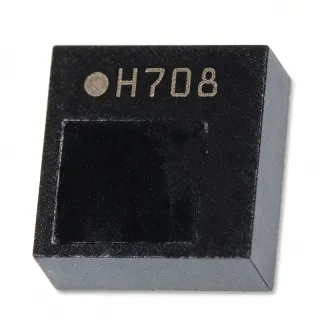
AS7331-AQFM-OLGA16-LF - UVA/UVB/UVC Spectral UV Sensor | ams OSRAM
Артикул: AS7331-AQFM-OLGA16-LF ✓ Активен| Кол-во | Цена за ед. | Итого |
|---|---|---|
| 1 | $10.58 | $10,58 |
| 10 | $9.52 | $95,20 |
| 100 | $8.57 | $857,00 |
| 500 | $7.71 | $3.855,00 |
| 1.000 | $6.94 | $6.940,00 |
AS7331-AQFM-OLGA16-LF Обзор
A spectral UV sensor is a type of optical sensor that resolves incoming ultraviolet radiation into specific wavelength bands rather than reporting a single total irradiance value. Within the sensor hierarchy (UV sensor -> spectral sensor -> optical sensor -> semiconductor sensor), the AS7331 belongs to ams OSRAM's ambient light, color, spectral and proximity sensor family. Unlike simple UV index sensors that only detect UVA plus some UVB, a true three-band spectral UV sensor separates UVA (roughly the 315-400 nm region), UVB and UVC (down to approximately 260 nm per DigiKey classification) so downstream firmware can distinguish sunlight exposure, germicidal irradiance and curing lamp output.
Key features include the three separated UVA/UVB/UVC channels, 24-bit digital resolution per channel, and adjustable irradiance responsivity: gain, conversion time and internal clock frequency can be programmed to trade sensitivity against full-scale range and LSB size. Four low-power operating modes (including continuous and triggered measurement) support both always-on monitoring and battery-friendly event-driven sampling, as highlighted in the SparkFun and Adafruit breakout documentation.
Technically, the AS7331 converts photocurrent from UV-optimized photodiodes through an integration-based ADC architecture, delivering high dynamic range without external optics. The I2C digital output eliminates analog-to-digital conversion burden on the host microcontroller, and the low-noise front end allows weak UVC signals to be resolved even in compact, unfiltered apertures.
Typical applications include wearable UV index monitors and sun-exposure alerts (UVA/UVB), germicidal lamp verification and disinfection cabinet monitoring (UVC), UV curing process control, and agricultural UV dosing stations, as noted by Adafruit for human and agricultural UV alerts across all three bands.
Design-wise, program the gain and conversion time so expected irradiance sits in the upper half of the 24-bit full scale for best SNR, and account for the 2.7-3.6 V supply budget in battery designs.
This page synthesizes distributor pricing, cross-reference data and practical design notes not found in the manufacturer datasheet, with prices as of 2026-10-11.
Аналоги без доработки для AS7331-AQFM-OLGA16-LF — тот же корпус, pin-to-pin совместимость. Компоненты в других корпусах, требующие переработки PCB, исключены.
Варианты в этой серии
Модели той же серии, совместимые без доработки с AS7331-AQFM-OLGA16-LF (тот же форм-фактор и посадочное место) — отличается по Interface, Operating Modes, Package, Sensor Type, Supply Voltage.
Инструмент быстрого сравнения — выберите альтернативные компоненты для сравнения бок о бок:
AS7331-AQFM
✅ Прямая замена✓ В наличии
$7.87 / шт.
Открыть даташит →AS7331-AQFM-OLGA16-LF Максимальные параметры и электрические характеристики
| Тип датчика | Spectral UV Sensor (UVA / UVB / UVC) |
| Spectral Range | 260 nm to 360 nm |
| Number of Channels | 3 (UVA, UVB, UVC) |
| Разрешение | 24-bit digital output |
| Интерфейс | I2C |
| Напряжение питания | 2.7 V to 3.6 V |
| Рабочая температура | -40 C to +105 C |
| Operating Modes | 4 (continuous and triggered measurement) |
| Responsivity Adjustment | Via gain, conversion time and internal clock frequency |
| Photodiode Type | UV-optimized photodiodes |
| Корпус | OLGA-16, 3.65 mm x 2.6 mm (16-TFLGA) |
| Тип монтажа | Surface Mount |
| Power Characteristic | Low power, low noise |
| Статус RoHS | Compliant (per JLCPCB/LCSC listing) |
| Packaging Suffix | T&R (Tape and Reel), LF lead-free finish |
Руководство по цоколевке AS7331-AQFM-OLGA16-LF в корпусе olga-16, 3.65 mm x 2.6 mm (16-tflga)
Цоколевка для AS7331-AQFM-OLGA16-LF (корпус olga-16, 3.65 mm x 2.6 mm (16-tflga)). Нумерация выводов, функции и схемы подключения определены в техническом описании производителя. Обратитесь к нему для точного посадочного места и рекомендаций по пайке.
Нет подробных данных о распиновке для AS7331-AQFM-OLGA16-LF.
Обратитесь к даташиту для полной конфигурации выводов.
Типичное применение
AS7331-AQFM-OLGA16-LF подходит для 6 применениеs: Wearable UV Index Monitoring, UVC Germicidal Lamp Verification, UV Curing Process Control, Agricultural UV Dosing, Automotive Cabin UV Sensing, Environmental UV Weather Stations.
Wearable UV Index Monitoring
Wearable sun-exposure devices require accurate UVA and UVB measurement in a tiny, power-constrained footprint. The AS7331 fits this role because its OLGA-16 package measures only 3.65 x 2.6 mm and its low-power architecture offers four operating modes, including triggered measurement that wakes the sensor only for periodic sampling. With a supply range of 2.7 V to 3.6 V it runs directly from a 3.3 V battery rail via an LDO, and the 24-bit per-channel resolution lets firmware compute a UV index across bright sunlight and shade without gain switching. The I2C interface draws minimal host overhead, and the industrial -40 C to +105 C rating tolerates a device left on a car dashboard. Place the sensor under a UV-transmitting resin window; standard watch glass blocks UVC and attenuates UVB, so verify window transmission during calibration for accurate exposure alerts.
Рекомендуется
UVC Germicidal Lamp Verification
Disinfection cabinets, UV sterilizer wands and germicidal enclosures need reliable verification that 254-280 nm UVC output is actually present and maintained over lamp life. The AS7331 is among the few compact digital sensors with a dedicated UVC channel, with spectral coverage listed by DigiKey from 260 nm to 360 nm, enabling direct monitoring of germicidal irradiance that simple UVA/UVB index sensors cannot see. Firmware programs the gain and conversion time so typical lamp irradiance lands in the upper half of the 24-bit full scale, maximizing signal-to-noise ratio, then compares readings against a commissioning baseline to flag lamp aging. Because UVC photodiodes can degrade under chronic exposure and quartz sleeves attenuate output, mount the sensor where line-of-sight to the lamp is unobstructed and schedule periodic recalibration against a reference radiometer for dose-critical medical or food-safety applications.
Рекомендуется
UV Curing Process Control
UV curing of adhesives, inks and coatings demands confirmation that target irradiance reaches the bond line, since under-cure causes bond failures and over-cure wastes lamp life. The AS7331's UVA and UVB channels align with the spectral output of typical mercury and UV LED curing lamps, and its programmable responsivity (gain, conversion time, internal clock frequency per the ams OSRAM product page) lets engineers extend the full-scale range for high-intensity curing zones without saturating the 24-bit ADC. In triggered measurement mode, the sensor samples exactly during the exposure window, and the I2C output feeds PLC or MCU-based process controllers that log dose and reject out-of-spec parts. For LED-curing systems centered near 365-395 nm, verify the sensor's response at the specific wavelength against its responsivity curves, since coverage is specified up to roughly 360 nm.
Рекомендуется
Agricultural UV Dosing
Controlled-environment agriculture uses targeted UVB and UVC dosing to boost secondary metabolites in herbs, harden seedlings, or suppress powdery mildew. The AS7331 addresses this because, as Adafruit notes, it differentiates all three UV bands, enabling separate control loops for growth-promoting UVA/UVB and pathogen-suppressing UVC exposure. The 24-bit resolution spans dim supplemental lighting through direct solar input, and the -40 C to +105 C operating range survives greenhouse and cold-frame temperature extremes. Firmware integrates each band over the photoperiod to deliver a programmed daily UV dose, opening or closing lamp relays based on live irradiance rather than lamp-rated output, which compensates for lamp aging and dirt on luminaires. Mount the sensor at canopy height facing the light source, and apply lens transmission calibration so the reported dose matches plant-level irradiance rather than sensor-face values.
Рекомендуется
Automotive Cabin UV Sensing
Premium vehicles increasingly report cabin and windshield UV load to trigger glare shading, glass coating diagnostics or occupant sun-exposure warnings. The AS7331 suits this environment because its -40 C to +105 C operating range matches automotive interior temperature specifications, and the small 3.65 x 2.6 mm OLGA-16 footprint mounts behind the windshield header or climate-control vent. Its three-band output lets the body controller distinguish windshield-filtered UVA from UVB leaking through open sunroofs, and triggered measurement keeps average current low on the always-on body domain. The I2C interface connects directly to a body-control MCU, typically over short shielded traces below 30 cm to maintain signal integrity in a noisy automotive EMC environment. Because laminated glass blocks most UVB while transmitting UVA, calibrate against installed-glass transmission rather than free-air values for meaningful cabin UV index reporting.
Рекомендуется
Environmental UV Weather Stations
Weather stations and smart-city environmental nodes publish UV index alongside temperature, humidity and particulate data. The AS7331 provides true UVA/UVB separation with 24-bit resolution per channel, allowing the station to compute a standardized UV index even under rapidly changing cloud cover, where slower integrating sensors under-respond to bright breaks between clouds. Its low noise lets clear-sky noon irradiance and heavily overcast values be resolved on the same gain setting in many climates, reducing firmware complexity. Supply current suits solar-powered nodes with 3.3 V LiFePO4 or supercapacitor backed rails, and triggered sampling every minute or two keeps the energy budget small. Mount the sensor behind a PTFE or PMMA diffuser to widen the field of view and reduce sensitivity to pointing, then apply a two-point calibration (shadowed and clear-sky reference) to align the node with nearby meteorological UV index reporting.
Рекомендуется
Сводка рекомендуемых товаров
Справочные инженерные данные для AS7331-AQFM-OLGA16-LF — сравнение, рекомендации по проектированию и информация о соответствии.
Руководство по выбору
Сравнение с аналогами
| Параметр | Этот товар | AS7331-AQFM |
|---|---|---|
| Package | OLGA-16 (16-TFLGA), 3.65 x 2.6 mm | OLGA-16 - same footprint |
| Brand | ams OSRAM | ams OSRAM |
| Spectral Range | 260 nm to 360 nm (UVA/UVB/UVC) | 260 nm to 360 nm |
| Channels | 3 (UVA, UVB, UVC) | 3 (UVA, UVB, UVC) |
| Resolution | 24-bit per channel | 24-bit per channel |
| Interface | I2C | I2C |
| Supply Voltage | 2.7 V to 3.6 V | 2.7 V to 3.6 V |
| Operating Temperature | -40 C to +105 C | -40 C to +105 C |
| Cross-Brand Pin-Compatible Alternatives | None found in web data | N/A (same family only) |
Ключевые отличия
- Dedicated UVC channel reaching ~260 nm (против LTR390 (functional, non drop-in))
- 24-bit per-channel resolution with programmable responsivity (против AS7331-AQFM (same family))
- Industrial temperature rating (против VEML6075 (functional, non drop-in))
Заметки по проектированию
Place a 100 nF ceramic decoupling capacitor within 2 mm of the AS7331 supply pin, with an additional 1 uF bulk capacitor nearby on the 2.7-3.6 V rail. Route I2C SDA/SCL as short as practical and use 4.7 kOhm pull-ups to the sensor supply, not a 5 V rail. Because the sensor is optical, ensure the OLGA aperture has a clear, unobstructed view through a UV-transmitting window (quartz or PMMA) and keep solder-mask or conformal coating out of the optical path. Follow the footprint in the manufacturer datasheet for the 3.65 x 2.6 mm OLGA-16 land pattern.
The supply range is 2.7 V to 3.6 V - applying 5 V to the sensor rail will damage the device; level-shift the I2C bus if the host runs at 5 V. Standard cover glass blocks UVC and attenuates UVB, so specifying the window material is as important as the sensor choice. Also, UV sources degrade the photodiodes over time; in dose-critical UVC applications, budget periodic recalibration. Per the ams OSRAM product page, responsivity depends on gain, conversion time and internal clock frequency - changing any one of them changes the LSB scale, so store calibration factors per register configuration.
For battery-powered UV wearables, use the AS7331 triggered measurement mode instead of continuous mode: sample every 10-60 s, integrate the dose in firmware, and let the host MCU sleep between conversions. Estimated: sampling 1/s vs 1/60/s reduces average sensor-related energy by roughly a factor of 60, dominating the power budget since the I2C pull-up resistors often draw more average current than the sensor itself. Size pull-ups at 10 kOhm on battery designs and confirm bus rise time meets I2C timing at the chosen bus speed.
Информация о соответствии
ROHS compliant per JLCPCB/LCSC part listing; LF suffix denotes lead-free finish. REACH, halogen-free and conflict-minerals declarations not stated in retrieved distributor data.