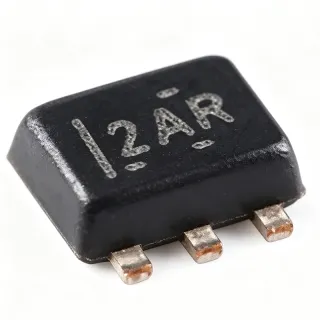
SZNUP2124MXWTBG - 28V CAN/CAN-FD Dual TVS Protector | onsemi
Артикул: SZNUP2124MXWTBG ✓ Активен| Кол-во | Цена за ед. | Итого |
|---|---|---|
| 1 | $0.09 | $0,09 |
| 10 | $0.08 | $0,80 |
| 100 | $0.07 | $7,00 |
| 500 | $0.06 | $30,00 |
| 1.000 | $0.05 | $50,00 |
SZNUP2124MXWTBG Обзор
A TVS (transient voltage suppressor) diode is a circuit-protection semiconductor that clamps fast, high-energy voltage transients before they can damage sensitive transceiver ICs. Within the protection hierarchy, the SZNUP2124 sits at the board-level ESD/EMI layer of surge protection devices, complementing system-level protection such as varistors and upstream power supervision. Bidirectional devices like this one protect differential signaling lines where the signal swings both above and below ground, as in CAN and CAN-FD automotive buses.
Key features include dual bidirectional channels in a single 1x1 mm footprint, Zener-based PN junction technology optimized for low dynamic resistance (Rdyn), a low turn-on voltage, and a wettable-flank package for reliable automated optical inspection (AOI). The device has been tested to EMI and ESD levels representative of ISO 7637-2 and ISO 7637-3 surge and transient events on road-vehicle power and data lines.
Technically, the SZNUP2124 uses optimized Zener diode architecture that expands the active junction area, distributing transient energy and lowering dynamic resistance during an event. Lower Rdyn translates directly into a lower clamped voltage at the transceiver pins during a surge, which reduces stress on the CAN transceiver receiver front-end. The combination of low turn-on voltage and low dynamic resistance gives designers a low-cost option for improving system robustness without compromising signal integrity on 5 Mbps CAN-FD networks.
Typical applications include CAN and CAN-FD bus line protection in automotive body, powertrain, and gateway ECUs, industrial CAN networks (DeviceNet, CANopen), and 12V/24V battery-system communication lines exposed to load-dump-like transients and ESD strikes at connectors.
Design consideration: place the protector as close as possible to the connector or transceiver pins, and keep the clamp path (including ground return) short; parasitic series inductance dominates the actual clamped voltage during fast transients.
This page synthesizes distributor pricing, drop-in variant options, and practical design notes not found in the manufacturer datasheet alone.
Аналоги без доработки для SZNUP2124MXWTBG — тот же корпус, pin-to-pin совместимость. Компоненты в других корпусах, требующие переработки PCB, исключены.
Инструмент быстрого сравнения — выберите альтернативные компоненты для сравнения бок о бок:
Для этого товара нет аналогов без доработки.
Запросить аналогиSZNUP2124MXWTBG Характеристики
| Configuration | Dual bidirectional (2 channels) |
| Technology | Zener-based PN junction TVS |
| Peak Pulse Current Ipp | 3 A (8/20 us) |
| Clamping Voltage | 40 V |
| Application | CAN / CAN-FD bus protection |
| Корпус | XDFNW3, 1x1 mm, wettable flank |
| Тип монтажа | Surface Mount |
| Operating Voltage (BG variant) | 28 V |
| ESD / EMI Test Standards | ISO 7637-2 and ISO 7637-3 (per datasheet) |
| Packing | Tape and Reel (suffix MXWT) |
| Статус RoHS | Compliant |
Руководство по цоколевке SZNUP2124MXWTBG в корпусе xdfnw3, 1x1 mm, wettable flank
Цоколевка для SZNUP2124MXWTBG (корпус xdfnw3, 1x1 mm, wettable flank). Нумерация выводов, функции и схемы подключения определены в техническом описании производителя. Обратитесь к нему для точного посадочного места и рекомендаций по пайке.

Нет подробных данных о распиновке для SZNUP2124MXWTBG.
Обратитесь к даташиту для полной конфигурации выводов.
Типичное применение
SZNUP2124MXWTBG подходит для 6 применениеs: Automotive CAN/CAN-FD Bus Protection, ECU Gateway and Body Control Modules, Industrial CAN Networks (CANopen / DeviceNet), ESD Protection at Automotive Connectors, 24 V Truck and Commercial Vehicle Systems, Compact and Wearable CAN-Based Devices.
Automotive CAN/CAN-FD Bus Protection
The SZNUP2124 fits automotive CAN and CAN-FD bus lines directly: its dual bidirectional channels protect CANH and CANL in one 1x1 mm XDFNW3 package, rated 40 V clamping and 3 A (8/20 us) peak pulse current. The SZ prefix marks it as an automotive-grade onsemi part, and it is tested to ISO 7637-2/-3 representative transient levels. In practice it is placed at the ECU connector between the common-mode choke and the transceiver, clamping ESD strikes and coupled transients before they reach the transceiver receiver front-end. Because CAN-FD edges at 5 Mbps are sensitive to capacitance, the Zener-based low-Rdyn design preserves signal integrity while clamping. The wettable-flank terminations enable reliable AOI inspection in automotive SMT lines.
Рекомендуется
ECU Gateway and Body Control Modules
Gateway ECUs aggregate multiple CAN and CAN-FD channels, so protection area and per-channel cost multiply across dozens of nodes. The SZNUP2124 addresses this by integrating two bidirectional channels in one 1x1 mm footprint, rated at 40 V clamping and 3 A (8/20 us), roughly halving protection board area versus two single-channel parts. Its low turn-on voltage and low dynamic resistance (Rdyn) keep the clamped voltage at the transceiver pins low during ISO 7637-2/-3 style transients on the vehicle harness. The 28 V (BG) variant suits 24 V truck or commercial-vehicle buses, while the 24 V (AG) variant fits standard 12 V passenger-car networks. Wettable-flank sides support the AOI inspection required in body-electronics production.
Рекомендуется
Industrial CAN Networks (CANopen / DeviceNet)
Industrial CAN runs through electrically noisy factory floors where cable-induced ESD and coupled switching transients routinely damage transceivers at connectors. The SZNUP2124 provides dual bidirectional clamping with a 40 V ceiling and 3 A (8/20 us) surge capability, sufficient for the coupled-transient environment described by ISO 7637-3-style testing. Its ultra-compact 1x1 mm XDFNW3 wettable-flank package fits dense I/O boards in remote I/O modules and servo drives where connector real estate is scarce. The low dynamic resistance of the Zener-based junction means the actual clamped voltage at the transceiver stays low even at peak current, extending CAN node uptime. The automotive-grade construction also improves reliability in high-vibration industrial settings.
Рекомендуется
ESD Protection at Automotive Connectors
Any CAN line that exits the module through a customer-accessible connector is an ESD entry point: service technicians and assembly robots routinely contact diagnostic (OBD-II) CAN pins. The SZNUP2124 clamps human-body-model and IEC-style contact discharges on CANH/CANL with its 40 V / 3 A (8/20 us) capability and low turn-on voltage, reacting within nanoseconds of the transient edge. Mounted directly behind the connector with a short, wide ground return, the Zener-based low-Rdyn structure minimizes residual overshoot. The 1x1 mm XDFNW3 wettable-flank package allows placement in the tight pitch immediately adjacent to connector pads, and the wettable flanks give assembly-line AOI the solder-fillet visibility that plain QFN packages lack.
Рекомендуется
24 V Truck and Commercial Vehicle Systems
Commercial-vehicle 24 V electrical systems impose higher standing and transient voltages than passenger cars, which is exactly where the SZNUP2124MXWTBG 28 V variant is specified. Per its Mouser categorization, the BG part is the '28V CAN-FD ESD PROTECTION' option, giving sufficient standoff margin above the 24 V bus while retaining 40 V clamping and 3 A (8/20 us) surge capability. Truck chassis harnesses are long and exposed, so ISO 7637-2-style supply transients couple strongly onto CAN lines; the low-Rdyn Zener architecture keeps the clamped voltage at the transceiver within safe limits during these events. Dual channels in one 1x1 mm wettable-flank XDFNW3 package also simplify the multi-node topologies typical of trailer-abs braking and telematics networks.
Рекомендуется
Compact and Wearable CAN-Based Devices
Space-constrained CAN nodes - electric-bicycle controllers, small battery-management units, and compact telematics dongles - cannot afford SOT-23 protection footprints on both bus lines. The SZNUP2124 solves this with two bidirectional protection channels in a 1x1 mm XDFNW3 package rated 40 V clamping and 3 A (8/20 us), the smallest footprint in its protection class. Its Zener-based junction provides low dynamic resistance, so even at modest board-level surge currents the clamp voltage stays low enough to protect typical 3.3 V and 5 V CAN-FD transceivers. The wettable-flank terminations permit AOI verification despite the package size, and the tape-and-reel MXWT packing supports high-volume pick-and-place assembly without tray handling.
Рекомендуется
Сводка рекомендуемых товаров
Справочные инженерные данные для SZNUP2124MXWTBG — сравнение, рекомендации по проектированию и информация о соответствии.
Руководство по выбору
Сравнение с аналогами
| Параметр | Этот товар | SZNUP2124MXWTBG | SZNUP2124MXWTAG | NUP2105LT1G |
|---|---|---|---|---|
| Package | XDFNW3 (1x1 mm, wettable flank) | XDFNW3 (1x1 mm) - same | XDFNW3 (1x1 mm) - same | SOT-23 (different footprint) |
| Brand | onsemi | onsemi | onsemi | onsemi |
| Channels / Configuration | Dual bidirectional | Dual bidirectional | Dual bidirectional | Dual bidirectional |
| Target Bus | CAN / CAN-FD | CAN / CAN-FD | CAN / CAN-FD | CAN / general dual line |
| Automotive Grade (SZ prefix) | Yes | Yes | Yes | No (standard grade) |
Ключевые отличия
- Dual channels in 1x1 mm automotive package (против NUP2105LT1G)
- CAN-FD optimized low dynamic resistance (против SZNUP2124MXWTAG)
- Higher voltage class for 24 V systems (против SZNUP2124MXWTAG)
Заметки по проектированию
Place the SZNUP2124 within a few millimeters of the CAN connector or immediately beside the transceiver CANH/CANL pins, and route the bus line into the protector before continuing to the transceiver. Keep the surge current loop - line trace plus the ground return from the protector's ground pin to the transceiver ground - short and wide. Even a few nanohenries of series inductance adds significant overshoot (V = L x di/dt) during ESD edges, defeating the 40 V clamp. Use at least two vias to the ground plane at the ground pin.
Select the suffix variant by system voltage: the MXWTBG is the 28 V CAN-FD variant for 24 V vehicle systems, while the MXWTAG is the 24 V variant for standard 12 V networks. Ordering the wrong suffix gives either insufficient standoff margin (AG on 24 V rails) or unnecessarily high clamping threshold (BG on 12 V rails). Do not substitute the plain NUP-prefix standard-grade part in automotive programs - the SZ prefix denotes the automotive manufacturing flow. Verify footprint and voltage class before any cross-family substitution such as NUP2105 (SOT-23).
At CAN-FD data rates up to 5 Mbps, the protector's junction capacitance and the total stub length it adds to the bus matter. Place the SZNUP2124 close to the transceiver so the un-protected stub is short, and account for the device capacitance in the bus loading budget (ISO 11898 allows roughly 100 pF per node total). The Zener-based low-Rdyn construction of the SZNUP2124 keeps the trade-off between clamping robustness and signal integrity favorable, but always confirm rise-time and eye-mask compliance on the actual PCB at maximum bus length.
Информация о соответствии
RoHS-compliant lead-free finish per distributor listings (DigiKey, Mouser, LCSC). SZ prefix denotes onsemi automotive-grade manufacturing flow supporting PPAP; formal AEC-Q100 applicability for discrete TVS should be confirmed via the onsemi product page.