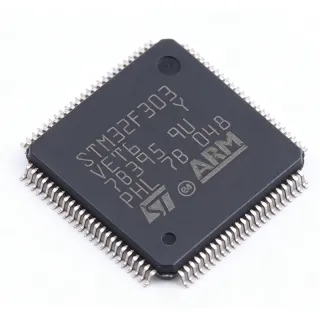
STM32F437VIT6 - 2MB Flash, 180MHz ARM Cortex-M4 MCU | STMicroelectronics
MPN: STM32F437VIT6 ✓ Hoạt độngSTM32F437VIT6 Tóm tắt
What is an ARM Cortex-M4 microcontroller? It is a 32-bit processor core designed for embedded systems, combining digital signal processing (DSP) instructions and a single-precision FPU for efficient handling of mathematical operations. The Cortex-M4 is part of the ARM Cortex-M family, which includes the M0, M0+, M3, M4, and M7 cores, each targeting different performance and power trade-offs. In the system hierarchy, a microcontroller integrates the processor core, memory, and peripherals on a single chip, enabling standalone operation in applications ranging from industrial control to consumer electronics.
Key features of the STM32F437VIT6 include a 180 MHz CPU with 225 DMIPS/1.25 DMIPS/MHz performance, a Chrom-ART Accelerator for enhanced graphical user interface (GUI) rendering, and a TFT LCD controller supporting up to XGA resolution. It also integrates a cryptographic/hash processor for AES, DES, and SHA-1/SHA-2 algorithms, a true random number generator (TRNG), and a camera interface. The device provides extensive connectivity with USB 2.0 OTG HS/FS, Ethernet MAC, CAN 2.0B, SPI, I2C, USART, and SDIO interfaces.
Technically, the STM32F437VIT6 is built on a 90 nm process technology, offering a balance of performance and power efficiency. It operates from a 1.8V to 3.6V power supply and includes multiple low-power modes (Sleep, Stop, Standby) to minimize energy consumption. The device supports external memory interfaces for SDRAM, SRAM, and NOR/NAND Flash, expanding its data storage capabilities beyond the internal 2 MB Flash.
Typical applications include industrial automation (PLC, motor control), medical devices (patient monitoring, diagnostic equipment), consumer electronics (smart home hubs, wearables), and IoT gateways. The combination of high performance, rich peripherals, and security features makes it a versatile choice for advanced embedded systems.
When designing with this MCU, ensure adequate decoupling on all power supply pins and follow the recommended layout for the 100-pin LQFP package. The internal LDO requires a 1.2V bypass capacitor, and the VBAT pin should be connected to a backup battery for RTC operation. Pay attention to the ADC reference voltage (VDDA) for accurate analog measurements.
Bộ thay thế dễ dàng lắp đặt cho STM32F437VIT6 — cùng gói, chân-to-chân tương thích. Các bộ phận yêu cầu hàn PCB bị loại trừ.
Các biến thể trong loạt này
Các mẫu cùng loạt có thể lắp đặt dễ dàng tương thích với STM32F437VIT6 (cùng hình factor và footprint) — khác nhau ở Package, Core, Flash Memory, Performance, ADC.
STM32F437VGT6
✅ Drop-In ⚠️ Thông số chưa được xác minh📋 Tham chiếu thay thế (không có trong danh mục)
STM32F407VGT6
✅ Drop-In ⚠️ Thông số chưa được xác minhLiên hệ để biết giá
Xem tài liệu →STM32F429VIT6
✅ Drop-In ⚠️ Thông số chưa được xác minhLiên hệ để biết giá
Xem tài liệu →STM32F439VIT6
✅ Drop-In ⚠️ Thông số chưa được xác minh📋 Tham chiếu thay thế (không có trong danh mục)
LPC4370FET100
⚡ Đồng gói ⚠️ Thông số chưa được xác minh📋 Tham chiếu thay thế (không có trong danh mục)
STM32F437VIT6 Tỷ lệ tối đa & tính chất điện
| Core | ARM Cortex-M4 with FPU |
| Tần số xung maksimum | 180 MHz |
| Flash Memory | 2 MB |
| SRAM | 256 KB |
| Điện áp cung cấp | 1.8 V to 3.6 V |
| Hộp | LQFP100 (14x14 mm, 0.5 mm pitch) |
| Nhiệt độ hoạt động | -40C to +85C |
| GPIO Pins | 82 |
| ADC | 3x 12-bit, 2.4 MSPS |
| DAC | 2x 12-bit |
| Timers | 12x 16-bit, 2x 32-bit |
| Communication Interfaces | USB 2.0 OTG HS/FS, Ethernet MAC, CAN 2.0B, SPI, I2C, USART, SDIO |
| Cryptographic Acceleration | AES, DES, SHA-1, SHA-2 |
| TFT LCD Controller | Up to XGA resolution |
| DMA | 2x DMA controllers with 16 streams each |
| RTC | Yes, with calendar and alarm |
| Low Power Modes | Sleep, Stop, Standby |
| Trạng thái RoHS | Compliant |
Cấu hình chân STM32F437VIT6
| Chân 1 | VBAT — Backup battery supply for RTC and backup registers |
| Chân 2 | PC13 — GPIO or RTC tamper/calendar output |
| Chân 3 | PC14 — GPIO or OSC32_IN |
| Chân 4 | PC15 — GPIO or OSC32_OUT |
| Chân 5 | PF0 — GPIO or OSC_IN |
| Chân 6 | PF1 — GPIO or OSC_OUT |
| Chân 7 | NRST — Reset (active low) |
| Chân 8 | PC0 — GPIO or ADC12_IN10 |
| Chân 9 | PC1 — GPIO or ADC12_IN11 |
| Chân 10 | PC2 — GPIO or ADC12_IN12 |
| Chân 11 | PC3 — GPIO or ADC12_IN13 |
| Chân 12 | VDD — Digital power supply (1.8V-3.6V) |
| Chân 13 | VSS — Digital ground |
| Chân 14 | PC4 — GPIO or ADC12_IN14 |
| Chân 15 | PC5 — GPIO or ADC12_IN15 |
| Chân 16 | PB0 — GPIO or ADC12_IN8 |
| Chân 17 | PB1 — GPIO or ADC12_IN9 |
| Chân 18 | PB2 — GPIO or BOOT1 |
| Chân 19 | PB10 — GPIO or I2C2_SCL/USART3_TX |
| Chân 20 | PB11 — GPIO or I2C2_SDA/USART3_RX |
| Chân 21 | VSS — Digital ground |
| Chân 22 | VDD — Digital power supply |
| Chân 23 | PB12 — GPIO or SPI2_NSS/I2S2_WS |
| Chân 24 | PB13 — GPIO or SPI2_SCK/I2S2_CK |
| Chân 25 | PB14 — GPIO or SPI2_MISO/I2S2_MCK |
| Chân 26 | PB15 — GPIO or SPI2_MOSI/I2S2_SD |
| Chân 27 | PD8 — GPIO or USART3_TX/FSMC_D13 |
| Chân 28 | PD9 — GPIO or USART3_RX/FSMC_D14 |
| Chân 29 | PD10 — GPIO or USART3_CK/FSMC_D15 |
| Chân 30 | PD11 — GPIO or USART3_CTS/FSMC_CLE |
| Chân 31 | PD12 — GPIO or USART3_RTS/FSMC_ALE |
| Chân 32 | PD13 — GPIO or FSMC_D0 |
| Chân 33 | PD14 — GPIO or FSMC_D1 |
| Chân 34 | PD15 — GPIO or FSMC_D2 |
| Chân 35 | PE0 — GPIO or FSMC_NBL0 |
| Chân 36 | PE1 — GPIO or FSMC_NBL1 |
| Chân 37 | PE2 — GPIO or FSMC_A23 |
| Chân 38 | PE3 — GPIO or FSMC_A19 |
| Chân 39 | PE4 — GPIO or FSMC_A20 |
| Chân 40 | PE5 — GPIO or FSMC_A21 |
| Chân 41 | PE6 — GPIO or FSMC_A22 |
| Chân 42 | VDD — Digital power supply |
| Chân 43 | VSS — Digital ground |
| Chân 44 | PE7 — GPIO or FSMC_D4 |
| Chân 45 | PE8 — GPIO or FSMC_D5 |
| Chân 46 | PE9 — GPIO or FSMC_D6 |
| Chân 47 | PE10 — GPIO or FSMC_D7 |
| Chân 48 | PE11 — GPIO or FSMC_D8 |
| Chân 49 | PE12 — GPIO or FSMC_D9 |
| Chân 50 | PE13 — GPIO or FSMC_D10 |
| Chân 51 | PE14 — GPIO or FSMC_D11 |
| Chân 52 | PE15 — GPIO or FSMC_D12 |
| Chân 53 | PB3 — GPIO or SPI1_SCK/TRACESWO |
| Chân 54 | PB4 — GPIO or SPI1_MISO/NJTRST |
| Chân 55 | PB5 — GPIO or SPI1_MOSI/I2C1_SMBA |
| Chân 56 | PB6 — GPIO or I2C1_SCL/USART1_TX |
| Chân 57 | PB7 — GPIO or I2C1_SDA/USART1_RX |
| Chân 58 | BOOT0 — Boot mode selection |
| Chân 59 | PB8 — GPIO or I2C1_SCL/CAN1_RX |
| Chân 60 | PB9 — GPIO or I2C1_SDA/CAN1_TX |
| Chân 61 | VSS — Digital ground |
| Chân 62 | VDD — Digital power supply |
| Chân 63 | PE0 — GPIO or TIM4_ETR/FSMC_NBL0 |
| Chân 64 | PE1 — GPIO or TIM4_CH1/FSMC_NBL1 |
| Chân 65 | PE2 — GPIO or TIM4_CH2/FSMC_A23 |
| Chân 66 | PE3 — GPIO or TIM4_CH3/FSMC_A19 |
| Chân 67 | PE4 — GPIO or TIM4_CH4/FSMC_A20 |
| Chân 68 | PE5 — GPIO or TIM9_CH1/FSMC_A21 |
| Chân 69 | PE6 — GPIO or TIM9_CH2/FSMC_A22 |
| Chân 70 | VDD — Digital power supply |
| Chân 71 | VSS — Digital ground |
| Chân 72 | PA0 — GPIO or TIM2_CH1/ADC12_IN0 |
| Chân 73 | PA1 — GPIO or TIM2_CH2/ADC12_IN1 |
| Chân 74 | PA2 — GPIO or TIM2_CH3/ADC12_IN2/USART2_TX |
| Chân 75 | PA3 — GPIO or TIM2_CH4/ADC12_IN3/USART2_RX |
| Chân 76 | PA4 — GPIO or SPI1_NSS/ADC12_IN4/DAC_OUT1 |
| Chân 77 | PA5 — GPIO or SPI1_SCK/ADC12_IN5/DAC_OUT2 |
| Chân 78 | PA6 — GPIO or SPI1_MISO/ADC12_IN6/TIM3_CH1 |
| Chân 79 | PA7 — GPIO or SPI1_MOSI/ADC12_IN7/TIM3_CH2 |
| Chân 80 | PA8 — GPIO or TIM1_CH1/USART1_CK/MCO1 |
| Chân 81 | PA9 — GPIO or TIM1_CH2/USART1_TX/USB_OTG_FS_VBUS |
| Chân 82 | PA10 — GPIO or TIM1_CH3/USART1_RX/USB_OTG_FS_ID |
| Chân 83 | PA11 — GPIO or TIM1_CH4/USART1_CTS/USB_OTG_FS_DM |
| Chân 84 | PA12 — GPIO or TIM1_ETR/USART1_RTS/USB_OTG_FS_DP |
| Chân 85 | PA13 — GPIO or JTMS-SWDIO |
| Chân 86 | VSS — Digital ground |
| Chân 87 | VDD — Digital power supply |
| Chân 88 | PA14 — GPIO or JTCK-SWCLK |
| Chân 89 | PA15 — GPIO or JTDI/TIM2_CH1_ETR |
| Chân 90 | PC10 — GPIO or UART4_TX/SDIO_D2 |
| Chân 91 | PC11 — GPIO or UART4_RX/SDIO_D3 |
| Chân 92 | PC12 — GPIO or UART5_TX/SDIO_CK |
| Chân 93 | PD0 — GPIO or FSMC_D2/OSC_IN |
| Chân 94 | PD1 — GPIO or FSMC_D3/OSC_OUT |
| Chân 95 | PD2 — GPIO or TIM3_ETR/SDIO_CMD |
| Chân 96 | PD3 — GPIO or USART2_CTS/FSMC_CLK |
| Chân 97 | PD4 — GPIO or USART2_RTS/FSMC_NOE |
| Chân 98 | PD5 — GPIO or USART2_TX/FSMC_NWE |
| Chân 99 | PD6 — GPIO or USART2_RX/FSMC_NWAIT |
| Chân 100 | PD7 — GPIO or USART2_CK/FSMC_NE1 |
Ứng dụng tiêu biểu
STM32F437VIT6 phù hợp cho 6 Áp dụngs: Industrial Automation, Medical Devices, IoT Gateway, Consumer Electronics, Test and Measurement, Smart Home Hub.
Industrial Automation
The STM32F437VIT6 is ideal for industrial automation due to its 180 MHz Cortex-M4 core, advanced timers, and multiple communication interfaces. It can handle PLC logic, motor control, and HMI interfaces. The FPU accelerates PID algorithms, and the Ethernet MAC enables factory network connectivity. With 2 MB Flash, it can store complex control algorithms and diagnostics. The device's robust operating temperature range (-40C to +85C) ensures reliability in harsh environments. For motor control, the advanced timers generate PWM signals with dead-time insertion, and the ADCs sample current/voltage feedback at 2.4 MSPS. The CAN interface supports industrial fieldbuses, while the USB OTG allows local programming and data logging. The cryptographic acceleration secures communication with higher-level systems. Overall, the STM32F437VIT6 provides a single-chip solution for demanding industrial controllers.
Được đề xuất
Medical Devices
In medical devices, the STM32F437VIT6 offers high performance and security features essential for patient monitoring and diagnostic equipment. The 180 MHz CPU processes biosignals in real-time, while the FPU handles filtering algorithms. The 2 MB Flash stores firmware and patient data, and the 256 KB SRAM buffers high-resolution ADC samples. The cryptographic acceleration ensures secure data transmission, complying with healthcare regulations. The TFT LCD controller drives graphical user interfaces for displays, and the camera interface can capture images for diagnostic tools. The device's low-power modes extend battery life in portable monitors. With multiple UARTs and SPI, it interfaces with sensors and wireless modules. The STM32F437VIT6's reliability and long-term availability make it suitable for medical-grade products.
Được đề xuất
IoT Gateway
The STM32F437VIT6 is well-suited for IoT gateways, combining Ethernet MAC, USB OTG, and multiple wireless interfaces. The 180 MHz Cortex-M4 handles protocol stacks like MQTT and TLS, while the cryptographic acceleration offloads encryption tasks. The 2 MB Flash stores firmware and certificates, and the 256 KB SRAM buffers network packets. The device supports SDIO for external storage, and the camera interface can capture images for edge processing. With low-power modes, it can operate on battery backup during outages. The rich peripheral set allows connection to sensors via SPI, I2C, and UART. The STM32F437VIT6's security features (TRNG, crypto) ensure secure boot and communication, making it a robust choice for smart home and industrial IoT gateways.
Được đề xuất
Consumer Electronics
In consumer electronics, the STM32F437VIT6 powers smart home hubs, wearables, and audio devices. The TFT LCD controller drives color displays, and the Chrom-ART accelerator enhances GUI rendering without CPU load. The 180 MHz CPU runs complex user interfaces and audio processing. The 2 MB Flash stores UI assets and audio samples, while the 256 KB SRAM handles dynamic data. The device supports USB OTG for charging and data transfer, and the camera interface enables image capture. Low-power modes extend battery life in portable devices. The cryptographic acceleration secures user data and communications. With a wide operating voltage range (1.8V-3.6V), it can run directly from Li-ion batteries. The STM32F437VIT6's rich feature set makes it a versatile choice for high-end consumer products.
Được đề xuất
Test and Measurement
The STM32F437VIT6 is used in test and measurement equipment such as oscilloscopes, logic analyzers, and data loggers. The 180 MHz CPU and FPU handle signal processing, while the 2.4 MSPS ADCs capture high-speed analog signals. The 2 MB Flash stores firmware and calibration data, and the 256 KB SRAM buffers large data sets. The TFT LCD controller displays waveforms and measurements, and the USB OTG enables PC connectivity. The device's multiple timers generate precise trigger signals, and the DMA controllers transfer data without CPU intervention. The cryptographic acceleration secures firmware updates. With a wide operating temperature range, it is reliable in lab environments. The STM32F437VIT6's high performance and rich peripherals make it ideal for portable and benchtop instruments.
Được đề xuất
Smart Home Hub
The STM32F437VIT6 serves as the central processor in smart home hubs, managing multiple wireless protocols (Zigbee, Z-Wave, Bluetooth) via external modules. The 180 MHz CPU runs the hub's operating system and protocol stacks, while the 2 MB Flash stores configuration and logs. The Ethernet MAC provides wired backbone connectivity, and the USB OTG allows local storage. The TFT LCD controller displays status and control interfaces. The cryptographic acceleration secures communication with cloud services. The device's low-power modes reduce energy consumption when idle. With multiple UARTs and SPI, it interfaces with various radio modules. The STM32F437VIT6's reliability and security features make it a trusted choice for smart home automation.
Được đề xuất
Tóm tắt các sản phẩm được đề xuất
Dữ liệu tham khảo kỹ thuật cho STM32F437VIT6 — so sánh, hướng dẫn thiết kế và thông tin tuân thủ.
Hướng dẫn chọn lựa
So sánh với các sản phẩm thay thế
| Tham số | Sản phẩm này | STM32F437VGT6 | STM32F407VGT6 | STM32F429VIT6 | STM32F439VIT6 | LPC4370FET100 |
|---|---|---|---|---|---|---|
| Package | LQFP100 | LQFP100 | LQFP100 | LQFP100 | LQFP100 | LQFP100 |
| Brand | STMicroelectronics | STMicroelectronics | STMicroelectronics | STMicroelectronics | STMicroelectronics | NXP Semiconductors |
| Core | ARM Cortex-M4 with FPU | ARM Cortex-M4 with FPU | ARM Cortex-M4 with FPU | ARM Cortex-M4 with FPU | ARM Cortex-M4 with FPU | ARM Cortex-M4 with FPU |
| Maximum Clock Frequency | 180 MHz | 180 MHz | 168 MHz | 180 MHz | 180 MHz | 204 MHz |
| Flash Memory | 2 MB | 2 MB | 1 MB | 2 MB | 2 MB | 1 MB |
| SRAM | 256 KB | 256 KB | 192 KB | 256 KB | 256 KB | 282 KB |
| TFT LCD Controller | Yes | Yes | No | Yes | Yes | Yes |
| Ethernet MAC | Yes | Yes | Yes | No | Yes | Yes |
| Cryptographic Acceleration | Yes | Yes | No | Yes | Yes | No |
Bảo phân biệt quan trọng
- 2 MB Flash and 256 KB SRAM in LQFP100 (vsSTM32F407VGT6)
- Integrated TFT LCD controller and Chrom-ART accelerator (vsSTM32F407VGT6)
- Cryptographic acceleration and TRNG (vsLPC4370FET100)
Ghi chú thiết kế
The STM32F437VIT6 requires a 1.8V to 3.6V power supply. Decouple each VDD pin with a 100nF ceramic capacitor and a 4.7uF bulk capacitor. The VDDA pin (analog supply) should be filtered with a ferrite bead and a 1uF capacitor to reduce noise for ADC accuracy. The VBAT pin must be connected to a backup battery (1.65V to 3.6V) for RTC operation when main power is off. Ensure the internal LDO's 1.2V bypass capacitor (VCAP1 and VCAP2 pins) is placed close to the pins with a 2.2uF low-ESR capacitor.
For the LQFP100 package, follow the recommended land pattern in the datasheet. Use a 4-layer PCB with dedicated power and ground planes. Place decoupling capacitors as close as possible to the power pins. For the crystal oscillator (OSC_IN/OSC_OUT), keep traces short and shielded with ground pour to minimize noise. The NRST pin should have a 100nF capacitor to ground for reset filtering. For high-speed interfaces like USB and Ethernet, maintain controlled impedance (90 ohms differential for USB, 100 ohms for Ethernet) and keep trace lengths matched.
A common mistake is forgetting to connect the VCAP pins (VCAP1 and VCAP2) with the required 2.2uF capacitor, which can cause the device to fail to start. Also, ensure the BOOT0 pin is properly configured; leaving it floating can cause unexpected boot behavior. For ADC accuracy, avoid routing digital signals near the VDDA pin. When using the TFT LCD controller, ensure the pixel clock and synchronization signals are correctly configured to avoid display artifacts. Finally, do not exceed the absolute maximum ratings on any pin, especially during programming.
Thông tin tuân thủ
STMicroelectronics products are RoHS compliant and lead-free. The STM32F437VIT6 is not AEC-Q100 qualified; for automotive, consider the STM32F437VIT6TR or other automotive-grade variants.