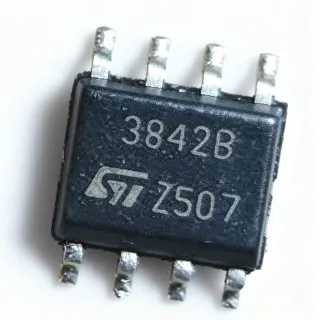
TPS54218ARTER - 2A, 6V Sync Step-Down Buck Regulator | TI
MPN: TPS54218ARTER ✓ Hoạt độngTPS54218ARTER Tóm tắt
A synchronous buck converter is a type of DC-DC switching regulator that replaces the freewheeling diode of a classic buck topology with an integrated second MOSFET, improving efficiency at low output voltages. Within the power-management hierarchy, it sits as a point-of-load voltage regulator IC, converting a higher intermediate bus voltage into a tightly regulated low-voltage rail for processors, FPGAs, and mixed-signal loads.
Key features include two integrated n-channel MOSFETs that reduce external component count, constant-frequency peak current-mode control that simplifies loop compensation and reduces output capacitance, and a wide programmable switching-frequency range of 200 kHz to 2 MHz that permits very small inductors. The adjustable output uses a 0.803 V feedback reference.
Technically, the peak current-mode architecture provides fast line and load transient response and cycles-by-cycle current limiting. The high switching capability enables single-digit-millihenry inductance values and a compact 3x3 mm power solution footprint, while integrated MOSFETs minimize switching-node parasitics.
Typical applications include point-of-load power for DSPs and FPGAs, 5 V or 3.3 V distributed-bus post-regulation in industrial controls, and telecom/networking line cards where a small 2 A POL buck is needed.
A key design consideration is that because this is a switching converter, PCB layout of the PH switching node, input decoupling, and ground return directly affects EMI and output ripple - keep the input capacitor loop minimal.
This page synthesizes verified distributor pricing, same-family drop-in alternatives, and practical design notes beyond the raw datasheet.
Bộ thay thế dễ dàng lắp đặt cho TPS54218ARTER — cùng gói, chân-to-chân tương thích. Các bộ phận yêu cầu hàn PCB bị loại trừ.
Các biến thể trong loạt này
Các mẫu cùng loạt có thể lắp đặt dễ dàng tương thích với TPS54218ARTER (cùng hình factor và footprint) — khác nhau ở Package, Topology, RoHS Status.
TPS54218RTER
✅ Drop-InLiên hệ để biết giá
Xem tài liệu →TPS54218RTE
✅ Drop-InLiên hệ để biết giá
Xem tài liệu →TPS54418ARTER
✅ Drop-In📋 Tham chiếu thay thế (không có trong danh mục)
TPS54418RTER
✅ Drop-In ⚠️ Thông số chưa được xác minh📋 Tham chiếu thay thế (không có trong danh mục)
TPS54218ARTER Tỷ lệ tối đa & tính chất điện
| Cấu trúc | Synchronous Step-Down (Buck) |
| Phạm vi điện áp đầu vào | 2.95 V to 6 V |
| Điện áp tối đa đầu ra | 2 A |
| Kiểu đầu ra | Adjustable |
| Feedback Reference Voltage | 0.803 V |
| Switching Frequency Range | 200 kHz to 2 MHz |
| Control Architecture | Constant Frequency Peak Current Mode |
| Integrated MOSFETs | 2 x N-Channel (synchronous) |
| Số lượng đầu ra | 1 |
| Family | SWIFT (Low-Input-Voltage SWIFT) |
| Hộp | 16-WFQFN Exposed Pad (RTE), 3 mm x 3 mm |
| Kiểu lắp đặt | Surface Mount |
| Trạng thái RoHS | Compliant (per distributor listings) |
| Product Status | Active |
Hướng dẫn cấu hình chân TPS54218ARTER 16-wfqfn exposed pad (rte), 3 mm x 3 mm
Cấu hình chân cho TPS54218ARTER (16-wfqfn exposed pad (rte), 3 mm x 3 mm gói). Động cơ điện này có chân cổng, nguồn và đầu ra. Đối với các gói không phân極, tham khảo tài liệu thông số kỹ thuật của nhà sản xuất để biết hướng dẫn chính xác của chân 1 và chi tiết về vân footprint. Các ứng dụng phổ biến bao gồm thiết kế nguồn cung cấp điện, điều khiển động cơ và chuyển đổi tải.

Không có dữ liệu chân cụ thể sẵn có cho TPS54218ARTER.
Tham khảo: tài liệu kỹ thuật cho cấu hình chân đầy đủ.
Ứng dụng tiêu biểu
TPS54218ARTER phù hợp cho 6 Áp dụngs: Point-of-Load Power for DSPs and FPGAs, Industrial Automation Control Boards, Networking and Telecom Line Cards, Test and Measurement Instrumentation, Battery-Powered Portable Equipment, Security and Camera Systems.
Point-of-Load Power for DSPs and FPGAs
The TPS54218ARTER fits point-of-load conversion from a 3.3 V or 5 V intermediate rail down to sub-1 V core voltages for DSPs and FPGAs. Its 0.803 V feedback reference supports modern low-voltage cores, and the 2 A rating covers typical small-core or I/O rail loads. Constant-frequency peak current-mode control delivers fast load-transient response, which matters when a processor wakes from idle or clocks up. Operating at up to 2 MHz lets designers use small, low-DCR inductors in the 1 uH range, keeping the entire POL solution inside a few square millimeters next to the load. The 3x3 mm VQFN-16 with exposed pad provides low thermal impedance to the PCB, supporting full 2 A operation with a modest copper area. Place input ceramics within 2 mm of the VIN pin to minimize switch-node ringing and EMI.
Được đề xuất
Industrial Automation Control Boards
Industrial controllers frequently regulate 5 V backplane power into local 3.3 V, 2.5 V, or 1.8 V analog and digital rails. The TPS54218ARTER accepts the 2.95 V to 6 V input range directly, so it can post-regulate a noisy 5 V bus without an intermediate stage. Its current-mode architecture rejects input-line disturbances well, and integrated MOSFETs remove diode losses, raising efficiency in always-on factory equipment. The 200 kHz to 2 MHz frequency flexibility lets designers place switching harmonics away from sensitive analog front-end bands or push frequency high to shrink magnetics on dense I/O cards. Thermal performance of the exposed-pad VQFN-16 sustains 2 A in 70 C ambient enclosures with roughly 1 square inch of copper. The compact footprint suits modular PLC I/O cards and motor-control interface boards where board area is constrained.
Được đề xuất
Networking and Telecom Line Cards
Telecom and networking line cards convert a distributed 5 V rail into many local low-voltage supplies. The TPS54218ARTER addresses one 2 A rail per device, and its small 3x3 mm footprint allows multiple converters to be clustered near their loads, reducing distribution losses and plane complexity. The ability to synchronize via the RT/CLK pin lets several converters lock to a common clock, spreading EMI spectrum predictably across the card - valuable for passing system-level EMC tests. Constant on-time alternatives struggle with this; peak current mode naturally supports paralleling of transient budgets and clean sequencing. The adjustable 0.803 V-referenced output covers PHY, SERDES, and memory rails. Wide 2 MHz capability shrinks the inductor so that power sections fit under connector overhangs on height-limited cards.
Được đề xuất
Test and Measurement Instrumentation
Bench instruments and modular test hardware need low-ripple local rails for ADC, DAC, and clock circuitry. The TPS54218ARTER provides a well-controlled switching regulator whose fixed-frequency peak current-mode operation produces predictable ripple at the programmed switching frequency, which is easy to filter with a post-LC stage. Its 2 MHz capability pushes ripple content far above sensitive signal bands, simplifying filtering for precision analog supplies. The 2 A output comfortably powers clock-distribution and reference sections. Because the device integrates both MOSFETs, the switching node is internally defined, reducing layout sensitivity in dense mixed-signal boards. Designers typically follow it with a ferrite bead or small LDO when feeding sub-uV-noise references, but for most measurement subsystem rails the TPS54218 output, with 22 uF of output capacitance, meets ripple budgets directly.
Được đề xuất
Battery-Powered Portable Equipment
Portable and handheld instruments powered by single-cell Li-ion packs near end-of-discharge (approximately 3 V) or USB 5 V sources fall squarely within the 2.95 V to 6 V input window of the TPS54218ARTER. High synchronous-conversion efficiency extends battery runtime, and the 2 A capability supports radios, displays, and processors simultaneously. Programmable switching frequency up to 2 MHz keeps magnetics small, preserving the compact PCB area demanded by portable enclosures. Current-mode control maintains stability across the wide battery voltage excursion, and the SS/TR soft-start pin allows controlled inrush when the pack is hot-swapped. Designers should verify quiescent and shutdown currents against battery budgets in the TI datasheet, and place the converter away from sensitive receivers to control radiated EMI within the small conductive enclosure.
Được đề xuất
Security and Camera Systems
IP cameras and security electronics regulate 5 V PoE-derived or adapter power into core, DSP, and sensor rails. The TPS54218ARTER handles the 2 A class rails typical of image-sensor and compression-processor supplies. Its efficiency and thermal performance suit sealed outdoor enclosures where airflow is absent - the exposed-pad VQFN-16 conducts heat into the PCB ground plane effectively. Fixed-frequency operation permits filtering of switching artifacts that could couple into analog video or low-light sensor readout chains. The converter's fast transient response handles the bursty load profile of image compression engines, where current steps of an ampere can occur frame-to-frame. Compact footprint allows integration on small camera module carrier boards, and the adjustable output covers the varied 1.2 V to 3.3 V rails of modern sensor and SoC chipsets.
Được đề xuất
Tóm tắt các sản phẩm được đề xuất
Dữ liệu tham khảo kỹ thuật cho TPS54218ARTER — so sánh, hướng dẫn thiết kế và thông tin tuân thủ.
Hướng dẫn chọn lựa
So sánh với các sản phẩm thay thế
| Tham số | Sản phẩm này | TPS54218RTER | TPS54218RTE | TPS54418ARTER | TPS54418RTER |
|---|---|---|---|---|---|
| Package | VQFN-16 (RTE) 3x3 mm exposed pad | VQFN-16 (RTE) 3x3 mm - same | VQFN-16 (RTE) 3x3 mm - same | VQFN-16 (RTE) 3x3 mm - same | VQFN-16 (RTE) 3x3 mm - same |
| Brand | Texas Instruments | Texas Instruments | Texas Instruments | Texas Instruments | Texas Instruments |
| Control Topology | Peak Current Mode (DF-CAP compatible) | Peak Current Mode - same | Peak Current Mode - same | Current Mode (SWIFT) | Current Mode (SWIFT) |
| Sourcing Channel | Rochester Electronics / LCSC / Wolfchip | Standard TI production channels | Standard TI production channels (tray) | Standard TI production channels | Standard TI production channels |
| Lifecycle Status | Active (extended-availability channel) | Active | Active | Active | Active |
Bảo phân biệt quan trọng
- Extended-availability sourcing channel (vsTPS54218RTER)
- Up to 2 MHz switching for minimal magnetics (vsTPS54418RTER)
- Trade-off: lower input voltage ceiling (vsTPS54418ARTER)
Ghi chú thiết kế
Minimize the hot loop: place the input ceramic capacitor (10 uF, X5R/X7R) as close as possible to the VIN and GND pins, keeping the loop from VIN capacitor through the internal high-side FET, PH node, and low-side FET to ground as short and wide as possible. Connect the exposed pad directly to a solid ground plane with an array of 4-6 vias directly under the pad; this is both the primary thermal path and the return for gate-drive currents. Keep the PH switching-node copper area small but wide enough for 2 A, and route the VSENSE feedback trace away from PH and BOOT to avoid injecting switching noise into the feedback loop.
Estimated: at 5 V input, 1.8 V output, and 2 A load, output power is 3.6 W; at approximately 90% efficiency the device dissipates roughly 0.4 W. With a typical theta_JA near 40-50 C/W for a VQFN-16 3x3 mm on 1 square inch of 2-oz copper, junction rise is about 16-20 C above ambient - comfortable at 70 C ambient. Verify the exact theta_JA from the datasheet thermal table for your specific stack-up; these figures are estimates and the datasheet values govern final design.
Do not exceed the 6 V absolute input limit - a 5 V rail with transient overshoot on long inductive harnesses can breach it; add local TVS or bulk decoupling. Set the RT resistor to give design margin below 2 MHz, since tolerance shifts can push operation to the limit. The SS/TR soft-start pin must be configured for controlled startup into heavy capacitive loads, otherwise inrush can trigger current limit. Ensure the compensation network matches the datasheet recommendation for your output capacitor ESR to avoid double-pole instability with low-ESR ceramics.
Thông tin tuân thủ
RoHS compliance indicated in distributor listings (LCSC C2926926). REACH, halogen-free, and conflict-minerals status not stated in provided data - consult TI product page for official certificates.