产品(32725)

W55RP20-S2E - Serial-to-Ethernet MCU, 2MB Flash | WIZnet
W55RP20-S2E

W55RP20-S2E - Serial-to-Ethernet MCU, 2MB Flash | WIZnet

The WIZnet W55RP20-S2E is a pre-programmed serial-to-Ethernet communications controller microcontroller IC built on the W55RP20 System-in-Package, delivering a dual ARM Cortex-M0+ core at 133 MHz, 2MB on-chip Flash, and a hardwired 10/100 Mbps Ethernet TCP/IP controller in a 68-pin VFQFN package with exposed pad. Each unit ships with WIZnet serial-to-Ethernet (S2E) firmware and a unique MAC address from the WIZnet OUI block. An application-specific communications microcontroller, or ioMCU, is a device that combines a general-purpose MCU core with dedicated network hardware. In the W55RP20-S2E, the integration hierarchy runs: serial-to-Ethernet chip -> communications controller MCU -> Ethernet IC -> power/networking semiconductor. Unlike software TCP/IP stacks that consume MCU cycles, the integrated W5500-style hardwired TCP/IP core offloads protocol processing in silicon. Key features include the SiP integration of Raspberry Pi's RP2040 microcontroller and WIZnet's W5500 Ethernet controller, 264kB on-chip SRAM organized in six independent banks, a 12-channel DMA controller supporting memory-to-peripheral, peripheral-to-memory, and memory-to-memory transfers, and a USB 2.0 full-speed (12 Mbps) controller usable as host or device. The serial-to-Ethernet firmware supports serial speeds up to 921,600 bps, letting any UART-equipped device gain Ethernet connectivity without protocol development. The dual Cortex-M0+ architecture lets one core handle application logic while the other manages network I/O, and the hardwired TCP/IP stack supports 8 independent sockets with minimal latency. Because the TCP/IP, MAC, and PHY functions are hardened in silicon, software stack bugs and CPU load from protocol handling are essentially eliminated. Typical applications include adding Ethernet to legacy industrial equipment with UART ports, IoT smart-device connectivity, and networked sensor or control nodes. The pre-programmed firmware approach removes firmware certification and development risk for serial-to-Ethernet designs. Design consideration: since this is a pre-programmed part, use the bare W55RP20 if custom firmware is required; the S2E variant is optimized for UART-to-Ethernet bridging with minimal development effort. This page synthesizes distributor pricing, drop-in alternatives, and practical design notes not found in the manufacturer datasheet.

USD $3.05 有现货
W6300-L - IPv4/IPv6 Hardwired TCP/IP Ethernet Chip | WIZnet
W6300-L

W6300-L - IPv4/IPv6 Hardwired TCP/IP Ethernet Chip | WIZnet

The WIZnet W6300-L is a hardwired TCP/IP Ethernet controller chip that integrates a dual IPv4/IPv6 protocol stack in hardware, delivering 10/100 Mbps Ethernet performance for embedded systems in an LQFP-48-EP (7x7 mm) surface-mount package. A hardwired TCP/IP controller is a type of offload engine (TOE - TCP/IP Offload Engine) in the broader hierarchy of network interface ICs. Unlike software stacks running on a host MCU, a hardware protocol stack offloads TCP, UDP, ICMP, ARP, and related processing from the main processor, so even a small 8-bit MCU can implement reliable network connectivity with minimal firmware overhead and deterministic timing. This makes the category essential for industrial automation, IoT gateways, and embedded networking nodes. Key features of the W6300-L include the dual IPv4/v6 hardware stack, which sets it apart from WIZnet's earlier IPv4-only devices; multiple independent hardware sockets for simultaneous connections; a high-speed host interface for fast data throughput; and low-power operation modes for energy-sensitive designs. According to the WIZnet product page, the chip combines high-speed Ethernet performance with advanced power efficiency. Technically, the W6300 continues WIZnet's well-established W-series architecture: socket registers, internal TX/RX buffers, PHY, and MAC are all integrated, so designers need only an external RJ45 magnetics jack and a host MCU to complete the network node. The hardware stack eliminates porting, memory-footprint, and real-time concerns associated with software TCP/IP stacks such as lwIP. Typical applications include industrial automation and factory networking, IoT gateways bridging field devices to cloud backends, and embedded equipment requiring IPv6 readiness for modern network infrastructure. For design consideration, verify host-interface timing against your MCU's SPI or bus clock, and follow the WIZnet reference schematic for magnetics, crystal, and decoupling placement to guarantee PHY signal integrity. This page synthesizes distributor pricing, drop-in alternatives, design notes, and AEO-optimized FAQs not found in the manufacturer datasheet.

USD $3.12 有现货
W634GU6RB-09 - 4Gb DDR3L SDRAM 1066MHz | Winbond
W634GU6RB-09

W634GU6RB-09 - 4Gb DDR3L SDRAM 1066MHz | Winbond

The W634GU6RB-09 is a 4Gbit DDR3L SDRAM memory IC from Winbond Electronics, organized as 512M x 8 bits. It operates at a clock frequency of 1.067 GHz (1066 MHz) with a data rate of 2133 Mbps per pin, and features a parallel interface with a 20 ns access time. The device is housed in a 96-ball VFBGA package measuring 7.5x13 mm, designed for surface mount assembly. DDR3L SDRAM (Double Data Rate 3 Low Voltage Synchronous Dynamic Random-Access Memory) is a type of volatile memory that operates at a lower supply voltage of 1.35V, reducing power consumption compared to standard DDR3 (1.5V). It is part of the DDR3 family, which uses double data rate signaling to transfer data on both edges of the clock, and is widely used in computing, networking, and embedded systems for high-bandwidth data storage and processing. Key features include a 4Gbit density, 1.35V supply voltage, 1066 MHz clock speed, and a 96-ball VFBGA package. The low voltage operation makes it ideal for power-sensitive applications, while the high speed supports demanding workloads. The device is RoHS compliant and halogen-free, meeting modern environmental standards. Technically, the W634GU6RB-09 uses an 8n-prefetch architecture typical of DDR3L, enabling high burst lengths and efficient data transfer. The 20 ns access time indicates the row-to-column delay, and the 1.067 GHz clock allows data rates up to 2133 Mbps. The VFBGA package offers excellent thermal and electrical performance, with a compact footprint suitable for space-constrained designs. Typical applications include high-performance computing, networking equipment, embedded systems, and industrial automation. The low power consumption and high speed make it suitable for servers, routers, and IoT gateways where memory bandwidth and efficiency are critical. When designing with this device, ensure proper decoupling capacitors near the power pins and follow the layout guidelines in the datasheet to maintain signal integrity at high frequencies. The 1.35V supply must be regulated accurately to avoid data corruption.

USD $9.69 有现货
W634GU6RB-09TR - 4Gb DDR3L SDRAM 1.35V | Winbond
W634GU6RB-09TR

W634GU6RB-09TR - 4Gb DDR3L SDRAM 1.35V | Winbond

The W634GU6RB-09TR is a 4Gbit DDR3L SDRAM memory IC from Winbond Electronics, organized as 256M x 16 bits. It operates at a clock frequency of 1.067 GHz (DDR3L-2133) with a CAS latency of 20 ns, and is supplied in a 96-ball VFBGA package measuring 7.5x13 mm. This device is designed for low-voltage operation at 1.35V, reducing power consumption by approximately 15% compared to standard DDR3 at 1.5V, making it ideal for power-sensitive applications. DDR3L SDRAM (Double Data Rate 3 Low Voltage) is a type of synchronous dynamic random-access memory that transfers data on both edges of the clock signal, effectively doubling the data rate. It operates at a lower voltage (1.35V) than standard DDR3 (1.5V), which reduces power consumption and heat generation, making it suitable for mobile and embedded systems. DDR3L is part of the DDR SDRAM family, which includes DDR, DDR2, DDR3, and DDR4, each offering higher speeds and lower voltages. Key features of the W634GU6RB-09TR include a parallel interface with a 16-bit data bus, a burst length of 8, and support for on-die termination (ODT) and programmable CAS latency. It also features auto-refresh and self-refresh modes to maintain data integrity with minimal power. The device is RoHS compliant and halogen-free, meeting environmental standards for modern electronics. Technically, the W634GU6RB-09TR uses a 96-ball VFBGA package with a 0.8 mm ball pitch, providing excellent thermal and electrical performance. The device supports a wide operating temperature range from 0°C to 95°C (case temperature), making it suitable for industrial applications. It also features a programmable output driver impedance and supports DLL (Delay-Locked Loop) for precise timing. Typical applications include embedded systems, networking equipment, industrial automation, and consumer electronics such as set-top boxes and routers. Its low voltage and high density make it ideal for designs requiring large memory capacity with limited power budgets. When designing with this device, ensure proper decoupling capacitors are placed near the power pins to minimize noise. Also, follow the PCB layout guidelines in the datasheet to maintain signal integrity at high speeds.

USD $25.00 有现货
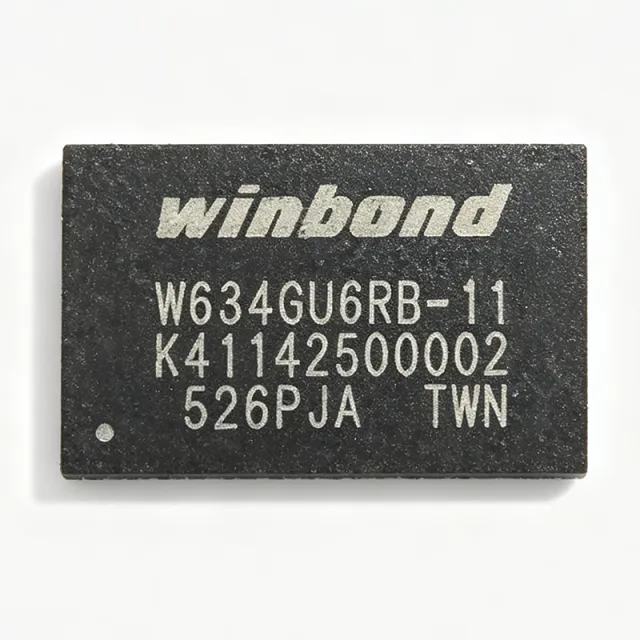
W634GU6RB-11 - 4Gb DDR3L SDRAM 933MHz | Winbond
W634GU6RB-11

W634GU6RB-11 - 4Gb DDR3L SDRAM 933MHz | Winbond

The W634GU6RB-11 is a 4Gbit DDR3L SDRAM memory IC from Winbond Electronics, organized as 256M x 16 bits. It operates at a clock frequency of 933 MHz (DDR3L-1866) with a CAS latency of 20 ns, and is supplied in a 96-ball VFBGA (7.5x13 mm) package. This device is designed for low-power applications, operating from a 1.35V supply (1.283V to 1.45V range), and supports parallel interface with a data rate of 1866 MT/s. DDR3L (Double Data Rate 3 Low Voltage) SDRAM is a type of synchronous dynamic random-access memory that transfers data on both edges of the clock signal, effectively doubling the data rate. It is a low-voltage variant of DDR3, operating at 1.35V instead of the standard 1.5V, reducing power consumption by about 20% compared to standard DDR3. DDR3L is part of the DDR SDRAM family, which includes DDR, DDR2, DDR3, and DDR4, and is widely used in computing, networking, and embedded systems where high bandwidth and low power are critical. Key features of the W634GU6RB-11 include auto self-refresh, auto precharge, data mask, write leveling, ZQ calibration, asynchronous reset, and dynamic on-chip termination (ODT). These features enhance signal integrity and simplify system design. The device supports a temperature range of -40°C to +95°C, making it suitable for industrial applications. It is RoHS compliant and halogen-free, aligning with environmental standards. Technically, the W634GU6RB-11 utilizes a 96-ball VFBGA package with a 7.5x13 mm footprint, offering a compact solution for space-constrained designs. The 20 ns CAS latency ensures fast access times, while the 933 MHz clock speed provides high bandwidth for data-intensive tasks. The device includes on-die termination (ODT) to improve signal quality on the memory bus, and supports write leveling for improved timing margins in multi-rank configurations. Typical applications include networking equipment (routers, switches), industrial computing, embedded systems, and consumer electronics such as set-top boxes and smart TVs. Its low voltage and high density make it ideal for power-sensitive designs where performance and efficiency are balanced. When designing with this device, ensure proper decoupling capacitors are placed near the VDD and VDDQ pins to minimize noise. Also, follow the JEDEC DDR3L layout guidelines for signal integrity, especially for high-speed signals. The device supports a 1.35V supply, so verify that the power management IC provides a stable 1.35V rail.

USD $13.52 有现货
W634GU6RB-11TR - 4Gb DDR3L SDRAM 933MHz | Winbond
W634GU6RB-11TR

W634GU6RB-11TR - 4Gb DDR3L SDRAM 933MHz | Winbond

The W634GU6RB-11TR is a 4Gbit DDR3L SDRAM memory IC from Winbond Electronics, organized as 256M x 16 bits. It operates at a clock frequency of 933 MHz (DDR3L-1866) with a CAS latency of 13, and features a parallel interface with a 20 ns access time. The device is housed in a compact 96-ball VFBGA (7.5x13 mm) package, making it suitable for space-constrained applications requiring high memory density. DDR3L (Double Data Rate 3 Low Voltage) SDRAM is a type of synchronous dynamic random-access memory that operates at a lower voltage (1.35V) compared to standard DDR3 (1.5V), reducing power consumption by up to 20% while maintaining similar performance. It is part of the memory hierarchy in computing systems, serving as the main working memory for processors, and is widely used in laptops, embedded systems, networking equipment, and industrial applications. Key features of the W634GU6RB-11TR include support for 1.35V operation (with 1.5V compatibility), auto self-refresh, auto precharge, data mask, write leveling, ZQ calibration, asynchronous reset, and dynamic on-chip termination (ODT). These features enhance signal integrity and simplify system design. The device is RoHS compliant and halogen-free, meeting environmental standards. Technically, the W634GU6RB-11TR uses a 96-ball VFBGA package with a 0.8mm ball pitch, providing excellent thermal and electrical performance. The 933 MHz clock rate enables data rates up to 1866 MT/s, delivering high bandwidth for demanding applications. The device supports a temperature range of -40°C to +95°C, making it suitable for industrial environments. Typical applications include embedded computing, networking routers and switches, industrial automation, and high-performance consumer electronics. Its low voltage and high density make it ideal for power-sensitive designs. When designing with this memory, ensure proper decoupling capacitors near the VDD and VDDQ pins, and follow the PCB layout guidelines in the datasheet to minimize signal integrity issues at high speeds.

USD $32.00 有现货
W634GU6RB-12 - 4Gb DDR3L SDRAM x16 933MHz | Winbond
W634GU6RB-12

W634GU6RB-12 - 4Gb DDR3L SDRAM x16 933MHz | Winbond

The W634GU6RB-12 is a 4Gbit DDR3L SDRAM from Winbond Electronics, organized as 256M x 16, operating at 1.35V with a parallel interface. It is housed in a 96-ball VFBGA (7.5x13mm) package and supports DDR3L-1600 (11-11-11) speed grade at 933 MHz clock. This memory IC is designed for high-bandwidth applications requiring low power consumption and high reliability. DDR3L SDRAM is a type of double data rate synchronous dynamic random-access memory that operates at a lower voltage (1.35V) compared to standard DDR3 (1.5V), reducing power consumption by up to 20% while maintaining similar performance. It is part of the DDR3 memory family, which uses 8n-prefetch architecture and on-die termination to achieve high data rates. DDR3L is widely used in mobile, embedded, and industrial systems where power efficiency is critical. Key features include a 4Gbit density, x16 organization, 933 MHz clock speed (DDR3L-1600), 20 ns tRCD, and a 96-ball VFBGA package. The device supports industrial temperature grades: the -12I grade guarantees -40°C to 95°C case temperature, and the -12J grade guarantees -40°C to 105°C. It is RoHS compliant and halogen-free, meeting environmental standards. The W634GU6RB-12 utilizes advanced DRAM process technology, offering high-speed data transfer with low power consumption. The 8n-prefetch architecture enables burst lengths of 8, and the on-die termination (ODT) improves signal integrity. The device includes programmable CAS latency, burst length, and output drive strength, providing flexibility for system optimization. Typical applications include networking equipment, industrial automation, embedded computing, and consumer electronics such as set-top boxes and smart TVs. The low voltage and high density make it ideal for space-constrained designs requiring large memory capacity. When designing with this device, ensure proper decoupling capacitors near the VDD and VDDQ pins, and follow the PCB layout guidelines in the datasheet to minimize signal integrity issues. The device requires a 1.35V supply and a separate VDDQ supply, which should be well-regulated.

USD $9.50 有现货
W634GU6RB09I - 4Gb DDR3L SDRAM x16 1066MHz | Winbond
W634GU6RB09I

W634GU6RB09I - 4Gb DDR3L SDRAM x16 1066MHz | Winbond

The W634GU6RB09I is a 4Gbit DDR3L SDRAM memory IC from Winbond Electronics, organized as 256M x 16 bits. It operates at a clock frequency of 1.067 GHz (DDR3L-2133) with a CAS latency of 20 ns, and is housed in a 96-ball VFBGA (7.5x13 mm) package. This device is designed for low-voltage operation at 1.35V, making it suitable for power-sensitive applications such as mobile devices, embedded systems, and networking equipment. DDR3L (Double Data Rate 3 Low Voltage) is a type of synchronous dynamic random-access memory (SDRAM) that operates at 1.35V, reducing power consumption by about 20% compared to standard DDR3 (1.5V). It is part of the DDR3 family, which uses double data rate signaling to transfer data on both edges of the clock, achieving high bandwidth. DDR3L is widely used in laptops, servers, and industrial applications where energy efficiency is critical. Key features include a 4Gbit density, x16 data bus width, 1.067 GHz maximum clock speed, and industrial temperature range (-40°C to +95°C). The device supports burst lengths of 8 and 4, on-die termination (ODT), and programmable CAS latency. It is RoHS compliant and lead-free, meeting environmental standards. Technically, the W634GU6RB09I uses a 96-ball VFBGA package with a 0.8mm ball pitch, enabling high-density mounting on PCBs. The memory core is based on advanced DRAM process technology, providing high reliability and performance. The device includes auto-refresh and self-refresh modes for low-power standby, and supports DLL (Delay-Locked Loop) for precise timing. Typical applications include embedded computing, networking routers, industrial automation, and consumer electronics such as set-top boxes and smart TVs. Its low voltage and high density make it ideal for designs requiring large memory capacity with minimal power draw. When designing with this component, ensure proper decoupling capacitors near the power pins and follow the layout guidelines in the datasheet to minimize signal integrity issues. The device requires a 1.35V supply and a separate VDDQ for I/O, which should be regulated accurately.

USD $6.00 有现货
W634GU6RB09J - 4Gb DDR3L SDRAM x16 1066MHz | Winbond
W634GU6RB09J

W634GU6RB09J - 4Gb DDR3L SDRAM x16 1066MHz | Winbond

The Winbond W634GU6RB09J is a 4Gbit DDR3L SDRAM organized as 256M x 16, operating at 1.35V with a data rate of 1066MHz (DDR3L-2133). It comes in a 96-ball VFBGA (7.5x13mm) package, offering a compact footprint for space-constrained designs. This memory IC is designed for high-bandwidth applications requiring low power consumption, making it ideal for mobile, embedded, and networking systems. DDR3L (Double Data Rate 3 Low Voltage) is a type of synchronous dynamic random-access memory (SDRAM) that operates at 1.35V, reducing power consumption by about 20% compared to standard 1.5V DDR3. It is part of the DDR3 family, which uses double data rate signaling to transfer data on both edges of the clock, achieving high throughput. DDR3L is backward-compatible with DDR3 and is widely used in laptops, servers, and industrial electronics where energy efficiency is critical. Key features include a 4Gbit density, x16 organization, 1.067 GHz clock speed, and a CAS latency of 20 ns. The device supports on-die termination (ODT), programmable CAS latency, and burst lengths of 8 and 4. It operates over a temperature range of 0°C to +95°C (case temperature) and is RoHS compliant. The 96-VFBGA package measures 7.5x13mm with a 0.8mm ball pitch, enabling high-density PCB layouts. Technically, the W634GU6RB09J uses a 30nm-class process technology, achieving low power and high speed. It features internal calibration for ZQ, write leveling, and read leveling to ensure signal integrity at high frequencies. The device supports auto-refresh and self-refresh modes, reducing standby power. Its low voltage operation and advanced power management make it suitable for battery-powered devices. Typical applications include mobile computing, networking equipment, industrial automation, and consumer electronics such as set-top boxes and smart TVs. The high density and low power make it ideal for systems requiring large memory capacity with minimal energy consumption. When designing with this component, ensure proper decoupling capacitors near the power pins and follow the layout guidelines in the datasheet to maintain signal integrity at 1066MHz. The device requires a 1.35V supply and a separate VDDQ, which should be regulated accurately.

USD $8.10 有现货
W634GU6RB11I - 4Gb DDR3L SDRAM x16 933MHz | Winbond
W634GU6RB11I

W634GU6RB11I - 4Gb DDR3L SDRAM x16 933MHz | Winbond

The W634GU6RB11I is a 4Gbit DDR3L SDRAM memory IC from Winbond Electronics, organized as 256M x 16 bits. It operates at a clock frequency of 933 MHz (DDR3L-1866) with a CAS latency of 20 ns, and is supplied in a 96-ball VFBGA package measuring 7.5 x 13 mm. This device is designed for low-voltage operation at 1.35V, reducing power consumption by approximately 15% compared to standard 1.5V DDR3, making it ideal for power-sensitive applications. DDR3L SDRAM (Double Data Rate 3 Low Voltage) is a type of synchronous dynamic random-access memory that transfers data on both edges of the clock signal, effectively doubling the data rate. It operates at a lower voltage (1.35V) than standard DDR3 (1.5V), offering improved energy efficiency. DDR3L is part of the DDR SDRAM family, which includes DDR, DDR2, DDR3, and DDR4, and is widely used in computing, networking, and embedded systems where high bandwidth and low power are critical. Key features of the W634GU6RB11I include a parallel interface with a 16-bit data bus, support for industrial temperature range (-40°C to +95°C), and compatibility with JEDEC DDR3L standards. The device offers burst lengths of 8 and 4, on-die termination (ODT), and programmable CAS latency. Its low-voltage operation and high density make it suitable for applications requiring large memory capacity with minimal power draw. The W634GU6RB11I utilizes advanced DRAM process technology, achieving high-speed data transfer while maintaining low power consumption. The 96-ball VFBGA package provides excellent thermal and electrical performance, with a compact footprint suitable for space-constrained designs. The device supports auto-refresh and self-refresh modes, ensuring data integrity with minimal power consumption during idle periods. Typical applications include networking equipment (routers, switches), industrial automation, embedded computing, and consumer electronics such as set-top boxes and smart TVs. Its industrial temperature rating makes it suitable for harsh environments, while the low-voltage operation extends battery life in portable devices. When designing with this component, ensure proper decoupling capacitors are placed near the power pins to minimize noise. The VFBGA package requires careful PCB layout to route the fine-pitch balls, and the DDR3L interface should be terminated according to JEDEC guidelines to maintain signal integrity.

USD $1.95 有现货
W634GU6RB11J - 4Gb DDR3L SDRAM x16 933MHz | Winbond
W634GU6RB11J

W634GU6RB11J - 4Gb DDR3L SDRAM x16 933MHz | Winbond

The Winbond W634GU6RB11J is a 4Gbit DDR3L SDRAM organized as 256M x 16, operating at a clock frequency of 933 MHz (DDR3L-1866) with a data rate of 1866 MT/s. It is housed in a 96-ball VFBGA package (7.5x13 mm) and operates from a 1.35V supply, making it suitable for low-power applications. The device supports parallel interface with a burst length of 8 and features a 20 ns CAS latency. DDR3L (Double Data Rate 3 Low Voltage) is a type of synchronous dynamic random-access memory (SDRAM) that operates at 1.35V, reducing power consumption by about 20% compared to standard DDR3 (1.5V). It is part of the DDR3 family, which uses double data rate signaling to transfer data on both edges of the clock, achieving high bandwidth. DDR3L is commonly used in mobile devices, embedded systems, and industrial applications where power efficiency is critical. Key features include auto self-refresh, auto precharge, data mask, write leveling, ZQ calibration, asynchronous reset, and dynamic on-chip termination (DTC). These features enhance signal integrity and simplify system design. The device supports industrial temperature range from -40°C to +95°C, making it suitable for harsh environments. It is RoHS compliant and halogen-free, aligning with environmental standards. Technically, the W634GU6RB11J uses a 96-ball VFBGA package with a 0.8mm ball pitch, providing excellent thermal and electrical performance. The memory array is organized in 8 banks, and the device supports programmable CAS latency (CL) and additive latency (AL) for flexible timing. The on-die termination (ODT) feature improves signal quality by matching impedance, reducing reflections on the data bus. Typical applications include networking equipment, industrial automation, medical devices, and embedded computing systems where high-density, low-power memory is required. The 4Gb density and x16 organization make it ideal for applications needing moderate memory capacity with a wide data bus. When designing with this device, ensure proper decoupling capacitors near the VDD and VDDQ pins to minimize power supply noise. Also, follow the JEDEC DDR3L layout guidelines for signal integrity, including controlled impedance traces and proper termination.

USD $9.50 有现货
W634GU6RB12I - 4Gb DDR3L SDRAM x16 800MHz | Winbond
W634GU6RB12I

W634GU6RB12I - 4Gb DDR3L SDRAM x16 800MHz | Winbond

The W634GU6RB12I is a 4Gbit DDR3L SDRAM organized as 256M x 16, operating at 1.35V with a data rate of 800MHz (DDR3L-1600). It is housed in a 96-ball VFBGA (7.5x13mm) package and is designed for industrial temperature range (-40°C to +95°C). This memory IC is ideal for applications requiring high-density, low-power volatile storage. DDR3L (Double Data Rate 3 Low Voltage) is a type of synchronous dynamic random-access memory (SDRAM) that operates at 1.35V, reducing power consumption by about 20% compared to standard DDR3 (1.5V). It is part of the DDR3 family, which uses double data rate signaling to transfer data on both edges of the clock, achieving high bandwidth. DDR3L is commonly used in computing, networking, and embedded systems where power efficiency is critical. Key features include a parallel interface with 800MHz clock speed, 20ns row cycle time, and support for industrial temperature grades. The device is RoHS compliant and halogen-free, meeting environmental standards. The 96-ball VFBGA package offers a compact footprint suitable for space-constrained designs. The W634GU6RB12I utilizes advanced DRAM process technology, providing reliable performance with low power consumption. It supports standard DDR3L features such as on-die termination (ODT), programmable CAS latency, and burst lengths of 8. The industrial temperature grade ensures operation in harsh environments. Typical applications include industrial automation, networking equipment, embedded computing, and automotive infotainment systems. Its high density and low power make it suitable for memory-intensive tasks in these domains. When designing with this device, ensure proper decoupling and signal integrity practices are followed, as high-speed memory interfaces require careful PCB layout to minimize noise and reflections.

USD $5.60 有现货
W634GU6RB12J - 4Gb DDR3L SDRAM 933MHz | Winbond
W634GU6RB12J

W634GU6RB12J - 4Gb DDR3L SDRAM 933MHz | Winbond

The W634GU6RB12J is a 4Gbit DDR3L SDRAM from Winbond Electronics, organized as 256M x 16 and operating at 1.35V. It features a parallel interface with a clock speed of 933 MHz (DDR3L-1866) and a CAS latency of 20 ns. The device is housed in a 96-ball VFBGA package (7.5x13 mm) and is designed for high-bandwidth memory applications. DDR3L SDRAM is a type of dynamic random-access memory that operates at a lower voltage (1.35V) compared to standard DDR3 (1.5V), reducing power consumption while maintaining high data rates. It is part of the DDR3L memory family, which is widely used in computing, networking, and industrial applications where power efficiency is critical. Key features include a 4Gbit density, x16 organization, 933 MHz clock speed, and support for the DDR3L-1866 specification. The device offers a burst length of 8 and supports on-die termination (ODT) for improved signal integrity. It operates over a temperature range of -40°C to +105°C (TCASE) for the 12J industrial plus grade, making it suitable for harsh environments. The W634GU6RB12J utilizes advanced DRAM process technology to achieve high speed and low power. It includes features such as programmable CAS latency, write leveling, and self-refresh modes to optimize performance and power consumption. The 96-ball VFBGA package provides excellent thermal and electrical performance. Typical applications include embedded systems, networking equipment, industrial automation, and automotive infotainment. The low voltage and high speed make it ideal for power-sensitive designs that require high memory bandwidth. When designing with this device, ensure proper decoupling and signal integrity practices are followed. The DDR3L interface requires careful PCB layout to minimize crosstalk and maintain signal quality at high speeds.

USD $6.00 有现货
W681308DG - USB Audio Controller 16-bit 48-LQFP | Nuvoton
W681308DG

W681308DG - USB Audio Controller 16-bit 48-LQFP | Nuvoton

The Nuvoton W681308DG is a USB audio controller IC with an integrated 16-bit audio codec, housed in a 48-pin LQFP (7x7 mm) surface-mount package. As a member of the Winbond/Nuvoton W6813 series of USB audio controllers, it integrates a USB controller, audio codec, and embedded microcontroller into a single chip for USB audio peripheral designs. A USB audio controller is a mixed-signal device that implements the USB audio class protocol on the digital side and an audio codec (codec = coder-decoder) on the analog side. Within the system hierarchy, it sits between a general-purpose USB microcontroller and a dedicated audio codec: it handles USB enumeration, audio streaming, clocking, and sample-rate conversion, while also providing microphone and speaker signal paths. This integration reduces bill-of-materials count compared to a discrete USB MCU plus external codec solution. Key features of the W681308DG include a 16-bit audio data path, USB full-speed audio transport, integrated microphone and speaker audio channels, and a compact 7x7 mm 48-LQFP footprint that supports consumer peripheral form factors. The device operates from a 3.3 V supply, consistent with the family datasheet description of the W681308 series as a 3.3 V part. Architecturally, the W681308 combines an 8-bit CISC microcontroller core with on-chip program memory and a hardwired USB audio function block. The codec front end handles anti-aliasing filtering, ADC for microphone inputs, and DAC for speaker outputs, while the MCU firmware manages HID interfaces, mute/volume controls, and other USB descriptor behavior. Refer to the manufacturer datasheet for precise clock, PLL, and interface specifications. Typical applications include USB headset and headphone amplifiers, desktop microphone arrays, USB speakerphones, VoIP handsets, and general USB audio dongles where a single-chip, low-cost USB audio solution is required. A key design consideration is analog layout: the microphone preamp and DAC outputs are sensitive to digital return-path noise, so a solid ground plane, careful separation of analog and digital traces, and proper decoupling of the 3.3 V rail per the manufacturer datasheet recommendations are essential for a low-noise result. This page synthesizes distributor sourcing data, datasheet references, and practical design notes not found in the manufacturer datasheet.

询价 有现货
W78E051C40PL - 8-bit 8051 MCU, 4KB Flash, 40MHz, 44-PLCC | Nuvoton
W78E051C40PL

W78E051C40PL - 8-bit 8051 MCU, 4KB Flash, 40MHz, 44-PLCC | Nuvoton

The Nuvoton/Winbond W78E051C40PL is an 8-bit 8051-compatible microcontroller operating up to 40 MHz, integrating 4 KB of in-system programmable Flash EPROM and 128 bytes of on-chip RAM in a 44-pin PLCC package. According to the manufacturer datasheet (publication release November 10, 2006, Revision A4), the W78E051C40PL exposes four 8-bit bi-directional bit-addressable I/O ports (P0-P3) plus an additional 4-bit P4 port, two 16-bit timer/counters, a full-duplex UART, and an enhanced 6-source/2-level interrupt controller. The "40" suffix denotes the 40 MHz top clock, while the "PL" package code designates the 44-lead Plastic Leaded Chip Carrier (JEDEC MS-018). Programming is supported via standard 8051 tools because the instruction set is binary-compatible with the industry-standard MCS-51 core. An 8051 microcontroller (technically an MCS-51 family MCU) is an 8-bit Harvard-architecture CISC microcomputer originally introduced by Intel in 1980; despite its age the family remains popular in cost-sensitive, deterministic, deeply embedded applications because of its tiny footprint, predictable interrupt latency, and unparalleled third-party tool support. As a Flash EPROM variant the W78E051C family sits at the highest tier of the classic 8051 hierarchy: mask-ROM < OTP EPROM < Flash EPROM, with Flash enabling ISP and field-upgradeable firmware. In the broader taxonomy, an MCU is a programmable subset of a microprocessor and, more generally, a digital integrated circuit under power management and embedded-computing classifications. Key features include 4 KB Flash program memory, 128 bytes internal RAM, 36 general-purpose digital I/O lines, two 16-bit timers/counters, one UART with framing-error detection, six interrupt sources with two priority levels, on-chip oscillator with external crystal, power-saving Idle and Power-Down modes, and an in-system programming (ISP) interface through the serial port. According to the datasheet the device supports a wide operating frequency range, allowing software to reduce clock speed dynamically for power-sensitive applications. Architecturally, the W78E051C uses a 12-clock-per-machine-cycle core (the classic 8051 convention) with separate 64 KB program and 64 KB external-data address spaces, plus a 256-byte internal RAM space split between register banks, bit-addressable area, and user RAM. The Flash memory subsystem provides on-chip page-erase and byte-program capability, supporting in-application firmware updates via the UART bootloader on PLCC-package variants. Typical applications include industrial control subsystems, home appliance mainboards, keyboard/mouse scanners, sensor signal conditioning, low-cost USB bridges, LED display drivers, and legacy 8051 firmware upgrades. The wide frequency range and low-power Idle/Power-Down modes make it suitable for both mains-powered controllers and battery-backed utilities. Design-wise, ensure the EA/VPP pin is tied to VCC for internal-Fetch operation, or driven to +12 V only during parallel programming. Decouple VCC and AVCC (if present) with 0.1 microfarad ceramic capacitors placed within 5 mm of the pins to suppress switching noise during oscillator start-up and ISP writes. This page synthesizes distributor pricing, cross-reference drop-in alternatives (Nuvoton W78E052 and W78E058 variants) and practical PCB layout notes not consolidated in the manufacturer datasheet.

USD $1.38 有现货
W78E052DDG - 40MHz 8-bit 8051 MCU | Nuvoton
W78E052DDG

W78E052DDG - 40MHz 8-bit 8051 MCU | Nuvoton

The Nuvoton Technology Corporation W78E052DDG is an 8-bit 8051-compatible CISC microcontroller operating up to 40 MHz, with 8 KB of flash program memory, 256 bytes of RAM, 36 I/O pins, and a 40-pin DIP package. It operates across the verified 2.4 V to 5.5 V supply range and supports temperature grades identified as -40°C to 70°C by Mouser and -40°C to 85°C for the W78E052D family by Nuvoton. The product is listed as Not Recommended for New Designs. An 8051-compatible microcontroller is an embedded controller that executes instruction sets designed around the established 8051 architecture while extending it with modern flash memory and configurable peripheral resources. Within the product hierarchy, this device is a microcontroller, an embedded processing IC, and ultimately a semiconductor. Nuvoton describes the W78E052D family as a 6T/12T architecture configurable for compatibility with traditional 12T 8051 designs. Verified distinguishing features include an operating frequency of up to 40 MHz, 8 KB of 8K × 8 flash program memory, 256 × 8 RAM, and 36 general-purpose I/O lines. The 40-DIP package supports through-hole PCB assembly and is convenient for prototypes, legacy industrial controls, alarm systems, bar-code readers, KVM equipment, key phones, user interfaces, and IPC products. A single full-duplex UART is also identified for serial communications. The W78E052D family combines a 6T/12T selectable machine cycle with flash memory and a broad supply range. Faster 6T operation can reduce instruction-cycle timing compared with traditional 12T execution, while 12T compatibility helps preserve behavior expected by established 8051 designs. Designers must still verify oscillator, reset, timing, peripheral, and software assumptions against the manufacturer documentation before replacing an existing design. A through-hole DIP-40 MCU is most appropriate where manual assembly, socketed prototypes, repairability, or stable industrial availability matter more than minimum PCB area. The DIP package exposes 36 I/O pins alongside control and power functions, allowing substantial parallel digital connectivity but requiring careful planning for board height and connector clearance. The primary engineering trade-off is lifecycle status: Nuvoton marks the W78E052D family Not Recommended for New Designs. Existing supported programs may continue using available stock, but new designs should first evaluate the W78E054D or another currently recommended MCU and perform a complete software, electrical, and package migration review. This page consolidates distributor pricing, lifecycle information, application context, verified specifications, and drop-in assessment data that are distributed across manufacturer and distributor pages. Engineering decisions should remain anchored to the manufacturer datasheet rather than distributor summaries alone.

USD $1.60 有现货
W78E516DDG - 8-bit 8051 MCU, 64KB Flash, 40MHz | Nuvoton
W78E516DDG

W78E516DDG - 8-bit 8051 MCU, 64KB Flash, 40MHz | Nuvoton

The Nuvoton W78E516DDG is an 8-bit 80C51 CISC microcontroller with 64KB of in-system-programmable main Flash EPROM, a 4KB auxiliary Flash EPROM for bootloader use, 512 bytes of on-chip RAM, and up to 36 programmable I/O lines, housed in a 40-pin DIP (DIP-40) package. It operates from 2.4V to 5.5V and clocks at up to 40MHz across a -40C to +70C industrial range. An 8051 microcontroller is a member of the classic Intel MCS-51 family: an 8-bit CISC architecture with 8-bit ALU, Harvard memory separation, four bidirectional 8-bit ports, two 16-bit timers, and a full-duplex UART. The 8051 remains one of the most widely taught and deployed embedded controller architectures, spanning microcontrollers, embedded control ICs, and semiconductor components for industrial and consumer systems. Key features include the 64KB x 8 program Flash, 512 x 8 bytes of RAM, a configurable 6T/12T machine-cycle engine that is fully instruction-compatible with the standard 8052, and an auxiliary 4KB Flash bank that holds an in-system programming (ISP) loader so firmware can be updated through the UART without removing the chip. Wide 2.4V-5.5V operation allows the same board to run from 3.3V or 5V logic. Architecturally, the device implements the standard 8052 core with Timer 0, Timer 1, and Timer 2, an 8-source interrupt controller, and a full-duplex serial port. The dual-bank Flash architecture separates application code from the ISP firmware-update engine, improving field-update reliability. Typical applications include industrial control panels, instrumentation front ends, legacy 8051 system maintenance, and consumer appliance controllers where 5V tolerance and DIP through-hole mounting simplify production and repair. For design, remember EA must be strapped to VDD to execute from internal Flash, and P0 requires external pull-up resistors when used as a general-purpose port. This page synthesizes distributor pricing, drop-in alternatives, pinout, and practical design notes not found in the manufacturer datasheet.

USD $0.95 有现货
W78L516A24PL - 24MHz 8-bit 8052 MCU 64KB Flash | Nuvoton
W78L516A24PL

W78L516A24PL - 24MHz 8-bit 8052 MCU 64KB Flash | Nuvoton

The Nuvoton (formerly Winbond) W78L516A24PL is an 8-bit 8052-compatible microcontroller built around an in-system programmable Flash EPROM architecture, operating at up to 24 MHz with 64 KB of main Flash program memory housed in a 44-pin PLCC package. The part integrates a 4 KB auxiliary Flash loader region that can rewrite the 64 KB main Flash, enabling field firmware updates without an external programmer. An 8-bit microcontroller (MCU) is a single-chip computer that combines a CPU core, program memory, RAM, and peripheral I/O on one die. The W78L516 belongs to the 8051/8052 family - one of the most widely deployed microcontroller architectures globally - and falls within the broader categories of embedded controller, microprocessor, and semiconductor IC. The 8052 instruction set is fully upward-compatible with the original 8051, giving the W78L516 access to a vast ecosystem of compilers, debuggers, and reference code. Key features include 64 KB main Flash plus 4 KB loader Flash, 256 bytes of on-chip RAM, four 8-bit I/O ports, three 16-bit timers/counters, a full-duplex UART, and a six-source interrupt controller. The Flash supports in-application programming via the on-chip loader, removing the need for an external ROM or EPROM. The device operates from a 2.4 V to 5.5 V supply and supports commercial and industrial temperature grades per the W78L516 datasheet. Architecture-wise, the W78L516 uses the standard 8052 machine cycle (12 oscillator clocks per cycle), giving roughly 2 MIPS at the 24 MHz maximum. The dual-Flash layout (main + loader) is the key differentiator over single-Flash 8051 parts, because it lets firmware rewrite itself - a useful capability for remote sensor nodes, industrial controllers, and consumer appliances that may need in-field patches. Typical applications include industrial control boards, smart sensors, motor-control front-ends, security alarm panels, consumer appliances, and legacy 8051 firmware migration projects. Designers commonly pair the W78L516 with Nuvoton W27C512 EEPROMs or low-dropout regulators such as the LM1117. When designing, evaluate whether the 12-clock 8052 core delivers enough throughput; if not, consider an enhanced 8051 such as the Nuvoton N76E003 or a 32-bit MCU. Confirm Flash endurance and retention figures against the application's write-cycle budget, and budget for the loader region in code-size calculations.

USD $3.95 有现货
W79E217AFG - 8-bit 8051 MCU 64KB Flash 33MHz PQFP-100 | Nuvoton
W79E217AFG

W79E217AFG - 8-bit 8051 MCU 64KB Flash 33MHz PQFP-100 | Nuvoton

The Nuvoton Technology Corporation W79E217AFG is an 8-bit 8051/8052-compatible microcontroller (MCU) with a redesigned processor core that eliminates wasted clock and memory cycles, delivering up to 33 MHz core frequency and integrating 64 KB (64K x 8) of on-chip Flash program memory. Housed in a 100-pin PQFP package, it operates from a single 5 V supply (with operating voltage range per datasheet) and is positioned as a drop-in upgrade for legacy 80C51/80C52 designs that need more code space, more I/O, and embedded Flash in-system programming (ISP). A microcontroller (MCU) is a single-chip computer containing a CPU core, program memory (ROM/Flash), data memory (RAM), and peripherals such as timers, UARTs, ADC, GPIO, and interrupt controllers. The 8051 family is the most widely deployed 8-bit MCU platform in history; it sits within the broader taxonomy: 8051 -> 8-bit MCU -> microcontroller -> embedded processor -> semiconductor. The W79E217AFG belongs to Nuvoton's W79 series of industrial-grade, Flash-based 8051 derivatives aimed at motor control, instrumentation, and human-machine interface (HMI) applications. Key features of the W79E217AFG include the 33 MHz single-cycle enhanced 8052 core, 64 KB Flash, 256 + 1 KB on-chip SRAM, four 8-bit I/O ports (P0-P3), three 16-bit timers, two full-duplex UARTs, an 8-channel 10-bit ADC, an on-chip oscillator, watchdog timer, power-on reset, and brown-out detector. Industrial temperature range (-40 °C to +85 °C), PQFP-100 package with 84 usable I/O lines, and ISP via UART make it well-suited for embedded designs. Architecturally, Nuvoton re-engineered the classic 8051 pipeline to remove the original 12-clock-per-machine-cycle penalty, allowing most instructions to complete in one clock. This typically yields 2x-3x throughput vs. legacy 80C51 at the same crystal frequency, while preserving binary compatibility with standard 8051 code, assemblers, and Keil C51 toolchains. The integrated 64 KB Flash also enables field updates without external EPROM. Typical applications include industrial motor drives, AC/DC inverter controls, induction cooker controllers, smart appliance HMI panels, security alarm panels, and other 8051-based legacy designs that need to migrate from ROM/EPROM to Flash. The wide operating temperature range and large PQFP package with abundant I/O make it appropriate for human-interface boards that drive LEDs, keypads, and character/graphic LCDs. When designing with this part, ensure your ISP tool is configured for the W79E217 family boot-loader entry mode and that decoupling is placed close to the analog AVSS/AVDD pins if the 10-bit ADC is used. This page synthesizes distributor pricing, drop-in alternatives, and practical design notes not found on the manufacturer datasheet alone.

USD $2.74 有现货

W79E352AFG - 8-bit 8051 MCU, 24MHz, 8KB Flash, 44-QFP | Nuvoton
W79E352AFG

W79E352AFG - 8-bit 8051 MCU, 24MHz, 8KB Flash, 44-QFP | Nuvoton

The Nuvoton W79E352AFG is an 8-bit 8051-family microcontroller core running up to 24 MHz, integrating 8 KB of on-chip Flash program memory and 256 bytes of SRAM, supplied in a 44-pin QFP package. It is built around an industry-standard 8051 instruction set, providing full compatibility with the MCS-51 toolchain, Keil C51, and SDCC while adding modern peripherals such as PWM, WDT, brown-out reset, low-voltage detect (LVD), and power-on reset. An 8-bit microcontroller (MCU) is a single-chip computer that integrates a CPU, program memory (ROM/Flash), data memory (RAM), and I/O peripherals into one package. The 8051 architecture, originally introduced by Intel in 1980 and now maintained by Nuvoton and others, sits within the broader hierarchy: microcontroller -> embedded processor -> digital IC -> semiconductor. The W79E352AFG belongs to Nuvoton's W79 series, optimized for cost-sensitive industrial control, home appliance, and motor drive front-ends. Key features of the W79E352AFG include up to 36 general-purpose I/O pins, multiple communication interfaces (EBI/EMI, I2C, UART/USART), four 16-bit timer/counters, hardware PWM channels, and an in-system programmable (ISP) Flash that enables firmware upgrades without removing the device from the board. Operating voltage spans 2.4 V to 5.5 V, supporting both 3.3 V and 5 V system designs with a single device. Technically, the part uses a single-cycle 8051 core that executes most instructions in 1 to 4 clocks (versus 12 in the original 8051), yielding roughly 4x to 12x higher effective MIPS than legacy designs. The integrated 4 KB auxiliary Flash area allows bootloader/ISP separation from the application code region. On-chip RC oscillator options reduce external BOM, and configurable GPIO drive strength simplifies interface to relays, MOSFETs, or 5 V peripheral logic. Typical applications include BLDC and stepper motor control (using the PWM and timer modules), home appliances (washing machines, induction cookers, microwave ovens), industrial control boards, low-end sensor hubs, and replacement of legacy 8051 designs where pin compatibility, code compatibility, and an upgrade path to ISP Flash are required. When designing in this part, reserve pin 30 (RST) for an external reset network and ensure the VDD-to-VSS decoupling is placed within 5 mm of the package. Designers moving from older Nuvoton N79E352ADG (44-DIP) parts can reuse existing firmware because the W79E352AFG shares the same SFR map. This page synthesizes distributor pricing, drop-in alternatives, package diagrams, and practical design notes that complement the official Nuvoton datasheet for engineers migrating legacy 8051 designs or evaluating the W79 series for new industrial and appliance projects.

USD $2.50 有现货
W79E8213AKG - 8-bit 8051 MCU, 4KB Flash, 20MHz, 20-DIP | Nuvoton
W79E8213AKG

W79E8213AKG - 8-bit 8051 MCU, 4KB Flash, 20MHz, 20-DIP | Nuvoton

The Nuvoton W79E8213AKG is an 8-bit 4T-8051 microcontroller with 4KB of in-system programmable Flash EPROM, executing one instruction per clock cycle at up to 20MHz and housed in a 20-pin PDIP (DIP-20) through-hole package. It provides 128 bytes of on-chip RAM, brown-out detection, and an integrated 4-channel 10-bit ADC, targeting cost-sensitive industrial and consumer control applications where a mature 8051 core simplifies firmware reuse. An 8-bit 8051 microcontroller is a small single-chip computer based on the original Intel MCS-51 architecture, combining an 8-bit CPU, program memory, data RAM, and peripherals on a single silicon die. The 8051 family is widely classified as an MCU (microcontroller unit) within the broader category of microcontrollers, embedded processors, and finally semiconductors. Nuvoton's W79 series extends the legacy 8051 footprint with modern process technology, larger Flash densities, and ICP (In-Circuit Programming) capability for field-reprogrammability without removing the part from the board. Key features include 4KB (4K x 8) Flash program memory that supports both hardware writer and ICP modes, 128 bytes of on-chip SRAM, an operating frequency up to 20MHz, internal watchdog timer and brown-out reset for robust field operation, and a 20-pin DIP form factor that fits legacy through-hole PCB designs. The device runs across the industrial -40C to +85C temperature range, supports standard 8051 peripherals (UART, timers, GPIO), and integrates an ADC for mixed-signal sensing. At the silicon level, the W79E8213 uses a 4T (four-clock-per-machine-cycle) 8051 core, providing single-cycle instruction execution that delivers up to four times the throughput of legacy 12T 8051 derivatives at the same clock rate. The mixed program/data Flash architecture is partitioned as 4KB code space at the base address, with hardware lock bits available to protect intellectual property against unauthorized readout. Power management includes idle and power-down modes that drop supply current to microampere levels for battery-backed installations. Typical applications include home appliance controls such as rice cookers and washing machines, white goods and HVAC blower control modules, battery chargers, LED lighting controllers, security keypads, and small-format industrial control boards. The DIP-20 package and 8051 instruction set also make the W79E8213AKG a drop-in upgrade for legacy 8051 designs that need more Flash without requiring PCB rework. When designing with the W79E8213AKG, provide a 0.1uF decoupling capacitor as close as possible to VDD and a bulk capacitor on the reset pin if external reset components are used. For ISP/ICP, three of the device's GPIO pins double as the programming interface and must not be permanently pulled to a logic level during the in-circuit programming sequence. Operating voltage is typically 5V with tolerance for 3V to 5.5V operation depending on frequency. This page synthesizes distributor stock levels, parametric alternatives, ICP programming notes, and 8051 architecture context that supplement the manufacturer datasheet and help engineers select the right drop-in replacement when the W79E8213AKG reaches end-of-life.

USD $0.82 有现货
W79E825AW - 8-Bit MCU, 16KB ISP Flash, 18 I/O Ports | Nuvoton
W79E825AW

W79E825AW - 8-Bit MCU, 16KB ISP Flash, 18 I/O Ports | Nuvoton

The Nuvoton W79E825AW (formerly Winbond W79E825A family) is an 8-bit CMOS microcontroller built around a high-speed 4T (four-clock-per-instruction) core architecture, providing 16 KB of in-system programmable (ISP) Flash program memory, 256 bytes of on-chip RAM, and 256 bytes of data-flash NVM. The device integrates 18 multi-function I/O pins, two 16-bit timer/counters, 13 interrupt sources arranged in four priority levels, one Enhanced full-duplex UART, one I2C bus interface, a programmable Watchdog Timer, four channels of 10-bit PWM, and a 4-channel multiplexed 10-bit A/D converter. According to the manufacturer datasheet, the on-chip oscillator and clock circuitry eliminate the need for an external crystal on many designs, while a selectable instruction cycle architecture balances throughput and power consumption. The W79E825AW shares its fundamental die with the broader W79E82xA family, and is offered in the 'AW' suffix package code. A microcontroller (MCU) is a single-chip computer that integrates a CPU, non-volatile program memory, volatile RAM, and peripheral interfaces into one package; 8-bit MCUs such as the W79E825AW remain widely used in cost-sensitive embedded designs where the processing workload (sensing, key handling, simple state machines, motor pulse trains) fits comfortably within an 8-bit data path. Within the broader semiconductor taxonomy, an MCU belongs to the microcontrollers sub-category of Integrated Circuits, sitting above Logic ICs and beneath microprocessors in capability. The 4T core architecture positions the W79E825AW for one-instruction-per-four-clock operation, providing up to several MIPS per MHz depending on the selected clock source. Key features of the W79E825AW include ISP Flash that supports in-application firmware updates without removing the part from the board, a configurable 4-/2-channel 10-bit PWM block for motor or LED control, a 10-bit ADC that can be routed to multiple I/O pins, and a Brown-out / Watchdog combination for unsupervised recovery from power or code faults. The four-level interrupt controller lets time-critical events preempt background tasks, and the Enhanced UART supports 9-bit address-mode communications for RS-485 multi-drop networks. Typical applications include white-goods control boards, low-end motor drives, simple sensor hubs, IR remote transceivers, and consumer-electronic user-interface modules. The 18 I/O budget covers keypad scanning, LED driving, and small display interfaces without external expanders. When designing with this part, leave at least one UART accessible as a serial debug / ISP window and verify the ISP entry sequence against the In-System Programming section of the manufacturer datasheet to avoid lock-out conditions.

USD $0.99 有现货
W79E9781AKG - 8-bit MCU 64KB Flash | Nuvoton | Industrial
W79E9781AKG

W79E9781AKG - 8-bit MCU 64KB Flash | Nuvoton | Industrial

The Nuvoton W79E9781AKG is an 8-bit Turbo 51-compatible microcontroller with 64 KB of in-system programmable Flash, 1.25 KB SRAM, and a wide operating voltage range, packaged in a 128-pin LQFP. It integrates a 10-bit ADC, four 16-bit timers, a watchdog timer, a full-duplex hardware UART, an I2C/SPI master interface, and a built-in brown-out detector for industrial-grade reliability. An 8-bit microcontroller (MCU) is a microprocessor-on-a-chip that integrates a CPU, program memory, data RAM, and peripherals into a single IC. The 8-bit architecture is optimized for cost-sensitive, low-power, deterministic control tasks; in the system hierarchy an MCU sits between discrete logic ICs and 32-bit microprocessors, providing firmware-driven I/O handling, sensor interfacing, and protocol conversion. Nuvoton's W79 family extends the legacy 8051 instruction set with Turbo-MCU enhancements, doubling the standard clock-per-instruction cycle for higher throughput at the same crystal frequency. Key features include 64 KB of in-system programmable (ISP) Flash allowing field firmware updates via UART, an operating voltage range of 2.4V to 5.5V that supports both 3.3V and 5V rails, and an industrial-grade operating temperature of -40C to +85C. The on-chip 10-bit ADC provides up to 8 analog input channels, while the four 16-bit timer/counters support PWM generation, capture, and event counting. A dedicated hardware watchdog and brown-out reset circuit protect against code lockup and unstable supplies. The W79E9781AKG uses the standard 8051 instruction set with Nuvoton Turbo-MCU extensions, allowing one machine cycle per clock rather than the original 12, while preserving binary compatibility with legacy 8051 firmware. The device's ISP mechanism boots from a ROM-resident bootloader that re-programs the Flash via the UART pins, eliminating external programming hardware during prototyping and field service. Typical applications include industrial control panels, home appliance main boards, motor control BLDC drivers, smart meter data concentrators, and point-of-sale terminals. The integrated ADC, timers, and UART let designers replace multiple discrete components with a single chip, shrinking BOM cost and PCB area. When designing with this device, plan ISP access by routing the UART pins to a header or optocoupler-isolated connector. Use the brown-out detector level matched to the lowest reliable rail voltage (typically 2.7V for 3.3V systems) to prevent Flash corruption during power-down events. This page consolidates distributor pricing, package-level drop-in alternatives, and engineering design notes that go beyond the manufacturer datasheet, supporting faster component selection and risk-aware substitution decisions.

USD $2.40 有现货
W83L951ADG - Mobile Keyboard Embedded Controller | Winbond
W83L951ADG

W83L951ADG - Mobile Keyboard Embedded Controller | Winbond

The Winbond W83L951ADG is a CMOS mobile keyboard and embedded controller fabricated in a 128-pin LQFP (PQFP128) surface-mount package, integrating an 8051-compatible microcontroller core with keyboard scanning, embedded controller, and system management functions for notebook and mobile computing platforms. It was originally produced by Winbond Electronics Corporation, whose embedded controller product line later transferred to Nuvoton Technology, which is why the same MPN appears under both Winbond and Nuvoton branding in distributor catalogs. An embedded controller (EC) is a specialized microcontroller in the power-management hierarchy of a computer system: it is a dedicated, always-on processor that supervises the keyboard matrix, power sequencing, battery charging supervision, thermal sensing, and low-level I/O even while the main CPU is asleep or off. In laptop and mobile designs the EC is the first silicon to wake and the last to sleep, making its firmware and electrical behavior critical to system reliability. Key features of the W83L951ADG include the 8051-derived instruction-set core with embedded firmware memory, an integrated keyboard controller (KBC) compatible with legacy PC/AT keyboard and PS/2 interfaces, general-purpose I/O for board-level control, and low-power CMOS operation suited to battery-powered systems. The device communicates with the host chipset over an LPC (Low Pin Count) style interface used in legacy EC architectures, allowing ACPI-compliant power management event handling. Architecturally, the part follows the classic Winbond/Nuvoton EC family: a single-chip design combining the CPU, program memory, RAM, keyboard matrix scanner, host interface, timers, and GPIO banks, minimizing external component count in dense mobile motherboards. The LQFP-128 package with 0.4 mm lead pitch provides the pin count needed for large keyboard matrix scanning plus numerous GPIO without a larger footprint. Typical applications include laptop and notebook keyboard controllers, embedded system management in x86 mobile platforms, tablet and portable device keyboard scanning, and industrial legacy designs that require PC/AT-compatible KBC functionality. Design consideration: because this device is long past active production, verify remaining authorized stock and confirm firmware compatibility before committing it to a new build; legacy designs should plan a migration path to current Nuvoton EC families. This page synthesizes distributor sourcing data, datasheet availability, drop-in variant information, and practical obsolescence guidance not consolidated in the manufacturer datasheet.

USD $4.25 有现货