LIN收发器
产品(16)

ADM3050EBRWZ-RL7 - 5.7kV Isolated CAN FD Transceiver | Analog Devices
The ADM3050EBRWZ-RL7 is a 5.7 kV rms isolated controller area network (CAN) physical layer transceiver with a high performance, basic feature set, manufactured by Analog Devices. It integrates a 2-channel digital isolator and a CAN transceiver into a single 16-lead SOIC package using Analog Devices' iCoupler technology. The device fully meets the CAN flexible data rate (CAN FD) ISO 11898-2:2016 requirements and supports data rates up to 12 Mbps, making it suitable for industrial and automotive networking applications. A CAN transceiver is a device that provides the physical layer interface between a CAN controller and the differential bus lines. It converts the digital signals from the controller into differential signals for transmission over the twisted-pair bus and vice versa. In isolated CAN transceivers, galvanic isolation is provided between the controller side and the bus side to protect against ground potential differences, noise, and transient voltages. The ADM3050E belongs to the family of isolated CAN transceivers, which are essential in harsh environments where safety and reliability are critical. Key features of the ADM3050EBRWZ-RL7 include 5.7 kV rms isolation voltage, integrated DC-to-DC converter for isolated power, and compliance with ISO 11898-2:2016. It supports CAN FD data rates up to 12 Mbps, ensuring high-speed communication. The device also passes EN 55022 Class B radiated emissions by 6 dB on a simple 2-layer PCB, eliminating the need for stitching capacitance or high-voltage SMT safety capacitors. This simplifies PCB layout and reduces BOM cost. Technically, the ADM3050E employs iCoupler technology, which uses chip-scale transformers to provide isolation, offering superior performance compared to optocouplers in terms of speed, reliability, and power consumption. The integrated DC-to-DC converter provides isolated power to the bus side, eliminating the need for an external isolated power supply. The device operates over a wide temperature range and includes thermal shutdown and current limiting protection. Typical applications include industrial fieldbus networks, building automation, motor control, and automotive electronics. The high isolation voltage and robust EMC performance make it ideal for systems where ground loops and noise are concerns. The ADM3050EBRWZ-RL7 is available in tape and reel packaging, suitable for high-volume production. When designing with this device, ensure proper PCB layout to maintain isolation creepage and clearance distances. The integrated DC-to-DC converter requires careful placement of external components to minimize noise. Refer to the ADM3050E datasheet for detailed application information.

ADM3051BRWZ - High Speed Industrial CAN Transceiver | Analog Devices
The ADM3051BRWZ is a high-speed industrial Controller Area Network (CAN) physical layer transceiver from Analog Devices. It operates from a 5 V supply (VCC) and complies with the ISO 11898 standard, enabling data rates up to 1 Mbps. The device is housed in a 14-lead SOIC (BRWZ) package and is designed for robust industrial communication, supporting connection of 110 or more nodes on a single bus. Key features include short-circuit protection on CANH and CANL against shorts to power or ground in 24 V systems, slope control for reduced EMI, thermal shutdown protection, and a low current standby mode. Unpowered nodes do not disturb the bus, ensuring system reliability during power cycling. A CAN transceiver is a physical layer device that interfaces between a CAN protocol controller and the differential bus lines (CANH and CANL). It converts the digital signals from the controller into differential signals for transmission over the twisted-pair bus and vice versa. The transceiver is a critical component in the CAN network hierarchy, which spans from the application layer down to the physical layer. The ADM3051BRWZ specifically implements the physical layer, providing the necessary drive strength, receiver sensitivity, and protection features required for robust communication in harsh industrial environments. Key features of the ADM3051BRWZ include its compliance with ISO 11898, which ensures interoperability with other standard CAN devices. The device supports data rates up to 1 Mbps, making it suitable for high-speed industrial control applications. Its short-circuit protection on CANH and CANL against shorts to power or ground in 24 V systems enhances robustness in industrial settings where wiring faults are common. The slope control feature allows the designer to reduce electromagnetic interference (EMI) by controlling the slew rate of the output signals, which is particularly useful in applications with stringent EMC requirements. Thermal shutdown protection prevents damage from excessive power dissipation, and the low current standby mode reduces power consumption when the bus is idle. From a technical perspective, the ADM3051BRWZ is designed to handle the electrical stresses of industrial environments. Its differential output voltage and receiver input sensitivity are optimized for reliable communication over long bus lengths (up to 1 km) and with many nodes. The device's common-mode input range accommodates ground potential differences between nodes, which is common in distributed systems. The transceiver's propagation delay and loop delay are carefully controlled to ensure timing compliance with the CAN protocol, even at 1 Mbps. The device also features a silent mode (via the RS pin) that disables the transmitter, allowing for bus monitoring without driving the bus. Typical applications for the ADM3051BRWZ include industrial automation, building automation, automotive electronics (non-safety critical), and any system requiring robust CAN communication. In industrial automation, it is used in PLCs, sensors, and actuators to provide reliable data exchange over long distances. In building automation, it enables communication between HVAC controllers, lighting systems, and access control panels. The device's high-speed capability and robustness make it ideal for these applications. When designing with the ADM3051BRWZ, it is important to consider proper bus termination (typically 120 ohms at each end) and to use twisted-pair cabling to minimize EMI. The slope control pin (RS) can be used to adjust the slew rate for EMI reduction, but this also limits the maximum data rate. For 1 Mbps operation, the slope control should be set to high-speed mode (RS connected to ground). Additionally, the VCC supply should be decoupled with a 100 nF capacitor close to the VCC pin to ensure stable operation.
ADM3052BRWZ - Isolated CAN Transceiver with Regulator | Analog Devices
The ADM3052BRWZ from Analog Devices is an isolated controller area network (CAN) physical layer transceiver with an integrated high-voltage, bus-side linear regulator. It complies with the ISO 11898 standard and employs iCoupler® technology to combine a 3-channel isolator, a CAN transceiver, and a linear regulator in a single 16-lead SOIC-W package. The device supports data rates up to 1 Mbps and operates from a 3.3V or 5V logic-side supply, while the bus-side regulator accepts inputs from 5V to 27V, providing a regulated 5V output for the bus-side circuitry. An isolated CAN transceiver is a component that provides galvanic isolation between the CAN protocol controller and the physical bus, protecting the logic side from high common-mode voltages, ground loops, and electrical noise. It integrates a digital isolator, a CAN transceiver, and often a DC-DC converter or regulator to power the isolated side. In the hierarchy of CAN interface components, it sits above a standard transceiver by adding isolation, which is critical in industrial, automotive, and building automation systems where long bus lengths and differing ground potentials are common. Key features include a 5 kVrms isolation rating, a bus-side linear regulator with 5V output, and compliance with ISO 11898-2. The device offers a common-mode voltage range of -12V to +12V and a common-mode transient immunity of 25 kV/µs, ensuring robust operation in noisy environments. It also features thermal shutdown protection and a logic-side supply range of 3.0V to 5.5V, making it versatile for various controller interfaces. Technically, the ADM3052 integrates a 3-channel iCoupler digital isolator for the TXD, RXD, and a control signal, eliminating the need for a separate isolation barrier. The integrated linear regulator simplifies power supply design by generating the isolated 5V bus supply from a higher input voltage, reducing component count and board space. The device is specified for the industrial temperature range of -40°C to +85°C and is available in a 16-lead SOIC-W package. Typical applications include industrial fieldbus networks, building automation systems, automotive diagnostics, and any CAN bus requiring galvanic isolation. The integrated regulator is particularly useful in systems where a 24V supply is available, as it can directly power the bus side without an external DC-DC converter. When designing with the ADM3052, ensure proper PCB layout with adequate creepage and clearance for the isolation barrier, and place decoupling capacitors close to the VCC and V+ pins. The bus-side regulator requires an output capacitor for stability, and the input voltage must not exceed the absolute maximum rating of 27V.

ADM3053BRWZ - Isolated CAN Transceiver with isoPower | Analog Devices
The ADM3053BRWZ from Analog Devices is a signal and power isolated controller area network (CAN) physical layer transceiver with an integrated isolated DC-to-DC converter. It combines a 2-channel isolator, a CAN transceiver, and Analog Devices isoPower DC-to-DC converter into a single 20-lead SOIC surface mount package. The device complies with the ISO 11898 standard and supports high-speed data rates up to 1 Mbps. It operates with a 5 V supply on VCC and either 5 V or 3.3 V on VIO, providing flexibility for interfacing with different logic levels. The ADM3053BRWZ features 2.5 kV rms signal and power isolation, making it ideal for applications requiring galvanic isolation in industrial, automotive, and instrumentation systems. An isolated CAN transceiver is a device that provides the physical layer interface between a CAN controller and the differential bus, while also providing electrical isolation between the two sides. This isolation protects the low-voltage logic side from high-voltage transients, ground loops, and common-mode noise that can occur on the bus. The integration of an isolated DC-to-DC converter eliminates the need for a separate isolated power supply, simplifying design and reducing board space. The ADM3053BRWZ is part of the broader family of isolated interface ICs, which includes isolated RS-485 transceivers and isolated digital isolators, all leveraging Analog Devices' iCoupler technology. Key features of the ADM3053BRWZ include its compliance with ISO 11898, high-speed data rates up to 1 Mbps, and the ability to connect 110 or more nodes on the bus. It also offers slope control for reduced EMI, thermal shutdown protection, and high common-mode transient immunity. The device supports unpowered nodes, meaning that nodes without power do not disturb the bus, which is critical for fault-tolerant systems. The integrated isoPower DC-to-DC converter provides up to 500 mW of isolated power, which can be used to power the transceiver itself or external circuitry on the isolated side. Technically, the ADM3053BRWZ uses iCoupler technology to achieve isolation, which uses chip-scale transformers to transmit data and power across the isolation barrier. This approach provides reliable isolation with high data rates and low power consumption compared to traditional optocoupler-based solutions. The device also features an internal split paddle lead frame on the bus side, which helps with thermal management and reduces parasitic inductance. The operating temperature range is -40°C to +125°C, making it suitable for harsh environments. Typical applications include industrial fieldbus networks, building automation, automotive diagnostics, and medical equipment. In industrial automation, the ADM3053BRWZ is used to connect sensors and actuators to a CAN bus while providing isolation to protect the control system from electrical noise. In automotive applications, it is used for in-vehicle networking and diagnostics, where isolation is required to prevent ground loops and protect sensitive electronics. When designing with the ADM3053BRWZ, it is important to place a low inductance ceramic capacitor close to the VCC and VIO pins, with the total lead length between the capacitor and the power supply pin not exceeding 10 mm. This ensures stable operation and minimizes noise. Additionally, the bus side should be properly terminated to match the characteristic impedance of the bus to prevent signal reflections.

ADM3053BRWZ-RL7 - Isolated CAN Transceiver with isoPower | Analog Devices
The ADM3053BRWZ-RL7 is a signal and power isolated CAN (Controller Area Network) physical layer transceiver with an integrated isolated DC-to-DC converter, manufactured by Analog Devices. It complies with the ISO 11898 standard and is available in a 20-lead wide-body SOIC package. The device operates from a single 5 V supply on VCC and supports 5 V or 3.3 V operation on VIO, enabling interface to different logic levels. It provides 2.5 kV rms signal and power isolation, making it suitable for industrial and automotive applications where galvanic isolation is required. A CAN transceiver is a device that interfaces between a CAN controller and the physical bus, providing differential transmit and receive capabilities. The ADM3053 integrates the transceiver with an isolated DC-to-DC converter using Analog Devices' iCoupler and isoPower technologies, eliminating the need for a separate isolated power supply. This integration reduces PCB footprint and simplifies design, as the device provides fully isolated power and data in a single package. Key features include high-speed data rates up to 1 Mbps, support for connecting 110 or more nodes on the bus, slope control for reduced EMI, thermal shutdown protection, and high common-mode transient immunity. The integrated isoPower converter uses high-frequency switching elements to transfer power through an internal transformer, requiring careful PCB layout to meet emissions standards. The ADM3053 is fully specified over the industrial temperature range and is available in a 20-lead wide-body SOIC package. It is designed for harsh environments where noise immunity and isolation are critical. The device's unpowered nodes do not disturb the bus, ensuring reliable operation in multi-node networks. Typical applications include industrial automation, building automation, automotive electronics, and any system requiring isolated CAN communication. The integrated isolation simplifies design and reduces component count, making it ideal for space-constrained applications. When designing with the ADM3053, special attention must be paid to PCB layout to minimize emissions from the isoPower converter. Following the manufacturer's layout guidelines is essential for meeting EMC standards.
ADM3054BRWZ - 5kVrms Isolated CAN Transceiver | Analog Devices
The ADM3054BRWZ is a 5 kV rms signal isolated controller area network (CAN) physical layer transceiver from Analog Devices. It integrates a 3-channel digital isolator and a CAN transceiver using Analog Devices' iCoupler technology, providing a complete isolated CAN solution in a 16-lead SOIC package. The device complies with the ISO 11898 standard and supports data rates up to 1 Mbps, making it suitable for industrial and automotive CAN networks. A CAN transceiver is a device that interfaces between the CAN controller (e.g., a microcontroller with built-in CAN) and the physical differential bus. It converts the digital logic levels of the controller to the differential voltages required on the CAN bus and vice versa. Isolation is critical in harsh environments to protect the controller and users from high voltages, ground loops, and noise. The ADM3054 provides galvanic isolation up to 5 kV rms, ensuring safe and reliable communication in industrial automation, motor control, and electric vehicle applications. Key features include 5 kV rms isolation, integrated DC-to-DC converter (for the BRWZ variant, it includes an integrated isolated power supply), bus protection up to ±58 V, and thermal shutdown. The device operates from a single 5 V supply on the logic side and a 5 V or 3.3 V supply on the bus side, with a typical data rate of 1 Mbps. It also features a high common-mode transient immunity of 25 kV/µs, ensuring robust operation in noisy environments. The ADM3054 uses iCoupler technology, which uses chip-scale transformers to isolate signals, providing superior performance compared to optocouplers in terms of speed, power consumption, and reliability. The integrated DC-to-DC converter eliminates the need for an external isolated power supply, simplifying design and reducing board space. The device also includes a VIO pin for logic-level translation, allowing interface with 3.3 V or 5 V microcontrollers. Typical applications include industrial fieldbus networks, motor control, HVAC systems, electric vehicle charging, and battery management systems. The high isolation voltage and robust bus protection make it ideal for applications where safety and reliability are paramount. When designing with the ADM3054BRWZ, ensure proper PCB layout with adequate creepage and clearance distances for the isolation barrier. Place decoupling capacitors close to the VCC and VIO pins, and follow the recommended layout in the datasheet to achieve the specified isolation performance.
ADM3054BRWZ-RL7 - 5kVrms Isolated CAN Transceiver | Analog Devices
The ADM3054BRWZ-RL7 is a 5 kV rms signal isolated controller area network (CAN) physical layer transceiver from Analog Devices. It integrates a 3-channel digital isolator and a CAN transceiver into a single 16-pin SOIC-W package using Analog Devices' iCoupler technology. The device complies with the ISO 11898 standard and supports data rates up to 1 Mbps, making it suitable for industrial and automotive CAN bus applications. A CAN transceiver is a device that provides the physical layer interface between a CAN controller and the differential bus lines. It converts the digital signals from the controller into differential signals for transmission over the twisted-pair bus and vice versa. The ADM3054 adds galvanic isolation, protecting the logic side from high voltages and ground loops on the bus side, which is critical in harsh industrial environments. Key features include 5 kV rms isolation voltage, a wide supply range of 3.3 V or 5 V on the logic side (VDD1) and 5 V on the bus side (VDD2), and a data rate of up to 1 Mbps. The device also features bus protection against short circuits and thermal shutdown, ensuring robust operation. The SOIC-16 package provides a compact footprint for space-constrained designs. The ADM3054 uses iCoupler technology, which employs chip-scale transformers to provide isolation, eliminating the need for optocouplers and external components. This results in higher reliability, lower power consumption, and better timing accuracy compared to traditional isolation methods. The device also includes a VREF output for bus biasing and a silent mode for listen-only operation. Typical applications include industrial fieldbus networks, motor control systems, building automation, and automotive body electronics. The high isolation rating and compliance with ISO 11898 make it ideal for systems requiring robust communication in noisy environments. When designing with the ADM3054, ensure proper PCB layout with adequate creepage and clearance distances for the isolation barrier. Place decoupling capacitors close to the VDD1 and VDD2 pins, and consider the thermal dissipation of the device under high data rates.
ADM3055EBRWZ - 5kV Isolated CAN FD Transceiver | Analog Devices
The ADM3055EBRWZ is a 5 kV rms signal and power isolated CAN transceiver with an integrated isoPower DC-to-DC converter, designed for CAN FD networks. It combines a 3-channel iCoupler isolator, a CAN transceiver, and an isolated DC-to-DC converter into a single 20-lead SOIC-W package, enabling a fully isolated CAN solution powered from a single 5 V supply. A CAN transceiver is the physical layer interface between a CAN controller and the differential bus lines (CANH and CANL). It converts the controller's logic-level signals to differential signals for transmission and receives differential signals back to logic levels. In industrial and automotive environments, galvanic isolation is often required to protect controllers from ground loops, voltage transients, and noise. The ADM3055E integrates this isolation, eliminating the need for external isolation components and simplifying PCB design. Key features include 5 kV rms isolation, compliance with ISO 11898-2:2016 for CAN FD, data rates up to 12 Mbps, a VIO pin for 1.7 V to 5.5 V logic levels, extended common-mode range of ±25 V, and bus fault protection of ±40 V on CANH and CANL pins. The device also supports low-power standby with remote wake request, making it suitable for power-sensitive nodes. The ADM3055E uses Analog Devices' iCoupler and isoPower technologies, which use chip-scale transformers to transmit data and power across the isolation barrier. This approach provides reliable isolation with low propagation delay (150 ns maximum loop) and high common-mode transient immunity. The integrated DC-to-DC converter eliminates the need for a separate isolated power supply, reducing component count and board space. Typical applications include industrial fieldbus networks, building automation, automotive diagnostics, and any system requiring robust, isolated CAN communication. The wide logic-level range and high data rate make it versatile for both legacy CAN and newer CAN FD designs. When designing with this device, ensure proper PCB layout for the isolation barrier and provide adequate decoupling on both the logic and bus sides. The integrated converter requires careful thermal management at high data rates and loads.
ADM3055EBRWZ-RL7 - 5kV Isolated CAN Transceiver | Analog Devices
The ADM3055EBRWZ-RL7 is a 5 kV rms signal and power isolated CAN transceiver with an integrated isoPower isolated DC-to-DC converter, designed for CAN FD networks. It complies with the ISO 11898-2:2016 standard and supports data rates up to 12 Mbps, making it suitable for industrial and automotive applications requiring robust, isolated communication. The device is available in a 16-lead SOIC-W package and operates over a wide temperature range. A CAN transceiver is a physical layer device that connects a CAN controller to the differential bus lines (CANH and CANL). It converts the digital signals from the controller into differential signals for transmission and vice versa. Isolation in a CAN transceiver provides galvanic isolation between the bus side and the logic side, protecting sensitive electronics from ground loops, voltage spikes, and noise. The ADM3055E integrates the isolation barrier and DC-to-DC converter, eliminating the need for external isolated power supplies. Key features include 5 kV rms isolation, an integrated isolated DC-to-DC converter, a VIO pin for 1.7 V to 5.5 V logic levels, low maximum loop propagation delay of 150 ns, extended common-mode range of ±25 V, and bus fault protection of ±40 V on CANH and CANL pins. It also supports low power standby with remote wake, making it ideal for power-sensitive nodes. The ADM3055E uses Analog Devices' isoPower technology, which integrates a DC-to-DC converter with the signal isolation, providing a complete isolated CAN solution in a single package. This reduces board space and component count compared to discrete isolation solutions. The device is designed to meet the stringent requirements of CAN FD, ensuring reliable communication at high data rates. Typical applications include industrial automation, building automation, motor control, and automotive electronics. The integrated isolation and DC-to-DC converter simplify design and improve reliability in harsh environments. The device is also suitable for battery management systems and other applications requiring isolated CAN communication. When designing with the ADM3055E, ensure proper PCB layout for the isolation barrier and provide adequate decoupling on the VIO and VCC pins. The integrated DC-to-DC converter requires careful consideration of the external components, such as the transformer and rectifier, to achieve optimal performance.

ISO1042 - Isolated CAN Transceiver with 70V Fault Protection | TI
The Texas Instruments ISO1042 is a galvanically-isolated controller area network (CAN) transceiver that meets the specifications of the ISO11898-2 (2016) standard. It offers ±70V DC bus fault protection and ±30V common-mode voltage range, making it robust for industrial and automotive networking. The device supports data rates up to 5 Mbps in CAN FD mode, enabling faster payload transfer compared to classic CAN. It is available in an 8-pin SOIC (DW) package and operates over a wide temperature range. A CAN transceiver is a physical-layer device that interfaces between the CAN protocol controller and the differential bus lines. It converts the digital signals from the controller into differential signals for transmission and vice versa. The ISO1042 adds galvanic isolation, which separates the bus side from the logic side, preventing ground loops and protecting low-voltage electronics from high-voltage transients. This isolation is critical in industrial environments where long bus lines and potential ground potential differences exist. Key features include reinforced isolation with a working voltage of 1000 Vrms, a common-mode voltage range of ±30V, and bus fault protection up to ±70V. The device also features a silent mode for bus monitoring and a dominant timeout function to prevent bus lock-up. Its low loop delay of 150 ns ensures high-speed communication, and it is compliant with ISO11898-2 (2016) and ISO11898-5 standards. The ISO1042 uses TI's capacitive isolation technology, which provides high immunity to magnetic interference and supports high data rates. The isolation barrier is rated for 5000 Vrms surge, ensuring reliable operation in harsh environments. The device is designed for use in automotive and industrial applications, including electric vehicles, battery management systems, and factory automation. Typical applications include automotive body control modules, industrial fieldbus networks, and building automation. The ISO1042 is also suitable for solar inverters and motor drives where galvanic isolation is required for safety. Its robust fault protection and high common-mode range make it ideal for long bus lines in noisy environments. When designing with the ISO1042, ensure proper PCB layout with adequate creepage and clearance distances for the isolation barrier. Use a 100 nF bypass capacitor on the VCC pin and a 10 µF capacitor on the VIO pin for stable operation. The device requires a single 3.3V or 5V supply on the logic side and a 5V supply on the bus side.

L9616-TR - LIN Bus Transceiver | STMicroelectronics | Automotive
The L9616-TR is a LIN (Local Interconnect Network) bus transceiver manufactured by STMicroelectronics, designed for automotive and industrial serial communication networks. It operates as a physical layer interface between the LIN protocol controller and the single-wire bus, supporting data rates up to 20 kbps as per the LIN standard. The device is available in an SO-8 package, making it suitable for space-constrained PCB designs. A LIN transceiver is a specialized integrated circuit that provides the physical layer for LIN networks, which are low-cost, single-wire serial communication buses used primarily in automotive body control applications. The transceiver converts the digital signals from the microcontroller's UART into bus-level voltages and vice versa, while providing protection against bus faults, ESD, and electromagnetic interference. In the system hierarchy, the LIN transceiver sits between the microcontroller (protocol layer) and the physical bus wire, forming the lowest layer of the LIN protocol stack. Key features of the L9616-TR include a wide operating voltage range of 5V to 27V, making it compatible with automotive battery voltages, and a low quiescent current for power-saving in standby modes. The device supports both normal and standby operating modes, with a wake-up capability via the bus line. It also features thermal shutdown and short-circuit protection, ensuring robust operation in harsh automotive environments. The SO-8 package provides a compact footprint with a thermal resistance of approximately 150 C/W, suitable for moderate power dissipation. The L9616-TR is built using STMicroelectronics' high-voltage BCD (Bipolar-CMOS-DMOS) technology, which integrates robust analog and digital circuitry on a single die. This technology enables the transceiver to handle high bus voltages and transient conditions while maintaining low power consumption. The device is fully compliant with the LIN 2.x and SAE J2602 standards, ensuring interoperability with other LIN nodes. Typical applications include automotive body control modules, door modules, seat control, steering column switches, and industrial sensor networks. The L9616-TR is also used in aftermarket automotive electronics and diagnostic tools. Its wide input voltage range and robust protection features make it ideal for direct connection to the vehicle battery. When designing with the L9616-TR, ensure proper bus termination (typically 1kΩ to 10kΩ pull-up to battery) and place a 100nF bypass capacitor close to the VCC pin. The TXD and RXD pins interface directly with the microcontroller's UART, and the INH pin can be used to control an external voltage regulator for power management in sleep mode.
L9969-TR - Automotive LIN Transceiver | STMicroelectronics
The L9969-TR is an automotive-grade LIN (Local Interconnect Network) transceiver from STMicroelectronics, designed for in-vehicle networking applications. It operates as a single-wire transceiver compliant with LIN 2.x and SAE J2602 standards, providing a robust physical layer interface between the LIN protocol controller and the single-wire bus. The device is available in a compact 8-pin SOIC (SO-8) package, making it suitable for space-constrained automotive electronic control units (ECUs). A LIN transceiver is a physical layer device that connects a microcontroller's UART to a single-wire bus, enabling communication at data rates up to 20 kbps. It converts the microcontroller's logic-level signals to the bus voltage levels (typically 12V) and provides protection against short circuits, overvoltage, and ESD. In the automotive network hierarchy, the LIN transceiver sits between the LIN protocol controller (often integrated in the MCU) and the physical bus, forming the lowest-cost networking layer below CAN and FlexRay. It is essential for body control modules, smart actuators, and sensor nodes. Key features of the L9969-TR include a wide operating voltage range of 5.5V to 18V (with 40V load dump protection), a low quiescent current of 10 uA in sleep mode, and a data rate of up to 20 kbps. It supports both 3.3V and 5V microcontroller interfaces, and includes a dominant state timeout and thermal shutdown protection. The device is AEC-Q100 qualified, ensuring reliability in harsh automotive environments. The L9969-TR uses a robust BiCMOS process technology, integrating a high-voltage bus driver, a receiver with slew-rate control, and protection circuitry. Its architecture ensures low electromagnetic emission (EME) and high electromagnetic immunity (EMI), meeting stringent automotive EMC requirements. The device also features a dedicated INH (inhibit) pin for controlling an external voltage regulator, enabling efficient power management in sleep mode. Typical applications include body control modules, door modules, seat control, steering column switches, and smart actuators. The L9969-TR is also used in LIN-based sensor nodes for climate control and lighting systems. Its low quiescent current makes it ideal for battery-powered modules that must remain in sleep mode for extended periods. When designing with the L9969-TR, ensure proper bus termination (typically 1 kOhm to 5V) and place a 220 pF capacitor on the bus line for EMC filtering. The INH pin should be connected to the enable input of the voltage regulator to achieve low standby power consumption. For thermal management, the SO-8 package has a thermal resistance of 150 C/W, so adequate PCB copper area is recommended for high-temperature environments.

MCP25612FDT-E/SL - Dual CAN FD Transceiver 8Mbps | Microchip
The Microchip Technology MCP25612FDT-E/SL is a second-generation high-speed dual CAN Flexible Data Rate (CAN FD) transceiver housed in a 14-pin SOIC (SL) package. The device integrates two complete CAN physical-layer channels, supports data rates up to 8 Mbps, and operates from a 5V supply while interfacing with 1.8V-5V microcontrollers via a SPLIT pin and dedicated VIO logic rail. A CAN FD transceiver is the physical-layer interface between a CAN protocol controller and the differential CAN bus. CAN FD (Controller Area Network with Flexible Data Rate) is the second-generation automotive and industrial networking protocol standardized in ISO 11898-1:2015, extending classic CAN by raising the payload from 8 bytes to 64 bytes and supporting bit rates above 1 Mbps in the data phase. The MCP25612FD sits at the boundary between the digital logic domain (CAN controller/MCU) and the analog bus domain, transmitting and receiving differential signals on the CANH/CANL lines while providing ESD protection and dominant-timeout fault handling. As part of the broader interface-IC taxonomy, it belongs to: CAN transceiver > bus transceiver > interface IC > integrated circuit. Key features include guaranteed loop-delay symmetry for CAN FD compliance at 2 Mbps and above, ±36V bus-fault protection on CANH/CANL, >±8 kV HBM ESD on bus pins, low-current standby mode with remote-wake-up via bus activity, an SPLIT pin for bus biasing, and an integrated VIO supply rail for 3.3V or 1.8V MCU compatibility. The dual-channel integration halves PCB area versus two discrete transceivers and simplifies wiring in star or bus topologies. Architecture combines bipolar bus-driver stages with CMOS logic, achieving <2.0 V loop delay symmetry between recessive-to-dominant and dominant-to-recessive transitions. Internal thermal-shutdown and driver-dominant-timeout protection prevent bus lock-up if the controller fails to release TXD. Typical applications include automotive gateway ECUs, body and chassis CAN nodes, industrial CAN FD networks (CANopen, DeviceNet), heavy-equipment telematics, and any system requiring two isolated CAN channels on one IC. When designing with this part, place 100 nF supply-decoupling capacitors within 2 mm of VCC and VIO, route the CANH/CANL differential pair with 120 ohm characteristic impedance and a common-mode choke for EMI-sensitive environments, and provide a split termination (60 ohm + 60 ohm with 4.7 nF to ground) for improved signal integrity. This page synthesizes distributor pricing, drop-in alternatives, and practical design notes not found in the manufacturer datasheet.

SIT1044TK/3 - 5Mbps CAN FD Transceiver | SIT | TDFN-8
The SIT1044TK/3 from SIT (Sitcores/芯力特) is a 5 Mbps CAN FD (Controller Area Network with Flexible Data-rate) bus transceiver housed in a TDFN-8-EP (3x3 mm) package with an exposed thermal pad. The device operates from a single 4.75 V to 5.25 V supply, draws 5 µA in standby, and provides ±40 V bus fault protection for harsh industrial and automotive CAN networks. A CAN FD transceiver is a physical-layer interface IC that converts the differential CAN protocol levels (CANH/CANL) on the bus into logic-level TX/RX signals that a microcontroller can drive and decode. CAN FD is the high-bandwidth evolution of classic CAN 2.0B, allowing payload sizes beyond 8 bytes and bit rates up to 5 Mbps in the data phase. The SIT1044TK/3 sits in the hierarchy CAN transceiver → automotive/industrial bus interface → power management & signal conditioning, and is fully compliant with the ISO 11898 standard for physical-layer compatibility. Key features include low-power standby mode with bus wake-up, a TXD dominant time-out function to prevent the network from being locked into a dominant state by a faulty MCU, ±40 V bus fault protection, thermal shutdown, under-voltage protection, and very low ElectroMagnetic Emission (EME). The TDFN-8-EP 3x3 mm package provides a low thermal-resistance path through the exposed pad, enabling sustained bus-fault and short-circuit robustness. The SIT1044T/3 and SIT1044TK/3 can interface directly to microcontrollers with supply voltages from 3.3 V to 5 V, simplifying logic-level translation. Timing is guaranteed at 5 Mbps in the CAN FD fast phase, and the unpowered transceiver disengages from the bus (zero load), preventing it from disturbing other nodes when VCC is removed. The design uses precision differential drivers and receivers tuned for low EME common-mode behaviour, reducing both conducted and radiated emissions on the CAN bus. Typical applications include automotive body and chassis CAN nodes, industrial CAN/CANopen networks, building automation (BACnet), battery management system (BMS) communication, and any MCU-based system needing robust differential CAN communication. It is commonly paired with NXP/Freescale, STM32, and Infineon AURIX microcontrollers. Pricing on LCSC is approximately $0.2034 per unit (as of 2026-10-10) with 16,000+ units in stock, making it one of the most cost-optimized 5-Mbps CAN FD transceivers in this footprint. When designing with the SIT1044TK/3, place the TDFN-8-EP exposed pad on a copper pour of at least 10 mm² for thermal dissipation, keep the CANH/CANL traces as a 100-Ω differential pair, and add a 100 nF decoupling capacitor adjacent to VCC. A split-termination network (60 Ω + 60 Ω + 4.7 nF to GND) at the bus end improves signal integrity and EME performance. This page synthesizes distributor pricing, drop-in alternatives, and practical CAN-bus design notes that are not collected in the manufacturer datasheet — providing the cross-reference and decision support engineers need when evaluating the SIT1044K family against competing CAN FD transceivers.
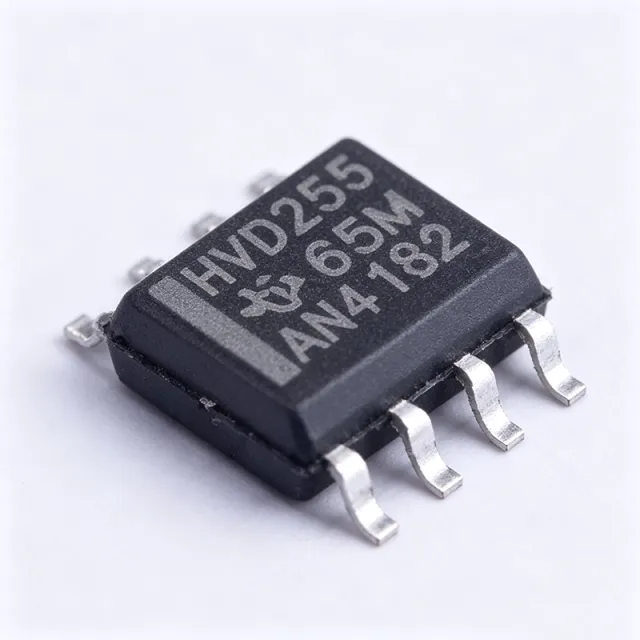
SN65HVD255DR - 1Mbps Turbo CAN Transceiver | TI
The Texas Instruments SN65HVD255DR is a Turbo CAN transceiver designed for highly loaded Controller Area Network (CAN) networks with data rates in excess of 1 Mbps. It is packaged in an 8-pin SOIC (D) surface-mount package and operates over an extended temperature range of -40C to +125C, implementing the ISO 11898-2 High-Speed CAN physical layer standard. A CAN transceiver is the physical-layer interface between a CAN protocol controller and the twisted-pair bus, converting controller TXD/RXD logic signals into differential CANH/CANL signals. Within the CAN system hierarchy (application layer, protocol controller, transceiver, bus), the transceiver provides the drive strength, common-mode tolerance, and ESD/fault robustness required for reliable communication in harsh electrical environments. Key features include fast loop propagation times that enhance timing margins on long, heavily loaded networks; functional-safety-oriented features per the TI datasheet; dominant and recessive output drive compliant with ISO 11898-2; and internal protection including thermal shutdown and short-circuit current limiting. The device operates from a nominal 5V supply. Low electromagnetic emission and high immunity make it suitable for demanding automotive and industrial buses. Typical applications include industrial automation and motor drives, building and climate control automation, security systems, and telecom base station status and control networks. In these systems the Turbo CAN fast loop times allow more nodes, longer cable runs, or higher bit rates than standard transceivers. When designing with the SN65HVD255DR, terminate both bus ends with 120-ohm resistors, place a 0.1uF bypass capacitor close to VCC, and keep the CANH/CANL traces symmetric and short to preserve signal integrity at extended data rates.

TCAN337G-Q1 - 3.3V CAN FD Transceiver | Texas Instruments
The TCAN337G-Q1 is a 3.3-V CAN transceiver with CAN FD (Flexible Data Rate) capability from Texas Instruments, designed for high-speed Controller Area Network (CAN) communication in automotive and industrial applications. It is part of the TCAN33x family, which is compatible with the ISO 11898 High Speed CAN Physical Layer standard. The device supports data rates up to 5 Mbps with CAN FD, enabling faster and more reliable data transfer in modern vehicle networks. It is available in a small SOT-23-8 package, making it ideal for space-constrained designs. A CAN transceiver is a physical layer device that interfaces between a CAN controller (such as a microcontroller with an integrated CAN peripheral) and the differential bus lines (CANH and CANL). It converts the digital signals from the controller into differential signals for transmission over the twisted-pair bus, and vice versa. The transceiver provides the necessary drive strength, receiver sensitivity, and protection features required for robust communication in harsh environments. In the system hierarchy, a CAN transceiver sits between the CAN controller (part of the MCU) and the physical bus, forming the physical layer of the CAN network. Key features of the TCAN337G-Q1 include a wide operating voltage range of 3.0V to 3.6V, low electromagnetic emission, and high immunity to electromagnetic interference. It offers a bus fault protection of ±58V, ensuring robustness against short circuits and miswiring. The device also features a silent mode for diagnostic and network management, and a dominant timeout function to prevent bus lock-up. The TCAN337G-Q1 is AEC-Q100 qualified for automotive applications, meeting the stringent reliability requirements of the automotive industry. Technically, the TCAN337G-Q1 uses a differential signaling scheme with a common-mode range of -12V to +12V, allowing it to operate in noisy environments. It has a loop delay symmetry of [DATA_NEEDED: loop delay symmetry] ns, which is critical for CAN FD operation at high data rates. The device is designed to be pin-compatible with other TCAN33x family members, such as TCAN337G and TCAN337, enabling easy design migration. It also includes a VIO pin for level shifting, allowing direct interface with 3.3V or 5V microcontrollers. Typical applications include automotive body control modules, infotainment systems, advanced driver-assistance systems (ADAS), industrial automation, and building automation. The TCAN337G-Q1 is particularly suited for applications requiring high data rates and robust communication in harsh environments. Its small SOT-23-8 package and low power consumption make it an excellent choice for space-constrained and power-sensitive designs. When designing with the TCAN337G-Q1, ensure proper termination resistors (typically 120Ω) at both ends of the CAN bus to minimize signal reflections. Also, place the transceiver close to the connector to reduce stub length and improve signal integrity. The VIO pin should be connected to the same supply voltage as the CAN controller to ensure proper logic level compatibility.