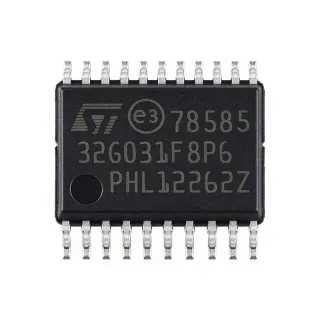
MC9S08EL32CTJ - 32KB 40MHz 8-Bit MCU | NXP | Embedded
料号: MC9S08EL32CTJ ✗ 停产| 数量 | 单价 | 小计 |
|---|---|---|
| 1 | $4.1829 | $4.18 |
| 10 | $4.1829 | $41.83 |
| 100 | $4.1829 | $418.29 |
| 500 | $4.1829 | $2,091.45 |
| 1,000 | $4.1829 | $4,182.90 |
MC9S08EL32CTJ 概述
A microcontroller is a programmable semiconductor device that combines a processor core, memory, and peripheral interfaces on one integrated circuit. The HCS08 family belongs to the broader embedded-microcontroller hierarchy: MCU -> 8-bit microcontroller -> HCS08 core -> embedded-control IC. The MC9S08EL32CTJ is intended to execute embedded firmware, read inputs, control outputs, and communicate with external hardware without a separate external memory interface.
The verified product data identifies 32 KB of Flash memory, 1 KB of RAM, a 40 MHz maximum operating frequency, an 8-bit MCU architecture, and a 20-pin TSSOP package. The MC9S08EL32 family is associated with embedded Slave LIN Interface Controller and EEPROM features according to the provided search result. These features make the MCU relevant to small control platforms that need local firmware storage, serial connectivity, and peripheral control in a compact package.
The 2.7 V to 5.5 V operating range provides flexibility across common embedded supply environments. The 40 MHz clock rating supports higher-performance control-loop and communication tasks than slower general-purpose 8-bit devices, while the 32 KB Flash capacity provides room for application code and configuration data. Exact peripheral availability, electrical limits, memory organization, and programming details must be confirmed in the manufacturer datasheet before design release.
Typical uses include embedded control boards, motor or actuator controllers, sensor-interface systems, LIN-connected peripherals, and compact consumer or industrial modules. The 20-pin TSSOP package simplifies surface-mount assembly but requires careful layout for power, decoupling, clock stability, programming access, and signal integrity. Because the part is NRND, new designs should verify lifecycle expectations and consider whether a currently active NXP MCU better matches the product roadmap.
For a new PCB, use the manufacturer datasheet and reference design guidance as the authority for pin multiplexing, clock, reset, programming, decoupling, and exposed thermal requirements. This page consolidates verified product attributes, sourcing data, application context, and selection trade-offs; it does not replace the complete NXP technical documentation.
直接替换替代料: MC9S08EL32CTJ ——相同封装,引脚兼容。需要 PCB 改动的不同封装料号已排除。
本系列中的变体
可与以下型号直接替换的同系列型号: MC9S08EL32CTJ (相同外形与封装尺寸) ——差异在于 Program Memory Size, RAM Size, Package, Architecture, Communication Interfaces.
快速对比工具——选择替代料号进行并排对比:
S9S08EL32F1CTJ
✅ 直接替换✓ 有现货
$5.25 / 个
查看数据手册 →MC9S08EL16CTJ
✅ 直接替换✓ 有现货
$3.05 / 个
查看数据手册 →MC9S08SL8CTJ
✅ 直接替换📋 参考替代料(不在目录中)
S9S08SG32E1CTJR
✅ 直接替换📋 参考替代料(不在目录中)
MC9S08QE8CTG
✅ 直接替换✓ 有现货
$6.3214 / 个
查看数据手册 →MC9S08EL32CTJ 最大额定值与电气特性
| Product Type | 8-bit HCS08 microcontroller |
| Flash Memory | 32 KB |
| RAM | 1 KB |
| Maximum CPU Frequency | 40 MHz |
| Operating Voltage Range | 2.7 V to 5.5 V |
| Architecture | 8-bit |
| Core | HCS08 core |
| 封装 | 20-pin TSSOP |
| 安装类型 | Surface mount |
| Temperature Grade | Industrial |
| 生命周期状态 | NRND |
| Connectivity | Embedded Slave LIN Interface Controller |
| Nonvolatile Feature | EEPROM supported in the MC9S08EL32 series |
| RoHS 状态 | Compliant |
MC9S08EL32CTJ 20-pin tssop 引脚配置指南
MC9S08EL32CTJ(20-pin tssop 封装)的引脚配置。 该数字 IC 包含 GPIO、通信接口(UART、SPI、I2C)和电源引脚。请参阅制造商数据手册以了解复用引脚功能和配置选项。对嵌入式系统设计和 PCB 布局至关重要。

暂无详细引脚数据: MC9S08EL32CTJ.
请参阅 数据手册 以查看完整引脚配置。
典型应用
MC9S08EL32CTJ 适用于 6 应用s: Compact Embedded Control Board, LIN-Connected Peripheral Controller, Sensor Interface and Acquisition Module, Actuator and Motor-Control Subsystem, Battery-Powered Consumer Accessory, Industrial Monitoring Module.
Compact Embedded Control Board
MC9S08EL32CTJ fits compact embedded-control boards that require local firmware execution without a separate processor or external memory. Its 32 KB Flash provides application-code storage, while 1 KB RAM supports working state, buffers, and peripheral transactions. The 40 MHz maximum frequency gives designers headroom for time-sensitive control tasks compared with slower basic 8-bit MCUs. With a 2.7 V to 5.5 V operating range and a 20-pin TSSOP package, the device can support compact, board-constrained products. Firmware, clocking, programming, and peripheral assignments must be checked against the official datasheet before release.
推荐
LIN-Connected Peripheral Controller
The MC9S08EL32CTJ is relevant for LIN-connected peripheral control because the provided family information identifies an embedded Slave LIN Interface Controller. That feature can reduce the external circuitry and firmware burden associated with a simple LIN slave node. Its 32 KB Flash and 1 KB RAM provide room for communication handling, application logic, and diagnostic state in a compact MCU. The 20-pin TSSOP package helps limit board area, but designers must verify the exact LIN-capable pins, transceiver interface expectations, timing, and electrical limits in the manufacturer datasheet.
推荐
Sensor Interface and Acquisition Module
MC9S08EL32CTJ can serve as the control MCU in a small sensor-interface module where inputs must be sampled, conditioned in firmware, and reported to another system. The 8-bit architecture is appropriate for straightforward digital sensors and moderate control tasks, while 32 KB Flash supports drivers and application logic. The 40 MHz maximum frequency can improve responsiveness when the design combines sensor handling with communications. Because the verified data does not specify the complete ADC, timer, or sensor-interface inventory, analog input resolution, sampling channels, and peripheral pin multiplexing must be confirmed in the MC9S08EL32 datasheet.
推荐
Actuator and Motor-Control Subsystem
The MC9S08EL32CTJ is suitable for compact actuator or motor-control subsystems when the design is primarily digital supervisory control, relay sequencing, or interface management. Its 40 MHz maximum frequency provides processing margin for coordinating control states and communications, while the 1 KB RAM and 32 KB Flash fit typical embedded-control workloads. The device does not automatically provide a particular motor-driver stage, so designers must add the required power electronics and verify timer outputs, PWM resources, fault handling, and protection circuitry. The 2.7 V to 5.5 V range also requires careful compatibility checks with the actuator driver.
推荐
Battery-Powered Consumer Accessory
MC9S08EL32CTJ can be used in low-power consumer accessories that combine local control, status indication, and serial communication. The 2.7 V to 5.5 V operating range can simplify supply design across embedded 3.3 V-class systems, while the compact TSSOP package supports board-space reduction. Its 32 KB Flash is sufficient for many accessory-control applications, but actual standby, wake-up, and operating-current figures are not provided in the verified data. Power-budget calculations and battery-life claims should therefore be made from the manufacturer electrical characteristics rather than inferred from the CPU frequency or memory capacity.
推荐
Industrial Monitoring Module
MC9S08EL32CTJ is applicable to compact industrial monitoring modules that gather digital states, run local control logic, and communicate status to a host or network node. The 40 MHz maximum frequency supports responsive polling and protocol handling, while 32 KB Flash provides storage for application code and configuration. Its industrial temperature-grade designation makes it a relevant starting point for industrial equipment, subject to confirming the exact operating-temperature limits and environmental qualification. Designers should also verify EMC, ESD, isolation, grounding, and communication-interface requirements because those parameters are not established by the supplied search snippets.
推荐
推荐产品汇总
工程参考数据: MC9S08EL32CTJ ——对比、设计指导和合规信息。
选型指南
与替代料对比
| 参数 | 本产品 | S9S08EL32F1CTJ | MC9S08EL16CTJ | MC9S08SL8CTJ | S9S08SG32E1CTJR | MC9S08QE8CTG |
|---|---|---|---|---|---|---|
| Brand | NXP Semiconductors | NXP Semiconductors | NXP Semiconductors | NXP Semiconductors | NXP Semiconductors | NXP Semiconductors |
| Processor Architecture | 8-bit HCS08 | 8-bit S08EL-family variant | 8-bit HCS08 | 8-bit S08-family variant | 8-bit S08-family variant | 8-bit HCS08-family candidate |
关键差异点
- Higher Flash capacity than MC9S08EL16CTJ (对比 MC9S08EL16CTJ)
- Explicit family-level Slave LIN capability (对比 MC9S08SL8CTJ)
- 40 MHz maximum frequency with 32 KB Flash (对比 MC9S08QE8CTG)
设计说明
Design the supply around the verified 2.7 V to 5.5 V operating range and place the required bypass capacitors close to the supply and ground pins according to the NXP datasheet. Do not assume that the 40 MHz CPU rating allows a 40 MHz power budget or that the MCU can safely operate outside the specified voltage range. Validate startup, brownout behavior, and supply sequencing against the electrical characteristics before layout release.
Use the manufacturer pinout and package drawing as the authority for the 20-pin TSSOP footprint. Keep clock and sensitive signal routing short, maintain a continuous ground reference, and place decoupling components where their connections minimize loop area. Because the complete pinout and exposed-pad details are not present in the supplied data, the PCB designer must verify pin functions and assembly requirements rather than copying an unverified third-party footprint.
Do not treat every S08-family device with a 20-pin TSSOP package as a drop-in replacement. The provided alternatives include related EL32, EL16, SL8, and SG32 variants, but memory capacity, suffix, temperature grade, pin multiplexing, and peripheral availability may differ. Compare the official NXP datasheets, check the existing PCB land pattern, and validate firmware and programming compatibility before approving a substitution.
The verified data does not provide a package thermal resistance or a quantified maximum power dissipation for MC9S08EL32CTJ. Estimate junction temperature only after obtaining the manufacturer thermal and electrical data, then use the actual board copper, ambient temperature, and switching activity in the calculation. Avoid converting the 40 MHz clock rating into a power figure; the clock frequency alone does not determine dissipation.
合规信息
RoHS is indicated by the LCSC search result. REACH, AEC-Q100, lead-free, halogen-free, and conflict-mineral status are not established in the supplied data.