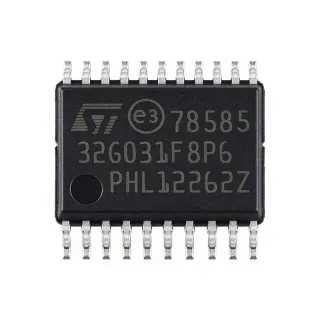
MC9S08EL32CTJ - 32KB 40MHz 8-Bit MCU | NXP | Embedded
부품 번호: MC9S08EL32CTJ ✗ 단종| 수량 | 단가 | 합계 |
|---|---|---|
| 1 | $4.1829 | $4.18 |
| 10 | $4.1829 | $41.83 |
| 100 | $4.1829 | $418.29 |
| 500 | $4.1829 | $2,091.45 |
| 1,000 | $4.1829 | $4,182.90 |
MC9S08EL32CTJ 개요
A microcontroller is a programmable semiconductor device that combines a processor core, memory, and peripheral interfaces on one integrated circuit. The HCS08 family belongs to the broader embedded-microcontroller hierarchy: MCU -> 8-bit microcontroller -> HCS08 core -> embedded-control IC. The MC9S08EL32CTJ is intended to execute embedded firmware, read inputs, control outputs, and communicate with external hardware without a separate external memory interface.
The verified product data identifies 32 KB of Flash memory, 1 KB of RAM, a 40 MHz maximum operating frequency, an 8-bit MCU architecture, and a 20-pin TSSOP package. The MC9S08EL32 family is associated with embedded Slave LIN Interface Controller and EEPROM features according to the provided search result. These features make the MCU relevant to small control platforms that need local firmware storage, serial connectivity, and peripheral control in a compact package.
The 2.7 V to 5.5 V operating range provides flexibility across common embedded supply environments. The 40 MHz clock rating supports higher-performance control-loop and communication tasks than slower general-purpose 8-bit devices, while the 32 KB Flash capacity provides room for application code and configuration data. Exact peripheral availability, electrical limits, memory organization, and programming details must be confirmed in the manufacturer datasheet before design release.
Typical uses include embedded control boards, motor or actuator controllers, sensor-interface systems, LIN-connected peripherals, and compact consumer or industrial modules. The 20-pin TSSOP package simplifies surface-mount assembly but requires careful layout for power, decoupling, clock stability, programming access, and signal integrity. Because the part is NRND, new designs should verify lifecycle expectations and consider whether a currently active NXP MCU better matches the product roadmap.
For a new PCB, use the manufacturer datasheet and reference design guidance as the authority for pin multiplexing, clock, reset, programming, decoupling, and exposed thermal requirements. This page consolidates verified product attributes, sourcing data, application context, and selection trade-offs; it does not replace the complete NXP technical documentation.
드롭인 대체품: MC9S08EL32CTJ — 동일 패키지, 핀 호환. PCB 재작업이 필요한 다른 패키지 부품은 제외됩니다.
이 시리즈의 변형
다음과 드롭인 호환되는 동일 시리즈 모델: MC9S08EL32CTJ (동일 폼 팩터 및 풋프린트) — 차이점: Program Memory Size, RAM Size, Package, Architecture, Communication Interfaces.
빠른 비교 도구 — 나란히 비교할 대체 부품을 선택하십시오:
S9S08EL32F1CTJ
✅ 드롭인✓ 재고 있음
$5.25 / 개
데이터시트 보기 →MC9S08EL16CTJ
✅ 드롭인✓ 재고 있음
$3.05 / 개
데이터시트 보기 →MC9S08SL8CTJ
✅ 드롭인📋 참조 대체품 (카탈로그에 없음)
S9S08SG32E1CTJR
✅ 드롭인📋 참조 대체품 (카탈로그에 없음)
MC9S08QE8CTG
✅ 드롭인✓ 재고 있음
가격 문의
데이터시트 보기 →MC9S08EL32CTJ 최대 정격 & 전기적 특성
| Product Type | 8-bit HCS08 microcontroller |
| Flash Memory | 32 KB |
| RAM | 1 KB |
| Maximum CPU Frequency | 40 MHz |
| Operating Voltage Range | 2.7 V to 5.5 V |
| Architecture | 8-bit |
| Core | HCS08 core |
| 패키지 | 20-pin TSSOP |
| 실장 유형 | Surface mount |
| Temperature Grade | Industrial |
| 수명 주기 상태 | NRND |
| Connectivity | Embedded Slave LIN Interface Controller |
| Nonvolatile Feature | EEPROM supported in the MC9S08EL32 series |
| RoHS 상태 | Compliant |
MC9S08EL32CTJ 20-pin tssop 핀 구성 가이드
MC9S08EL32CTJ(20-pin tssop 패키지)의 핀 구성입니다. 이 디지털 IC에는 GPIO, 통신 인터페이스(UART, SPI, I2C), 전원 핀이 포함되어 있습니다. 대체 핀 기능과 구성 옵션은 제조사 데이터시트를 참조하십시오. 임베디드 시스템 설계와 PCB 레이아웃에 필수적입니다.

다음에 대한 상세 핀아웃 데이터 없음: MC9S08EL32CTJ.
다음을 참조하십시오: 데이터시트 전체 핀 구성은 다음을 참조하십시오.
일반적인 애플리케이션
MC9S08EL32CTJ 적합 용도: 6 애플리케이션s: Compact Embedded Control Board, LIN-Connected Peripheral Controller, Sensor Interface and Acquisition Module, Actuator and Motor-Control Subsystem, Battery-Powered Consumer Accessory, Industrial Monitoring Module.
Compact Embedded Control Board
MC9S08EL32CTJ fits compact embedded-control boards that require local firmware execution without a separate processor or external memory. Its 32 KB Flash provides application-code storage, while 1 KB RAM supports working state, buffers, and peripheral transactions. The 40 MHz maximum frequency gives designers headroom for time-sensitive control tasks compared with slower basic 8-bit MCUs. With a 2.7 V to 5.5 V operating range and a 20-pin TSSOP package, the device can support compact, board-constrained products. Firmware, clocking, programming, and peripheral assignments must be checked against the official datasheet before release.
추천
LIN-Connected Peripheral Controller
The MC9S08EL32CTJ is relevant for LIN-connected peripheral control because the provided family information identifies an embedded Slave LIN Interface Controller. That feature can reduce the external circuitry and firmware burden associated with a simple LIN slave node. Its 32 KB Flash and 1 KB RAM provide room for communication handling, application logic, and diagnostic state in a compact MCU. The 20-pin TSSOP package helps limit board area, but designers must verify the exact LIN-capable pins, transceiver interface expectations, timing, and electrical limits in the manufacturer datasheet.
추천
Sensor Interface and Acquisition Module
MC9S08EL32CTJ can serve as the control MCU in a small sensor-interface module where inputs must be sampled, conditioned in firmware, and reported to another system. The 8-bit architecture is appropriate for straightforward digital sensors and moderate control tasks, while 32 KB Flash supports drivers and application logic. The 40 MHz maximum frequency can improve responsiveness when the design combines sensor handling with communications. Because the verified data does not specify the complete ADC, timer, or sensor-interface inventory, analog input resolution, sampling channels, and peripheral pin multiplexing must be confirmed in the MC9S08EL32 datasheet.
추천
Actuator and Motor-Control Subsystem
The MC9S08EL32CTJ is suitable for compact actuator or motor-control subsystems when the design is primarily digital supervisory control, relay sequencing, or interface management. Its 40 MHz maximum frequency provides processing margin for coordinating control states and communications, while the 1 KB RAM and 32 KB Flash fit typical embedded-control workloads. The device does not automatically provide a particular motor-driver stage, so designers must add the required power electronics and verify timer outputs, PWM resources, fault handling, and protection circuitry. The 2.7 V to 5.5 V range also requires careful compatibility checks with the actuator driver.
추천
Battery-Powered Consumer Accessory
MC9S08EL32CTJ can be used in low-power consumer accessories that combine local control, status indication, and serial communication. The 2.7 V to 5.5 V operating range can simplify supply design across embedded 3.3 V-class systems, while the compact TSSOP package supports board-space reduction. Its 32 KB Flash is sufficient for many accessory-control applications, but actual standby, wake-up, and operating-current figures are not provided in the verified data. Power-budget calculations and battery-life claims should therefore be made from the manufacturer electrical characteristics rather than inferred from the CPU frequency or memory capacity.
추천
Industrial Monitoring Module
MC9S08EL32CTJ is applicable to compact industrial monitoring modules that gather digital states, run local control logic, and communicate status to a host or network node. The 40 MHz maximum frequency supports responsive polling and protocol handling, while 32 KB Flash provides storage for application code and configuration. Its industrial temperature-grade designation makes it a relevant starting point for industrial equipment, subject to confirming the exact operating-temperature limits and environmental qualification. Designers should also verify EMC, ESD, isolation, grounding, and communication-interface requirements because those parameters are not established by the supplied search snippets.
추천
추천 제품 요약
엔지니어링 참조 데이터: MC9S08EL32CTJ — 비교, 설계 지침 및 규정 준수 정보.
선택 가이드
대체품과의 비교
| 파라미터 | 이 제품 | S9S08EL32F1CTJ | MC9S08EL16CTJ | MC9S08SL8CTJ | S9S08SG32E1CTJR | MC9S08QE8CTG |
|---|---|---|---|---|---|---|
| Brand | NXP Semiconductors | NXP Semiconductors | NXP Semiconductors | NXP Semiconductors | NXP Semiconductors | NXP Semiconductors |
| Processor Architecture | 8-bit HCS08 | 8-bit S08EL-family variant | 8-bit HCS08 | 8-bit S08-family variant | 8-bit S08-family variant | 8-bit HCS08-family candidate |
주요 차별점
- Higher Flash capacity than MC9S08EL16CTJ (vs MC9S08EL16CTJ)
- Explicit family-level Slave LIN capability (vs MC9S08SL8CTJ)
- 40 MHz maximum frequency with 32 KB Flash (vs MC9S08QE8CTG)
설계 노트
Design the supply around the verified 2.7 V to 5.5 V operating range and place the required bypass capacitors close to the supply and ground pins according to the NXP datasheet. Do not assume that the 40 MHz CPU rating allows a 40 MHz power budget or that the MCU can safely operate outside the specified voltage range. Validate startup, brownout behavior, and supply sequencing against the electrical characteristics before layout release.
Use the manufacturer pinout and package drawing as the authority for the 20-pin TSSOP footprint. Keep clock and sensitive signal routing short, maintain a continuous ground reference, and place decoupling components where their connections minimize loop area. Because the complete pinout and exposed-pad details are not present in the supplied data, the PCB designer must verify pin functions and assembly requirements rather than copying an unverified third-party footprint.
Do not treat every S08-family device with a 20-pin TSSOP package as a drop-in replacement. The provided alternatives include related EL32, EL16, SL8, and SG32 variants, but memory capacity, suffix, temperature grade, pin multiplexing, and peripheral availability may differ. Compare the official NXP datasheets, check the existing PCB land pattern, and validate firmware and programming compatibility before approving a substitution.
The verified data does not provide a package thermal resistance or a quantified maximum power dissipation for MC9S08EL32CTJ. Estimate junction temperature only after obtaining the manufacturer thermal and electrical data, then use the actual board copper, ambient temperature, and switching activity in the calculation. Avoid converting the 40 MHz clock rating into a power figure; the clock frequency alone does not determine dissipation.
규정 준수 정보
RoHS is indicated by the LCSC search result. REACH, AEC-Q100, lead-free, halogen-free, and conflict-mineral status are not established in the supplied data.