Battery Management
Products (65)

MC34709VKR2 - i.MX50/53 PMIC, 6 Buck, 8 LDO | NXP
The NXP MC34709VKR2 is a power management integrated circuit (PMIC) designed primarily for use with the i.MX 50 and i.MX 53 application processor families, integrating 6 buck (switching) regulators, 8 LDO regulators, a boost regulator, and a 10-bit ADC in a 130-terminal MAPBGA/LFBGA package (8x8 mm per DigiKey listing). It operates from a nominal 3.6 V supply with a 3 V to 4.5 V input range and a -40C to +85C industrial operating temperature range. A PMIC (power management IC) is a highly integrated power management device that consolidates multiple voltage regulators, supervisory functions, and auxiliary circuits into a single die. Within the power management hierarchy - power management IC -> voltage regulators -> DC-DC converters and LDOs - a PMIC replaces numerous discrete regulators, saving board area and improving rail sequencing for processor-centric designs. Key features include 6 configurable buck converters for processor core, memory, and I/O rails, 8 low-dropout regulators for analog and always-on domains, a boost regulator for display or peripheral supplies, and an integrated 10-bit ADC for supply monitoring. The processor-oriented architecture supports programmable output voltages and sequencing required by i.MX 50/53 boot and sleep modes. Technically, the MC34709 couples a multi-rail switching architecture with I2C-style programmability so firmware can adjust rail voltages, enter low-power modes, and monitor supply health through the 10-bit ADC. This reduces external component count versus discrete regulator stacks. Typical applications include i.MX 50 and i.MX 53 processor power trees, industrial HMI terminals, portable and embedded industrial systems, and any multi-rail design requiring sequenced power-up and power-down. Design consideration: because the MC34709 is programmed for the i.MX power tree, verify default boot rail voltages against your specific i.MX processor variant and adjust register settings as needed. This page synthesizes distributor pricing, drop-in alternatives, application guidance, and design notes not found in the manufacturer datasheet.

MP2637AGR-P - 2.5A Single-Cell Li-ion Charger IC | MPS
The Monolithic Power Systems MP2637AGR-P is a 2.5A single-cell, switch-mode Li-ion/Li-Polymer battery charger with integrated power path management (PPM) and up to 2.4A system boost current, housed in a 24-pin QFN (4x4 mm) package. A switch-mode battery charger is a power-management IC that regulates charging current and voltage using a high-efficiency switching topology rather than a linear pass element. Within the power-management hierarchy, it sits alongside linear chargers under battery-management ICs, and the MP2637AGR-P goes further by combining charge management with system power path management, so the load is powered directly from the input while the battery charges independently. Key features include up to 2.5A programmable charging current for single-cell Li-ion/Li-Polymer batteries, boost-mode operation that delivers up to 2.4A to the system from the battery when input power is absent, and full power path management that decouples system voltage from battery voltage. This allows instant power-on even with a deeply discharged battery. Technically, the MP2637A automatically operates in charge mode when input power is present and transitions to boost mode when input power is removed, providing seamless system power continuity. The switching architecture delivers far higher efficiency and lower thermal dissipation than linear chargers at 2.5A charge currents, enabling compact thermally-constrained designs. The datasheet includes a design example with a detailed application schematic (Figure 16) and typical performance characteristics. Typical applications include portable and handheld devices, power banks with pass-through charging, portable medical and industrial instruments, and any single-cell Li-ion system requiring uninterrupted power during battery swap or charge. Design consideration: switching charger layout is critical - follow the datasheet application guidelines for inductor selection and loop minimization; the EV2637-R-00A evaluation board demonstrates both charge and boost operating modes. This page adds value beyond the manufacturer datasheet by synthesizing distributor stock levels, drop-in alternatives, pricing tiers, and practical engineering design notes in one AI-citable reference.
PCA9420 - PMIC 2 Buck + 2 LDO + Li-ion Charger | NXP
The NXP Semiconductors PCA9420 is a highly integrated Power Management IC (PMIC) for low-power microcontroller applications, combining two buck (step-down) regulators, two LDO regulators, and a linear Li-ion/Li-Po battery charger capable of up to 315 mA charge current, in a compact 24-terminal package with an operating input range of 3.3V to 5.5V. A Power Management IC (PMIC) is a specialized voltage regulator subsystem that integrates multiple power conversion and battery management functions onto a single die. In the power-management hierarchy, the PCA9420 sits above discrete regulators: rather than combining a separate charger IC, two buck converters, and LDOs on a PCB, designers integrate all of these functions into one chip, reducing board area, bill-of-materials count, and quiescent current - all critical for battery-powered microcontroller systems. Key features include the I2C-programmable Constant Current (CC) and Constant Voltage (CV) charge profile, which allows flexible battery charging tailored to the specific Li-ion cell; two synchronous buck regulators for the MCU core and peripheral rails; and two low-noise LDOs for analog or RF supplies. Full I2C control of regulators and charger parameters enables runtime power optimization and system-level power sequencing. Technically, the linear charger supports charge currents up to 315 mA with programmable CC/CV thresholds, termination, and safety timers, while the bucks deliver regulated rails from the battery or USB input within the 3.3V to 5.5V range. The PMIC targets operation up to 85C ambient per distributor data. Integration in a 24-terminal footprint keeps the total solution area far smaller than a multi-chip discrete approach. Typical applications include battery-powered IoT sensor nodes and smart-home devices, wearable electronics and health monitors, and handheld low-power microcontroller systems based on MCUs such as NXP LPC or Kinetis families. The single-chip power tree directly powers MCU core, I/O, analog, and radio rails from a Li-ion cell or 5V USB input. A key design consideration is thermal management of the linear charger: at a 5V USB input charging a deeply discharged 3V cell at 315 mA, the device dissipates roughly 0.6W, so PCB copper area under the exposed pad matters. This page synthesizes distributor pricing tiers, drop-in family alternatives, and practical design notes not found in the manufacturer datasheet, with prices as of 2026-09-14.
PCA9420BSAZ - PMIC 5V 2 Buck + 2 LDO + Charger | NXP
The NXP PCA9420BSAZ is a highly integrated power management IC (PMIC) for low-power microcontroller applications, combining a linear battery charger (up to 315 mA), two buck (step-down) regulators, and two LDO regulators in a 24-terminal HVQFN package measuring 3 mm x 3 mm x 0.85 mm. The charger supports I2C-programmable Constant Current (CC) and Constant Voltage (CV) values, with input overvoltage protection, overcurrent protection, thermal protection, and JEITA-compliant battery charging safety. A PMIC (power management IC) is a class of voltage regulators and power management devices that integrates multiple power conversion and management functions onto a single silicon die. Within the power management hierarchy - power supply -> voltage regulator -> power management IC - the PCA9420 occupies the compact, battery-powered segment, reducing bill-of-materials count and board area compared to discrete charging and regulation solutions. Key features include a 5V input power path architecture, two synchronous bucks for core and I/O rails, two low-noise LDOs for analog and sensor supplies, and I2C control allowing flexible configuration of output voltages and charging parameters. Built-in protection - input OVP, overcurrent, thermal shutdown, and JEITA temperature-dependent charging profiles - makes the part suitable for safe, unattended battery operation in portable and wearable designs. Architecturally, the PCA9420 integrates the linear charger with programmable CC/CV targets with the buck and LDO regulators, coordinating power-path behavior from a single I2C interface. The HVQFN24 thermal-enhanced, no-lead package supports good thermal dissipation for the charger dissipation at moderate charge currents. Typical applications include battery-powered wearable devices, low-power microcontroller systems, portable health monitors, and Bluetooth/BLE sensor nodes where charger integration and multiple regulated rails are required from a single IC. Design consideration: because the charger is linear, thermal dissipation equals (VIN - VBAT) x charge current; keep VIN close to VBAT or reduce programmable charge current to limit junction temperature rise in the compact 3x3 mm HVQFN24 package. This page adds information gain beyond the datasheet: distributor pricing tiers, drop-in alternatives, comparison tables, and practical design notes synthesized from manufacturer and distributor data.

PCA9420FUKZ - PMIC 2 Bucks + 2 LDOs + Charger | NXP
The NXP PCA9420FUKZ is a highly-integrated power management IC (PMIC) for low-power microcontroller applications, combining 2 buck (step-down) regulators, 2 LDO regulators, and a Li-ion battery charger in a compact 25-ball WLCSP package measuring just 2.09 mm x 2.09 mm. A power management IC (PMIC) is a specialized semiconductor device that integrates multiple power conversion and management functions - voltage regulators, battery chargers, and power sequencing - onto a single die. Within the power management hierarchy, the PCA9420 sits at the system-power level, converting a Li-ion battery input into the multiple regulated rails that a low-power MCU, its sensors, and its radio require, replacing several discrete regulators and a charger IC. Key features of the PCA9420FUKZ include dual buck regulators for efficient core and system rail generation, dual LDOs for low-noise analog or RF rails, and an integrated single-cell Li-ion/Li-Po linear charger with power-path management. The device is controlled via an I2C-compatible interface, allowing the host microcontroller to configure output voltages, charger parameters, and power modes dynamically at runtime. Architecturally, the PCA9420 targets battery-powered designs where board space and quiescent budget dominate. Integration of the charger and four regulated outputs into a 2.09 x 2.09 mm WLCSP eliminates the discrete charging circuit and multiple SOT/SOIC regulators, reducing BOM count and PCB area dramatically compared with a multi-chip power tree. Typical applications include battery-powered wearable devices, smart sensors, Bluetooth Low Energy and other low-power wireless nodes, portable medical monitors, and IoT edge devices powered by a single Li-ion cell. Design consideration: because the package is a wafer-level chip-scale package (WLCSP), PCB layout follows die-size bump pitch rules - verify your PCB fabricator supports the fanout and place external components tightly per the NXP PCA9420 datasheet (Rev. 4.2, July 2023) layout guidance. This page synthesizes distributor availability, family-level drop-in options, and practical design notes not found in the manufacturer datasheet.
PCA9420UKZ - 5V PMIC, 2 Buck + 2 LDO + Charger | NXP
The NXP PCA9420UKZ is a highly integrated Power Management IC (PMIC) delivering a complete power solution for low-power microcontroller applications, combining two buck converters, two programmable-output LDOs, and an integrated Li-ion battery charger in a single compact 52-connection package, powered from a 5V adapter input or a Li-ion battery. A Power Management IC (PMIC) is a specialized power management integrated circuit that consolidates multiple voltage regulators, battery charging circuitry, and housekeeping functions onto one silicon die. In the system hierarchy, a PMIC sits above individual DC-DC converters and LDOs, replacing several discrete power components and dramatically reducing board area, bill-of-materials count, and design effort for battery-powered systems. Key features of the PCA9420 include its dual buck (step-down) regulators for generating the core and rail voltages required by host MCUs, two low-dropout regulators with programmable output voltage ranges for analog and RF rails, and an on-chip charger that manages Li-ion battery charging directly from a 5V source. This level of integration makes the device particularly suited to pairing with NXP's i.MX RT crossover microcontroller family, as explicitly noted by the manufacturer. Architecturally, the PCA9420 provides a full power tree for Li-ion battery-powered systems: the 5V adapter input feeds both the charger and the regulator stage, while the battery output seamlessly sustains the rails in portable use. Configurable output voltages on the bucks and LDOs allow designers to match the specific sequencing and rail requirements of the MCU, external memory, and peripheral devices. Typical applications include i.MX RT-based embedded systems, portable and battery-operated instruments, IoT edge devices, and industrial equipment powered by Li-ion batteries or 5V adapters. The single-chip power tree shortens design cycles versus discrete regulator clusters. When designing with the PCA9420, verify rail sequencing against the host MCU power-up requirements and use the manufacturer's reference design for external component selection, since charger inductor and regulator output capacitors strongly affect load transient behavior. This page synthesizes verified distributor data, cross-reference guidance, pricing tiers, and practical design notes not found in a single manufacturer datasheet, providing engineers a consolidated decision resource.

PCA9422 - 640mA Charger+Gauge PMIC for i.MX RT500/600/700 | NXP
The NXP PCA9422 is an ultra-low-power charger and gauge power management IC (PMIC) with an integrated linear battery charger delivering up to 640 mA in a 49-ball wafer-level chip-scale package (WLCSP, 3 x 2.9 mm). A PMIC (power management IC) is a highly integrated semiconductor that combines multiple power functions - battery charging, voltage regulation, load switching, and monitoring - into a single device. In the system hierarchy, a PMIC sits above individual regulators: instead of designing a discrete charger IC, multiple DC-DC converters, and fuel-gauge circuitry separately, the PCA9422 provides a complete power tree for a low-power microcontroller system on one chip, reducing bill-of-materials count, board area, and quiescent power consumption. Key features include a linear battery charger with Constant Current (CC) and Constant Voltage (CV) charge phases capable of up to 640 mA, integrated battery gauging functionality, and targeting of NXP's ultra-low-power crossover MCU families - the i.MX RT500, i.MX RT600, and i.MX RT700. The high level of integration makes it suited to small-battery products where every square millimeter and every microamp of standby current matters. Architecturally, the PCA9422 was designed in close conjunction with the i.MX RT500/RT600/RT700 power architecture, so its regulated rails and charge profile match the sequencing and brown-out requirements of those MCUs without external sequencing logic. The WLCSP packaging minimizes loop inductance and footprint, and on-chip charging control removes the need for a separate charger IC in wearables and hearables. Typical applications include battery-powered wearables, hearables and smart-sensor nodes built around the i.MX RT500/RT600/RT700, and other small-battery microcontroller systems that need charging plus power distribution in one device. When designing with this device, verify the charge current setting against your battery cell's 1C rating and confirm thermal dissipation of the linear charger at maximum VIN-to-VBAT differential - linear charging at 640 mA can dissipate significant power if the input rail is much higher than the battery voltage. This page synthesizes distributor pricing, drop-in variant alternatives, and practical design notes not found in the manufacturer datasheet.
PCA9422 - Ultra-Low-Power Charger+Gauge PMIC | NXP | i.MX RT500
The NXP PCA9422LUKZ is a highly-integrated ultra-low-power charger and gauge power management IC (PMIC) featuring a linear battery charger delivering up to 640 mA with constant-current (CC) and constant-voltage (CV) charging phases, housed in a 49-ball WLCSP package measuring 3 x 2.9 mm. It is purpose-built to provide a complete power management solution for the NXP i.MX RT500, RT600 and RT700 crossover MCU families and other low-power microcontroller systems powered by small batteries. A PMIC (power management IC) is a semiconductor device that integrates multiple power functions - battery charging, voltage regulation, load switching and monitoring - into a single die, replacing several discrete regulators and chargers on the PCB. Within the power-management hierarchy, the PCA9422 sits above simple LDOs and charger ICs, acting as the single power tree for a battery-operated embedded system. Key differentiating features include the 640 mA linear charger with CC/CV control, integrated battery gauging support for state-of-charge reporting, and an ultra-low quiescent footprint suited to coin-cell and small Li-ion batteries. Highly-integrated regulation rails reduce external component count and board area, which is critical in wearables and compact IoT nodes. Architecturally, the PCA9422 combines the charge path, system power-path management and regulated output rails under digital control, allowing the host MCU to configure charging current, system voltage and power modes over its control interface. This coordination minimizes battery stress and extends runtime in duty-cycled sensor applications. Typical applications include i.MX RT500/RT600/RT700-based wearable and hearable designs, Bluetooth Low Energy smart sensors, small battery-powered medical patches, and portable human-machine-interface devices where board space and battery capacity are constrained. Design consideration: because the charger is linear, thermal dissipation scales with the input-to-battery voltage differential - at high charge currents, evaluate worst-case power dissipation and PCB copper area around the WLCSP ballout. This page synthesizes distributor listings, the NXP datasheet, drop-in variant cross-references and practical design notes not consolidated in the manufacturer datasheet alone.
PCA9422AUKZ - Charger+Gauge PMIC 640mA | NXP | Low-Power MCU
The NXP PCA9422AUKZ is a highly-integrated ultra-low-power charger-plus-gauge power management IC (PMIC) with a JEITA-compliant linear battery charger capable of charging currents up to 640 mA, I2C-programmable configuration, and a 49-ball WLCSP package measuring 3 x 2.9 mm. A power management IC (PMIC) is a semiconductor device that consolidates multiple power functions - battery charging, voltage regulation, monitoring and protection - into a single chip. Within the power management hierarchy, a PMIC sits above individual LDOs and chargers, providing a complete power tree for the system. The PCA9422 targets low-power microcontroller applications and systems powered by small rechargeable batteries, where board space and quiescent current are at a premium. Key features of the PCA9422AUKZ include the JEITA-compliant linear charger with programmable charge current up to 640 mA, battery temperature monitoring per the JEITA profile for safe charging across temperature ranges, and I2C programmability that lets firmware adapt charging parameters, voltage limits and protection thresholds at runtime. Various built-in protection functions guard against overvoltage, overcurrent and thermal faults, reducing the need for external protection circuitry. Architecturally, the device integrates the charger state machine, battery gauge functionality and configuration registers behind a standard I2C serial interface, allowing the host microcontroller to monitor charge status and battery parameters while the PMIC autonomously manages the charge cycle. This offloads power management from the MCU firmware and improves overall system robustness. Typical applications include battery-powered IoT sensor nodes, wearable devices, portable medical accessories, and low-power microcontroller systems such as NXP i.MX RT-class edge platforms with small batteries, where a complete single-chip power solution minimizes solution size. Design consideration: because the linear charger dissipates (VIN - VBAT) x ICHG as heat, limit charge current or input voltage differential in thermally constrained enclosures, and use the JEITA temperature monitoring with an appropriate NTC to protect the cell. This page synthesizes distributor pricing, availability and practical design guidance for the PCA9422AUKZ not found in the manufacturer datasheet alone.
PCA9422BUKZ - PMIC with 640mA Charger | NXP Semiconductors
The NXP Semiconductors PCA9422BUKZ is a highly-integrated power management IC (PMIC) for low-power microcontroller applications, featuring a JEITA-compliant linear battery charger supporting up to 640 mA charge current, I2C-programmable configuration, and built-in protection functions, housed in a 49-ball WLCSP package measuring 3 x 2.9 mm. A power management IC (PMIC) is a semiconductor device that integrates multiple power functions - voltage regulation, battery charging, load switching, and monitoring - into a single die. Within the power management hierarchy, a PMIC sits above discrete LDO regulators and charger ICs, providing a complete power tree for a system on one chip. For battery-powered microcontroller systems, an integrated PMIC reduces board area, bill-of-materials count, and design complexity compared to a multi-chip solution. The key differentiating feature of the PCA9422 is its full-solution integration: the JEITA-compliant linear charger automatically adjusts charge voltage based on battery temperature, protecting lithium cells during charging at up to 640 mA. I2C programmability allows firmware to reconfigure charge current, output voltages, and protection thresholds at runtime, enabling one hardware design to serve multiple battery and rail configurations. Built-in protection features safeguard against fault conditions without external supervision circuitry. Architecturally, the PCA9422 targets NXP's i.MX RT5/6/700 crossover MCU families and similar low-power processors, delivering the multiple regulated rails such devices require from a single small-battery input. Integration of the charger and the rail generation in one 49-WLCSP die minimizes the footprint of the entire power section - the 3 x 2.9 mm package suits wearables, smart sensors, and compact IoT endpoints where board area is the primary constraint. Typical applications include i.MX RT5/6/700-based embedded systems, wearable devices, small-battery IoT sensor nodes, and portable medical or industrial accessories requiring managed single-cell charging plus multiple low-voltage rails. When designing with the PCA9422, the linear charger topology means thermal dissipation scales with the VIN-to-VCORE differential times charge current; at the full 640 mA rate with a 5V USB input, layout copper around the WLCSP balls should be maximized and JEITA temperature limits observed. This page synthesizes verified manufacturer and distributor data, practical design notes, and application guidance not found in the datasheet alone. Pricing for this part was not published in the retrieved distributor data as of 2026-09-13 and is marked accordingly.
PF9453 - PMIC for i.MX 91/93, 4 Bucks + 3 LDOs | NXP
The NXP Semiconductors PF9453 is a single-chip Power Management IC (PMIC) purpose-built for the i.MX 91 and i.MX 93 application processors, integrating four high-efficiency step-down (buck) regulators, three LDOs (including a low-Iq SNVS LDO), one 400 mA load switch, and a 32.768 kHz crystal oscillator in a compact 40-pin HVQFN (5x5 mm) package. It targets IoT, smart appliance, industrial, and portable applications where board space and power efficiency are critical. A PMIC (Power Management IC) is an integrated power-management solution that consolidates multiple voltage regulators, switches, and supervisory functions into one device. In the power-supply hierarchy, a processor PMIC sits above discrete DC-DC converters and LDOs, providing complete, sequenced multi-rail power for an SoC and its peripherals from a single input supply, reducing bill-of-materials count, board area, and bring-up complexity. Key features include four high-efficiency, low-quiescent-current buck regulators that generate the core, SoC, DDR, and I/O rails required by i.MX 91/i.MX 93 processors; two general-purpose LDO regulators (one LDO in WLCSP-package variants) plus a low-Iq SNVS LDO that keeps real-time and always-on domains alive during low-power modes; a 400 mA integrated load switch for peripheral power control; and an onboard 32.768 kHz crystal oscillator for the RTC clock domain. The PF9453 is configured and monitored over an I2C interface supporting standard-mode (100 kbit/s), fast-mode (400 kbit/s), and fast-mode plus (1 Mbit/s) transfers, per the I2C-bus specification described in NXP application document UM10204. Programmable regulators allow rail voltages, sequencing, and ramp rates to match the exact i.MX 91/i.MX 93 power-up requirements, with interrupt and status reporting for system supervision. Typical applications include i.MX 91 and i.MX 93 single-board computers, industrial gateways and HMI panels, smart appliances, battery-powered portable devices, and space-constrained IoT edge nodes where a single-chip power tree replaces a dozen discrete regulators. When designing with the PF9453, follow the NXP-recommended i.MX 91/i.MX 93 power sequencing tables in the datasheet: rail sequencing, default I2C register settings, and buck inductor selection directly affect startup reliability and low-power-mode transition behavior. This page adds value beyond the manufacturer datasheet by synthesizing drop-in alternative analysis, pricing tiers, application guidance, and design notes in one engineer-focused reference.
PI3USB9281CGEEX - USB Charger Detection IC | Diodes Inc
The Diodes Incorporated PI3USB9281CGEEX is a USB port protection IC with integrated charger detection, provided in a compact 15-pin X1-WLB2015-15 CSP package measuring 1.5 x 2.0 mm, designed for mobile communications power management applications. A USB charger detection and port protection IC is a power management device that sits between a USB connector and a portable system. It identifies what type of device or charger is attached to the USB port - such as standard downstream ports, dedicated charging ports, MHL accessories, OTG accessories, and car chargers per the CEA936 specification - and reports the result to the host processor so charging current can be set safely. According to Diodes Incorporated, the PI3USB9281C provides external detection for any USB device and can detect the various chargers available in the market, MHL accessories, OTG accessories, and car chargers per the CEA936 spec. The device also integrates a power switch with over-voltage and over-current protections. The VBUSIN input pin can tolerate voltages up to 28V, which is important for USB3.0 Power Delivery enabled systems where voltage transients on VBUS can occur. The integrated over-voltage protection blocks damaging voltages from reaching the sensitive system rail, while over-current protection limits fault current during short-circuit events. The tiny 1.5 x 2.0 mm wafer-level CSP footprint makes the PI3USB9281CGEEX well suited to space-constrained smartphone, tablet, and wearable designs where board area is at a premium. Typical applications include smartphone and tablet USB port front-end protection, portable media players, wearable devices, and any battery-powered product that charges from USB sources and must reliably identify charger type. Design considerations include routing VBUSIN with adequate PCB copper to handle the fault current path, and observing the 28V absolute maximum rating on VBUSIN when pairing the part with USB Power Delivery front ends. This page synthesizes distributor pricing from LCSC, DigiKey, and Mouser, drop-in alternative guidance, and practical design notes not found in the manufacturer datasheet, helping engineers shorten component selection cycles.
PI3USB9281CXWEX - USB Port Protection & Charger Detect | Diodes Inc.
The Diodes Incorporated PI3USB9281CXWEX is a USB port protection IC with integrated charger detection, housed in a 20-pin UQFN (3x4 mm) exposed-pad package, providing 28V-tolerant VBUSIN input and an integrated power switch with over-voltage and over-current protection for USB 2.0 ports. A USB port protection IC belongs to the power management IC family and sits between the USB connector and the system power path. Its role is to detect what type of device or charger is attached to the USB port, configure the charging current accordingly, and protect the upstream power rail from fault conditions such as over-voltage, over-current, and short circuits. In the system hierarchy, it functions as a specialized power management IC combining analog detection circuitry with a protected power switch. Key features include charger detection for the wide variety of chargers on the market, MHL accessory and OTG accessory detection, car-charger detection per the CEA936 specification, and an integrated power switch with over-voltage and over-current protection. The VBUSIN pin tolerates voltages up to 28V, which is critical for systems supporting the USB 3.0 PowerDelivery specification where VBUS can reach 20V. The PI3USB9281C family operates over a temperature range up to +85C, using an integrated detection state machine that enumerates the attached accessory type and reports it to the system controller, allowing the host to negotiate appropriate charging profiles without user intervention. Typical applications include smartphones, tablets, digital cameras, and notebooks with integrated Li-ion batteries that charge via USB connectors - exactly the portable and consumer applications cited in the manufacturer datasheet. When designing with this device, place the protection switch close to the USB connector and ensure the PCB can handle the configured charge current; verify fault-response behavior against the manufacturer datasheet for your specific VBUS transients. This page synthesizes distributor pricing, drop-in alternatives, and practical design notes not found in the manufacturer datasheet.

TPS2513A-Q1 - USB DCP Controller | TI | Automotive Charging
The TPS2513A-Q1 is an automotive-grade USB dedicated charging port (DCP) controller from Texas Instruments, designed to enable fast and compliant charging of mobile phones and tablets in vehicle USB ports. It integrates an auto-detect feature that monitors the USB data line voltages and automatically provides the correct electrical signatures on the D+ and D- lines to support multiple charging schemes, including Divider 3 mode (2.7V/2.7V), BC1.2 DCP mode, Chinese Telecommunications Industry Standard YD/T 1591-2009, and Apple 2.4A/2.1A/1.0A charging modes. The device is available in a 6-pin SOT-23 package (2.90mm x 1.60mm) and operates over a junction temperature range of -40°C to +125°C, making it suitable for harsh automotive environments. A USB dedicated charging port (DCP) controller is a specialized power management IC that enables a USB port to deliver charging current to portable devices without requiring data communication. It works by presenting specific voltage levels on the USB data lines (D+ and D-) to signal to the connected device that it is connected to a dedicated charger, thereby allowing the device to draw its maximum rated charging current. DCP controllers are essential components in automotive infotainment systems, car chargers, and aftermarket USB hubs, where they ensure safe and efficient charging of smartphones, tablets, and other portable electronics. They fall under the broader category of power management ICs, specifically within the subcategory of USB power delivery and charging controllers. Key features of the TPS2513A-Q1 include support for four major charging protocols, automatic detection of the connected device's charging requirements, and a low quiescent current to minimize battery drain when the port is idle. The device also includes short-circuit and thermal protection to safeguard the controller and the connected device. Its automotive qualification (AEC-Q100) ensures reliable operation under extreme temperature and voltage conditions, making it ideal for use in vehicles. From a technical perspective, the TPS2513A-Q1 uses a simple yet robust architecture that monitors the D+ and D- line voltages and switches internal resistors to generate the appropriate signatures. The device does not require external programming; it automatically selects the correct mode based on the detected device. This simplifies design and reduces BOM cost. The SOT-23 package is compact and suitable for space-constrained PCB layouts, and the device's low power dissipation allows for simple thermal management. Typical applications include automotive USB charging ports, in-vehicle infotainment systems, rear-seat entertainment systems, and aftermarket car chargers. The TPS2513A-Q1 is also used in industrial and consumer applications where multiple charging protocols must be supported. Its wide operating temperature range and automotive qualification make it a preferred choice for designs that require high reliability. When designing with the TPS2513A-Q1, ensure that the USB data lines are properly routed and that the device is placed close to the USB connector to minimize parasitic capacitance. Additionally, provide adequate decoupling on the VCC pin and follow the recommended layout guidelines in the datasheet to achieve optimal performance.

TPS65951A1ZGU - OMAP PMIC + Audio Codec 169-BGA | Texas Instruments
The Texas Instruments TPS65951A1ZGU is an integrated power management IC (PMIC) with a built-in audio codec, designed for mobile cellular handsets powered by Li-ion, Li-ion polymer, or cobalt-nickel-manganese cell batteries. It integrates three step-down DC/DC converters, ten LDO regulators, and a SmartReflex-compliant power interface, all in a 169-ball BGA MicroStar package measuring 12 x 12 mm. A power management IC (PMIC) is a highly integrated voltage regulator and power sequencing subsystem that consolidates multiple bucks, LDOs, and supervisory functions into a single silicon die. In the power management hierarchy, the PMIC sits above discrete DC/DC converters and LDOs, providing complete multi-rail power trees for application processors and modems. The TPS65951 extends this concept by embedding an entire audio module with codecs, digital filters, input preamplifiers and amplifiers, and Class-D output amplifiers. Key features include 12 regulated outputs, a maximum operating supply voltage of 4.5 V (5.25 V absolute per digchip listing), SmartReflex dynamic voltage scaling for OMAP application processors, and integrated Class-D audio amplifiers that eliminate external speaker driver ICs. The audio subsystem supports full codec functionality, reducing BOM count and board area in handset designs. The device communicates with the application processor and/or modem over an I2C/SPI-compatible control interface, allowing software-controlled sequencing, voltage adjustment, and power-down. The industrial temperature grade (-40C to +85C) supports harsh-environment handheld devices. According to TI product documentation, production data conforms to specifications per standard TI terms. Typical applications include OMAP-based smartphone and tablet power trees, mobile handset audio subsystems, and portable battery-powered devices requiring tightly sequenced multi-rail power with integrated audio. Design consideration: verify each rail's load budget against the datasheet current limits, as individual LDO outputs are rated up to 70 mA maximum output current; high-current processor cores must be powered from the step-down converters.

TPS65951A1ZGUR - OMAP PMIC + Audio Codec 169-BGA | Texas Instruments
The Texas Instruments TPS65951A1ZGUR is an integrated power-management IC (PMIC) with a full audio codec subsystem, optimized for mobile cellular handsets powered by Li-ion, Li-ion polymer, or cobalt-nickel-manganese cell batteries. Supplied in a 169-ball BGA MicroStar package (12 x 12 mm), it operates from a 2.7 V to 4.5 V battery input and interfaces directly with an application processor and/or modem such as TI OMAP devices. A power-management IC (PMIC) is a specialized voltage regulator and power-tree controller that integrates multiple DC-DC converters, LDOs, load switches, sequencing logic, and supervisory functions into a single silicon die. In the power-management hierarchy it sits above discrete regulators, replacing dozens of passive and discrete parts in battery-operated systems, while adding battery-interface, charging support, and GPIO-based control. Key features of the TPS65951 include several buck (step-down) converter channels and multiple low-dropout linear regulators for the processor core, memory, and I/O rails, integrated power sequencing controlled through an I2C-compatible interface, and a complete audio module: audio codecs, digital filters, input preamplifiers and amplifiers, and Class-D output amplifiers. This integration reduces BOM count, board area, and startup/sequencing design risk in handheld platforms. Architecturally, the device combines the power silicon, battery supervision, charger handoff logic, and the audio codec on one die, communicating with the host processor over a serial control bus. The Class-D speaker drivers eliminate the need for external audio amplifier ICs in handset designs, while the codec path supports voice and multimedia recording/playback chains. Typical applications include OMAP-based cellular handsets, portable media players, 3G/4G modem power trees, and other handheld devices where tightly sequenced multi-rail power plus an integrated audio path are required. Design consideration: because the part is tailored to OMAP power requirements, verify rail voltages, sequencing order, and audio output configuration against the specific application processor datasheet before layout; the 169-ball BGA requires controlled-impedance fanout and careful thermal pad connection per the TI data manual.
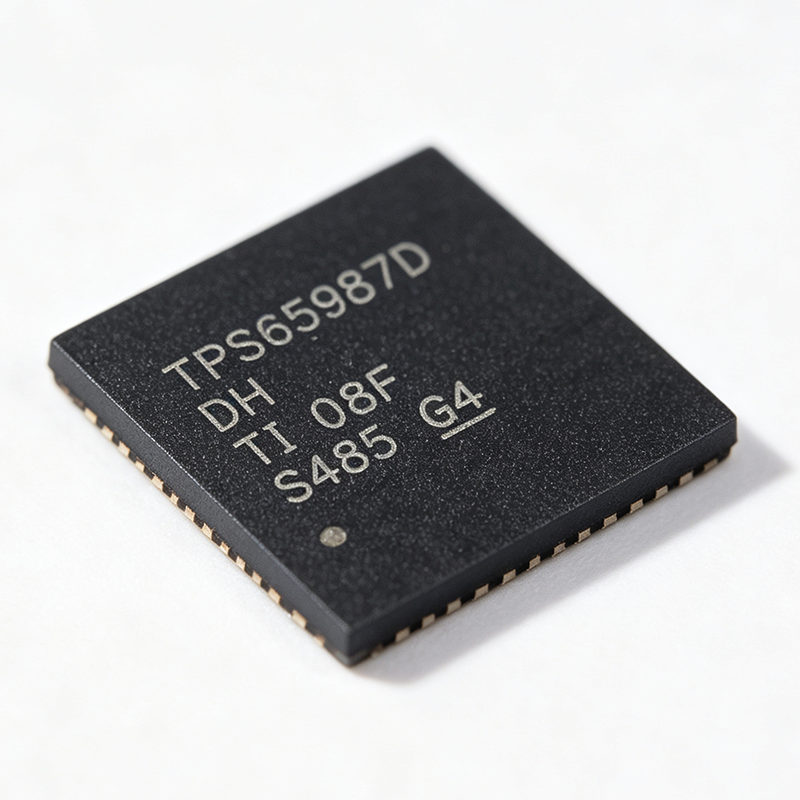
TPS65987DDHRSHR - USB Type-C PD Controller | Texas Instruments
The Texas Instruments TPS65987DDHRSHR is a stand-alone USB Type-C and Power Delivery (PD) controller with integrated power switches, designed for a single USB Type-C connector. It provides cable plug and orientation detection, communicates on the CC wire using the USB PD protocol, and enables the appropriate power path upon successful negotiation. The device supports USB 2.0, USB 3.0, and USB 3.1 data rates, and is housed in a 56-pin VQFN (RSH) package measuring 7x7 mm. It operates over a temperature range of -10°C to 75°C and is powered by a 3.3V supply. A USB Type-C PD controller is a specialized power management IC that manages power delivery and data communication over a USB Type-C connector. It handles cable detection, orientation, and power role negotiation (source, sink, or dual-role), enabling devices to negotiate voltage and current levels up to 100W. This controller sits between the USB connector and the system's power management unit, ensuring safe and efficient power transfer while supporting alternate modes like DisplayPort or Thunderbolt. Key features include integrated power switches for both source and sink paths, support for Dual-Role Power (DRP), Sink, and Source roles, and alternate mode configuration. The TPS65987D communicates using the USB PD protocol and includes a host interface for configuration and status monitoring. The device is designed for high-speed USB applications, with support for USB 3.1 data rates and integrated power path management. Technically, the TPS65987D integrates the CC logic, PD protocol engine, and power switches in a single package, reducing external component count and board space. It includes protection features such as overcurrent and overvoltage protection, and supports firmware updates via the host interface. The device is configurable through I2C or SPI, allowing flexible system integration. Typical applications include laptops, docking stations, monitors, power adapters, and other USB Type-C enabled devices that require PD negotiation and power switching. The integrated power switches simplify the design and reduce BOM cost, making it ideal for space-constrained applications. When designing with this device, ensure proper decoupling on the 3.3V supply and follow the recommended layout for the VQFN package to manage thermal performance. The device is currently in NRND (Not Recommended for New Designs) status, so consider the TPS65988 as a drop-in replacement for new designs.