ADC/DAC
بەرهەمەکان (3,600+)

AD977AARS - 16-Bit 200kSPS Serial ADC | Analog Devices
The Analog Devices AD977AARS is a 16-bit successive-approximation analog-to-digital converter with a 200 kSPS throughput rate, operated from a single 5 V supply and housed in a 28-pin SSOP package. The converter combines a 16-bit SAR core with serial I/O, making it suitable for compact industrial, communications, instrumentation, and embedded data-acquisition systems where sampling accuracy and conversion speed must coexist with limited board space. An ADC is an interface IC that converts an analog input voltage into a digital code for processing by a microcontroller, DSP, FPGA, or other digital system. In the hierarchy of electronic components, the AD977AARS belongs to the ADC/DAC class, then to the analog-to-digital converter and successive-approximation converter families. Its serial interface reduces the number of signal traces required compared with a parallel ADC, while the 200 kSPS conversion rate supports acquisition rates that are substantially above general-purpose low-speed measurement devices. The AD977A provides 16-bit resolution, a 200 kSPS throughput rate, and operation from one 5 V supply. Its successive-approximation architecture performs conversion through a sequence of comparisons, combining a deterministic conversion process with low power consumption for a single-supply device. The 28-lead SSOP package uses a 0.65 mm lead pitch and is designed for surface-mount assembly, allowing the converter to be placed on conventional high-density analog and mixed-signal circuit boards. AD977AARS is identified as a one-input ADC with one SAR conversion core, although the product listings also characterize the associated family as a multichannel converter. Designers should use the pin-description table and analog input configuration in the manufacturer datasheet when assigning channels, references, and digital control signals. The product-page summary distinguishes AD977A from the base AD977 through throughput rate: the AD977A reaches 200 kSPS, while the base AD977 reaches 100 kSPS. Typical uses include process-control and factory data acquisition, communications receivers, measurement instruments, digital diagnostics, and embedded systems that require accurate serial conversion. The 5 V supply and serial output make the device suitable for designs where a dedicated parallel ADC bus would increase routing complexity. In signal-chain layouts, input and reference grounding remain as important as converter selection because they determine the repeatability of the sampled code. PCB implementation should follow the pin assignments and layout guidance in the manufacturer datasheet. Keep analog input and reference traces short, maintain a continuous ground reference, and place required bypass capacitance close to the supply pins. Because the converter uses a single 5 V rail, supply decoupling and clock or serial-interface timing should be checked together during signal-integrity and power-integrity reviews. This product page combines the manufacturer family specifications with practical selection guidance, verified package characteristics, sourcing instructions, and clearly qualified drop-in alternatives. It distinguishes electrically equivalent grade or lead-free ordering options from speculative cross-package substitutes so engineers can assess replacement risk without redesigning an existing 28-pin SSOP footprint.

AD977ABN - 16-Bit 100 kSPS Serial ADC | Analog Devices
The Analog Devices AD977ABN is a 16-bit successive-approximation analog-to-digital converter with a 100 kSPS throughput rate, operated from a single 5 V supply and housed in a 20-pin PDIP package. The converter uses a serial interface for data transfer, making it suitable for compact instrumentation and measurement systems. Its input architecture supports unipolar and bipolar signal ranges, while the internal switched-capacitor ADC provides a direct conversion function for precision signal acquisition. An ADC is an analog-to-digital converter, a mixed-signal semiconductor that transforms continuous voltage signals into digital codes. ADCs are used within measurement, control, communication, and instrumentation systems to place analog sensor or conditioning outputs into a form that can be processed by a microcontroller, DSP, or other digital logic. The AD977ABN belongs to the high-speed ADC category and combines a 16-bit resolution with a 100 kSPS sampling rate. The AD977 family includes the AD977 and AD977A versions. The AD977 provides a 100 kSPS throughput rate, while the AD977A provides a 200 kSPS throughput rate. Both families operate from a single 5 V supply and use a serial I/O architecture. The AD977ABN also supports power-down operation, reducing power dissipation to 50 W during the stated power-down condition described by the manufacturer documentation. The converter's switched-capacitor architecture supports external reference and input-range configuration. The available family information identifies unipolar ranges of 0 to 5 V and 0 to 4 V, along with bipolar ranges of plus or minus 5 V and plus or minus 3.3 V. The input range selection therefore determines the analog signal span that the converter maps to its 16-bit output codes. Typical uses include industrial process measurement, instrumentation, data acquisition, communications, and embedded control systems. A serial interface reduces the number of signal connections required on the PCB, while the 16-bit resolution is useful when the captured signal requires more dynamic range than a lower-resolution converter. The AD977ABN can also serve as a functional building block in measurement systems requiring programmable analog input ranges and controlled shutdown behavior. When designing a board around the AD977ABN, verify the exact input range, reference voltage, digital interface timing, and power-supply sequencing against the manufacturer datasheet. Keep analog input routing short and away from high-current digital paths, place bypass capacitors close to the supply pins, and use a clean reference source when high conversion repeatability is required. Because this is a 100 kSPS SAR converter, the circuit must also account for acquisition time, source impedance, and the required sampling interval. This product page combines the manufacturer family specifications, exact AD977ABN conversion and package details, pricing structure, and practical engineering guidance. The comparison and selection material highlights how throughput, input range, package format, and interface requirements affect replacement decisions for 16-bit serial ADCs.
AD977ABNZ - 16-Bit 200 kSPS SAR ADC | Analog Devices
Analog Devices AD977ABNZ is a 16-bit successive-approximation analog-to-digital converter with a 200 kSPS throughput rate, single 5 V operation, and a 20-pin PDIP package. It is designed for precision signal acquisition where a serial output, low power consumption, and factory-calibrated performance are valuable. The converter uses a factory-calibrated switched-capacitor architecture and incorporates an internal 2.5 V reference. An ADC is an interface component that converts an analog voltage into a numeric value for processing, measurement, or control. The AD977 belongs to the successive-approximation ADC family within the broader data-acquisition and signal-conversion hierarchy. Compared with flash and pipeline converters, a SAR ADC generally offers good accuracy and power efficiency in a compact package, although its sampling rate is lower than many high-speed architectures. The AD977ABNZ provides 16-bit resolution, one analog input, and a serial SPI-compatible interface. Its maximum throughput is 200 kSPS, while its specified power dissipation is no more than 100 mW. Operation from a single 5 V supply simplifies analog and digital rail design. The device also supports power-down mode and is factory tested for SNR and THD in addition to conventional offset, gain, and linearity specifications. Its switched-capacitor sampling system supports deterministic conversion sequencing, while the internal reference reduces the need for an external precision reference in many measurement systems. The serial interface reduces the number of PCB traces and can be useful in compact instrumentation. As with any sampling ADC, input bandwidth, source impedance, acquisition time, clock quality, reference stability, and PCB grounding directly affect achievable accuracy. Typical uses include industrial process measurement, sensor signal acquisition, laboratory instruments, medical monitoring, industrial control, and embedded data acquisition. The 200 kSPS rate is appropriate for many slowly changing or multiplexed analog signals rather than high-bandwidth waveform capture. The 20-pin through-hole PDIP package is also convenient for prototypes, legacy equipment, and repair assemblies that use leaded components. When laying out the circuit, keep the analog input path short, place decoupling capacitors near the supply pins, and provide a clean return path from the converter ground to the source. Check the input range and acquisition timing before selecting source resistance. For systems replacing a modern surface-mount ADC, verify the complete pinout, interface timing, reference behavior, and calibration requirements rather than relying on package dimensions alone. This product page combines the AD977 family architecture, exact AD977ABNZ package and performance details, replacement considerations, and practical implementation guidance to support component selection, PCB design, and lifecycle planning.

AD977ABR - 16-Bit 200kSPS Serial SAR ADC | 20-SOIC | ADI
The Analog Devices AD977ABR is a 16-bit, 200 kSPS successive-approximation (SAR) analog-to-digital converter with a serial I/O interface, packaged in a 20-pin SOIC (R-20) wide-body surface-mount package. It operates from a single +5 V supply, dissipating a maximum of 100 mW, and supports input ranges of 0 V to 5 V (unipolar), 0 V to 4 V (unipolar), ±5 V (bipolar) and ±3.3 V (bipolar) via factory-trimmed or user-configurable scaling resistors. The SAR architecture with internal conversion clock and auto-calibrating capacitive DAC achieves true 16-bit performance with no missing codes over the industrial temperature range. An ADC (analog-to-digital converter) is a data-converter integrated circuit that samples a continuous analog input voltage and produces a corresponding digital code at its output. SAR ADCs use a binary-search successive-approximation register together with an internal DAC to resolve each conversion in N clock cycles for N-bit precision; they are valued for zero pipeline latency, deterministic behavior, low power, and excellent DC linearity. SAR converters occupy a unique position in the data-converter hierarchy between high-speed flash/pipeline ADCs (>10 MSPS) and slow integrating/sigma-delta ADCs (audio, precision DC). The AD977A family is one of the classic low-power industrial SAR ADCs of the 1990s and remains in production for installed-base applications. Key features include an aperture delay of 5 ns, track-and-hold bandwidth of 2 MHz, and a power-down mode that reduces quiescent dissipation to 50 µW for battery-powered designs. The serial interface is compatible with standard SPI/QSPI/MICROWIRE hosts, simplifying connection to microcontrollers and DSPs. Input protection diodes are absent on the analog input pin, so external clamping is required when the input can exceed the supply rails. Typical applications include industrial process control data acquisition, multichannel PLC analog input modules, portable instrumentation, weighing scales, and remote sensor digitizers. The combination of ±5 V true-bipolar input range and serial output makes the part especially well suited to legacy PLCs and 4-20 mA loop digitizers. Designers should observe the datasheet's reference decoupling and analog-input filtering guidelines to realize the rated INL/DNL and signal-to-noise ratio, and should add an external TVS/Schottky clamp at the analog input when transients beyond ±5 V are possible.
AD977ABRS - 16-Bit 200kSPS Serial I/O ADC | Analog Devices
The Analog Devices AD977ABRS is a 16-bit, 200 kSPS successive approximation register (SAR) analog-to-digital converter with a serial I/O interface, housed in a 28-pin SSOP package. Operating from a single 5 V supply, the AD977A variant delivers 200 kSPS throughput while its companion AD977 delivers 100 kSPS, both with 100 mW maximum power dissipation and a 50 µW power-down mode. An SAR ADC is a precision data converter that performs a binary search against the analog input using an internal capacitive DAC, sample-and-hold, reference, and clock. SAR ADCs occupy the precision-mid-tier in the converter hierarchy (SAR -> ADC -> data converter -> mixed-signal IC -> semiconductor), combining high DC accuracy, low latency, and a compact serial output - ideal for multiplexed data-acquisition systems. Key features of the AD977ABRS include unipolar input ranges of 0V to 5V and 0V to 4V plus bipolar ranges of ±5V and ±3.3V, providing measurement flexibility across industrial sensor signal levels. The device integrates a reference, clock, and sample-and-hold, and provides either an internal clock or an external data-clock-synchronized serial output. Maximum power dissipation is 100 mW active and 50 µW in shutdown mode. The AD977ABRS is fabricated on a BiCMOS process that pairs bipolar input buffers with CMOS logic, achieving low input-referred noise and stable DC linearity at the 200 kSPS conversion rate. The integrated 2.5 V reference and single-supply 5 V operation remove the need for external reference components in many applications. Typical applications include industrial process control, multi-channel data-acquisition systems, instrumentation, weigh scales, and portable battery-powered measurement equipment. The serial interface simplifies isolation barriers, while the small 28-SSOP footprint suits dense multi-channel layouts. When designing with this ADC, ensure the analog input is driven from a low-impedance source and referenced to AGND1 to avoid resistive ground-drop artifacts. Place the 2.5 V reference bypass and the input RC anti-alias filter within 1 mm of the input and reference pins. This page synthesizes distributor pricing, drop-in same-package alternatives, and practical design notes not found in the Analog Devices datasheet alone, enabling faster component selection and PCB layout decisions.
AD977ABRSZ - 16-Bit 200 kSPS SAR ADC | Analog Devices
The Analog Devices AD977ABRSZ is a 16-bit successive-approximation analog-to-digital converter with a 200 kSPS throughput rate, a single 5 V supply, and a 28-pin SSOP package. It combines a 16-bit switched-capacitor ADC, sample-and-hold circuit, internal reference, clock, and serial SPI-compatible data interface in one low-power mixed-signal device. An ADC is an interface IC that converts an analog voltage into a digital number for processing by a microcontroller, DSP, FPGA, or data-acquisition system. The AD977 belongs to the successive-approximation register, or SAR, converter family. SAR ADCs compare the sampled input against a capacitive DAC array during successive conversion cycles, making them well suited to low-power, high-resolution measurement systems that do not require continuous conversion. The AD977A provides a throughput rate of 200 kSPS with 16-bit resolution and operates from a single 5 V supply. The specified input supply range is 4.75 V to 5.25 V, while the operating temperature range is -40°C to 85°C. Its serial data interface reduces the number of PCB connections required for conversion data, control signals, and clocking compared with a parallel ADC. The switched-capacitor SAR architecture provides the core conversion function, while the integrated sample-and-hold network, reference, and clock reduce the number of external components required in a measurement circuit. Data can be transferred using the internal clock or synchronized to an external data clock. This flexibility helps the converter accommodate both continuously sampled channels and externally triggered measurements. Typical uses include industrial process monitoring, sensor signal acquisition, laboratory instrumentation, industrial control systems, and embedded data acquisition. The 200 kSPS conversion rate supports high sampling throughput, while the 16-bit word length preserves fine amplitude detail for slowly changing or precision-oriented measurements. A serial interface also reduces routing congestion on compact mixed-signal boards. When designing around the AD977ABRSZ, keep analog input, reference, and ground paths short, and isolate digital clock and serial-data traces from sensitive analog nodes. The input range and acquisition time must be checked against the source impedance and sensor bandwidth. Stable supply and reference bypassing are essential because supply variation can directly affect conversion accuracy. This product page combines the AD977 family specifications with a structured comparison of pin-compatible options, application guidance, and practical PCB design notes. It is intended to help engineers evaluate conversion speed, resolution, interface method, packaging, and supply requirements before integrating the ADC.
AD977ACNZ - 16-Bit 200 kSPS SAR ADC | Analog Devices
The Analog Devices AD977ACNZ is a 16-bit, single-input successive-approximation ADC with a 200 kSPS throughput rate, a single 5 V supply, and a 20-pin PDIP package. It consumes no more than 100 mW and includes an internal 2.5 V reference. These characteristics position it as a compact, low-power data-conversion device for industrial instrumentation, process measurement, and precision analog signal acquisition. An ADC is an interface IC that converts a continuous analog voltage into a numeric representation for processing, storage, or transmission. The AD977ACNZ belongs to the SAR ADC hierarchy, where a successive-approximation internal capacitor array compares the input against a generated reference voltage. Its 16-bit resolution provides 65,536 digital code levels, making it appropriate for measurement systems requiring substantially more resolution than ordinary 8-bit or 12-bit converters. Key features include 16-bit resolution, 200 kSPS throughput, single 5 V operation, and maximum power dissipation of 100 mW. The device is factory calibrated and tested for signal-to-noise ratio and total harmonic distortion in addition to offset, gain, and linearity. The manufacturer identifies the AD977 family as a high-speed, low-power converter intended to balance conversion rate, accuracy, and power consumption. Internally, the AD977 uses a factory-calibrated switched-capacitor SAR architecture and an internal 2.5 V reference. This architecture supports deterministic conversion behavior and allows the converter to operate from one supply rail, reducing the number of external power rails required by the analog front end. The verified product information identifies the AD977A as the 200 kSPS member of the AD977 and AD977A family. Typical uses include industrial process-control loops, sensor-interface modules, laboratory measurement equipment, digital instrumentation, and embedded data-acquisition systems. In these applications, the converter can digitize slow or medium-rate sensor outputs while keeping supply complexity and power requirements low. A 20-pin PDIP package also supports through-hole assembly where board space and mechanical robustness are more important than minimal footprint area. The primary design consideration is input conditioning. Keep analog traces short, provide a stable 5 V supply, and follow the manufacturer pinout and application guidance when connecting signal and reference circuitry. Verify the selected input range, acquisition timing, source impedance, and system noise requirements before sampling high-frequency or low-amplitude signals. This page combines the exact AD977ACNZ identity, manufacturer specifications, package information, family-level replacement context, and practical application guidance. It is intended to help engineers distinguish genuine drop-in options from related converters that differ in speed, package, or qualification.
AD977ACR - 16-Bit 200 kSPS SAR ADC | Analog Devices
The Analog Devices AD977ACR is a 16-bit, 200 kSPS successive-approximation analog-to-digital converter operating from a single 5 V supply in a 20-pin SOIC package. It combines a switched-capacitor SAR conversion architecture with an internal 2.5 V reference and supports industrial-temperature applications requiring a precise, low-power conversion solution. An ADC is a mixed-signal integrated circuit that converts a continuously varying analog voltage into a numeric code for processing, measurement, or transmission. Within the semiconductor hierarchy, the AD977ACR is a data converter, specifically a SAR ADC and analog-to-digital converter. SAR converters compare the sampled input against an internal reference through a binary-search conversion process, making them well suited to instrumentation and control systems where power consumption and deterministic latency matter more than maximum sampling frequency. The verified device information identifies the AD977 family as a high-speed, low-power 16-bit converter with single 5 V operation. The AD977A member provides a 200 kSPS throughput rate, while the related AD977 reaches 100 kSPS. Other verified characteristics include BiCMOS construction, an internal 2.5 V reference, switched-capacitor conversion, one analog input, and an industrial temperature grade for the AD977ACR ordering code. The 20-lead gull-wing surface-mount package is identified as a rectangular SOP package by distributor listings. Its SAR architecture avoids the continuous internal sequencing demands of pipeline converters, helping limit power use while retaining 16-bit nominal resolution. Because the available web excerpts do not publish complete timing curves, input impedance, common-mode range, or full-scale accuracy tables, those parameters require confirmation in the Analog Devices AD977/AD977A technical documentation before a production design is released. Typical uses include industrial process-control instrumentation, digital measurement systems, data-acquisition modules, sensor interface equipment, and embedded test systems. The single 5 V supply simplifies analog and digital power planning, while the internal 2.5 V reference can reduce the external component count when the application's accuracy and reference-current requirements allow it. The principal design consideration is reference and layout discipline. Keep the analog input trace short, place decoupling capacitors close to the supply pins, and route high-current digital return currents away from the converter input. Confirm the source impedance, acquisition time, common-mode limits, and output-code behavior against the complete manufacturer datasheet rather than relying on marketplace summaries alone.
AD977ACRS - 16-Bit 200 kSPS SAR ADC | Analog Devices
The Analog Devices AD977ACRS is a 16-bit, 200 kSPS successive-approximation analog-to-digital converter operating from a single 5 V supply, housed in a 28-pin SSOP package. It combines 16-bit resolution with a 200 kSPS sampling rate for applications requiring accurate digitization of low-frequency analog signals. The converter uses a serial interface, operates from 4.75 V to 5.25 V, and is specified over the -40°C to +85°C industrial temperature range. An ADC converts an analog input voltage into a corresponding digital code for processing, storage, transmission, or control. The AD977A belongs to the successive-approximation ADC family, which compares the input against a series of internal trial values and progressively resolves the conversion result. Compared with flash and pipeline architectures, this SAR approach is well suited to instrumentation, industrial control, sensor acquisition, and data acquisition systems where a precise conversion result and serial output are more important than extremely high sampling rates. The principal features of the AD977A include 16-bit resolution, one analog input, a 200 kSPS throughput rate, and operation from one 5 V supply. Its serial output reduces the number of signal interconnections required between the converter and a digital controller. The AD977ACRS package also carries the S ordering suffix associated with the 28-pin SSOP format and the R suffix associated with reel presentation. The AD977A architecture is designed for low-power, single-supply operation. Because the converter uses a 5 V supply, its digital interface and analog input circuitry must remain within the device's specified input and supply limits. A stable reference and careful grounding are central to achieving repeatable conversion performance. The manufacturer datasheet should be used as the controlling document for reference requirements, input voltage limits, acquisition timing, digital timing, and decoupling recommendations. Typical uses include precision industrial measurement, process-control loops, laboratory instrumentation, portable sensor interfaces, communications equipment, and embedded data-acquisition systems. At 200 kSPS, it is appropriate for signals whose useful bandwidth is comfortably below the converter's sampling capability, allowing designers to use basic analog anti-alias filtering before the sampled input reaches the ADC. A practical design should preserve a quiet reference net, use short analog traces, provide local supply bypassing, and keep digital clock and data lines away from the analog input. The input network should also limit ringing and establish the source impedance expected by the SAR sampling network. For systems requiring more than one channel, synchronization and settling time must be evaluated before selecting the AD977ACRS. This product page combines the Analog Devices family specifications with package, interface, operating-range, and sourcing details, then adds replacement, comparison, and design guidance. It is intended to help engineers evaluate the AD977ACRS for 16-bit, 200 kSPS single-supply acquisition before implementing the manufacturer's reference and layout recommendations.
AD977AN - 16-Bit 100 kSPS Serial SAR ADC | Analog Devices
The Analog Devices AD977AN is a 16-bit, single-input successive-approximation analog-to-digital converter with a 100 kSPS throughput rate, operated from a single 5 V supply and housed in a 20-pin PDIP package. It includes an internal 2.5 V reference and a high-speed serial interface, combining 16-bit resolution with low power dissipation of no more than 100 mW. An ADC is a data-conversion IC that transforms an analog voltage into a numeric code for processing, storage, or transmission. The AD977AN belongs to the SAR ADC family, a subtype of data converters whose switched-capacitor conversion process provides accurate, direct conversion without the complexity of a pipeline converter. In the electronic-component hierarchy, it is a 16-bit ADC, then an analog-to-digital converter, data converter, and integrated circuit. The principal features include 100 kSPS conversion throughput, one analog input, a serial interface, and factory calibration. According to the Analog Devices manufacturer datasheet, the AD977 supports unipolar input ranges of 0 V to 5 V and 0 V to 4 V, as well as bipolar ranges of plus or minus 5 V and plus or minus 3.3 V. A 5 V analog supply and a separate 2.5 V reference are identified as core operating characteristics. The converter uses a factory-calibrated switched-capacitor SAR architecture. Its internal 2.5 V reference supports repeatable conversion behavior, while the serial output reduces the number of package pins required for transferring 16-bit results. The AD977AN dissipates no more than 100 mW, making it suitable for instrumentation where converter accuracy and power consumption must both be controlled. A power-down mode is also identified in the manufacturer documentation. Typical uses include industrial process measurement, laboratory data acquisition, instrumentation, sensor-interface systems, and embedded measurement equipment where 16-bit resolution is useful but high conversion speed beyond 100 kSPS is unnecessary. The single-ended input architecture and serial interface can also simplify designs that already employ serial data acquisition buses. When laying out a circuit, place the input, reference, and decoupling connections according to the manufacturer application guidance and minimize digital-clock crosstalk into the analog input path. Care is required when operating near the limits of the unipolar or bipolar input ranges because excessive input voltage can exceed the converter's permitted range. Check the complete input common-mode and source-impedance requirements before finalizing the analog front end. This product record combines manufacturer specifications, distributor availability information, parameter-by-parameter family comparisons, and practical design guidance. It also distinguishes the exact AD977AN from related AD977A and suffix variants, helping engineers identify pin-compatible procurement options without confusing throughput, package, or temperature-grade differences.
AD977ANZ - 16-Bit 100 kSPS SAR ADC | Analog Devices
Analog Devices AD977ANZ is a 16-bit successive-approximation analog-to-digital converter with a sampling rate of 100 kSPS, single-ended analog input, serial output, and a 20-pin PDIP package. The converter operates from a single 5 V supply and incorporates a switched-capacitor ADC core with an internal 2.5 V reference. Its combination of moderate throughput, low power consumption, and 16-bit resolution suits precision measurement systems that do not require the 200 kSPS rate of the AD977A family member. An ADC is a data-conversion integrated circuit that transforms a continuously varying analog voltage into a digital value. The AD977 belongs to the SAR ADC hierarchy, where successive-approximation switched-capacitor circuitry compares the sampled input against an internal reference and resolves each conversion through successive bit decisions. SAR ADCs are commonly used within test and measurement equipment, industrial control systems, instrumentation, and embedded data-acquisition platforms. The AD977ANZ provides 16-bit resolution at 100 kSPS from one analog input. Its single 5 V operating supply simplifies system-level power planning, while the internal 2.5 V reference supports the converter core. The serial interface reduces the number of package pins needed for data transfer, and the 20-pin PDIP package is suitable for conventional through-hole PCB assembly and prototype development. Compared with the faster AD977A, the AD977ANZ has a lower maximum throughput of 100 kSPS versus 200 kSPS. This distinction matters when designing multiplexed sensor acquisition, process-control, or digital instrumentation systems: the AD977ANZ can serve lower-rate precision channels, while the AD977A is better aligned with twice-rate acquisition requirements. The AD977 family also supports over-sampling techniques when additional effective resolution is needed, subject to the analog and digital noise limits of the complete measurement chain. Typical uses include industrial process monitoring, laboratory measurement instruments, data-acquisition modules, digital panel meters, and embedded control systems. Engineers should preserve clean analog grounding, provide suitable reference and bypass decoupling, and route the serial data lines away from high-current switching nodes. Input-source impedance and acquisition time must also be checked against the required sampling rate. For PCB layouts, use a continuous ground plane and place input, reference, and supply bypass components close to their associated pins. The 20-pin PDIP format simplifies socket-based prototyping, but production designs should minimize long analog traces and protect the input node from electrostatic discharge and switching-node coupling. This page organizes the AD977ANZ conversion-rate, supply, resolution, packaging, and application characteristics with drop-in family alternatives and practical PCB guidance for faster component selection.
AD977AR - 16-Bit 100 kSPS Serial ADC | Analog Devices
The Analog Devices AD977AR is a 16-bit, 100 kSPS, single-input successive-approximation analog-to-digital converter operating from one 5 V supply and housed in a 20-pin SOIC package. The AD977 family uses a switched-capacitor ADC architecture with an internal 2.5 V reference and a high-speed serial interface. According to the Analog Devices product page, the AD977A reaches 200 kSPS while the AD977 reaches 100 kSPS. An ADC is an analog-to-digital converter, a semiconductor that samples a continuous analog voltage and produces a corresponding numeric code for digital processing. AD977AR belongs to the successive-approximation ADC family, a type commonly used where moderate sampling rate, low power, compact packaging, and straightforward system integration are more important than very high conversion bandwidth. Its 16-bit resolution supports finely quantized measurements while the single 5 V supply simplifies system power architecture. The verified features include a 16-bit conversion resolution, 100 kSPS throughput for AD977, and 200 kSPS throughput for AD977A. The device is factory calibrated, has unipolar and bipolar input-range options, supports 5 V and 3.3 V bipolar configurations as described in the retrieved datasheet material, and provides a power-down mode. Its switched-capacitor SAR architecture separates acquisition and conversion functions while retaining a compact, low-power implementation. The AD977AR is suitable for industrial measurement, instrumentation, process control, sensor acquisition, data acquisition systems, and embedded control platforms. A system designer should select the input range and reference arrangement required by the analog signal, then validate conversion timing against the 100 kSPS device rating. The serial interface reduces package pin count and board area, but the host processor must support the required clocking and data protocol. The main design consideration is analog signal conditioning. Keep the input within the selected unipolar or bipolar range, account for source impedance and sampling behavior, and provide stable reference and supply decoupling close to the device. For replacement decisions, the exact suffix, package, interface, input range, reference configuration, and timing must be checked rather than relying only on the AD977 family name. This page combines the verified AD977 family specifications with application guidance, pin-level caveats, comparison placeholders, and procurement-oriented information. It is intended to help engineers identify whether the AD977AR matches a 16-bit, 100 kSPS, single 5 V ADC design and to locate the manufacturer datasheet and distributor listings before committing to a board or production release.
AD977ARS - 16-Bit 100 kSPS SAR ADC | Analog Devices
Analog Devices AD977ARS is a 16-bit successive-approximation analog-to-digital converter with a 100 kSPS throughput rate, operating from a single 5 V supply and housed in a 28-pin SSOP package. It accepts selectable unipolar and bipolar input ranges and provides a high-speed serial interface for data transfer. An ADC is a data-acquisition IC that converts an analog voltage into a numeric code. The AD977 belongs to the successive-approximation, or SAR, ADC family within the broader data-converter and signal-processing semiconductor hierarchy. SAR converters compare the input against an internal DAC during successive conversion cycles, providing a practical balance of resolution, conversion speed, power consumption, and implementation complexity for precision measurement systems. The AD977ARS offers 16-bit resolution, a 100 kSPS throughput rate, a single 5 V supply, and a factory-calibrated internal 2.5 V reference. Its selectable input ranges support systems requiring unipolar operation, bipolar operation, and externally referenced conversion. The serial output interface reduces the number of data pins required when connecting the converter to a digital controller or acquisition system. The switched-capacitor ADC architecture samples the analog input and performs the successive-approximation conversion process. AD977 devices include an internal reference and are factory calibrated, while the serial interface is designed for reliable transfer of 16-bit conversion results. The AD977 family is configured for 100 kSPS throughput, whereas the closely related AD977A family operates at 200 kSPS. Typical uses include industrial process measurement, instrumentation, data acquisition, communications equipment, audio and control systems, and embedded measurement modules. The 16-bit code width supports substantially more signal detail than lower-resolution converters when the analog front end, reference, excitation, and layout preserve the required precision. Designers should account for input settling time, reference accuracy, source impedance, digital-interface timing, and the analog noise coupled into the conversion. A stable reference and appropriately bypassed supply are especially important in high-resolution designs because errors at these nodes can limit the useful accuracy of the converter. This page organizes the key electrical characteristics, application guidance, pin-package information, and verified alternatives for the AD977ARS. It also highlights practical design constraints for using this 16-bit SAR ADC in precision acquisition systems.
AD977ARSZ - 16-Bit 100 kSPS SAR ADC | Analog Devices
Analog Devices AD977ARSZ is a 16-bit successive-approximation analog-to-digital converter with one input, a 100 kSPS throughput rate, and a 28-lead SSOP package. It operates from a single 5 V supply, uses an internal 2.5 V reference, and is factory calibrated. These characteristics make it suitable for precision signal acquisition, industrial instrumentation, communications equipment, and control systems requiring compact, low-power data conversion. An ADC is an analog-to-digital converter, a semiconductor that converts a continuously varying analog voltage into a numeric representation. Within the signal-chain hierarchy, the AD977 belongs to the SAR ADC family, combines with sample-and-hold and reference circuitry inside the IC, and supports digital signal processing downstream. The SAR architecture is appropriate when moderate conversion throughput, low power consumption, and compact implementation are more important than maximum sampling speed. Key features include 16-bit resolution, one analog input, a 100 kSPS conversion rate, and operation from a single 5 V supply. The internal 2.5 V reference reduces the need for an external reference circuit, while factory calibration helps simplify production setup. The 28-SSOP package supports conventional surface-mount assembly and provides a practical footprint for compact industrial and communications designs. The AD977 uses a successive-approximation, switched-capacitor conversion architecture and includes a high-speed serial interface. Each conversion successively compares the sampled input against internal capacitor-generated reference levels. Because the AD977 family includes the faster AD977A, engineers should distinguish the 100 kSPS AD977 from the 200 kSPS AD977A when selecting a converter for a timing-sensitive acquisition channel. Typical applications include pressure and temperature instrumentation, battery-powered data loggers, industrial sensor interfaces, communications receivers, and embedded control systems. The single 5 V supply simplifies power architecture, while the 16-bit resolution provides 65,536 digital codes across the converter range. Factory calibration also supports repeatable measurement performance without requiring extensive board-level adjustment. Design the input network to minimize distortion and high-frequency noise at the ADC pins. Place input and reference bypass capacitors close to their associated device pins, maintain a quiet analog ground return, and route the serial clock and data traces away from sensitive analog inputs. Confirm the required sampling rate against the 100 kSPS device limit before allocating acquisition time in the system control loop. This product page combines the manufacturer device description with package, interface, comparison, sourcing, and implementation guidance. It also distinguishes the AD977ARSZ from related AD977 family devices and identifies where pin-level design decisions should be made using the official Analog Devices datasheet and pin-description table.
AD977ARZ - 16-Bit 100 kSPS SAR ADC | Analog Devices
The Analog Devices AD977ARZ is a 16-bit, single-channel, successive-approximation analog-to-digital converter with a throughput rate of 100 kSPS, operated from a single 5 V supply and packaged in a 20-pin SOIC. The converter combines an internal 2.5 V reference, factory calibration, and a high-speed serial interface in a low-power analog-to-digital converter package. An ADC is an integrated circuit that converts an analog voltage into a digital code for processing, measurement, or control. The AD977 belongs to the successive-approximation, or SAR, ADC family, which successively compares the input voltage with an internally generated reference voltage. SAR ADCs are widely selected for precision measurement because they provide deterministic conversion behavior, compact implementation, and an effective balance of resolution, speed, and power consumption. The AD977ARZ provides 16-bit nominal resolution, one analog input, and a 100 kSPS conversion rate. It operates from a single 5 V supply, while an internal 2.5 V reference supplies the conversion reference. Its factory calibration is designed to minimize gain, offset, and nonlinearity errors, reducing the need for extensive calibration in the end system. Digital information is transferred through the high-speed serial interface rather than a parallel data bus, which keeps the package compact and reduces the number of PCB signal traces. The switched-capacitor SAR architecture supports low-power operation compared with many higher-speed flash and pipeline converters. The manufacturer documentation identifies low power dissipation as a core characteristic, with a 100 mW maximum value reported in the retrieved specification data. Power-down operation is also available for systems that need to reduce consumption when conversions are not continuously required. The usable analog supply range reported by the retrieved data is 4.75 V to 5.25 V. Typical uses include industrial process monitoring, sensor signal acquisition, instrumentation, communications equipment, data acquisition, and embedded control systems where a 16-bit conversion result and 100 kSPS throughput are sufficient. The serial interface is particularly useful when board space is constrained or the converter is connected to a microcontroller, programmable logic device, or dedicated digital controller. When designing around the AD977ARZ, preserve separate analog and digital ground return paths and reference the analog input to the AGND1 pin specified by Analog Devices. Drive the analog input from a low-impedance source, and verify the complete power, ground, decoupling, and serial-interface implementation against the manufacturer datasheet before production release. This page combines the verified manufacturer and distributor specifications, sourced pricing, package information, practical application guidance, and explicit data gaps. It is intended to help engineers evaluate the AD977ARZ for 16-bit, 100 kSPS single-supply acquisition without concealing information that remains unavailable in the retrieved source material.
AD977BN - 16-Bit 100 kSPS ADC | Analog Devices
The Analog Devices AD977BN is a 16-bit, single-channel, successive-approximation analog-to-digital converter with a 100 kSPS throughput rate, serial interface, and 20-pin PDIP package. It operates from a single 5 V supply and provides selectable unipolar and bipolar input ranges for precision signal acquisition. An ADC converts an analog voltage into a digital code for measurement, control, instrumentation, and signal-processing systems. The AD977 belongs to the successive-approximation ADC, or SAR ADC, family within the broader data-converter and mixed-signal semiconductor hierarchy. Its 16-bit resolution supports fine amplitude quantization, while its 100 kSPS throughput is suited to accurate acquisition of slowly changing or moderate-bandwidth signals. The verified product information identifies a 16-bit SAR architecture, one analog input, serial I/O, and operation from a single 5 V supply. Available input ranges include unipolar 0 V to 5 V and 0 V to 4 V, plus bipolar 0 V to 5 V and 0 V to 3.3 V. The AD977 family also offers an external-reference option, while the manufacturer describes the converter as a low-power, high-speed data-acquisition device. The AD977A is a related family member with a 200 kSPS throughput rate, whereas the AD977 used by AD977BN is specified at 100 kSPS. This distinction matters when selecting a replacement: a faster related device may require different timing, acquisition, and system-level validation even when its resolution and function are similar. Typical applications include industrial process measurement, laboratory data acquisition, instrumentation, transducer interfaces, and embedded control systems. The serial interface can reduce PCB routing requirements compared with a parallel ADC, but the host processor must read the serial data at the converter's supported rate and account for acquisition and conversion timing. For robust designs, provide a stable reference and supply, connect the analog input according to the selected input range, and validate signal-conditioning bandwidth against the 100 kSPS throughput. The 20-pin PDIP package is through-hole and is not a direct substitute for surface-mount implementations without a package and pinout review. This page combines the verified Analog Devices family description, distributor identification, package information, and practical selection guidance. It also distinguishes the AD977BN from the faster AD977A rather than presenting related family variants as interchangeable without qualification.
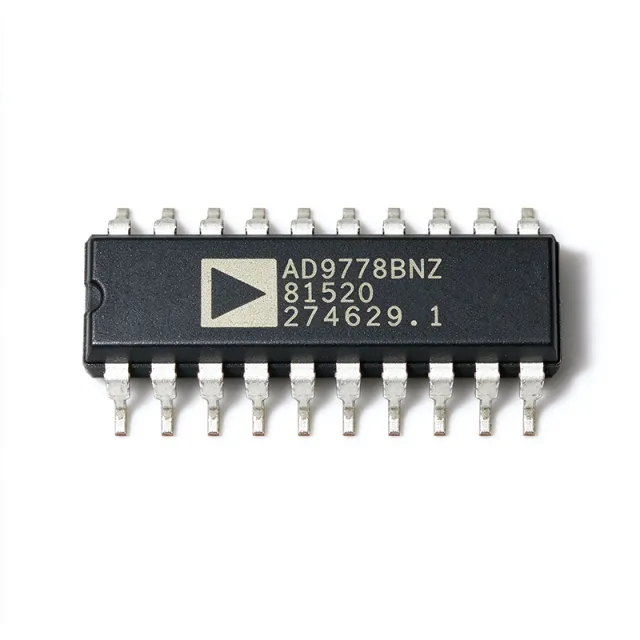
AD977BNZ - 16-Bit 100 kSPS SAR ADC | Analog Devices
The Analog Devices AD977BNZ is a 16-bit, 100 kSPS, single-input successive-approximation analog-to-digital converter operating from a single 5 V supply in a 20-pin PDIP package. It provides serial SPI-compatible data output, an internal 2.5 V reference, and an industrial operating-temperature range of -40°C to +85°C. An ADC is a data-conversion IC that converts an analog voltage into a digital code for processing by a microcontroller, DSP, or other digital system. The AD977 belongs to the SAR ADC family within the broader analog-to-digital converter and data-converter hierarchy. SAR conversion repeatedly compares the sampled input with an internally generated reference to determine successive bits of the 16-bit result. Key features include 16-bit resolution, a 100 kSPS throughput rate, one analog input channel, a serial SPI interface, and single 5 V operation. Maximum power dissipation is 100 mW, while a dedicated power-down mode helps reduce consumption when conversions are not required. The converter is housed in a 20-pin PDIP package measuring approximately 0.300 inches wide, or 7.62 mm. The AD977 uses a switched-capacitor successive-approximation architecture and includes an internal 2.5 V reference. Its serial interface reduces the number of signal connections compared with a parallel-output ADC, making the device suitable for space-constrained instrumentation where conversion rate requirements are below 100 kSPS. The analog input remains single-ended according to the product specifications. Typical applications include industrial process measurement, sensor signal acquisition, laboratory instrumentation, factory automation, and embedded control systems. These uses benefit from the combination of 16-bit resolution, serial connectivity, and a moderate conversion rate rather than the very high throughput required by waveform capture or communications receivers. When designing around the AD977BNZ, preserve adequate input-headroom margin for the full 4.75 V to 5.25 V supply range and follow the manufacturer's grounding and reference recommendations. Confirm that 100 kSPS meets the application's acquisition rate and allow for acquisition, conversion, and serial-transfer time when calculating end-to-end throughput. This product page combines the AD977BNZ electrical characteristics, package information, replacement analysis, and practical design guidance to help engineers evaluate the converter before integrating it into a new analog measurement system.
AD977BR - 16-Bit 100 kSPS Serial ADC | Analog Devices
The Analog Devices AD977BR is a 16-bit, 100 kSPS, single-input successive-approximation analog-to-digital converter operating from one 5 V supply in a 20-lead SOIC package. It uses serial I/O, provides unipolar and bipolar input ranges, and includes an internal 2.5 V reference according to the manufacturer product page. The converter combines a 16-bit sampling rate of 100,000 conversions per second with low-power operation and a 100 mW maximum specified power dissipation. An ADC is a data-acquisition semiconductor that converts an analog voltage into a digital code for measurement, control, instrumentation, and signal-processing systems. The AD977 belongs to the successive-approximation ADC family, also called a SAR ADC. Compared with flash and pipeline converters, a SAR ADC generally uses sequential internal comparisons, making this device suitable for moderate-speed precision acquisition where output resolution, serial communication, and low power are more important than very high conversion throughput. The AD977BR provides a 16-bit conversion result at 100 kSPS from a single 5 V supply. Its input architecture supports unipolar ranges of 0 V to 5 V and 0 V to 4 V, plus bipolar ranges of ±5 V and ±3.3 V. The verified sources also identify external-reference and power-down options, internal-reference capability, and industrial-temperature packaging. These features allow the same converter family to address sensor interfaces, process-control measurements, laboratory acquisition, and industrial diagnostic systems. The switched-capper architecture is factory calibrated, as stated in the Analog Devices datasheet description. Sampling and conversion behavior must be coordinated with the serial interface and external analog network. The AD977BR uses serial I/O rather than a parallel data bus, reducing package pin count and PCB routing requirements while requiring compatible firmware or control logic. The AD977A member provides a higher 200 kSPS rate, whereas the AD977BR is the 100 kSPS version. Typical applications include industrial process monitoring, sensor signal acquisition, medical instrumentation, laboratory measurement, communications equipment, and embedded data-acquisition systems. A system designer should verify the exact input range, reference configuration, timing, electrical limits, and pin-level requirements against the manufacturer datasheet before layout or firmware release. The most important design consideration is preserving analog signal integrity while supporting the serial interface. Keep the analog input and reference paths short, use suitable bypass and filtering components, and account for source impedance during acquisition. The verified data does not provide all timing, accuracy, temperature, and reference-load details, so those values should be obtained from the official AD977/AD977A datasheet. This page consolidates the verified manufacturer and distributor information, separates confirmed AD977BR characteristics from unknown parameters, and provides application guidance without treating unverified values as specifications.
AD977BRRL - 16-Bit 100 kSPS SAR ADC | Analog Devices
The Analog Devices AD977BRRL is a 16-bit, single-input, successive-approximation analog-to-digital converter with a 100 kSPS sampling rate, a serial SPI interface, and a 20-lead SOIC package. It operates from a single 5 V supply and is specified for maximum power dissipation of 100 mW. The converter is designed for measurement and control systems that require moderate throughput, 16-bit resolution, and low power consumption without a parallel digital interface. An ADC converts an analog voltage into a digital number for processing by a microcontroller, DSP, FPGA, or other digital controller. The AD977 belongs to the successive-approximation ADC category within the broader ADC and data-converter semiconductor hierarchy. Its internal switched-capillator architecture performs one conversion through a sequence of binary-weighted comparisons, allowing the 16-bit result to be transferred through a serial interface. Key features include 100 kSPS throughput, 16-bit resolution, single 5 V operation, a serial SPI data interface, factory calibration, and a power-down mode. The manufacturer also tests the devices for signal-to-noise ratio and total harmonic distortion in addition to conventional offset, gain, and linearity specifications. These characteristics make the converter suitable for industrial instrumentation, sensor interfaces, process monitoring, and embedded measurement systems. The switched-capitor SAR architecture provides deterministic sampling and conversion behavior while limiting power dissipation to 100 mW maximum. Because the converter is not a high-frequency pipeline ADC, it is better suited to continuous precision measurements than to waveform capture at megahertz rates. The SPI interface reduces the number of required signal connections and supports compact PCB layouts where pin count and routing simplicity are important. Typical uses include digital pressure and temperature instrumentation, laboratory data acquisition, industrial process control, factory monitoring, and low-rate sensor signal capture. In these applications, the 100 kSPS rate is sufficient for many control and monitoring loops, while 16-bit resolution preserves fine amplitude distinctions after conversion. The single 5 V supply also simplifies analog and digital power architecture when the surrounding system already operates at 5 V. When laying out the circuit, treat the analog input, reference, and ground connections as sensitive signal paths even though the sampling rate is relatively low. Place input and reference decoupling capacitors near their associated pins, keep digital clock and serial-data traces away from the analog input, and use a stable reference source. Follow the manufacturer datasheet pin-description table when assigning PCB tracks and verify the complete power-up sequence in the final system. This product page consolidates the manufacturer specifications, package details, interface characteristics, selection guidance, and pin-compatible comparison information into one engineering-focused reference. It also distinguishes the AD977BRRL from related family members whose speed, package, or ordering options differ, helping designers verify replacement suitability before committing a PCB layout to production.
AD977BRS - 16-Bit 100 kSPS SAR ADC | Analog Devices
Analog Devices AD977BRS is a 16-bit successive-approximation analog-to-digital converter with a 100 kSPS throughput rate, serial I/O, and a 28-pin SSOP package. It operates from a single 5 V supply, supports unipolar 0 V to 5 V and 0 V to 4 V input ranges plus bipolar 5 V and 3.3 V input ranges, and includes a 50 µW power-down mode. An ADC is a data-conversion IC that transforms an analog voltage into a digital number for processing, storage, transmission, or control. The AD977 belongs to the successive-approximation ADC family, within the broader ADC and data-converter semiconductor hierarchy. Compared with flash and pipelined converters, a successive-approximation ADC can provide useful resolution and speed in a compact, relatively low-power design for precision acquisition systems. The AD977BRS converts 16-bit samples at up to 100 kSPS while offering selectable input ranges and external-reference capability. Its single 5 V architecture simplifies system power planning, while the internal 2.5 V reference supports applications that do not require a separate reference source. Maximum power dissipation is 100 mW, and serial output reduces the number of signal lines required to transfer conversion results. Internally, the converter uses a switched-capacitor successive-approximation architecture. This implementation supports a compact 28-pin SSOP package and is suited to instrumentation, industrial control, communications, and embedded data-acquisition systems. External reference and input-range selections allow designers to balance conversion accuracy, signal conditioning, and system flexibility for different analog input conditions. Typical uses include multichannel process monitoring, transducer signal acquisition, communications-channel digitizing, industrial sensor interfaces, portable measurement equipment, and laboratory instruments. The 100 kSPS rate is especially appropriate for continuous monitoring signals that require more resolution than a low-cost comparator-based system but do not need flash-converter throughput. Design around the 5 V supply requirement, selected input range, and 100 mW maximum power dissipation. Place bypass capacitance close to the supply pins, route analog inputs away from fast digital transitions, and use the pin-description table in the manufacturer datasheet when assigning tracks and grounding. The power-down function can reduce consumption during inactive intervals, but system timing must account for startup behavior. This page organizes the AD977BRS specifications, package information, application guidance, and drop-in replacement considerations into one engineering reference. It also identifies the key electrical, timing, power, and selection trade-offs that matter when adapting an existing 28-SSOP data-acquisition design.
AD977BRSZ - 16-Bit 100 kSPS SAR ADC | Analog Devices
The Analog Devices AD977BRSZ is a 16-bit, single-input successive-approximation analog-to-digital converter with a 100 kSPS throughput rate, operating from a single 5 V supply and packaged in a 28-pin SSOP. The converter uses a high-speed serial interface and includes an internal 2.5 V reference. Factory calibration minimizes linearity errors, making the device suitable for precision signal acquisition where compactness, low power, and calibrated performance are important. An ADC converts an analog input voltage into a digital code for processing, storage, or transmission. The AD977 belongs to the successive-approximation ADC, or SAR ADC, category within the broader analog-to-digital converter and semiconductor hierarchy. SAR AD977-family devices compare the input against an internally generated DAC value during successive conversion cycles. Their serial interface reduces the number of external signal connections, while the internal reference simplifies analog front-end design and system calibration. The AD977BRSZ combines 16-bit resolution with a 100 kSPS conversion rate. It operates from a single 5 V rail, with a stated supply range of 4.75 V to 5.25 V. Its power dissipation is listed at a maximum of 100 mW, and a power-down mode is available for reducing consumption when conversions are not required. The operating-temperature range extends from -40°C to +85°C, supporting industrial-temperature equipment when the complete system is designed for that environment. Internally, the AD977 uses a switched-capacitor successive-approximation architecture. The manufacturer describes the family as factory calibrated to minimize all linearity errors, reducing the need for board-level offset, gain, and nonlinearity correction in many applications. The high-speed serial interface provides a compact connection to a controller or programmable logic device. Because the converter uses an internal 2.5 V reference, designers should budget for the resulting input range and avoid assuming that the full 5 V supply can be applied directly to the analog input. Typical uses include industrial process monitoring, sensor signal acquisition, instrumentation, communications equipment, and embedded control systems where a 16-bit measurement interface is needed without a high-speed parallel bus. The 100 kSPS rate is appropriate for many slowly changing analog quantities, including temperature, pressure, position, and analog instrumentation signals. The part can also support repeated sampling when the application requires more frequent updates than a slow sensor naturally produces. Layout should preserve a quiet analog return path and keep the serial clock and data traces away from sensitive input routing. Decoupling should be placed close to the supply pins, and unused inputs should be handled according to the manufacturer pin-description table. Designers should also check acquisition timing against the serial clock rate and digital control timing rather than assuming that the maximum sample rate is suitable for every signal or data-capture implementation. This product page consolidates the manufacturer specifications, package information, sourcing context, and engineering guidance for the AD977BRSZ. It also identifies the closely related family members that can support replacement decisions while making clear that a physical footprint match alone does not guarantee identical conversion throughput.
AD977BRZ - 16-Bit 100 kSPS SAR ADC | Analog Devices
The Analog Devices AD977BRZ is a 16-bit successive-approximation analog-to-digital converter with one analog input, a 100 kSPS throughput rate, a single 5 V supply, and a 20-pin SOIC package. The device also provides an internal 2.5 V reference and a high-speed serial interface, making it suitable for precision signal acquisition when both resolution and compact implementation are important. Factory calibration is used by the manufacturer to minimize linearity error. An ADC is an interface component that converts a continuously varying analog voltage into a numeric value for processing, measurement, display, or control. The AD977 belongs to the successive-approximation, or SAR, ADC family. SAR converters compare the input against successive trial values, making this architecture suitable for medium-speed data acquisition, industrial measurement, communication equipment, and embedded instrumentation. Within the broader hierarchy, the AD977 is an ADC, then a data-conversion IC, and finally a semiconductor or analog-to-digital converter. The AD977BRZ provides a 16-bit conversion result, 100 kSPS throughput, and operation from one 5 V supply. Its internal 2.5 V reference reduces the external component count, while the serial interface supports compact board layouts. The 20-pin SOIC package uses surface-mount assembly and is available from distributors including DigiKey, Mouser, LCSC, Win Source, and Octopart. Technically, the converter uses a switched-capacitor successive-approximation architecture. The internal reference establishes the conversion scale, and the factory calibration is intended to improve offset and linearity performance. Because this is a medium-speed SAR converter rather than a flash or pipeline ADC, it provides a practical balance among throughput, resolution, power consumption, and implementation complexity for precision acquisition systems. Typical uses include precision process measurement, laboratory and test instrumentation, communications equipment, and embedded control systems. The 100 kSPS rate permits acquisition of relatively slow or medium-bandwidth signals, while the 16-bit resolution preserves fine amplitude detail. The serial interface can also reduce the number of parallel data paths when board space is constrained. Designers should verify the analog input range, acquisition timing, reference behavior, and serial-interface timing against the manufacturer datasheet before finalizing signal-chain calculations. Input buffering, source impedance, sampling-capacitor settling, digital grounding, and decoupling remain important even though the converter integrates reference and conversion circuitry. This product record combines verified manufacturer and distributor data with an honest drop-in assessment. It distinguishes the electrically compatible AD977CR option from broader functional substitutes, documents unavailable pricing and pinout details, and highlights the practical design information needed to choose and implement a 16-bit SAR ADC without treating similar converters as automatic PCB replacements.
AD977CN - 16-Bit 100 kSPS ADC | Analog Devices
The Analog Devices AD977CN is a 16-bit, 100 kSPS successive-approximation analog-to-digital converter in a 20-pin through-hole DIP package. It operates from a single 5 V supply, supports unipolar and bipolar input ranges, and is designed for precision signal acquisition where 16-bit resolution is useful without the throughput demands of a flash converter. The AD977 family also includes the faster AD977A, which is specified at 200 kSPS. An ADC is a data-acquisition IC that converts an analog voltage into a digital code. A successive-approximation ADC, commonly called a SAR ADC, performs conversion by comparing the unknown input with an internally generated trial voltage and progressively refining a binary approximation. The AD977CN therefore belongs to the ADC, data-converter, signal-processing, and semiconductor hierarchy, with relevance to industrial measurement, instrumentation, communications, and embedded control systems. The converter provides a 16-bit resolution, a 100 kSPS throughput rate, and single 5 V operation. Its input architecture includes unipolar ranges of 5 V and 4 V and bipolar ranges of 5 V and 3.3 V, according to the verified manufacturer product information. Available interface choices and power-management behavior should be confirmed in the manufacturer datasheet for the exact AD977CN ordering configuration. Maximum power dissipation is listed as 100 mW in the supplied verified description, while a power-down mode is also indicated. Because this is a SAR ADC, the input is sampled and converted through a sequence of internal comparison decisions rather than a parallel flash architecture. This makes the converter suitable for control loops, sensor interfaces, test equipment, and communication front ends that need moderate speed and high resolution. The AD977CN is a 100 kSPS device, whereas AD977A is the 200 kSPS family variant; selecting the correct suffix is important when sample rate is a hard system constraint. AD977CN applications include industrial process monitoring, precision instrumentation, communications receivers, data-acquisition cards, and embedded measurement systems. In each case, the analog front end must establish the correct input range, provide suitable reference and drive circuitry, and account for acquisition time before conversion. The serial or parallel data interface and required digital support components should be selected from the datasheet and system clock plan. A key design consideration is the input and reference network. Incorrect source impedance, inadequate filtering, or unsuitable bypass capacitance can degrade effective resolution and conversion accuracy. The 5 V supply should be decoupled close to the device, and the analog input should be protected against overvoltage and transients. Because the AD977CN is listed as obsolete in one verified distributor-style source, new designs should confirm lifecycle status, availability, and any supported migration path before committing to production. This page consolidates the verified Analog Devices family description, distributor identity, package information, and practical replacement guidance for AD977CN. It also distinguishes confirmed facts from parameters that require the exact manufacturer datasheet, helping engineers evaluate the obsolete 16-bit SAR ADC without treating unverified electrical values as production specifications.
AD977CNZ - 16-Bit 100 kSPS SAR ADC | Analog Devices
The Analog Devices AD977CNZ is a 16-bit, single-input successive-approximation analog-to-digital converter with a 100 kSPS throughput rate, operating from a single 5 V supply and housed in a 20-pin plastic DIP package. It combines a factory-calibrated switched-capacitor conversion core, an internal 2.5 V reference, and a high-speed serial interface for precision signal-acquisition systems. An ADC converts an analog input voltage into a digital code for measurement, control, recording, or signal processing. The AD977 belongs to the successive-approximation ADC family within the broader ADC/DAC and data-converter hierarchy. Its SAR architecture repeatedly compares the sampled input with a internally generated reference, making it suitable for applications requiring accurate conversion without the complexity of flash conversion. Key specifications include 16-bit resolution, one analog input, a 100 kSPS sampling rate, and operation from a single 5 V rail. Maximum power dissipation is 100 mW, supporting low-power acquisition systems. The supported operating-temperature range is -40°C to 85°C, while the 20-PDIP package is supplied in a tube for through-hole PCB assembly. Internally, the AD977 combines a switched-capacitor ADC, a 2.5 V internal reference, and a high-speed serial interface. Factory calibration minimizes offset, gain, and linearity errors, while listed AC testing includes signal-to-noise ratio and total harmonic distortion performance. The AD977 family provides 100 kSPS throughput, whereas the related AD977A family provides 200 kSPS. Typical uses include industrial process measurement, instrumentation, laboratory data acquisition, audio and low-frequency waveform sampling, sensor-interface systems, and embedded control platforms. The 100 kSPS rate is appropriate for acquiring slowly changing or moderate-bandwidth analog signals rather than high-frequency communications waveforms. Designers should provide a stable 5 V supply, observe the analog and reference grounding requirements, and validate input range and acquisition timing against the manufacturer datasheet. Because the serial interface, reference behavior, conversion timing, and digital signaling remain important to system accuracy, firmware and PCB validation should be completed before production release. This product page consolidates verified manufacturer and distributor specifications, package details, availability references, and selection guidance. It also distinguishes the AD977CNZ from the faster AD977A family and clearly identifies where equivalent drop-in replacement data was not established by the supplied cross-reference evidence.